Skip to content
Capitalism Lab Taking Business Simulation to a New Frontier
Capitalism Lab

Types of Internet Companies

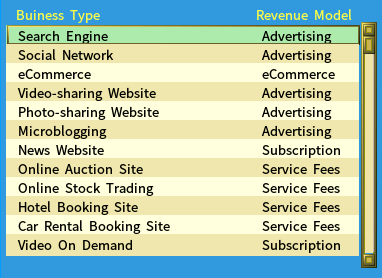
The Digital Age DLC lets you set up 12 types of Internet company, across four revenue models. Each type has its own ceiling on how much of the Internet population it can reach, and its own mix of technologies behind its quality rating.

The dialog for choosing which type of Internet company to set up

Userbase potential is the figure to watch when choosing a type. It caps the share of all Internet users a site can ever reach — a search engine can reach every user, a car rental site no more than 30%.

Revenue model: advertising

The key difference between an Internet company and a traditional media company is reach. Access to a website is not limited by geography: users in any city can visit it, so advertising placed there covers all cities. A traditional media firm’s advertising reaches its local city only.

Revenue from an advertising site depends on two things: its userbase potential and its average click-through rate.

Search Engine

Modeled on google.com. The most valuable advertising type in the game: it reaches 100% of Internet users at the highest click-through rate of any site, 1.9%.

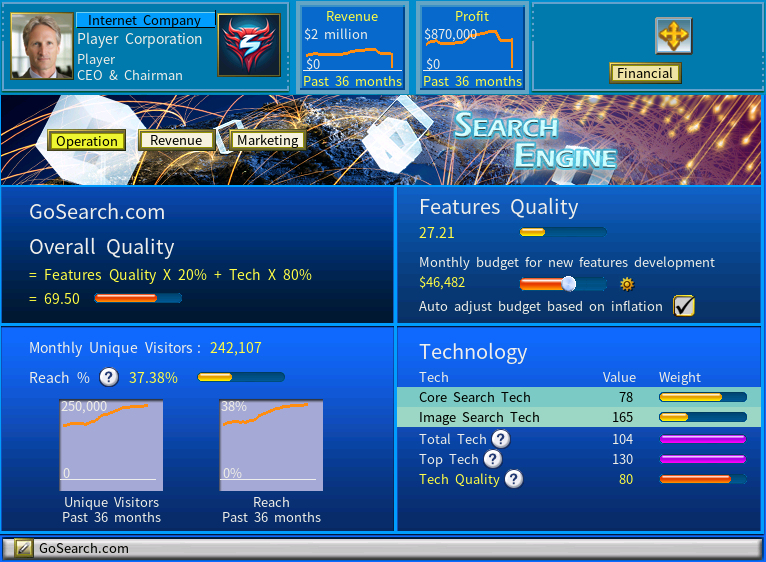
Quality is 80% technology, 20% features — the most technology-driven site of them all. Two technologies feed it: Core Search Tech (70%) and Image Search Tech (30%).

The management screen for a search engine company

Social Network

Modeled on facebook.com. Reaches 100% of Internet users at a 1.5% click-through rate, second only to a search engine.

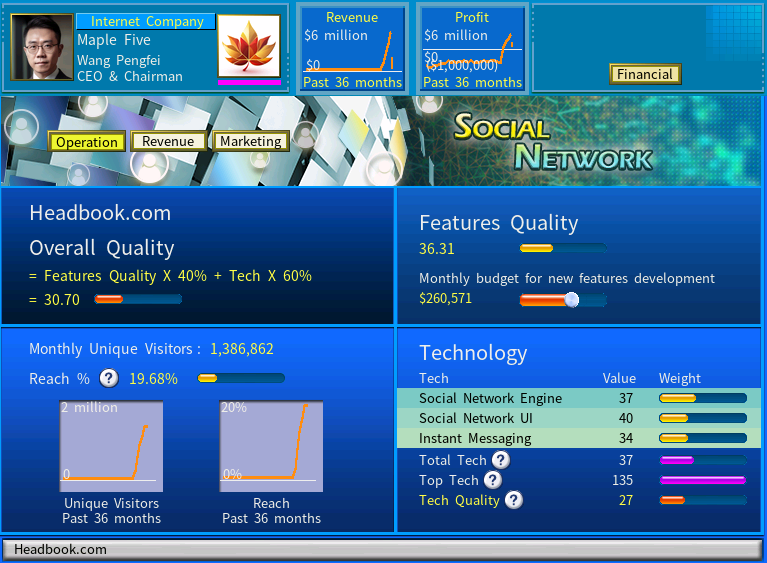
Quality is 60% technology, 40% features, and the technology side is the broadest of any type — three of them: Social Network Engine (40%), Social Network UI (30%) and Instant Messaging (30%).

The management screen for a social network company

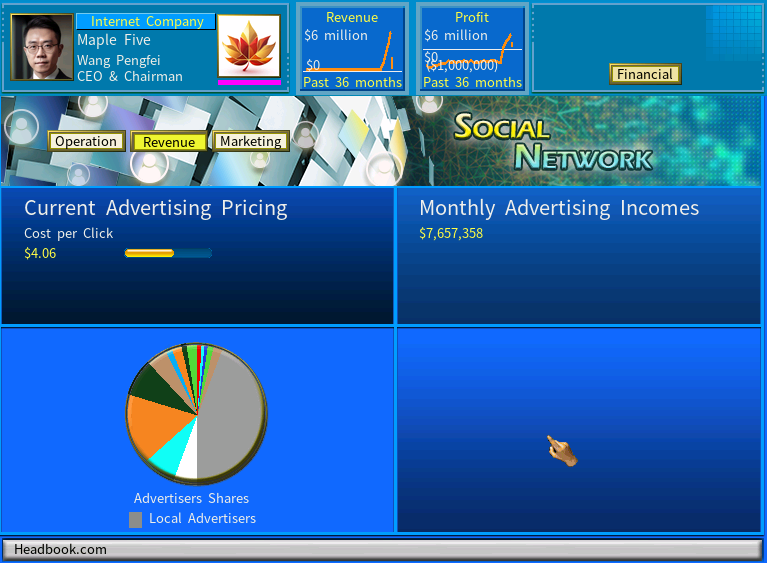
You set the cost per click charged to advertisers on the Revenue page.

The Revenue page of a social network, showing the cost per click setting

If your advertising cost is significantly higher than your competitors’, advertisers will take their business to their sites instead. Keep the price competitive.

Video-sharing Website

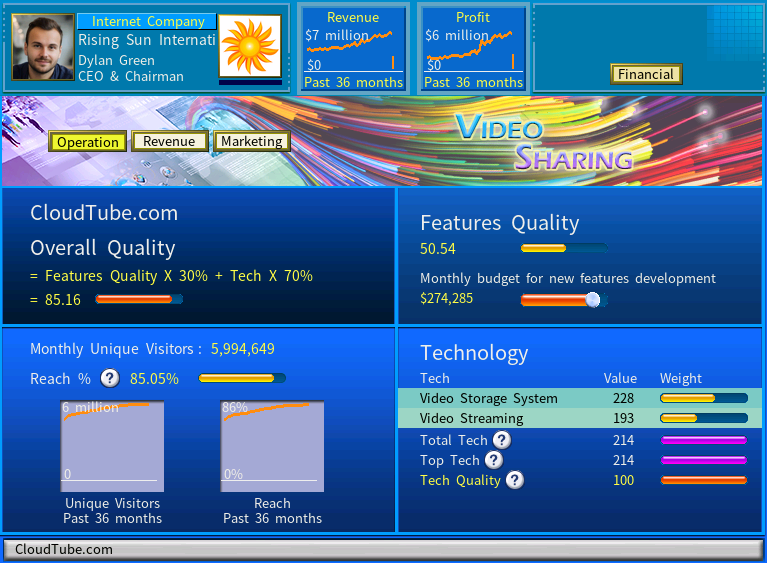
Modeled on youtube.com. Reaches 100% of Internet users, but at a 1% click-through rate — the lowest of the three full-reach advertising types.

Quality is 70% technology, 30% features, from Video Storage System (60%) and Video Streaming (40%).

The management screen for a video-sharing website

Photo-sharing Website

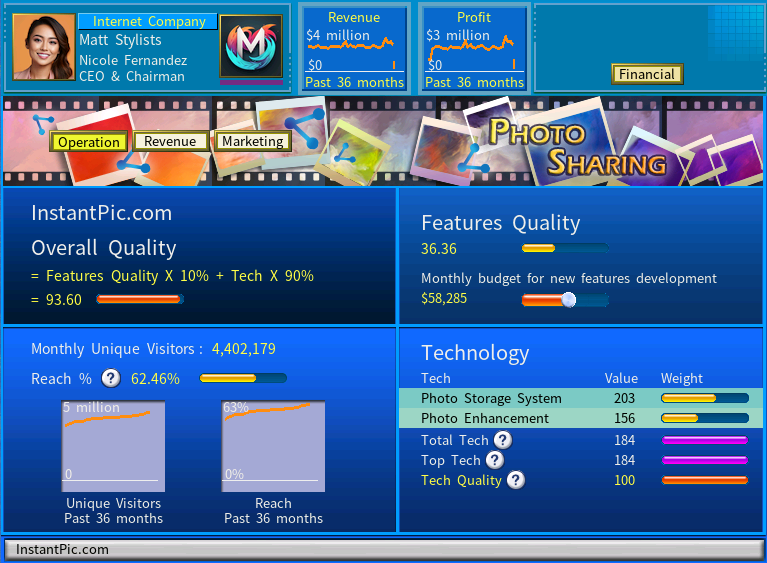
Modeled on instagram.com. Reaches up to 70% of Internet users at a 1.2% click-through rate.

The most technology-dependent site in the game: quality is 90% technology, 10% features, split between Photo Storage System (60%) and Photo Enhancement (40%). Features barely matter here — the research budget does.

The management screen for a photo-sharing website

Microblogging

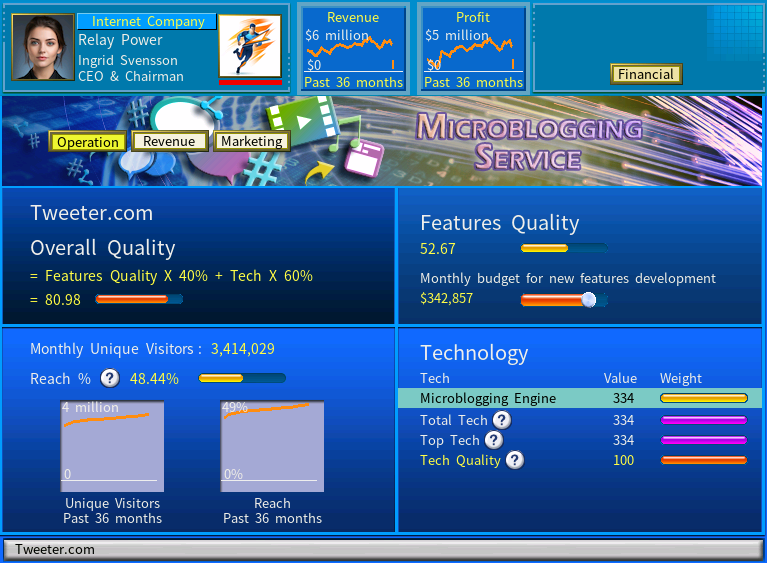
Modeled on twitter.com. The smallest advertising audience, at 60% of Internet users, and the lowest click-through rate of any site, 0.8%.

Quality is 60% technology, 40% features, and the technology side rests on a single one: Microblogging Engine (100%). That makes it the simplest type to research, with only one line of development to fund.

The management screen for a microblogging website

Revenue model: e-commerce

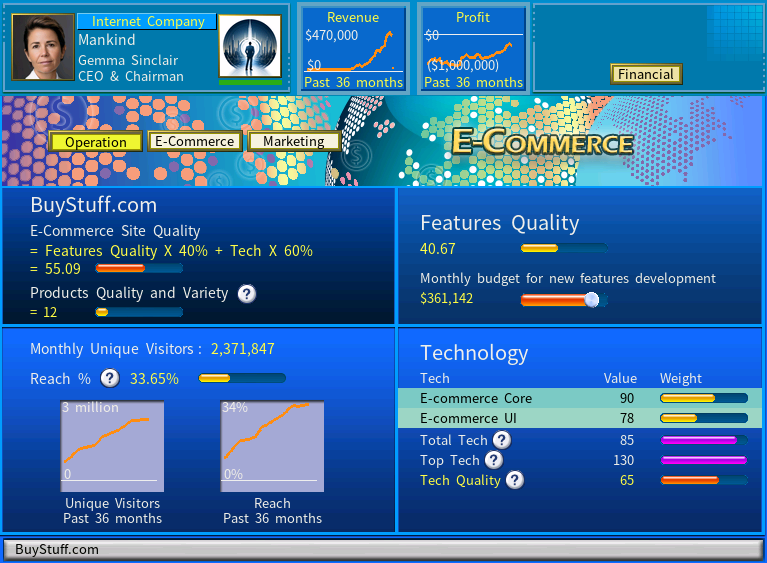
Modeled on amazon.com. An e-commerce site reaches 100% of Internet users and earns from what it sells rather than from advertising.

Quality is 60% technology, 40% features, from E-commerce Core (60%) and E-commerce UI (40%).

The management screen for an e-commerce website

E-commerce has enough depth to warrant its own page.

E-Commerce

Revenue model: service fees

Sites in this group earn a fee on each transaction they handle — a hotel booking site takes a fee on every booking. The fees earned are directly proportional to the site’s visitor traffic, so growing the userbase is the whole game here.

All four types split quality more evenly between technology and features than the advertising sites do.

Online Auction Site

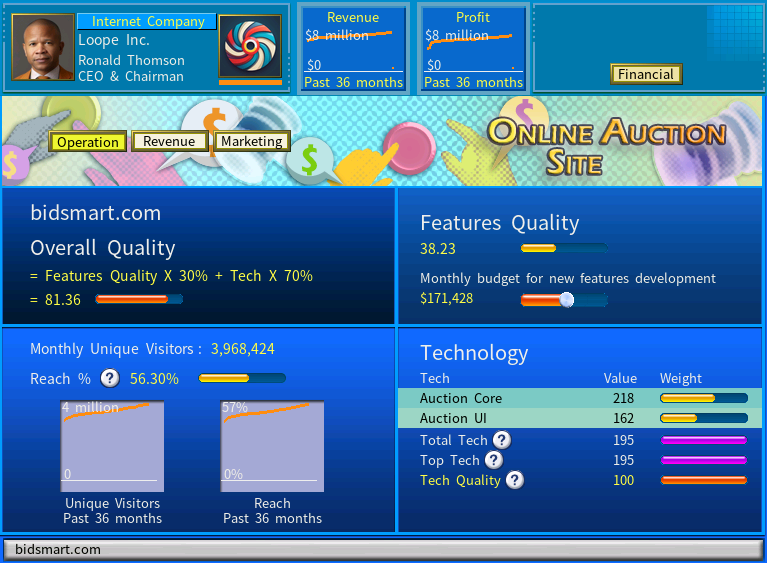
Modeled on ebay.com. The largest audience of the four, at 70% of Internet users. Quality is 70% technology, 30% features, from Auction Core (60%) and Auction UI (40%).

The management screen for an online auction site

Hotel Booking Site

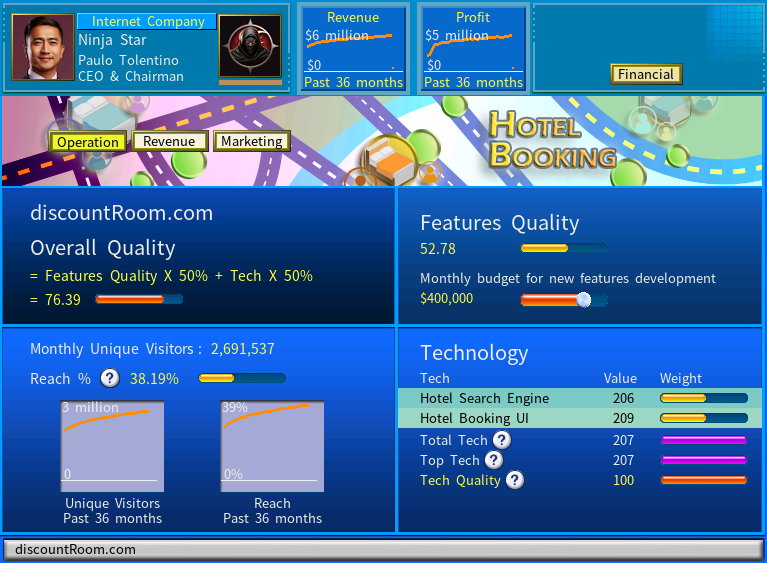
Modeled on booking.com. Reaches up to 50% of Internet users. Quality is an even 50/50 split between technology and features, and the two technologies weigh equally: Hotel Search Engine (50%) and Hotel Booking UI (50%).

Select the Revenue page to see the service fees earned.

The Revenue page of a hotel booking site, showing the service fees earned

Car Rental Booking Site

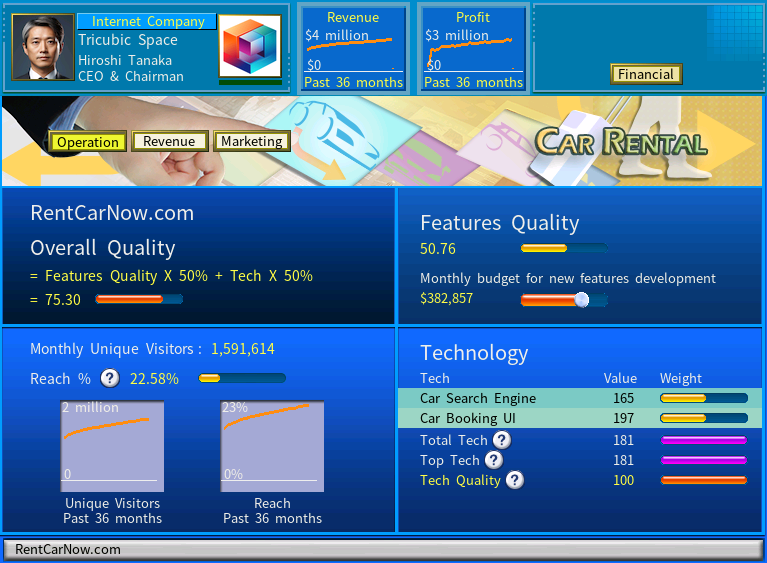
Modeled on rentalcars.com. The smallest audience in the game alongside stock trading, at 30% of Internet users. Quality is a 50/50 technology and features split, from Car Search Engine (50%) and Car Booking UI (50%).

The management screen for a car rental booking site

Online Stock Trading

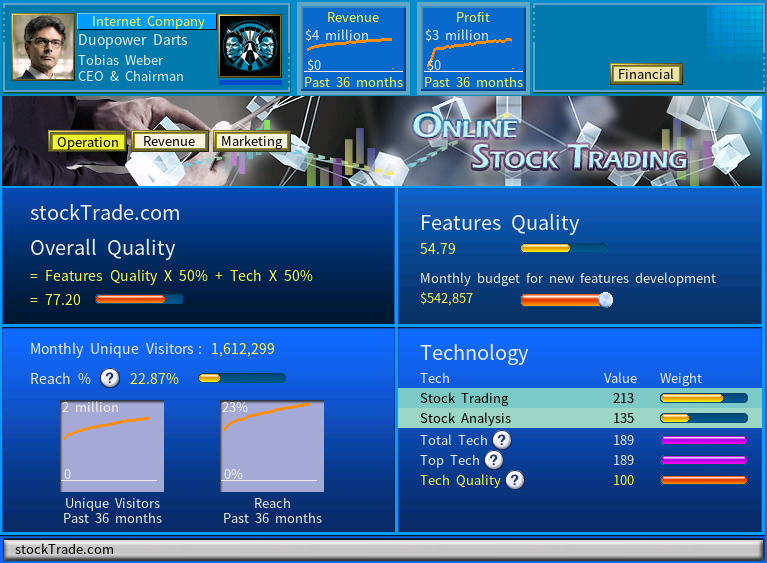
Modeled on etrade.com. Reaches 30% of Internet users. Quality is a 50/50 technology and features split, weighted towards Stock Trading (70%) over Stock Analysis (30%).

The management screen for an online stock trading site

Revenue model: subscription

These sites charge a subscription fee for premium content. Both are the mirror image of the advertising types: quality is 70% content and only 30% technology, so what you publish matters more than what you build.

News Website

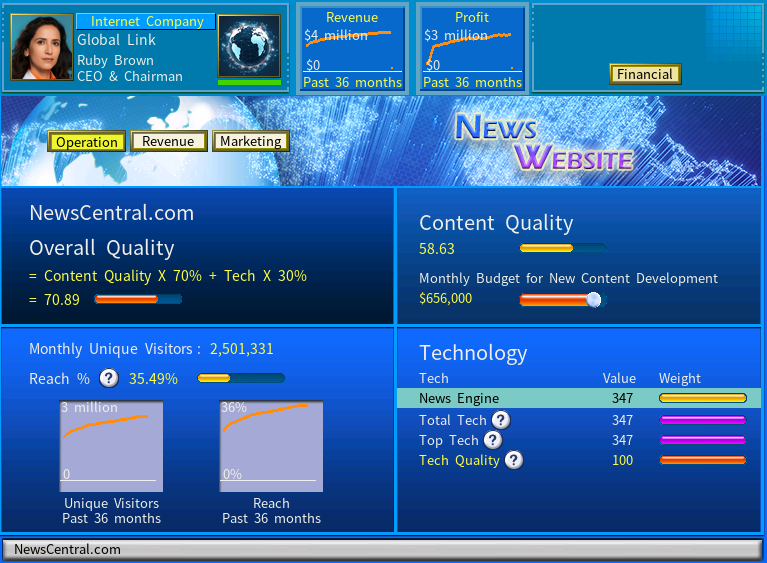
Modeled on nytimes.com. Reaches up to 50% of Internet users. Its technology score comes entirely from one source, the News Engine (100%).

The management screen for a news website

Video On Demand

Modeled on Netflix. Reaches up to 80% of Internet users — the largest subscription audience by a wide margin. Its technology score comes from Video Streaming (60%) and Video Storage System (40%), the same pair a video-sharing site uses but weighted the other way round.

The management screen for a video on demand website