

Capitalism Lab – Goals
By Stylesjl
Overview of goals
Every scenario starts by giving you one or more goals, and they shape the whole strategy you need to win. The common ones are:
- Product category or industry dominance
- Revenue and profit targets
- Market capitalization
- Corporate or personal net worth
Others exist — return on equity, number of employees, controlling companies — but this guide covers the four above, which are the ones the built-in scenarios use.
What each goal actually means
Dominance of a product category
You must be the biggest manufacturer in the category. To dominate Furniture you must be the largest producer of tables, chairs, beds and sofas all at once.
Buying does not count. Being the biggest purchaser of those products from another company or a seaport contributes nothing towards dominance.
With a seaport, the manufacturing share is credited to the seaport itself, based on how much every company buys from it.
Dominance of an industry
Being number one in revenue for that industry — the biggest retailer, or the largest real estate or media empire.
Here you do not need dominance in any individual product or category. You only need to be the biggest producer or seller overall.
Dominance means the biggest share, not a majority. Hold 20% while no single competitor exceeds 20% and you are dominant — even if every competitor’s share adds up to 80% of the market. You have to beat your nearest rival, not the field combined.
Revenue and profit
Revenue is the total value of products and services sold. Sell a million dollars of furniture in a year and that is a million dollars of revenue — even at a loss.
Profit is revenue less costs.
Profit here excludes one-off gains and losses: interest payments, inflation and deflation, asset price changes, new buildings and similar items.
Market capitalization
What your corporation is worth on the stock market, which moves with how investors value it. The share price is higher when you have a history of profits, pay dividends, own valuable assets — land, technology, branding, shares in other companies — and have not been diluting your shares.
Corporate net worth
What your corporation’s actual assets are worth in total, regardless of share price. It can be higher or lower than market capitalization.
Personal net worth
The same idea applied to you: personal cash, mansions, and the percentage of your company you own.
Worked example. Your company is worth $1 billion and you own 50% — your personal net worth is $500 million, plus any other assets.
Two ways to raise it: make the company worth more, or own more of it — by paying yourself a CEO salary, or buying shares back from everyone else.
Achieving goals
At the start of a game, check the goals you have been assigned and the sub-goals. Sub-goals are usually optional, and their rewards help you towards the main goal.
An example: Corporate Leadership
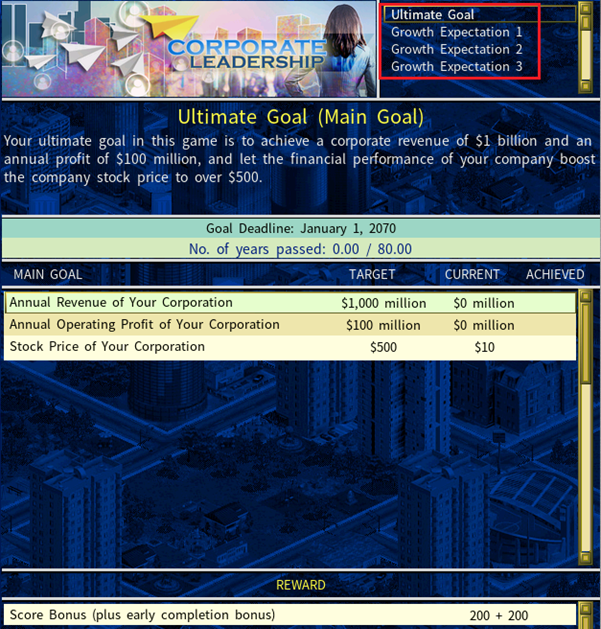
The main goal: raise the stock price to $500, and reach $1 billion in revenue and $100 million in profit, within 80 years.
Its sub-goals are smaller versions of the same thing — lower profit, revenue and share price, within 10 years.
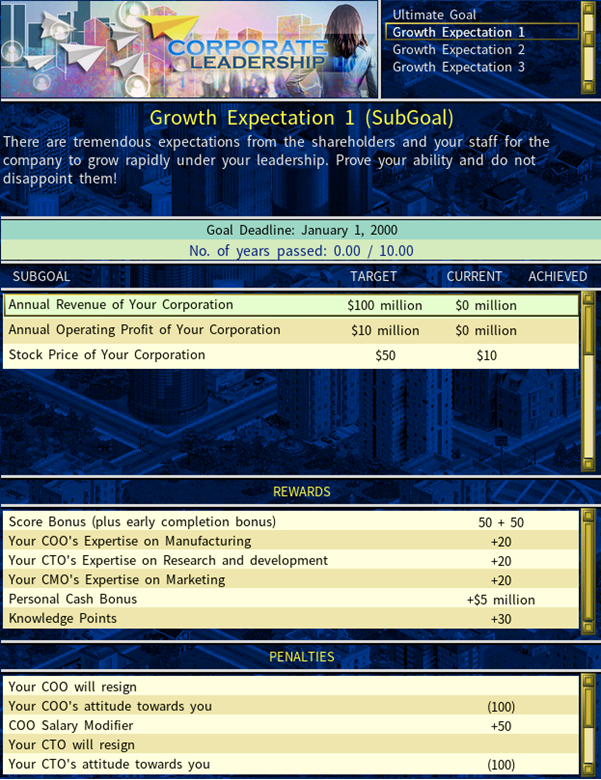
Sub-goals cut both ways here — you are rewarded for achieving one and penalized for missing it. The rewards are expertise for your senior executives and Knowledge Points, both of which make the next goal easier.
A sub-goal with no main goal
Where a scenario gives a sub-goal and no main goal, completing it unlocks the next one. In Toys & Gadgets you get unlimited time to dominate the toy industry — and another goal appears once you have.
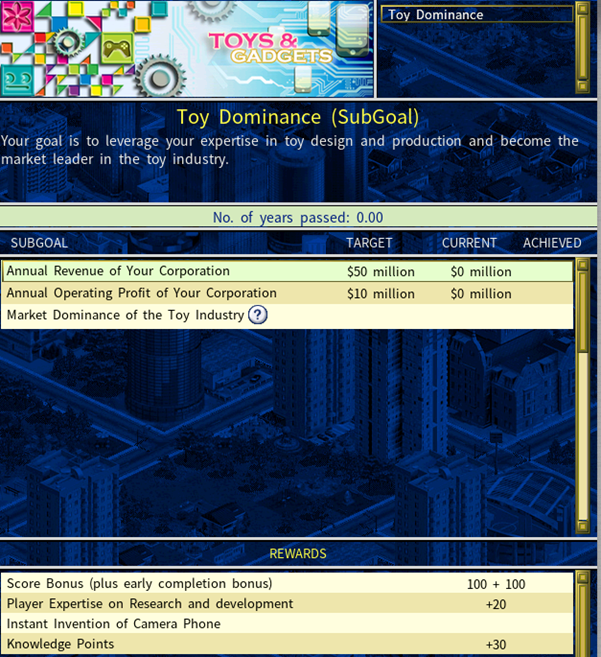
Every scenario has its own goals, but the main ones are usually profit, revenue, or dominance of an industry or product category.