

Radical R&D and Product Invention
Requires the Subsidiary DLC. Radical R&D units exist when the Subsidiary DLC is enabled. To choose a risk level for an invention you also need a CEO or CTO with an R&D expertise of at least 20. Below that, a radical unit still invents — it simply does so at the normal pace, with no gamble.
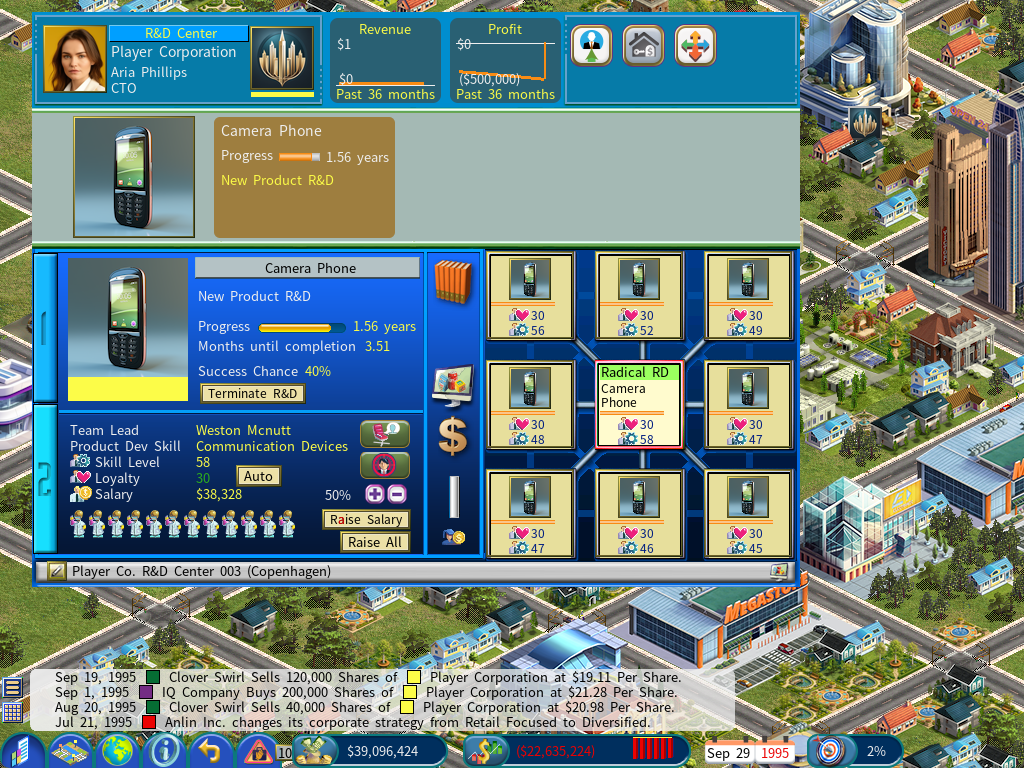
Two different bets on one unit
| Technology gamble | Invention time gamble (new) | |
|---|---|---|
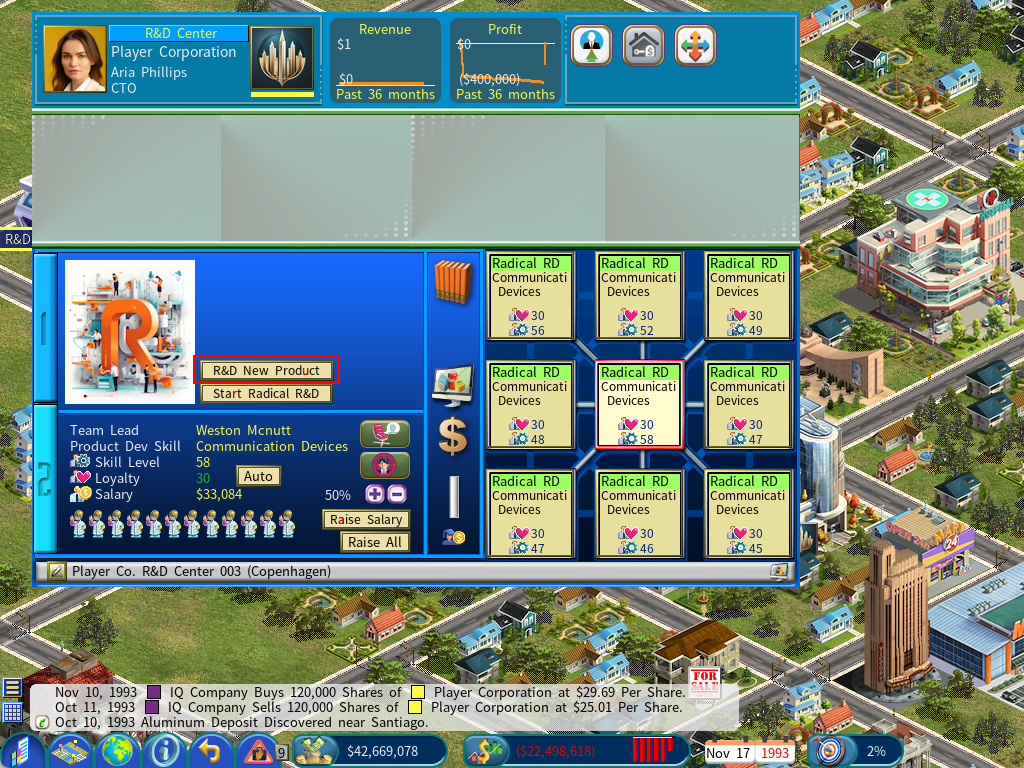
| Start it with | [Start Radical R&D] | [R&D New Product] |
| You choose | A target multiple, 200%–600% | A risk level, Cautious to Reckless |
| You are betting for | A much larger technology gain | A much shorter development time |
| Failure costs | The whole period — no technology gained, and the project repeats | Extra years — but the product is still invented |
| Rolls | Once per research period, repeatedly | Once, at the target time |
The technology gamble is unchanged in 13.0. Everything below is about the new one, and the existing Radical R&D Unit page still describes the technology side.
Fast-tracking an invention
- Set up a Radical R&D team in an R&D Center, and in talent mode hire a team lead with product-development skill.
- Press [R&D New Product] on the unit. The button sits just above [Start Radical R&D].
- Pick the product to invent from the list, as you would on an ordinary Product R&D unit.
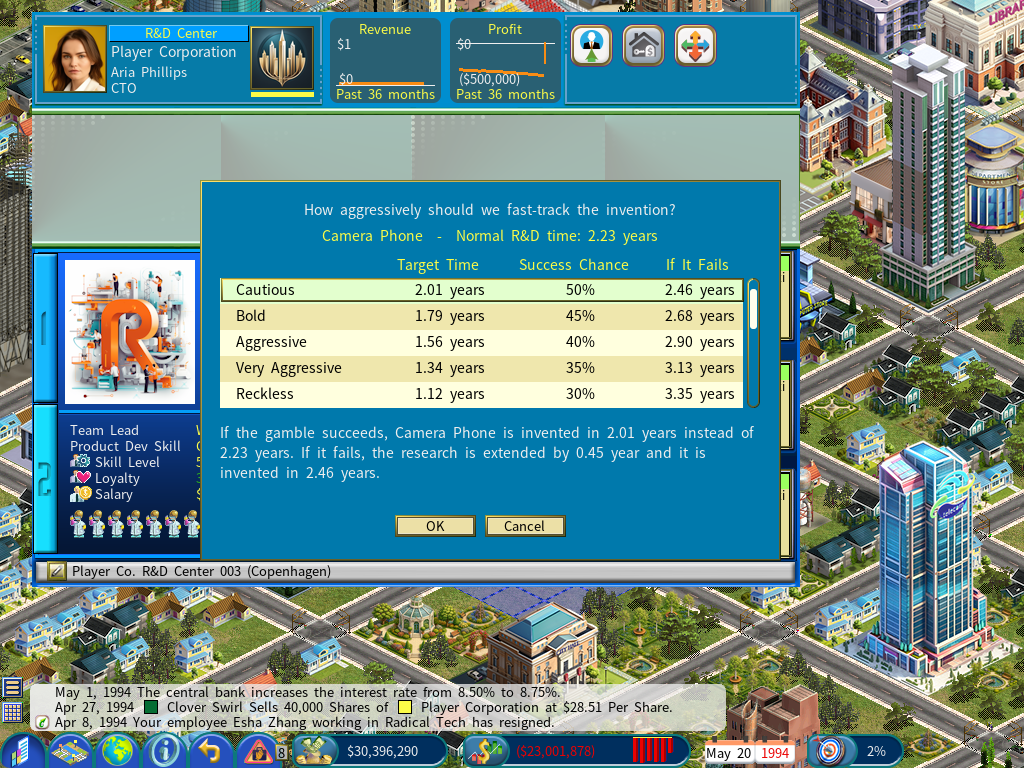
- A new window asks how aggressively to fast-track it. Each row shows the target time, the success chance, and the total time if it fails — all calculated for the product you just picked and the team you actually have.
- Confirm, and the project starts on the shortened schedule. The unit’s progress bar and completion date reflect the target time from the outset.
The risk levels
Each level cuts the normal development time by a percentage. A failed gamble adds back twice what you tried to save, so you risk exactly as many years as you stand to gain. Only the levels your CEO’s or CTO’s R&D expertise permits are listed.
| Risk level | Time cut | Success chance | If it fails | Needs R&D expertise |
|---|---|---|---|---|
| Cautious | −10% | 50% | +10% | 20 |
| Bold | −20% | 45% | +20% | 40 |
| Aggressive | −30% | 40% | +30% | 60 |
| Very Aggressive | −40% | 35% | +40% | 70 |
| Reckless | −50% | 30% | +50% | 100 |
The If it fails column is measured against the normal time: at Aggressive you target 70% of the normal schedule and, on a failure, finish at 130% of it.
A worked example
A product that normally needs 10 years to invent, at Aggressive — a 30% cut:
| Outcome | Chance | Result |
|---|---|---|
| Success | 40% | Invented at 7 years — three years early. |
| Failure | 60% | Research is extended by 6 years and the product is invented at 13 years — three years late. |
What happens when the target time arrives
The gamble is rolled once, at the target time, not repeatedly.
- Success: the product is invented there and then, exactly as an ordinary invention would be, and an event-track alert reports how many years early it arrived. Your company gains the know-how and the unit moves on to improving the new product’s technology.
- Failure: the research is extended by the penalty and an event-track alert reports that your bid to fast-track the product fell short, and by how many years it slipped. The extended completion is then certain — there is no second roll, and the product cannot be lost.
You can only ever win or lose time. Unlike the technology gamble, a failed invention gamble never destroys the work — the product still arrives, just later. That makes this the safer of the two bets in absolute terms, and the more painful one in a race.
The odds, honestly
Because the penalty is twice the saving, the higher levels are expected to cost you time. Averaged over many attempts, against a product that normally takes 10 years:
| Risk level | Target | If it fails | Average outcome |
|---|---|---|---|
| Cautious | 9.0 yrs | 11.0 yrs | 10.0 yrs — break-even |
| Bold | 8.0 yrs | 12.0 yrs | 10.2 yrs |
| Aggressive | 7.0 yrs | 13.0 yrs | 10.6 yrs |
| Very Aggressive | 6.0 yrs | 14.0 yrs | 11.2 yrs |
| Reckless | 5.0 yrs | 15.0 yrs | 12.0 yrs |
So when is it worth it? Often. The average cost is small — a fifth of a year at Bold, about seven months at Aggressive — while the upside is a product two or three years early. That is a cheap price when being first matters: racing a rival to a product nobody sells yet, or reaching a product that unlocks the rest of your line-up. Cautious is free on average, so there is no reason not to use it on any invention you would have run anyway. Only Reckless asks for a real strategic conviction, at two years of expected cost for a five-year prize.
Your team sets the clock
The schedule you gamble against is your team’s development time, not a fixed number for the product. A larger, better-staffed R&D team shortens the normal time, and therefore shortens both the target and the penalty. The window always shows the numbers for the team you actually have, so it is worth comparing the same product on a 4-unit team and a 9-unit team before committing.
Reading the unit
- While a fast-tracked invention runs, the panel shows New Product R&D, the progress bar, the shortened duration, and the Success Chance of the gamble.
- Last — a tick or a cross under the product image records how this unit’s previous gamble ended, with a ? icon beside it. Hover the ? for the details: for an invention it reports how many years were won or lost and the chance the attempt had; for a technology gamble it reports the multiple, the technology points won or forfeited, and the current run of failures.
Your competitors do it too
AI companies fast-track inventions as well, so a rival’s product can appear on the market years sooner than its normal development time suggests. Two limits apply to them: they never use the top two risk levels, because an AI cannot judge a decade-long setback the way you can, and an R&D Center their company depends on to invent a specific product is never turned radical in the first place. The recklessly aggressive plays remain yours alone.
At a glance
| Question | Answer |
|---|---|
| What do I need? | Subsidiary DLC, and a CEO or CTO with R&D expertise of at least 20 to choose a risk level |
| Where do I start it? | A Radical R&D unit, then [R&D New Product], pick the product, pick the risk level |
| How many times is it rolled? | Once, at the target time |
| Can I lose the product? | No — only time. A failed gamble extends the research and then completes for certain |
| Which level is free? | Cautious — a 50% chance at −10% against a 50% chance at +10% is break-even on average |
| Does it change the technology gamble? | No — [Start Radical R&D] behaves exactly as before |
See also: Radical R&D Unit — the unit itself, and the technology gamble this page contrasts against.