

Billionaire Life DLC
Lifestyle Satisfaction
A person’s personal happiness — built from their home, luxuries, art and good works, drained by overwork — that quietly shapes how well they perform.
Lifestyle Satisfaction is how content a character is with their personal life. A satisfied person works at their best; an unhappy one underperforms. It turns your personal fortune — mansions, luxuries, an art collection, philanthropy — into a real edge, and makes overwork a genuine cost.
Requires the Billionaire Life DLC. The satisfaction system is always on with the DLC. Setup options let you decide whether it affects skills, whether overwork counts against it, and whether persistent unhappiness makes people retire (see Setting it up).
What it does
Every character with business skills has a Lifestyle Satisfaction score. That score scales their effective skill — the skill they actually bring to running a firm:
- At 0 satisfaction, a person works at half their rated skill.
- Satisfaction rises the multiplier smoothly up to full skill at 100. Beyond 100 there’s no further gain.
So this applies to your own character, to your executives (a happy COO/CMO/CTO runs your firms better), and to AI competitors. Keeping the people who matter to you satisfied is a lasting performance investment — and you can help, by gifting luxuries or art that lift their satisfaction directly.
The skill effect only applies when Lifestyle Affects Skills is on (it is by default). With it off, satisfaction is still tracked and shown, but it won’t change anyone’s performance.
The five components
Satisfaction is built from four things that raise it and one that lowers it:
| Component | Comes from | Decays? |
|---|---|---|
| Residence Satisfaction | The mansion(s) the person owns — proportional to market value. | No |
| Luxury Satisfaction | Owned luxury goods — supercars, yachts, jets. | Yes — fades toward 50% |
| Art Collection Satisfaction | Owned fine art, plus a bonus for completing their favorite artist. | No |
| Philanthropy Satisfaction | Donating art to a museum (a permanent running total). | No |
| Stress Penalty (−) | Overwork — running too many firms hands-on. | — |
How the score is worked out — the Lifestyle Score
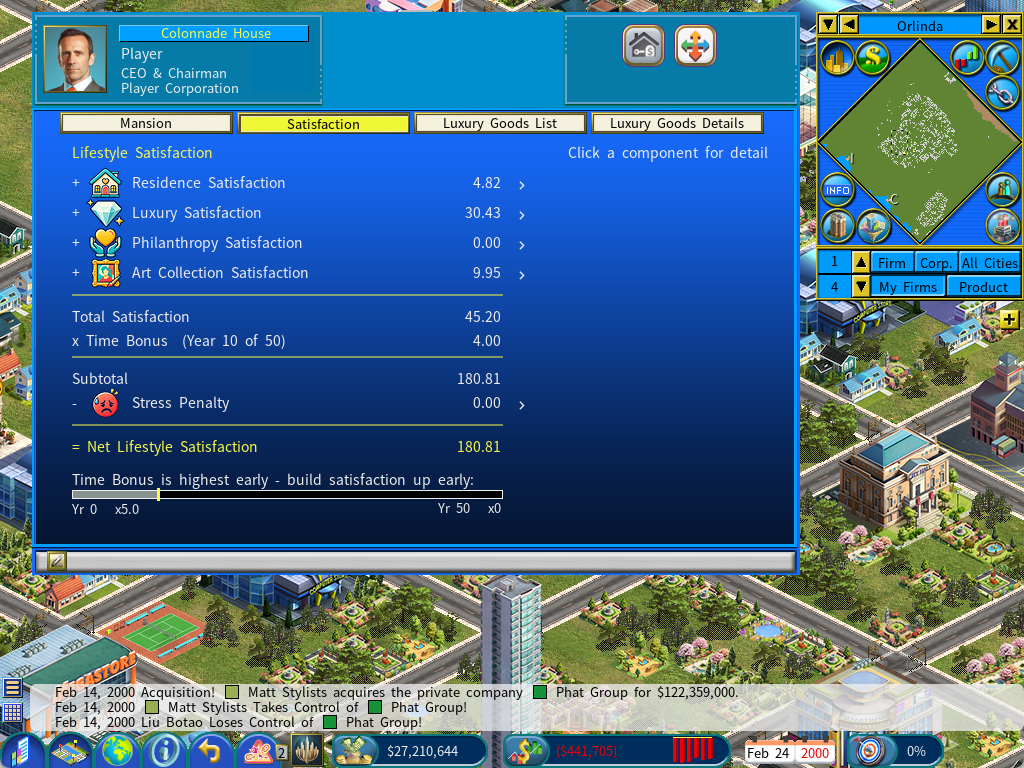
The four positives are added up, multiplied by a Time Bonus, and then the Stress Penalty is subtracted. This is exactly the breakdown you see on the Lifestyle Score report (open Score and choose the Lifestyle Score tab, alongside Wealth & Business Score and Influence Score):
  + Residence Satisfaction .........    30
  + Luxury Satisfaction ............    20
  + Art Collection Satisfaction ....    36
  + Philanthropy Satisfaction ......     0
  ----------------------------------------
    Total ..........................    86
    x Time Bonus (Year 1) ..........  4.90
  ----------------------------------------
    Subtotal .......................   421
  - Stress Penalty ................     0
  ----------------------------------------
  = Net Lifestyle Satisfaction ....   421
The Time Bonus
The same satisfaction is worth more the earlier in the game you enjoy it. The Time Bonus starts high and falls to zero by year 50, so building a good life early pays off far more than doing it late:
| Years into the game | Time Bonus |
|---|---|
| 0 | ×5.0 |
| 20 | ×3.0 |
| 40 | ×1.0 |
| 50 and later | ×0.0 |
The Total (the raw sum of positives) is the number that matters for the skill and retirement effects — those read the net satisfaction, which is capped at 100 for skill. The Time Bonus mainly rewards enjoying the good life early; don’t chase the huge “Net” number for its own sake.
The components in detail
Residence Satisfaction — your mansion
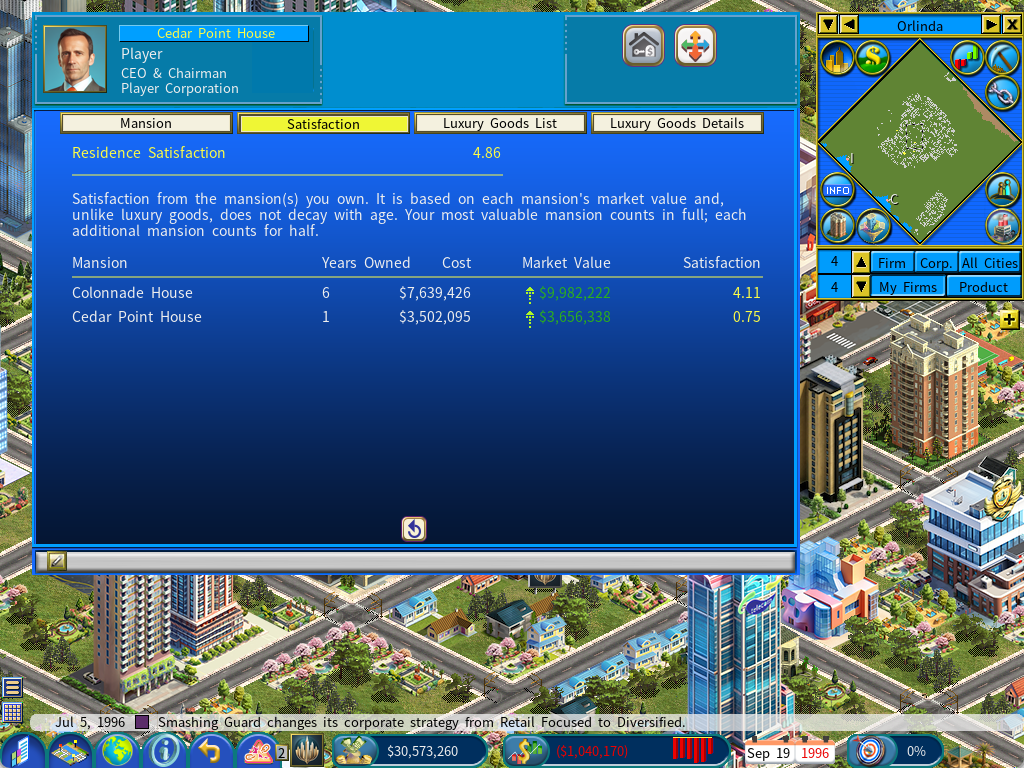
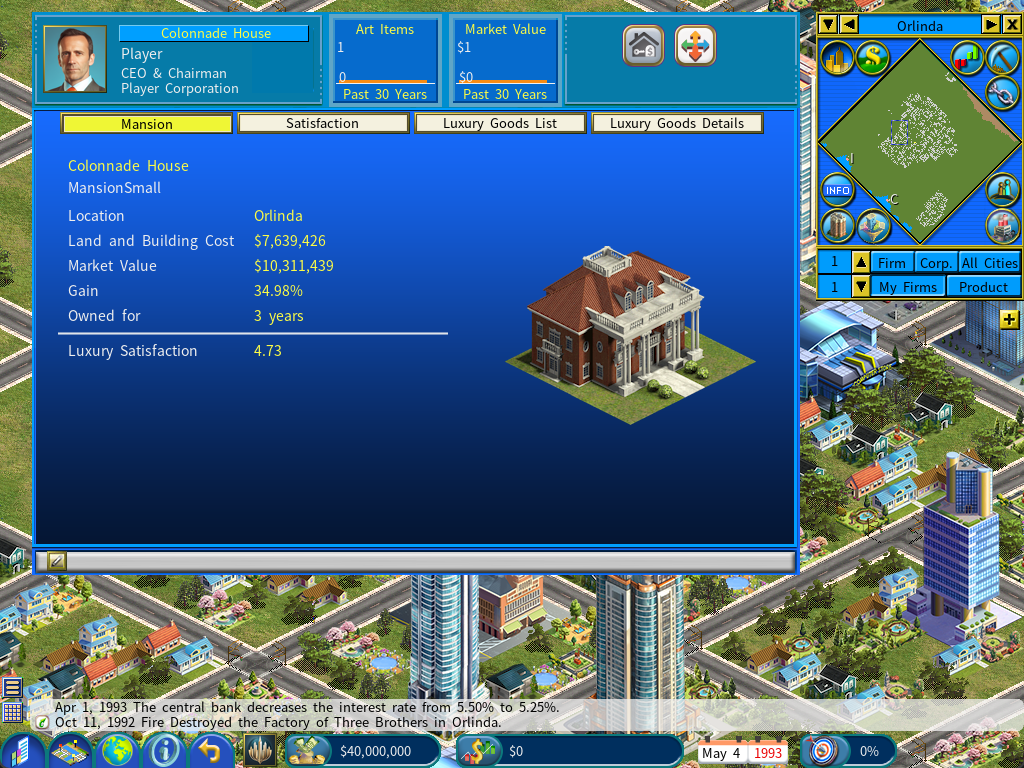
Owning a mansion is a lasting source of pride: its satisfaction is proportional to the mansion’s market value and never decays. Owning several gives diminishing returns — your single most valuable home (your “primary residence”) counts in full, and every additional mansion counts at half. So a bigger, better home helps more than piling up extra houses.
Luxury Satisfaction — luxury goods
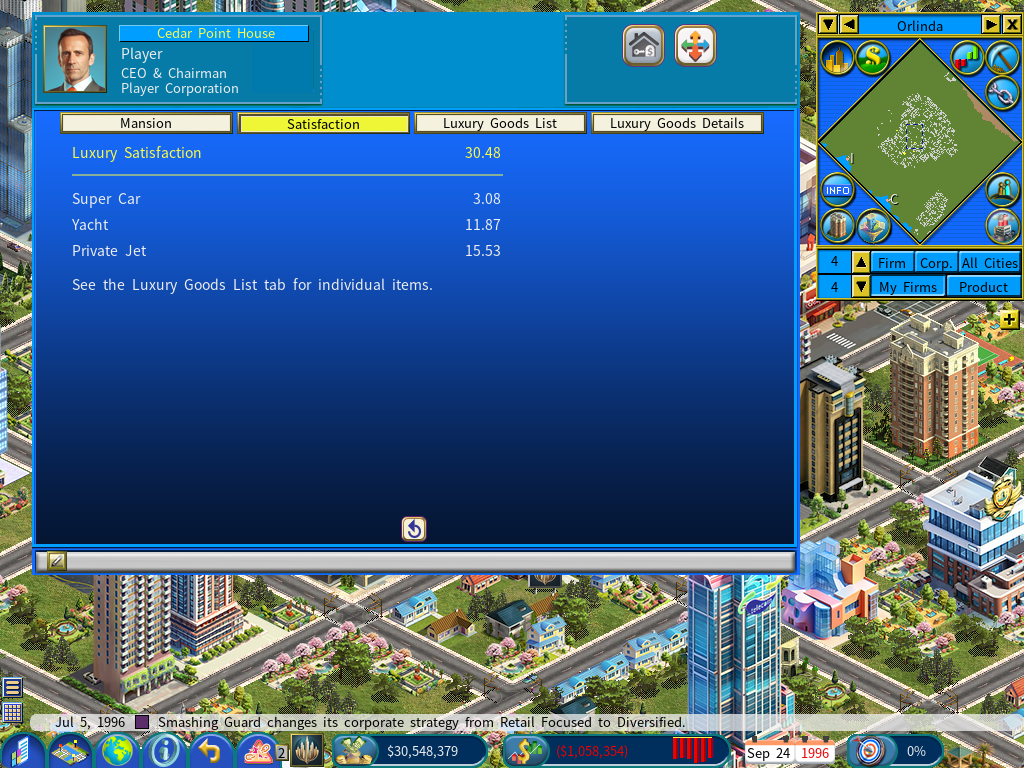
Supercars, yachts, jets and the like. Each item is worth its price ÷ $1M, but its thrill fades with age toward a 50% floor, and only one copy of a model ever counts — so you keep buying fresh, different pieces to hold the total up. Full details in the Luxury Goods guide.
Art Collection Satisfaction — fine art
Owning paintings adds satisfaction proportional to their market value (no decay), and completing your favorite artist’s works adds a growing bonus on top. Full details in the Fine Art guide.
Philanthropy Satisfaction — giving art away
When you donate art to your own museum, its value is added to your Personal Philanthropy — a permanent total that only grows. Donating great art therefore rewards you twice: standing and lasting satisfaction. See the Fine Art guide.
Stress Penalty — overwork
The one thing that drains satisfaction. Managing too many firms hands-on builds stress, which is subtracted after the Time Bonus (so it stays meaningful late in the game). It is role-scaled: it falls hardest on you as an owner-operator, while a hired COO — whose sole job is operations — carries the same firms at just 30% of the stress.
- A person can manage up to a free allowance of firms with no penalty (currently 10). Beyond that, each extra firm adds more stress than the last — a large personally-run empire is genuinely stressful.
- Delegation is the cure. Appointing a COO or turning on auto-manage moves a firm off your hands and onto the COO. Those firms add no stress to you, and your COO absorbs them at a much lower rate. Your own stress then eases off over a few weeks.
- Stress builds faster than it unwinds, so you can’t dodge it by flipping auto-manage on for a single day.
- A COO builds stress at just 30% of the rate an owner-operator would for the same number of firms. The reason is role focus: operations is a COO’s whole job, whereas a CEO or Chairman is simultaneously handling strategy, finance, deals and ownership — so the same operational load weighs far less on a dedicated operations chief. Even at 30%, a COO running a very large company can still build up some stress of their own, so for a sprawling empire, spreading the load across more executives (or not overloading a single one) keeps everyone performing.
Tip: if your satisfaction is being eaten by stress, hand your least-important firms to a COO or enable auto-manage. You keep the firms; you just stop micromanaging them — and the stress lands on you far more lightly through your COO.
Where to see it in game
Your Lifestyle Satisfaction shows up in several places:
| Where | What it shows |
|---|---|
| Score → Lifestyle Score | The full report shown above — every positive component, the Total, the Time Bonus, the Stress Penalty, and your Net Lifestyle Satisfaction. Sits beside your Wealth & Business Score and Influence Score. |
| Top 100 Charts → Lifestyle Score | A leaderboard ranking people by lifestyle score — see below. |
| Mansion → Satisfaction tab | The same breakdown, but here every row is clickable and drills into a detail page for that component (your mansions, your luxury total, your art collection and favorite-artist progress, your philanthropy, or your stress and what’s driving it). |
| Top-of-screen readout | A small “Your lifestyle satisfaction (N)” figure at the top of the screen keeps your current net score in view as you play. |
You need to own a mansion to have a mansion screen, but the Score → Lifestyle Score report is always available. A character’s effective skill (the payoff of all this) also appears on their Expertise information, so you can see how satisfaction is helping — or hurting — an executive’s performance.
Where you rank — the Lifestyle Score chart
Open Top 100 Charts and choose the Lifestyle Score tab (alongside 100 Billionaires, Local Billionaires and Most Influential People) to see a leaderboard of the people living best — each person’s Name and their Lifestyle Score (their Net Lifestyle Satisfaction), highest first.
| # | Name | Lifestyle Score |
|---|---|---|
| 1 | Sofia Rodriguez | 237.13 |
| 2 | Ethan Foster | 214.71 |
| 3 | Chen Ling | 203.94 |
| … | … | … |
It’s a quick way to see how your character’s good life stacks up against the AI billionaires — and, because lifestyle score scales effective skill, a rough read on who is quietly performing at their best. Early in the game the scores run high (the Time Bonus is large); they compress as the decades pass and the bonus fades.
Lifestyle Expectations — retirement
If you switch on Lifestyle Expectations, characters develop a standard of living they expect to keep. If a person’s satisfaction stays below their expected level for a full year, they retire — walking away from the game. The higher the setting, the higher the bar:
| Setting | Satisfaction a person must stay above |
|---|---|
| No (default) | Off — no one auto-retires from unhappiness. |
| Low | 10 |
| Moderate | 20 |
| High | 40 |
| Very High | 60 |
This applies to you too — if it’s on and your own character’s satisfaction stays below the bar for a year, your character can retire and end the run. That’s why it’s off by default. Turn it on for an added challenge where a comfortable lifestyle is something you must actively maintain.
Setting it up
On the new-game Billionaire Life setup, the Lifestyle page carries these switches (the Luxury Goods options live here too — see the Luxury Goods guide):
| Setting | What it does | Default |
|---|---|---|
| Lifestyle Affects Skills | Whether satisfaction scales effective skill. With it off, satisfaction is tracked but changes no one’s performance. | Yes |
| Lifestyle Expectations | The auto-retire bar (No / Low / Moderate / High / Very High). | No |
| Stress Penalty | Whether overwork subtracts from satisfaction. | Yes |
Frequently asked questions
My executive’s skill looks lower than their rating. Why?
Their Lifestyle Satisfaction is low, so their effective skill is scaled down (as little as half at zero satisfaction). Raise their satisfaction — an AI executive collects their own mansion, luxuries and art, and you can help by gifting luxuries or paintings that go straight into their collection. One extra cause for a COO: running a very large company builds up overwork stress that eats into their satisfaction — spread the load across more executives, or hand fewer firms to one COO.
What’s the fastest way to raise satisfaction?
A better mansion (no decay), an art collection (no decay, plus the favorite-artist bonus), and keeping fresh luxury goods. And cut stress by delegating firms. Because of the Time Bonus, doing it early is worth far more than late.
Does the huge “Net” number mean anything on its own?
Mostly it reflects the early-game Time Bonus. The skill effect caps at a satisfaction of 100, and the retirement bar reads the net level — so past a point, more satisfaction is comfort rather than raw advantage.