

Radical Technology R&D
Requires the Digital Age DLC. Your company’s CEO or CTO, or the COO managing the R&D Center, must have an R&D expertise of at least 20 — the same requirement as ordinary Radical R&D. Without that executive the team type is not offered at all.
Where it fits among the four R&D team types
When you set up a team in an R&D Center, the Set Up a Team of R&D Units window offers up to four tiles.
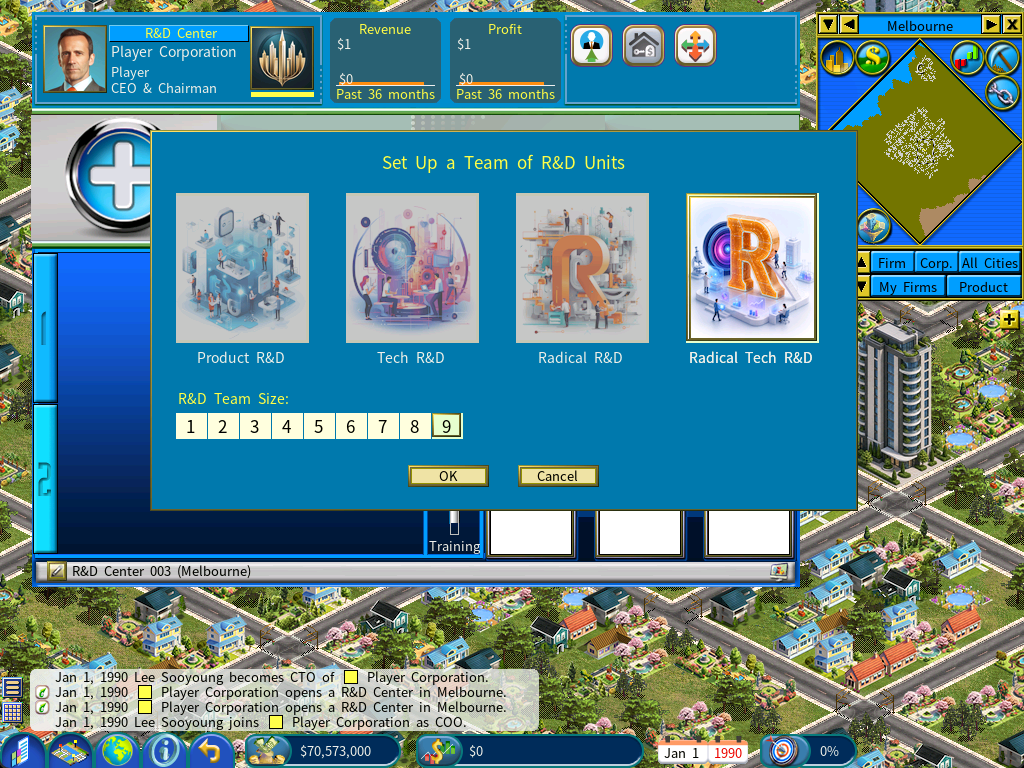
Two questions decide which one you want: what are you researching, and are you willing to gamble?
| Team type | Researches | Outcome |
|---|---|---|
| Product R&D | One product’s own technology | Guaranteed, steady gain |
| Technology R&D | A global technology | Guaranteed, steady gain |
| Radical R&D | One product’s own technology | 2×–6× gain, gambled |
| Radical Technology R&D | A global technology | 2×–6× gain, gambled |
Why gamble on a technology rather than a product? A global technology sits underneath many products at once. One successful 4× leap doesn’t improve a single item — it lifts every product in your line-up that depends on that technology, and can immediately unlock products you were not yet able to invent. That leverage is the whole reason to gamble here rather than on one product’s tech.
Setting up a Radical Technology R&D team
- Open one of your R&D Centers and set up a team as usual. Choose the Radical Technology R&D tile and the team size (1–9 units — a bigger team researches faster).
- Hire a team lead who knows a technology. Because this feature needs the Digital Age DLC you are always playing with talents, so the unit researches the technology its team lead knows — the researcher you hire decides what gets researched.
- Press [Start Radical R&D] on the unit.
- Choose the research duration. A longer period produces a larger base gain, which the multiple then multiplies.
- Choose the target multiple in the “How aggressive is your radical research project?” window — from 200% tech gain up to 600% tech gain, each with its own success rate.
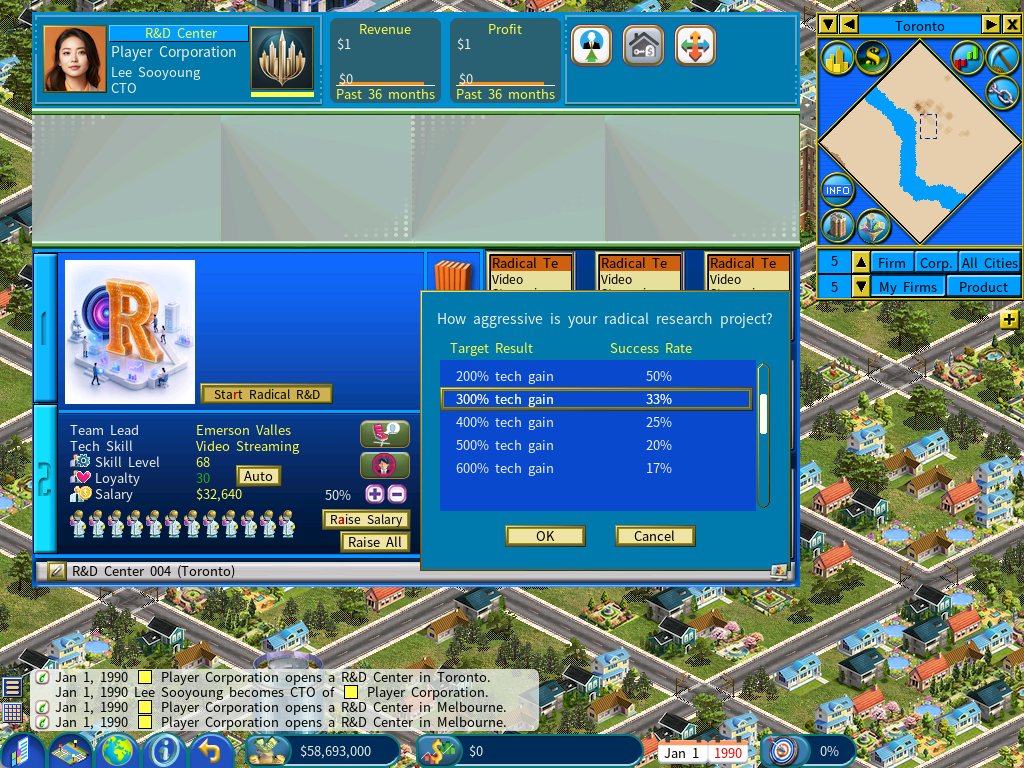
The multiples
How high you may reach is capped by the higher of your CEO’s and CTO’s R&D expertise:
| Target | Tech gain | Success chance | Needs R&D expertise |
|---|---|---|---|
| 200% tech gain | 2× | 50% | 20 |
| 300% tech gain | 3× | 33% | 40 |
| 400% tech gain | 4× | 25% | 60 |
| 500% tech gain | 5× | 20% | 70 |
| 600% tech gain | 6× | 17% | 100 |
Only the multiples your executives can support are listed, so the window itself tells you where your R&D leadership stands. Promoting a stronger CTO widens the range immediately.
When the research period ends
| Outcome | What happens |
|---|---|
| Success | The full multiplied gain is applied to your company’s level in that technology. Any product that now meets all of its technology requirements is invented automatically, and an entry appears in your R&D event track. |
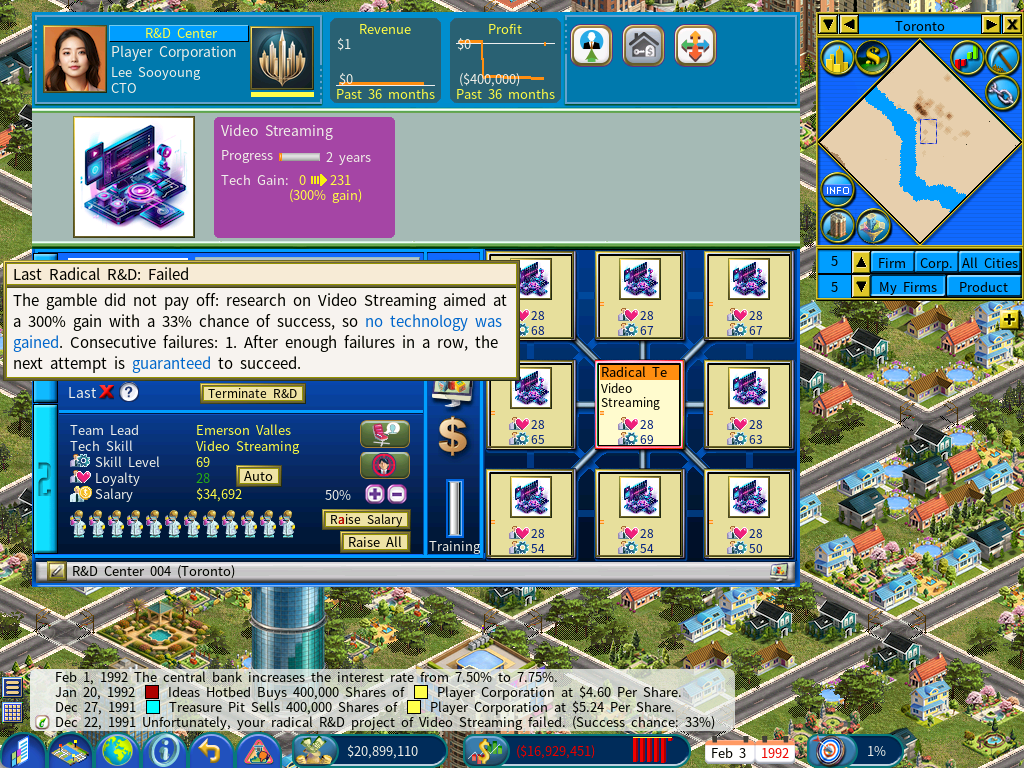
| Failure | No technology is gained at all — the period’s work is lost. The team starts the same project again by itself, so you don’t need to re-issue it. An event-track entry reports the failure and the chance it had. |
Bad luck does not last forever
An anti-frustration rule guarantees a success after enough consecutive failures on the same unit, so a losing streak always ends:
| Target | Success chance | Guaranteed success after |
|---|---|---|
| 200% tech gain | 50% | 3 failures |
| 300% tech gain | 33% | 4 failures |
| 400% tech gain | 25% | 6 failures |
| 500% tech gain | 20% | 7 failures |
| 600% tech gain | 17% | 7 failures |
The counter resets on every success and belongs to the unit, not to the technology.
Reading the unit
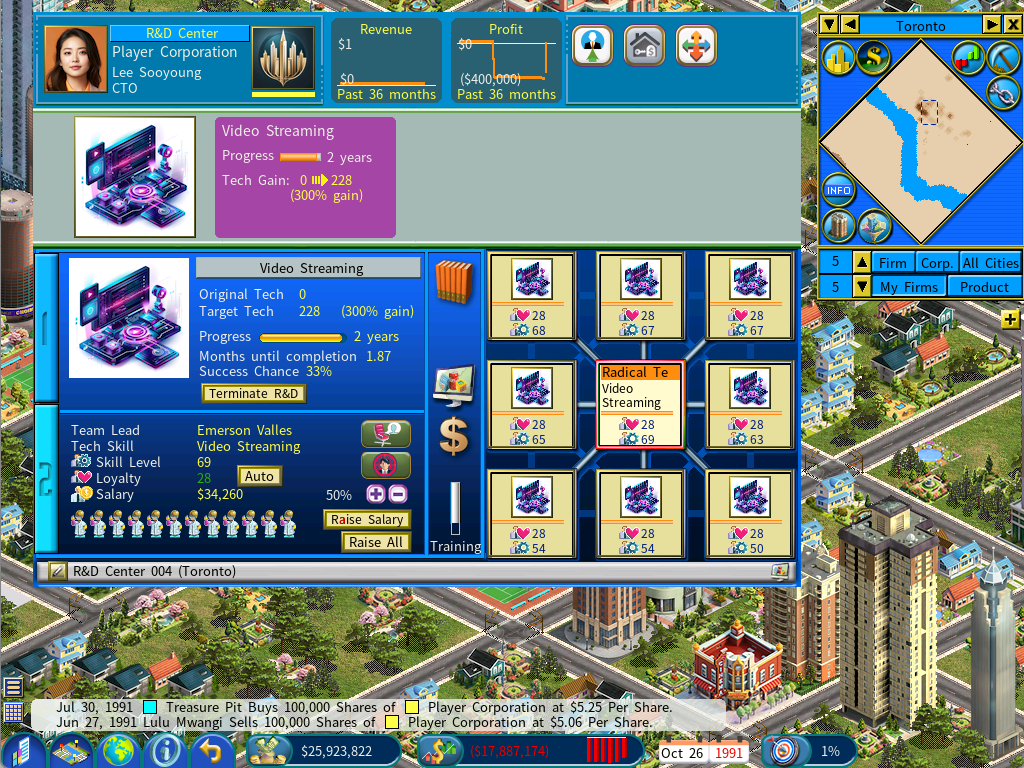
While a radical project is running, the unit’s detail panel shows:
- Original Tech and Target Tech, with the multiple in brackets — e.g. 228 (300% gain). The target already includes the multiple, so it shows what you stand to win.
- Success Chance — the odds of actually getting it.
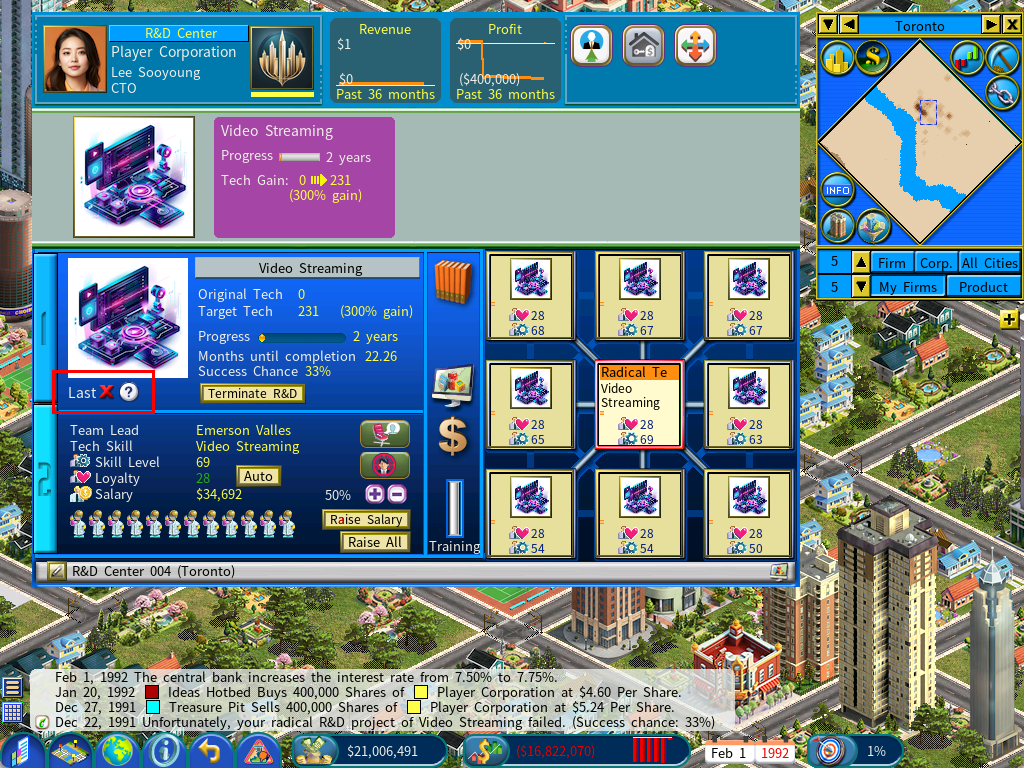
- Last — a tick or a cross recording how this unit’s previous gamble ended, with a ? icon beside it. Hover the ? for the details: which technology it was, the multiple it aimed at, the chance it had, how much technology was won or forfeited, and how many failures have accumulated in a row.
Using it well
- Gamble where you are behind. If a rival leads you on a technology, one 4×–6× success can close a deficit that steady research would take a decade to grind down. If you are already the leader, ordinary Technology R&D banks progress with no risk.
- Never gamble your whole research program. A failed period is a period in which none of the products depending on that technology advanced. Keep at least one reliable Technology R&D team running alongside.
- Mind the products waiting on it. If a technology is the last prerequisite for a product you want, a failed gamble delays that product too — automatic invention only fires on a successful gain.
- Match the duration to the target. The multiple scales whatever the base gain was, so a longer period is worth more per successful roll. A long period at 300% often beats a short one at 600%.
Your competitors do it too
AI companies build Radical Technology R&D teams under the same rules you do, aiming their gambles at the technologies they are furthest behind on and reaching for a bigger multiple the bigger the deficit. One thing they stay away from: any R&D Center their company is relying on to invent a specific product. Leaving a rival trailing on technology is therefore no longer a safe assumption — a trailing AI can leapfrog you in a single research cycle.
At a glance
| Question | Answer |
|---|---|
| What do I need? | The Digital Age DLC (Radical R&D itself needs either the Subsidiary or the Digital Age DLC), and a CEO, CTO or managing COO with R&D expertise ≥ 20 |
| Where do I build it? | R&D Center → set up a team → Radical Technology R&D |
| What decides the technology? | The team lead you hire |
| What do I choose? | The research duration, then the target multiple (200%–600%) |
| What does failure cost? | The whole period — no technology at all — and the project restarts |
| Can a run of failures ruin me? | No — a success is guaranteed after 3–7 consecutive failures, depending on the multiple |
See also: Radical R&D and Product Invention — the product-side unit and its new ability to fast-track an invention as a time gamble · Radical R&D Unit — the unit itself and its technology gamble on a single product · Version 12.5 new features.