

Community Let’s Play
The Berkshire Hathaway Approach
How one player built a $168 billion holding company in Capitalism Lab — a patient story of subsidiaries, acquisitions and turnarounds, played out with the Subsidiary DLC.
This walkthrough was originally posted by community member buells on the Capitalism Lab forum on 10 December 2019. It is reproduced here in the author’s own words, with only light formatting for the web. Read the original thread and the discussion that followed ›
Introduction
I thought I would provide a walkthrough of how I built a $168 billion company in my latest attempt. I am running Subsidiary DLC with the settings set forth in the screenshots below. I like to play with lots of cities and competitors and high AI expertise. I tend to experiment with different Product settings, but I always have macroeconomic realism set to high and inverse inflation. I set the price competition settings for this game to moderate to see how it compares to what the game was like before.
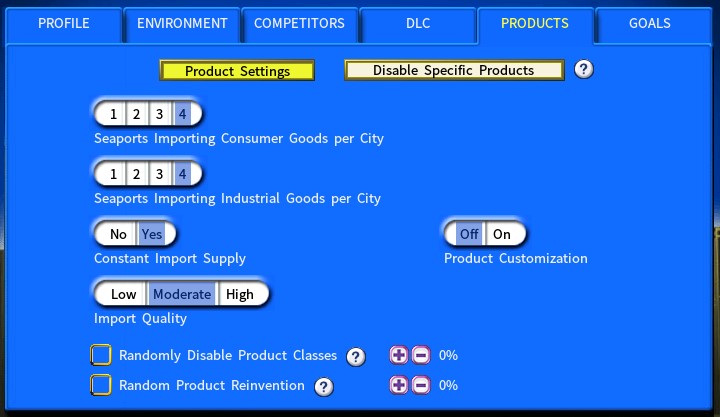
Product settings.
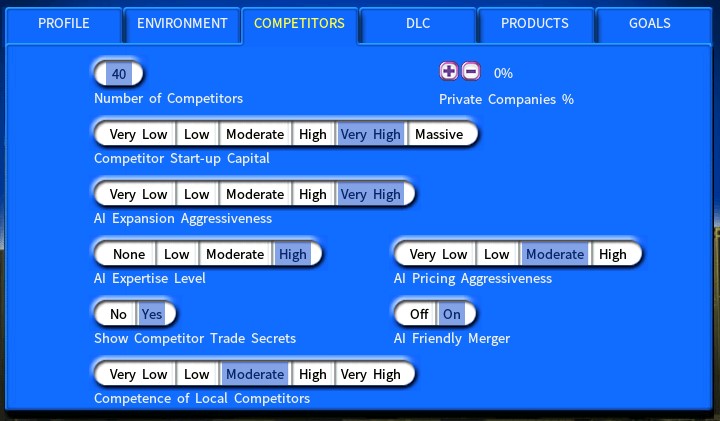
Competitor settings.
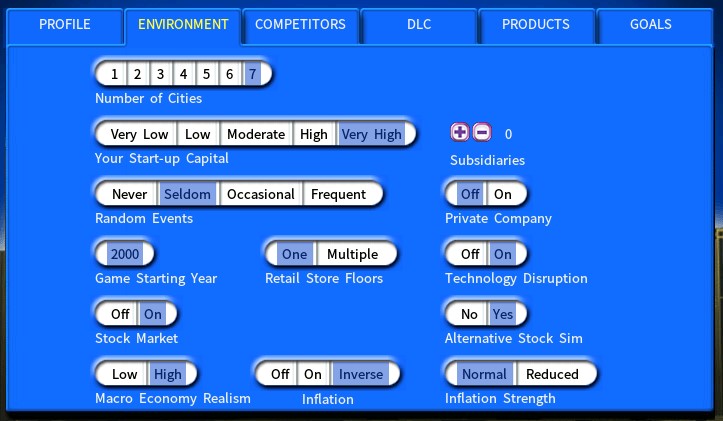
Environment settings — macroeconomic realism high, inverse inflation, moderate price competition.
Subsidiary DLC feature used here
DLC New Game Settings
The macroeconomic realism, inverse inflation, price-competition and AI-expertise options shown above all live on the DLC’s new-game settings screens — the choices that shape the whole playthrough before it begins.
The beginning
I started the game as a public company (largely by mistake). My first move was to max out my borrowings and build discount megastores in Lanzhou and Atlanta to sell imported goods. I built a bunch of apartment towers and commercial buildings in Lanzhou early on given that it was largely undeveloped.
I used the cashflow I was generating from those enterprises to begin investing in R&D after hiring a chief technology officer with the right know-how. My main interest was getting into the market for appliances even though my expertise was in Body Care products. The Lanzhou seaports were bringing in Electronic Components and Steel, so I built my first factories in the seaport zone once my technology was competitive in 2007. I have attached a picture of the seaport zone in 2092.
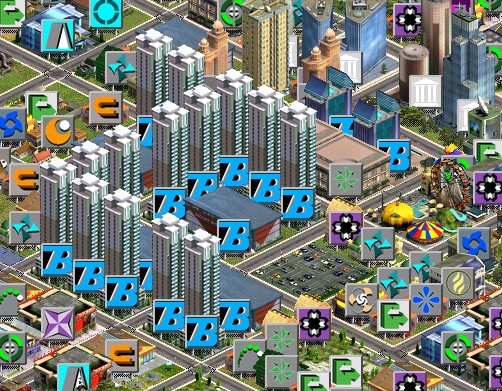
Downtown Lanzhou.
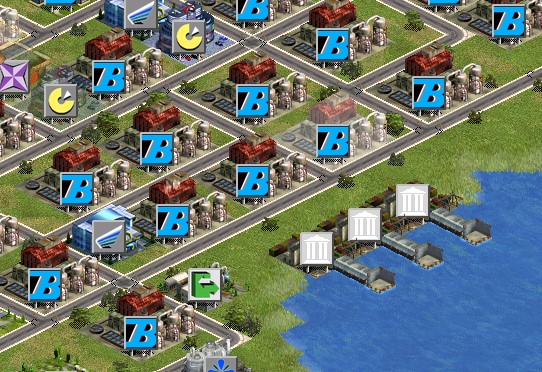
The Lanzhou seaport zone in 2092.
Into electronics: the Logic Logic acquisition
After developing a chain of Electronic Stores spanning the globe to sell appliances, in 2015, I bought several technologies in the Electronic Goods space. I built out an R&D capability in electronics to build on my acquired technological assets and hired a new COO with expertise in that space to run the research and improve my factory efficiency. However, my profits were declining because margins were beginning to come under pressure due to intense competition. My main competitor was Logic Logic. I slowly built up a position in their stock and used as much debt as I could to acquire them. In order to successfully integrate the acquisition and paydown the debt, I had to rationalize their operations once I had consolidated the market. Significant synergies were generated by closing down underutilized factories and redundant R&D facilities. Before I could buy them out, I had to issue shares to generate enough cash to remain in operation. Once the cash began flowing, I quickly bought back as many shares as I could to bring my ownership back to 70%. To generate more cash, I put their media assets up for sale and got $300 million for their TV station.
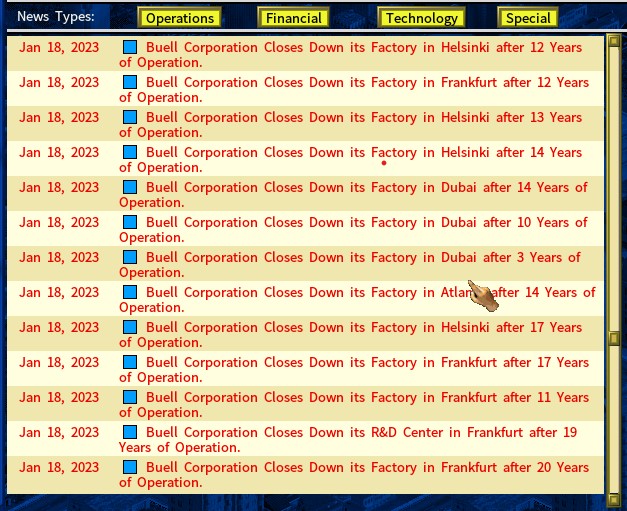
Consolidation.
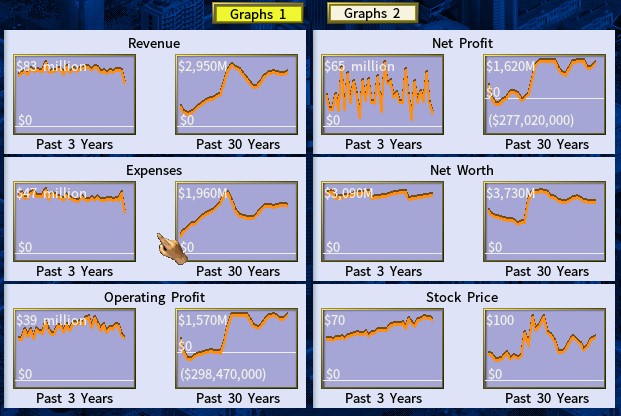
The numbers after consolidation.
Subsidiary DLC feature used here
Greater Control over Subsidiaries
Building up a stake in a rival, taking control, then rationalising its factories and R&D and steering its share count back to 70% is the kind of hands-on direction the DLC’s subsidiary-control tools are built for.
Celeris and Horizon
My next move in 2028 was to purchase a controlling stake in a company called Speedy Avion, which I renamed Celeris Systems. Speedy Avion started as a stock focused company that went on to develop a small computer business. Over the next few years, I massively expanded their computer business to dominate the market with a focus on tablet computers and desktops. I sold Celeris Computer Stores I had acquired from Logic Logic and my next acquisition, Shining Star, which I renamed Horizon Mobility. Horizon was another tech play, this time focused on Smart Phones and HUD Glasses. These nascent markets were hardly being served and there was tremendous opportunity to grow. I transferred their Electronic Goods division to my holding company, Buell Corporation, and built more stores to sell their products. At this point, I noticed a problem with my operating model. All of divisions were operated as Internal Sales only so I could sell products to my retail stores at cost. This meant I couldn’t cross sell my products across divisions. While this was hardly ideal, I felt the benefits of highly competitive retail prices outweighed the dissynergies. I also could not sell my high quality semi-products (electronic components and CCDs) to my subsidiaries. However, I did transfer them the technologies required to make the best products possible. Horizon’s performance improved dramatically under my ownership, while Buell Corporation’s core operations were nicely augmented.
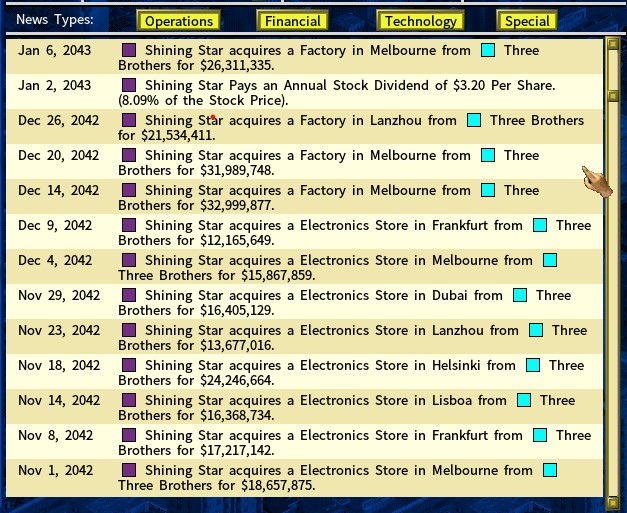
The Horizon acquisitions.
Subsidiary DLC feature used here
Subsidiary Management Policies
Running every division as Internal Sales to feed his own stores at cost, transferring a division up to the holding company, and pushing technologies down to a subsidiary are all set through the per-subsidiary management policies.
Two more deals
In the early 2040s, I made two more deals. I acquired Round Petal and Three Brothers. I split up their retail networks and manufacturing between Horizon and Celeris to increase each company’s scale and merged the shells of each company flush with cash into my holding company.
Subsidiary DLC feature used here
Merging Subsidiary Companies
Splitting two acquisitions between existing subsidiaries for scale, then merging the cash-rich shells into the holding company, is exactly what the merge mechanic makes possible.
The automotive play: Target Strike becomes Chariot
In 2049, with echoes of Kirk Kerkorian, I made my next big acquisition. This time, I took a controlling stake in a company called Target Strike, which I made especially to get into the automotive business. Buell Corporation had a great technology for steel, which I wanted to use in auto production. Target Strike was making about $170mm a year in gross profit from its car sales, but it only had 12% of the market. Its technology was behind the curve, but I had recently begun using Radical R&D to use my cash pile to drive big competitive advantages and catch up to competitors. I began building a massive automotive complex in Helsinki to begin taking share in the automotive market.
Previously, Chariot had been purchasing its automotive inputs from competitors. I realized that the Car technology alone did not give me the quality advantage I sought, so I built out a whole supply chain to use newly improved technologies for Car Body, Wheel & Tire, and Engine to improve my products. I also built steel mills in the area under Buell Corporation that I used to supply the necessary steel at low cost. I managed these facilities myself to allow for external sales. Warehouses helped keep the supply chain running smoothly once the number of factories required to meet automotive demand exploded. Automotive sales reached nearly $2 billion a year with $1.45 billion a year in gross profit, even in a slow growth environment.
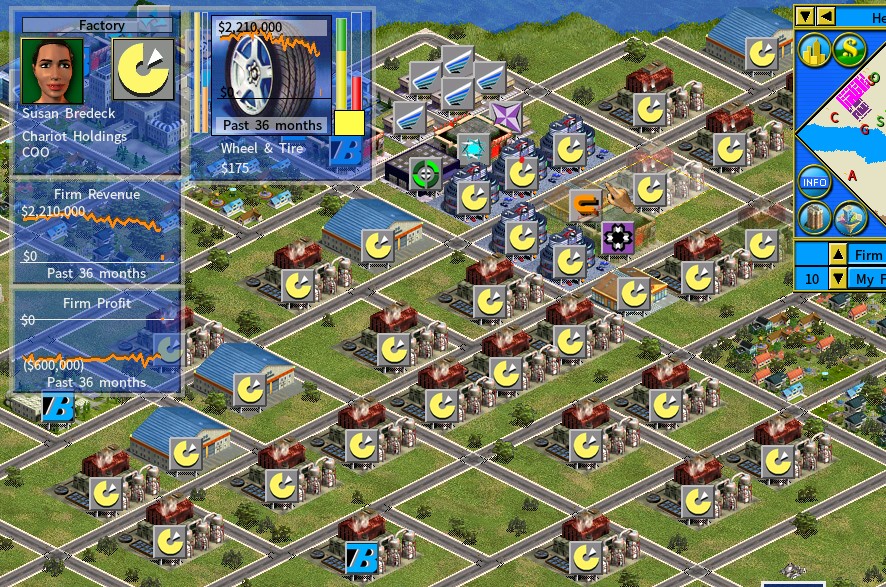
Chariot’s Helsinki complex.
Subsidiary DLC feature used here
Radical R&D
He names it himself: Radical R&D let him spend his cash pile to leapfrog a laggard’s car technology and build a competitive automotive supply chain far faster than ordinary research would allow.
Turning around Mayfair
In 2067, I began increasing my stake in Mayfair’s predecessor company, Compass Point. Compass Point had been failing for years trying to operate as a huge conglomerate and the value of my stake in the company had dropped by $4 billion. To staunch the bleeding, I decided to take full control of Compass and orchestrate a turnaround. The first step was to shutdown the company’s failing Cosmetics, Leather Products, and Furniture divisions, which were far behind the competitors. Next, I changed the brand strategy to Range Brand to save several million a month in advertising costs. I decided to focus on the company’s Drug and Apparel divisions, which were the company’s gems. I bought another company called Beta Corp and merged it into Mayfair. I changed the management team and expanded significantly in the Apparel division, which seemed to have the best prospects.
In 2078, I acquired what came to be called James Corporation. I sold off its apparel division to Mayfair in order to focus it on Leather Goods and Footwear. Mayfair grew steadily as a result of these changes.
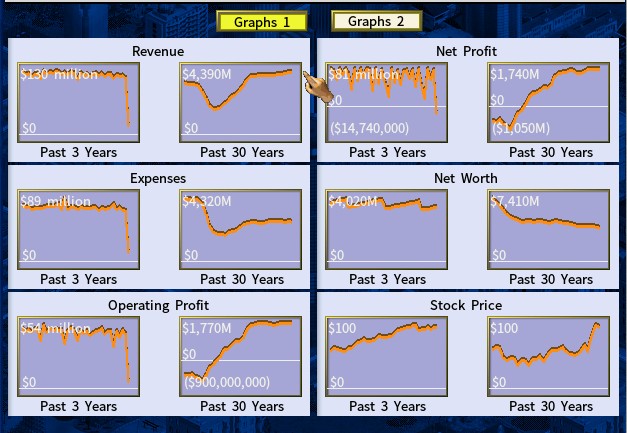
Mayfair after the turnaround.
Subsidiary DLC feature used here
Privatization
Buying out the remaining shares to take full control of a struggling public company — so you can shut divisions, change the brand strategy and replace management without answering to other shareholders — is the privatization move.
The Body Care roll-up: Spotlight Brands
My next play was to try and do a roll-up of the Body Care and Cosmetics industries, which were controlled by a few weak companies in which I had acquired large equity interests over time. Spotlight Brands became the vehicle for consolidation. I bought Spotlight’s predecessor company and its competitor Hyper Power in 2087. I merged the two companies and then acquired Serpentine and SSA using Spotlight. I closed numerous R&D centers and factories in order to bring down the cost structure. Spotlight went from having a small market share to totally dominating most of its markets in just a few years. Many of these companies I acquired at a discount to book value, creating huge ROI.
Subsidiary DLC feature used here
Merging Subsidiary Companies
A classic industry roll-up: use one subsidiary as the vehicle, buy up the weak players you already hold stakes in, and merge them together to strip out duplicated R&D and factories and dominate the market.
The results
Here are my gains on the companies I bought and kept public:
| Company | Return |
|---|---|
| Celeris | 1,028% |
| Horizon | 312% |
| Chariot | 321% |
| Mayfair | (1%) — I bought most of the shares before the company tanked under previous management |
| James | 308% |
| Spotlight | 548% |
Each of these companies also throws off a healthy annual dividend I remit to the holding company, which has allowed me to generate a $66 billion cash pile at my holding company. I have $72 billion in cash across the fully consolidated group. I have received a total of $109 billion of dividends, much of which I have reinvested in buying various businesses.
Subsidiary DLC feature used here
Initial Public Offering (IPO)
The returns above are on companies he floated and kept publicly listed. Taking a subsidiary public through an IPO — then collecting its dividends at the holding company — is where a story like this one finally pays off.
Want to try this style of play yourself? Building and floating companies like this needs the Subsidiary DLC. You can also read the questions and answers that followed in the original forum thread.