

Community Let’s Play · Real-estate AAR
Office space — Part I
In-game 1990–1999. The story of Tomahawk Corporation, a real-estate empire built on debt in the little country of Sylvania.
This is a player-written After Action Report, first posted by community member colonel_truman on the Capitalism Lab forum between March 2018 and October 2020. It is reproduced here in the author’s own words, lightly formatted and split into four parts. Read the original thread and its discussion ›
DLCs used in this series
Tomahawk is played with two expansions: the Subsidiary DLC (for floating companies, raising capital and building a corporate group) and the City Economic Simulation DLC (for the living cities the real-estate game is built on).
Chapter 1 — 21 March 2018
It's 1996 and Tomahawk corporation has been pursuing a path of extreme indebtedness since its humble beginnings, teaming with the national bank of Sylvania to construct office districts in the cities of this brave new frontier country, expecting that the pay-off will be good enough to buy back its independence, sometime in the future.
For the moment the situation looks rosy… but is it so? Will the new residential districts turn into a profitable business? Is the current debt manageable under present circumstances? Could we ask for further loans to finance new projects without endangering the stability of the corporation? Will the bankers show their true colors and start sharpening their knives… once they realize we have grown fat enough?
In this new article, you will follow the CEO of Tomahawk corporation from the begining as he tries to succeed carving out a business in the Real State sector, in the tiny country of Sylvania.
We'll explore certain aspects that often remain more dormant in traditional game plays. So if you feel your curiosity piqued, come and join the living thread, as we expect you'll find useful insights that will help you understand better some of the mechanics of the game, and maybe spark anew your love for it.
———————-
We begin the gameplay in 1990, and will be using both the subsidiary DLC as well as the city economic simulation DLC.
My main objective by writting this article will be (hopefully):
to provide an enjoyable discussion of Tomahawk's progress, our Real Estate (RE) corporation, through time.
to show how playing a RE game can be both fun and challenging, and
to provide useful insights, for your next game.
At the beginning we'll be focusing primarily on our corporation's perceived value: our assets, and their growth. That is, the value of our property, and it's appreciation.
As we have a very small amount of money when we start, we need to find an investor willing to provide the cash we lack to fund our expansion.
So, we'll choose Sylvania's commercial bank as our main financing agent, and try to avoid stock market investors.
Most games focus on selling merchandise by producing and retailing it. In our case we'll be selling something different, but selling nevertheless, these being claims on our property.
We'll report every year money rates as they price such claims.
The bank will keep looking at the value of our property and will estimate how much to lend to us using mainly that criteria, so the more value we add, the bigger the credit line at our disposal.
We'll start inflating our "30 million cash" assets by creating new RE districts in Sylvania's cities. We'll have to choose carefully the location of our first RE stronghold, and keep adding to it, maximizing the increase in value in our land purchases.
And to do so we'll build on that land our own offices, and later on, apartments.
We'll also try to enrich the gameplay providing a few off-game sheets that are fed by the game's data, periodically:
One to measure how profitable some of our residential buildings are: We'll try to know the years it took them to pay back their credit funded set-up costs with their rent.
One to show in one place the income and value we get: per building; per class of RE firm; per city; per square of land (as we consider our offices and apartments income-bearing land assets).
One to try to size our liabilities (our debt) so they can be properly assesed and managed.
One where we'll compare our residential districts to our commercial districts, in terms of income and value, per city and globally.
One where we'll try to asess the viability of whole city sectors, considering our total liabilities and money rates.
Finally, if possible, we'll attempt a modest nation building approach: by setting up new subsidiaries to engage in regular business, as well as by bidding for political power in every city.
Always trying to properly manage our debt, which we'll have no particular reason to fully "return"…
Chapter 2 — 21 March 2018
Ok, so below you'll find a save file for February 1990.
I wait one month to see where the commercial district is located, as it flips from the area around the stock exchange to somewhere else, and I haven't figured out how it flips. My guess is there is a "mass" of office space and the game tries to find the center of masses for each city.
Edited: my new guess is it's attracted by land value.
The cities are Funk, Lynden, Glen Fork and Lambs grove.
There are 2 ports in each of them.
There are 4 real state companies that have bought land to develop a neighborhood of their own. (Guess a bit irrelevant, but for the record)
The city detail screen shows a strong demand in all of them for commercial buildings (about -50 to -60)
We have 2% inflation, and 6% interest on loans, so a 4% real interest rate.
I have chosen Lambs Grove as a starting point. Lynden has already 2 supermarkets spoiling the area.
These two have the highest wages, so the rent collected from the buildings will be higher. Also the land value is higher so it will pay the most to increase it there, in relative terms.
One might argue I could start in the cheapest city, but I prefer to have it tough at the beginning and easier later on.
Chapter 3 — 21 March 2018
FEBRUARY 1990
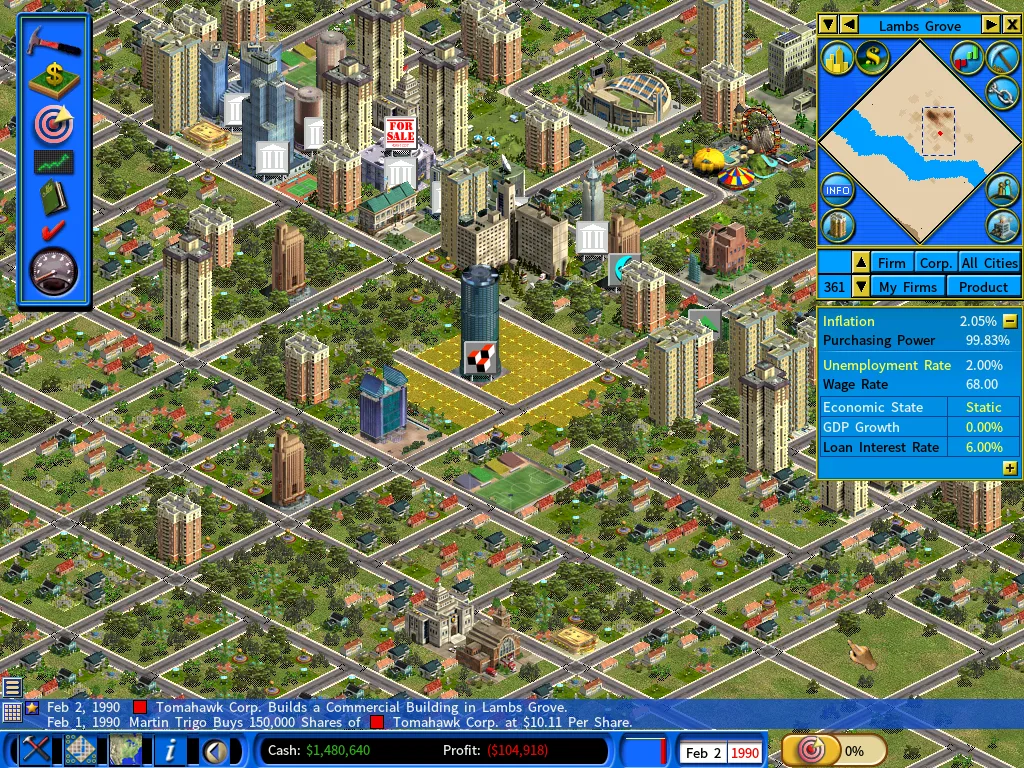
There you are!
Humble start.
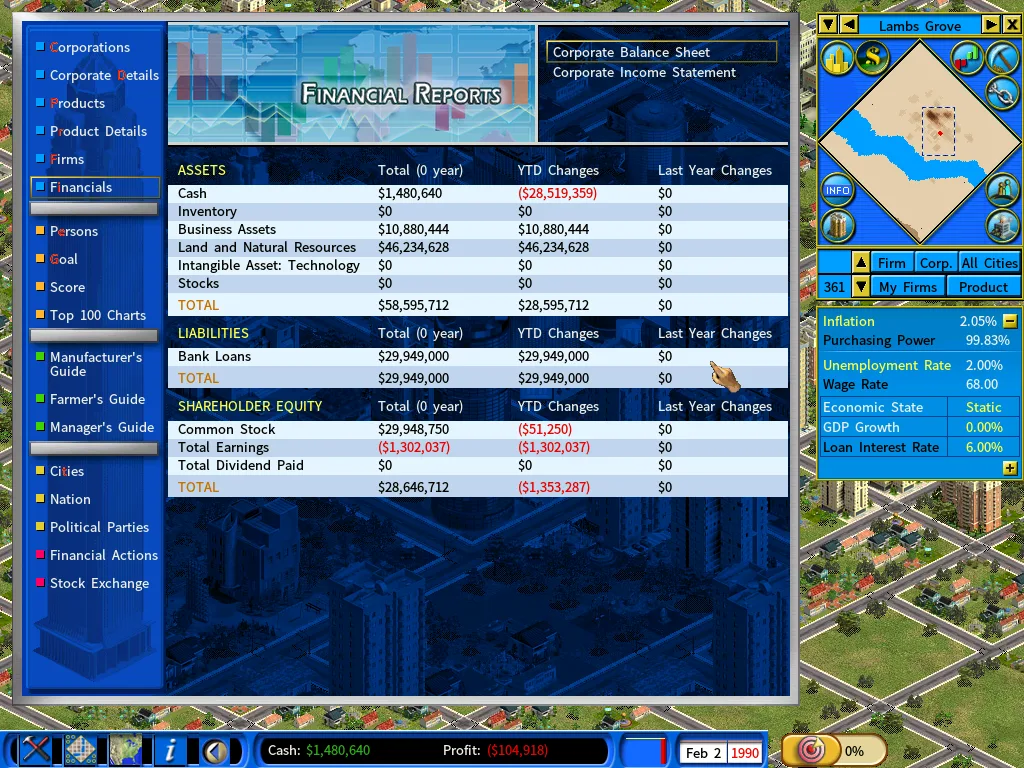
I borrowed 30 million and bought a nice square, with a building in the middle to increase the value of the land around it.
Chapter 4 — 21 March 2018
FEBRUARY 1990 – FEBRUARY 1991
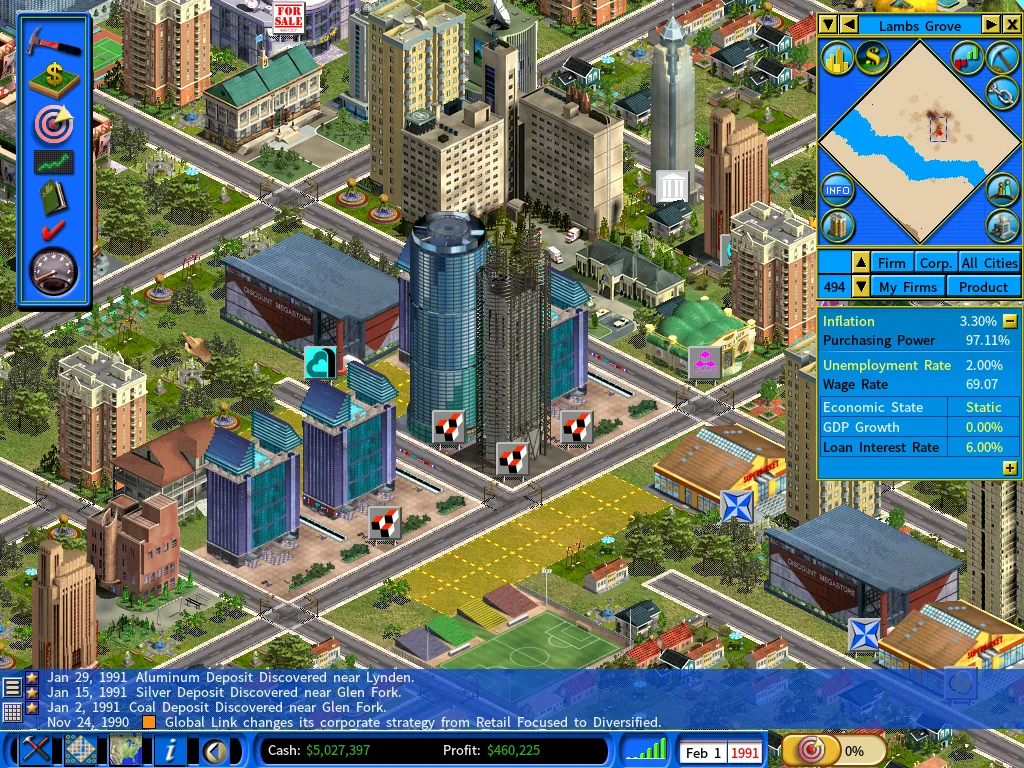
Here is the commercial district of Lambs Grove after one year of buying land and "placing" the skyscrapers. Notice how tight they are located in order to maximize the lift in land value, as each of them "support" the land below the others.
Very nice improvement to have the BIG office building as a 3×3 now. I called it the "value bomb" in previous games when it was a 4×4.
It doesn't compete with the 2×2 in terms of rent income, but it increases the value around it the most. Correct me if wrong.
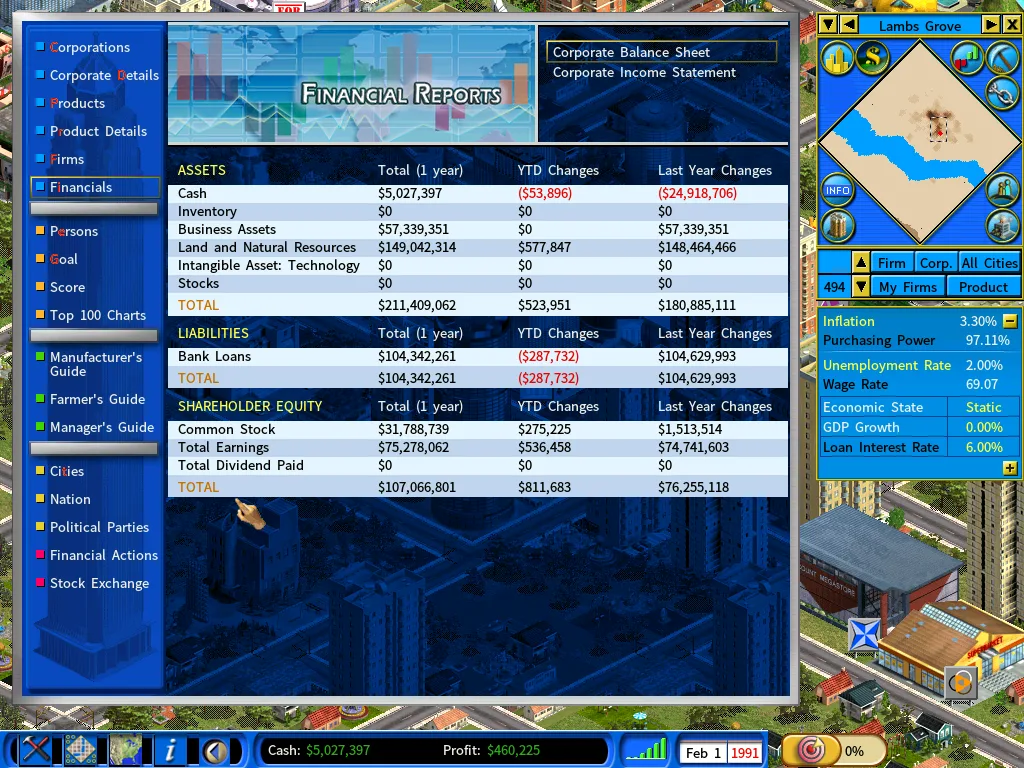
We owe the bank about 100 million. The increase in the company's value has been about 77 million net (I discount the 30 million of starting capital), so the bank will allow its lending department to increase their line to us every passing month, or so. We're paying 2.7% in real rates thanks to inflation (I changed it to inverse) So we are having cheap financing.
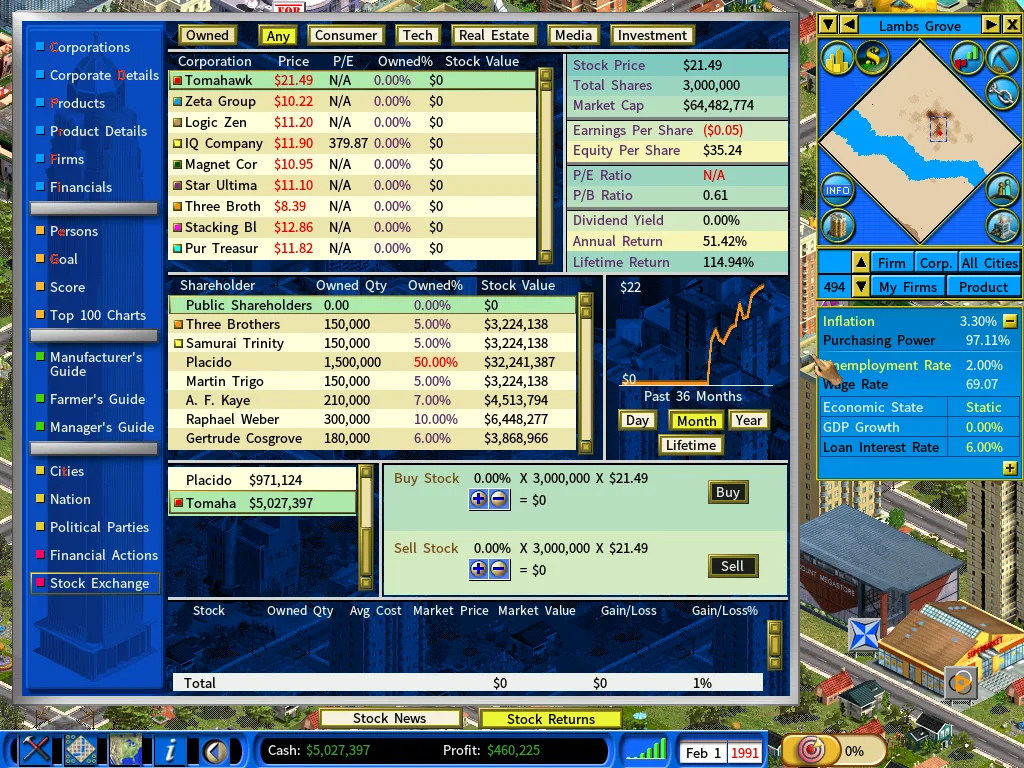
Here is the stock performance. It has doubled its price and is currently undervalued at 0.61 PB. We are not planning to issue new shares as we have cheap money from the bank, and most important, because we believe the company will become very profitable, very soon. So no need to offer cheap stock to new investors.
Chapter 5 — 21 March 2018
FEBRUARY 1991 – AUGUST 1991
After one and a half years: We have completed building the financial district in Lambs Grove. We sell the land lying south so we have a bit more of capital to expand, and we'll be selling the land north as soon as it increases in value.
The demand for office space in the city now stands at zero, so we have to move on to greener pastures.
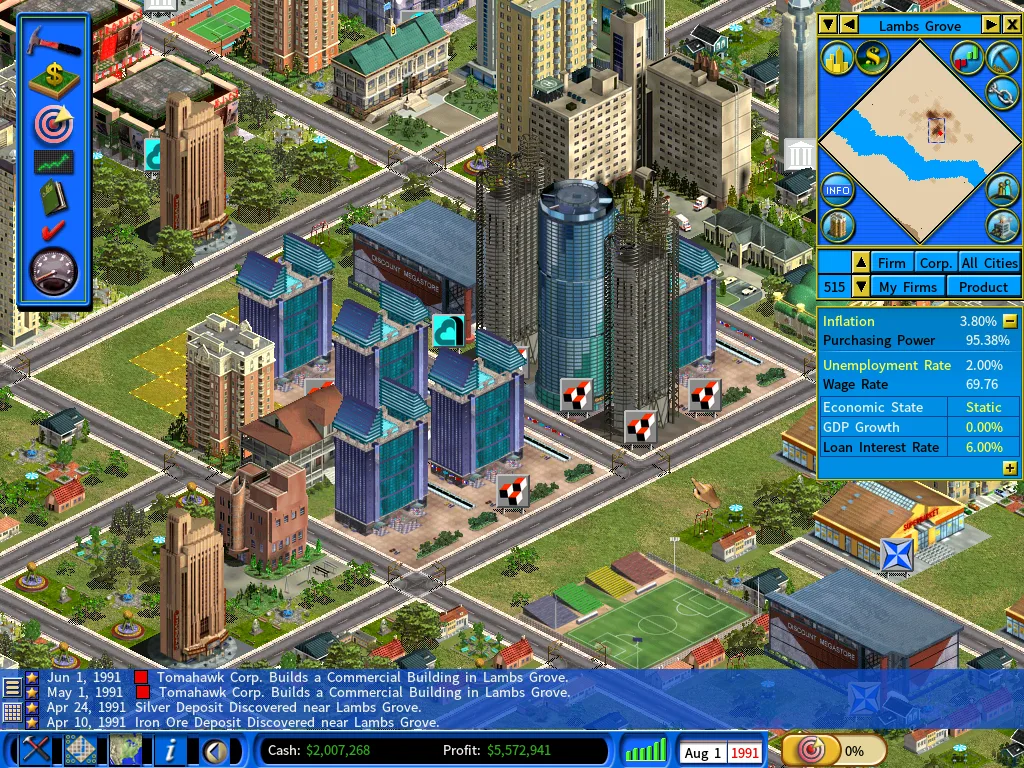
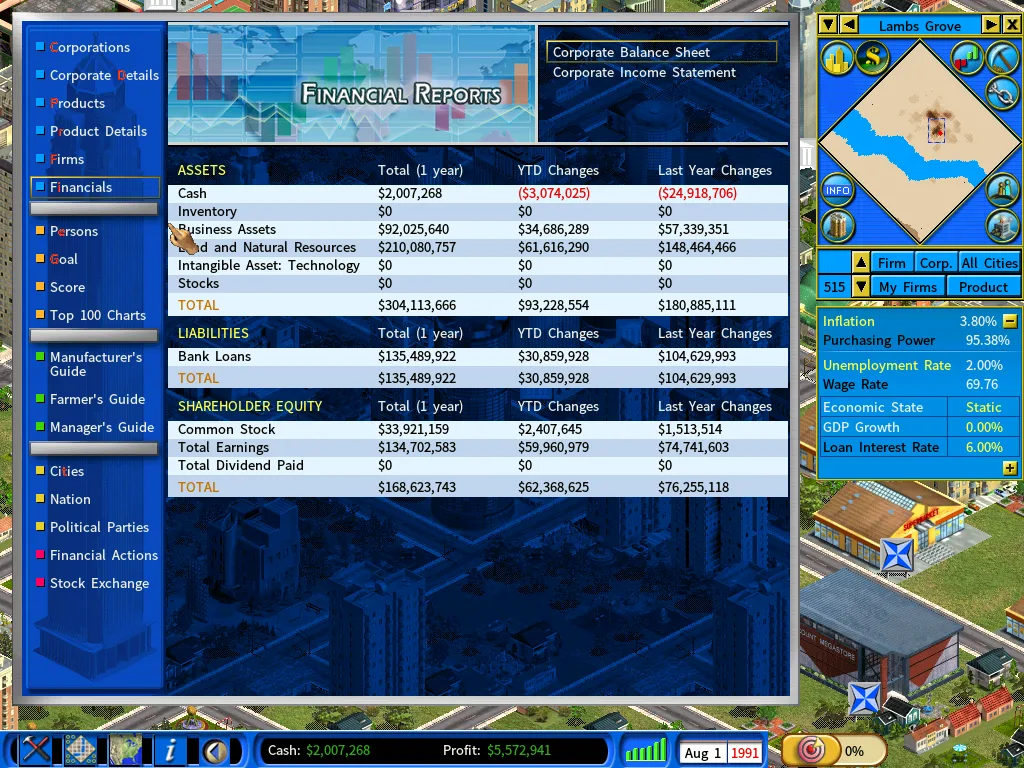
The company now has a value of 168 million, so the building of the district was worth roughly 138 million, to date.
The real interest rate is 2.2% now thanks to an increase in inflation, so we have cheap financing still.
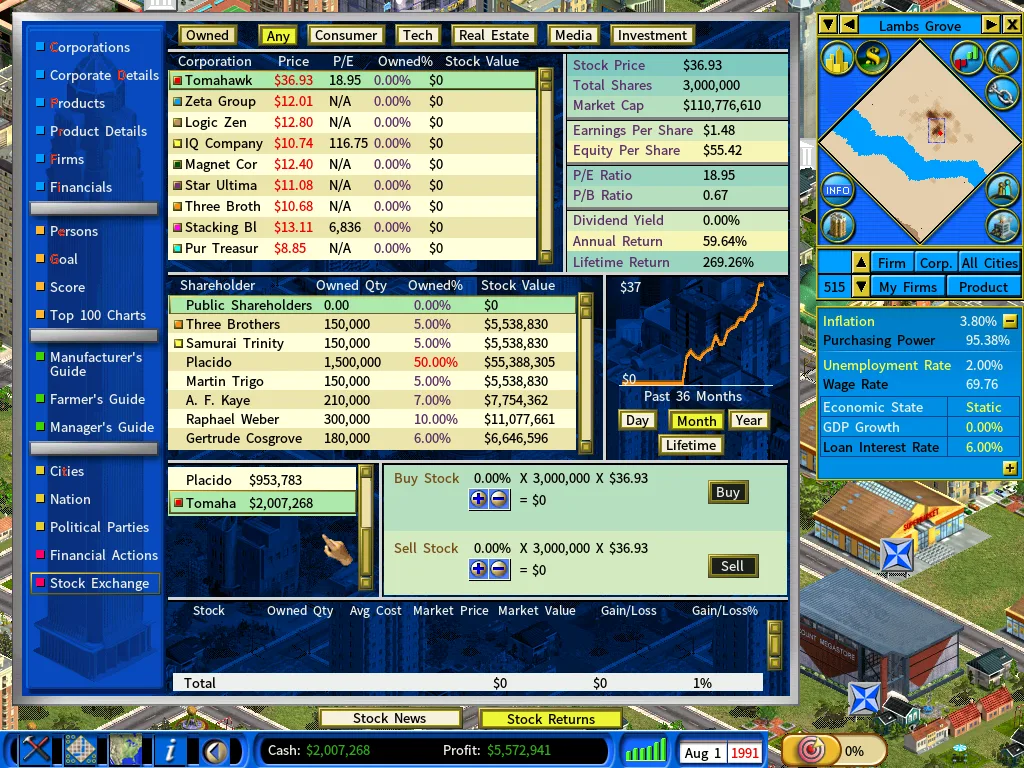
The price of the stock now stands at roughly 37$ per share, and climbing, and we have the best p/e of any company in the realm, what means we are already making a buck!
Still undervalued at 0.67 pb. So no need to issue shares at all.
Chapter 6 — 22 March 2018
AUGUST 1991 – FEBRUARY 1992
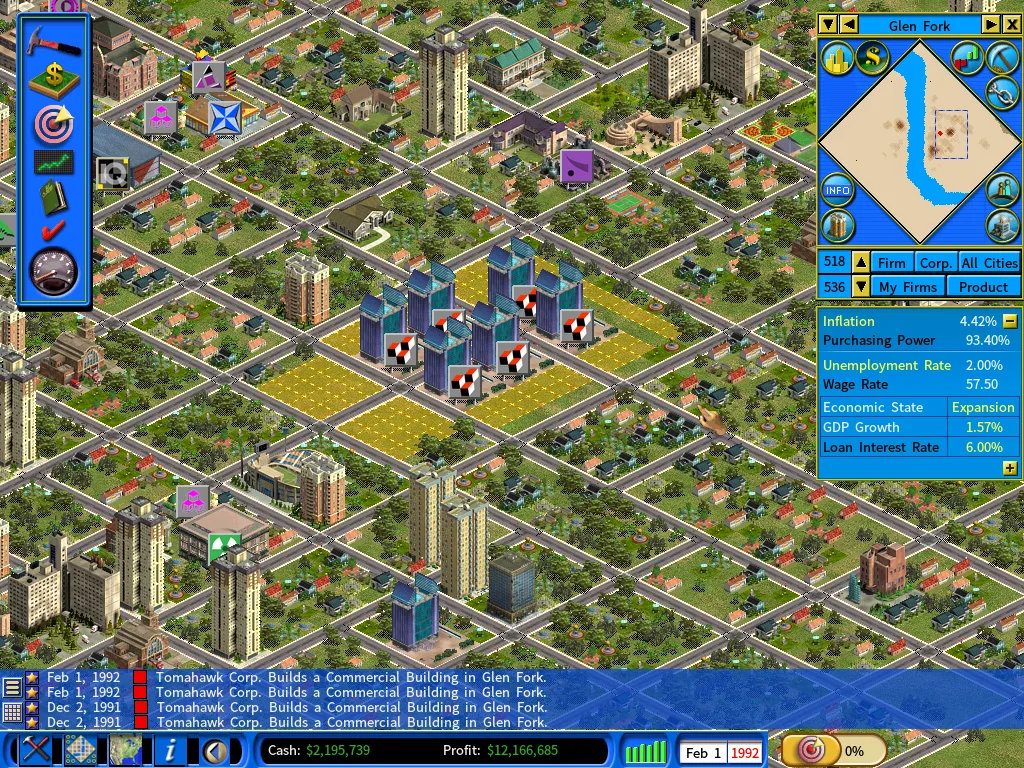
Next objective is Glen Fork. The land a bit to the south east of the commercial district area is cheaper and has bigger room for expansion. So we buy the land and place the skyscrappers with less concerns as in Lambs Grove.
Always focusing on placing the big value commercial buildings in the middle of our purchased land, bit by bit, to make it increase in value, and keep the bank financing our project. Notice the commercial district should be ideally closer to the fire station in the left, so it isn't too far away.
As the demand for commercial buildings gets to zero, shown in the city details screen, we know the city has enough of them and there's no need to push it further, altough we could. The "distance to CBD" is the most important variable to consider, as the other two can be "manipulated" later on. So if we build close to it the commercial buildings owned by the city and the AI players won't be able to compete with ours as they are farther away. That's why we can keep adding new buildings without too big concerns, but the thing is we have two more cities with high demand at the moment…
A last observation, the minimum land I tend to purchase is two squares away from any new building, ideally, so here you see we have an extra lot towards the stadium that I planned to develop, but didn't. Still that land is an asset, can be sold to pay down the loans if interest rates go up or inflation down (recession) or to buy the land in the other cities next if the bank tightens a bit.
Or also keep it in case the city grows and needs extra office space…
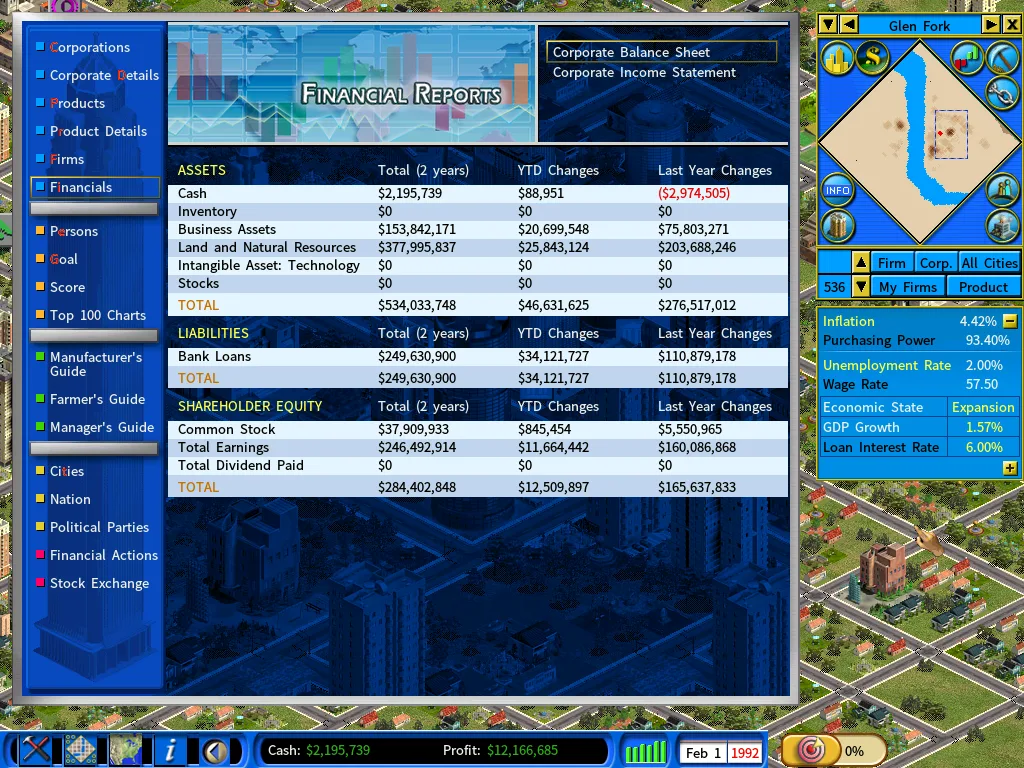
The increase in the value of the company has been 254 million in two years, and up 115 million in half a year. As always, the beginning is the hardest and now business is going to keep rolling. The real interest paid is 1.6%, so even better for us real estaters.
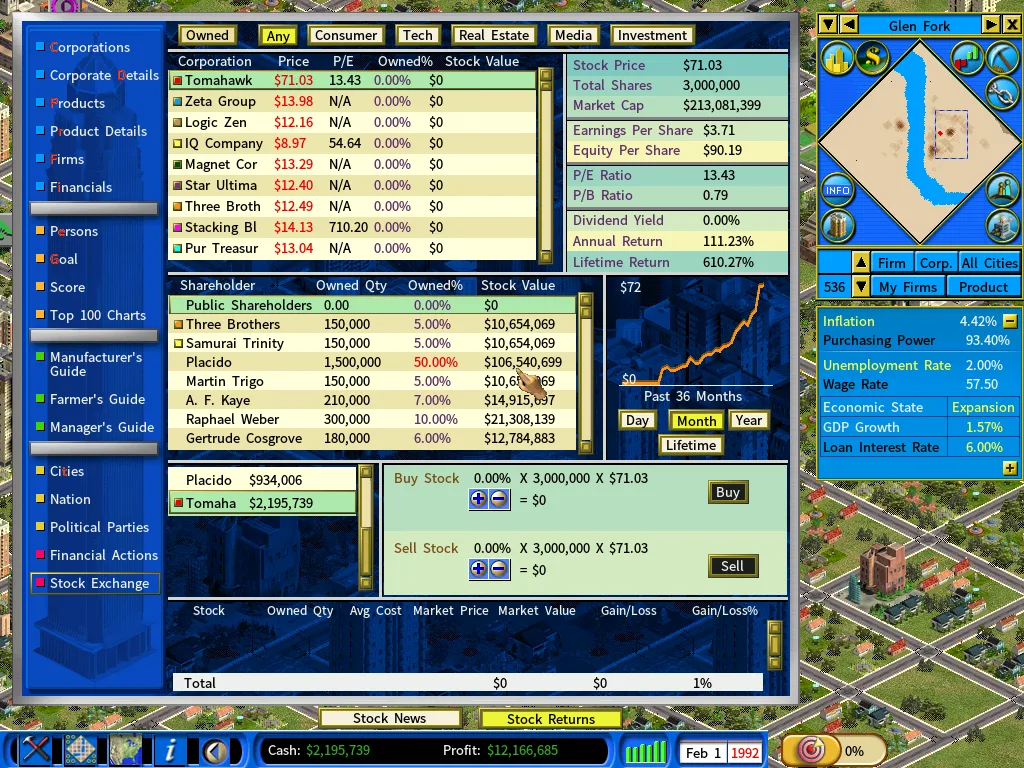
The stock price is booming, still undervalued with a p/b of 0.79 (picking up) and with a very good p/e. Already the most profitable company in the realm.
Chapter 7 — 22 March 2018
FEBRUARY 1992 – FEBRUARY 1993
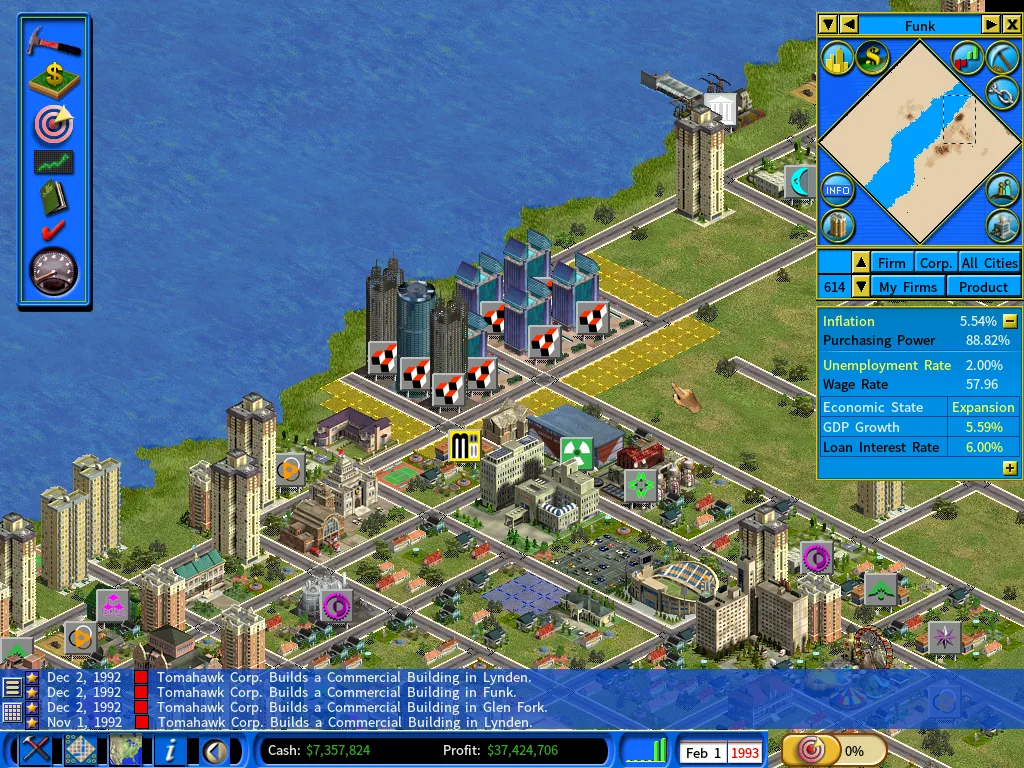
About one year later we have developed the office space in the other two cities, making our company quite profitable (as things stand at the moment) thanks to the rents we collect from the offices, and also a par player with the big companies (in terms of assets) we compete against.
In Funk city the financial district is not shown because it was displaced to a point above the river. The location was chosen because it was the neatest area and the closest possible to that elusive cbd dot.
In Lynden city our chosen spot, as well, had factored the distance to the cbd, the neatness and price of its surroundings and of course the spoiling web of supermarkets south of its location.
Here is how the commercial district in the other two cities stands.
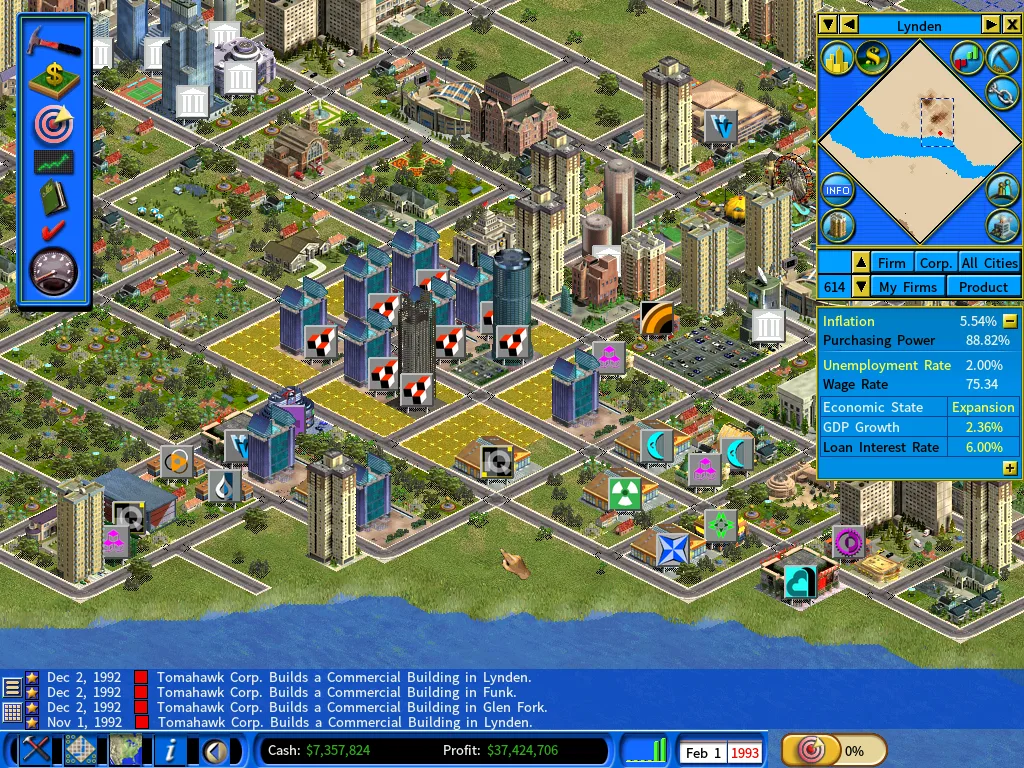
The real rate we keep paying the bank gets every time closer to zero. When it equals zero we'll be returning principal with the interest payments, and if the central bank keeps lowering the rate to stimulate the economy (in theory, unproved), inflation will eat even a bigger chunk of our debt. But that's common knowledge.
The important part is to develop quickly so we have the maximum accrued debt that we expect to incur in the best of possible times, that is, central bank easing and inflation rising.
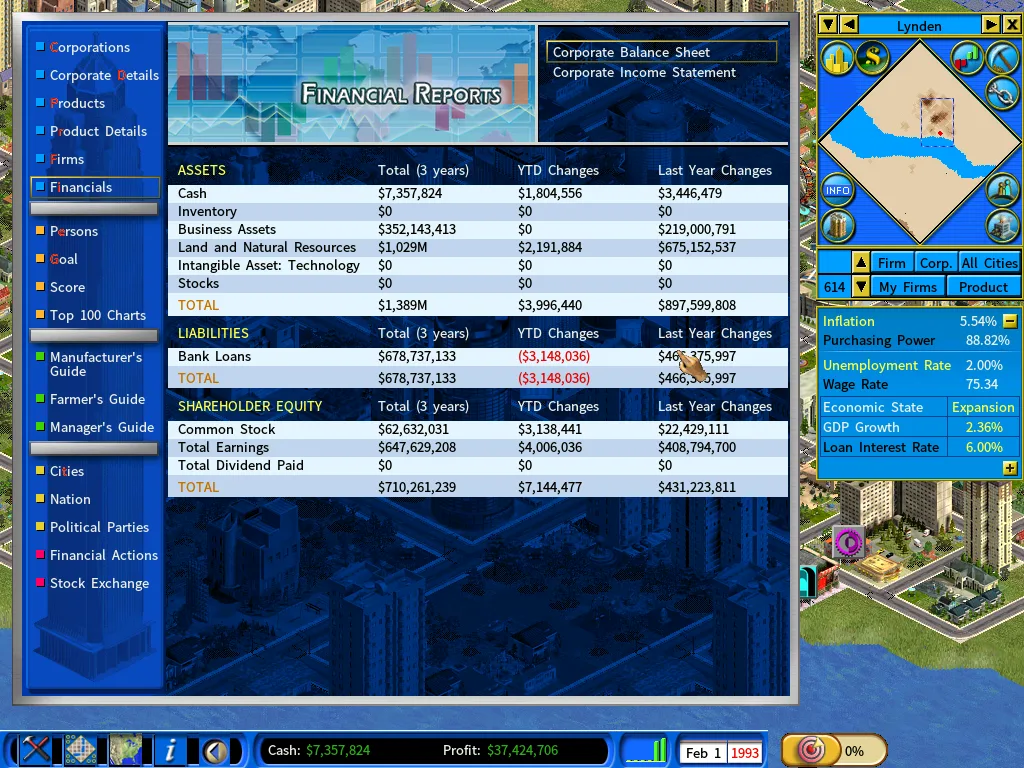
Our net assets now equal 710 million of which 680 have been added through our little project.
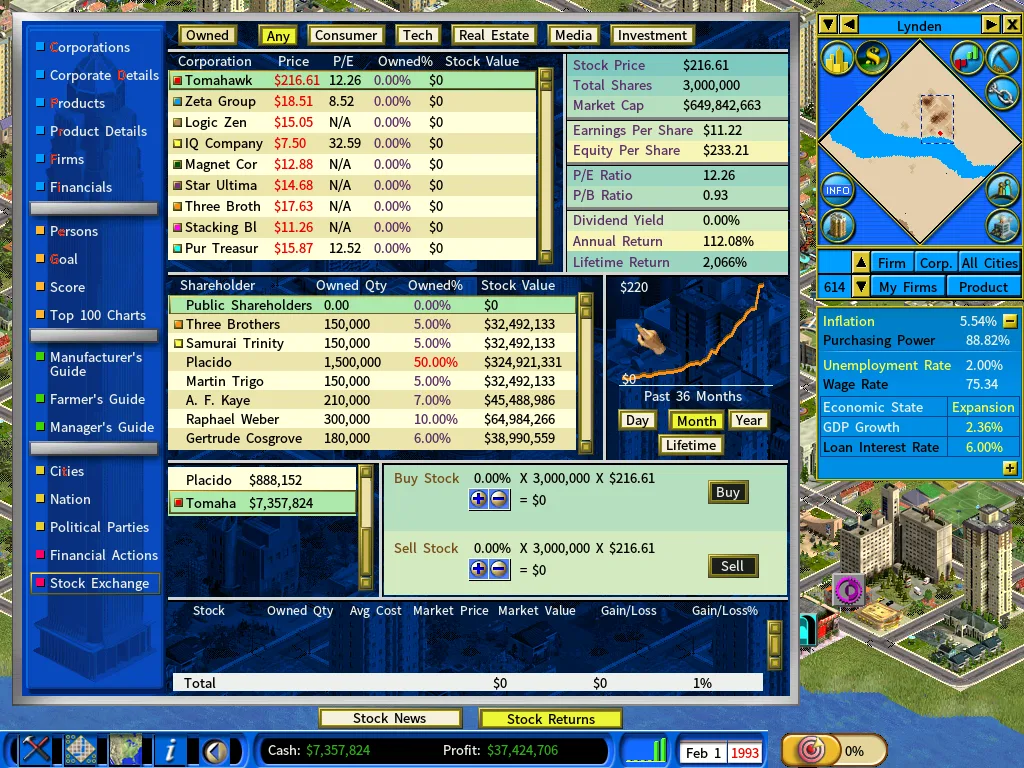
The price of the stock keeps skyrocketing, now at 216$ a share. We still have our friend the banker rolling out dollars so we won't issue new shares.
We believe the price of the land under our buildings will increase further, as well as our revenues from renting out the offices, this coming year. In this fashion the book value and the earnings are expected to improve which will lift the price of the stock even more.
Chapter 8 — 23 March 2018
OBSERVATIONS:
The debt problem: You could easily overcome it, at this time, by having started as a private firm and then undergo an IPO, issuing 3 million extra shares to investors when the price reaches about 226$. But we like it the hard way.
Current income after interest payments is about 1,175 million/month.
We expect it to steadily increase the coming year as more office space gets occupied, but we have no estimates.
Debt accrued gets vaporized at the current rate of inflation. At the moment 5.5%.
An adverse scenario would be inflation 0% and rates 10%, making us pay 68 million in interests per year to the bank, without reducing principal.
But that's a possibility a bit further away in time. As long as profits stay above 5,6 million per moth we won't go under water, accordingly. Currently below.
All of the above should be kept in mind if we are going to increase our debt, so we know our margins beforehand.
So, what now? as always with this game the possibilities are a bit dizzying.
As a Real Estate developer, we can try to increase the appeal of our "displaced" offices in Funk city by building some residentials close because their commuting ratings are quite low. In all cities the demand for residentials is about zero, so any expansion there is going to find some headwinds. We don't know if such an investment will pay nicely for the borrowed money. Although, as soon as immigrants find prospects of nice housing facilities, they move in, and so increase the demand for office space, which we dominate.
Another possibility is to go full tech. A bit of in-game research shows there isn't a single firm focusing on cosmetics, so that's encouraging.
Acquisitions: maybe a bit too early, but we could start buying some shares. Most public listed companies (all of them?) are overvalued in terms of price to equity, are seemingly having a tough time selling their stuff or the harbor's, are already foolishly into mining , and losing money, and so on. So they make bad purchases. There are two exceptions that have a good P/E ratio but these have apparently sold their technology and will be experiencing a temporary price rush at best.
And, of course, in case you didn't notice, we don't want to stain our manicured hands with menial activities. No retailing, nor manufacturing, nor farming/mining and so on.
We'll be delegating that to our subsidiaries and acquisitions in that case… we deal cash.
Stay tuned and thanks for reading.
Chapter 9 — 24 March 2018
The city competitiveness for cosmetics in Glen Fork is below that in Funk, but just a little and we have extra land already purchased, so we decide to build our tech complex there: 4 labs to research each of the cosmetic products and the HQ to hire a head of research and to keep an eye on the technology market.
Here's how it looks from above.
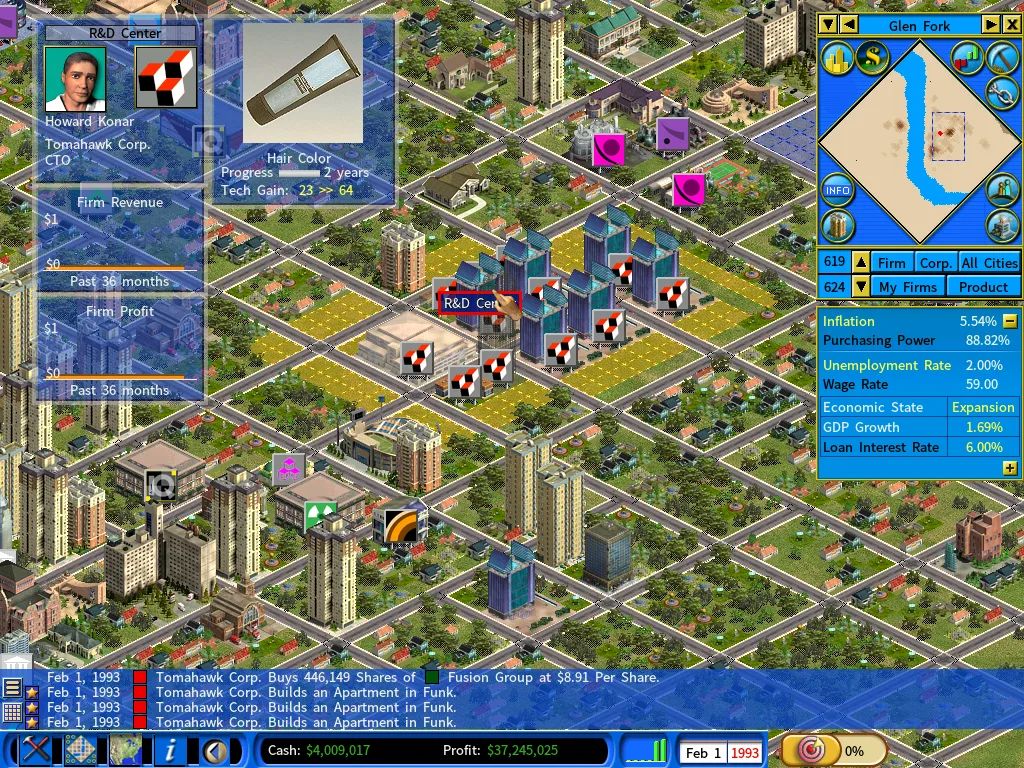
And here's the CEO, and the head of research.
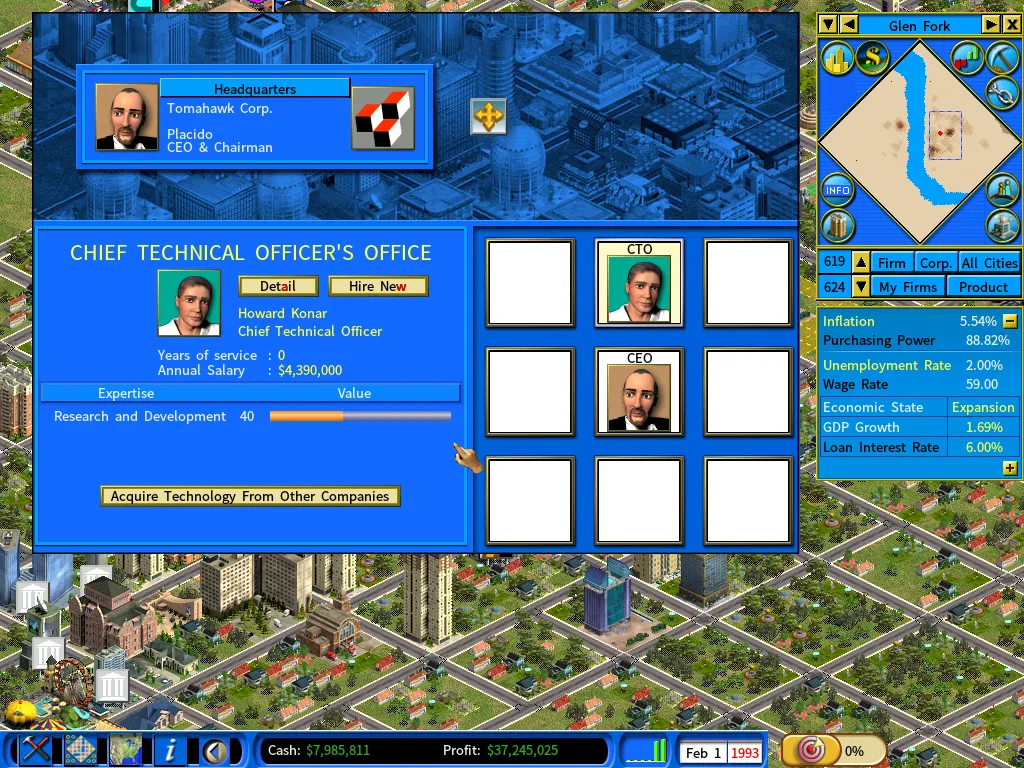
The tech complex will cost about 40 million in two years, so 10 million estimated cost per technology.
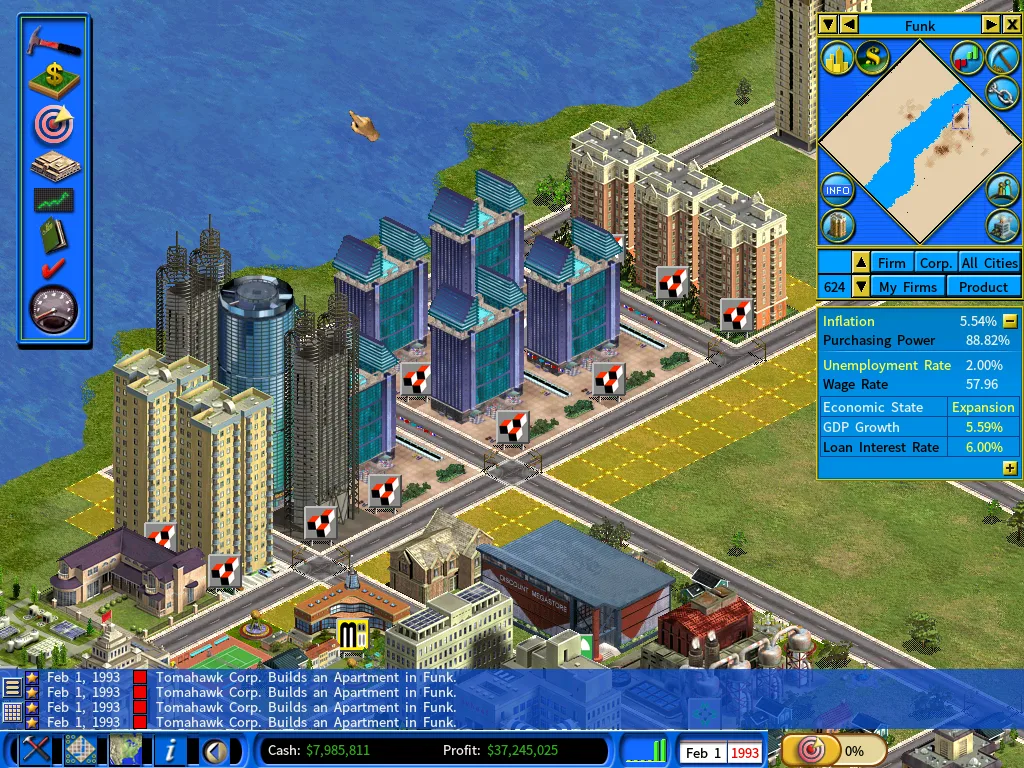
We place some residential buildings in Funk and we'll be watching how the ratings in the offices behave.
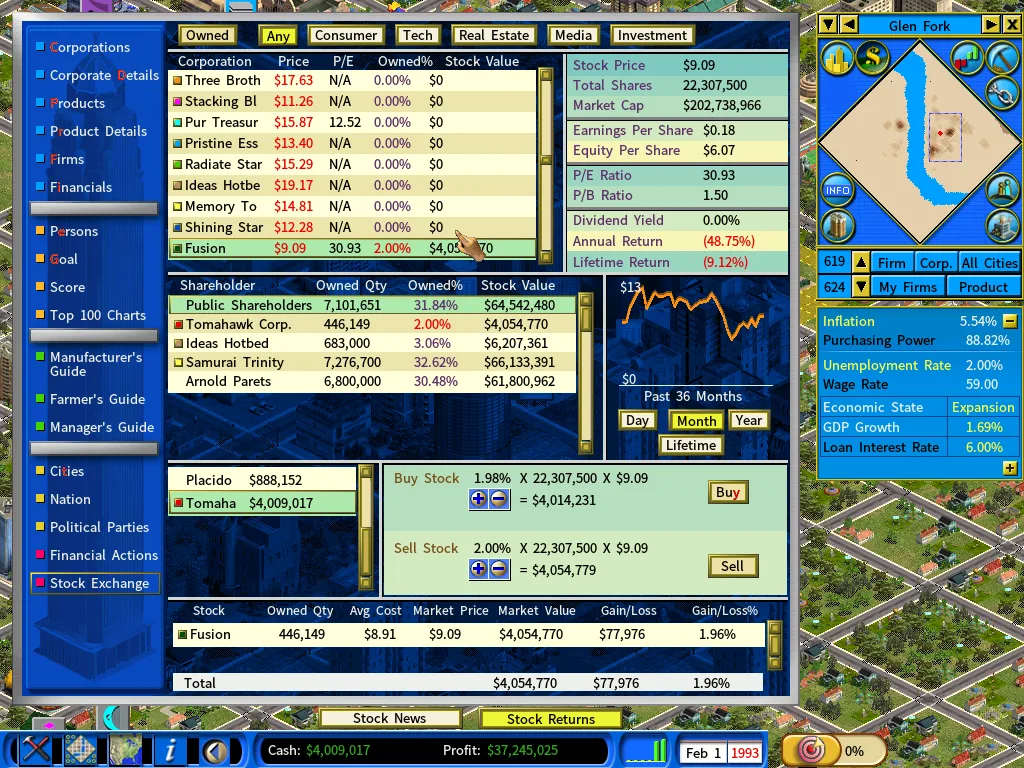
Finally we drop the remaining of the cash in a stock pick: Fusion corp. The manager has good research capabilities and his specialty is furniture. At the moment he's focused on retailing (exclusively). The company has a strong ownership but we think we could make the AI firms dump their shares if we bid high enough.
And no more cash available.
Let's wait one year until the office space consolidates and see what income we finally get. In the meantime we'll keep adding to our stock pick without borrowing.
Also, we'll let the value of our assets dictate the bank how much to lend us next, and do nothing more. Hopefully we'll have a ton of cash to borrow for our residential expansion in the coming 1994.
Chapter 10 — 26 March 2018
FEBRUARY 1993 – FEBRUARY 1994
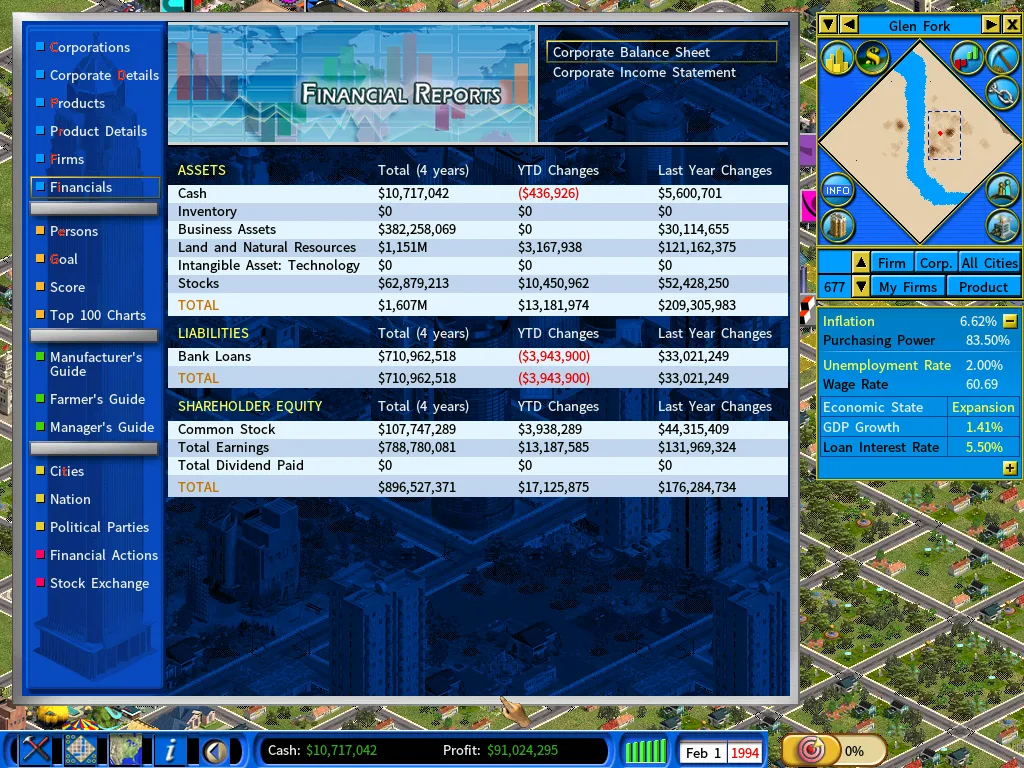
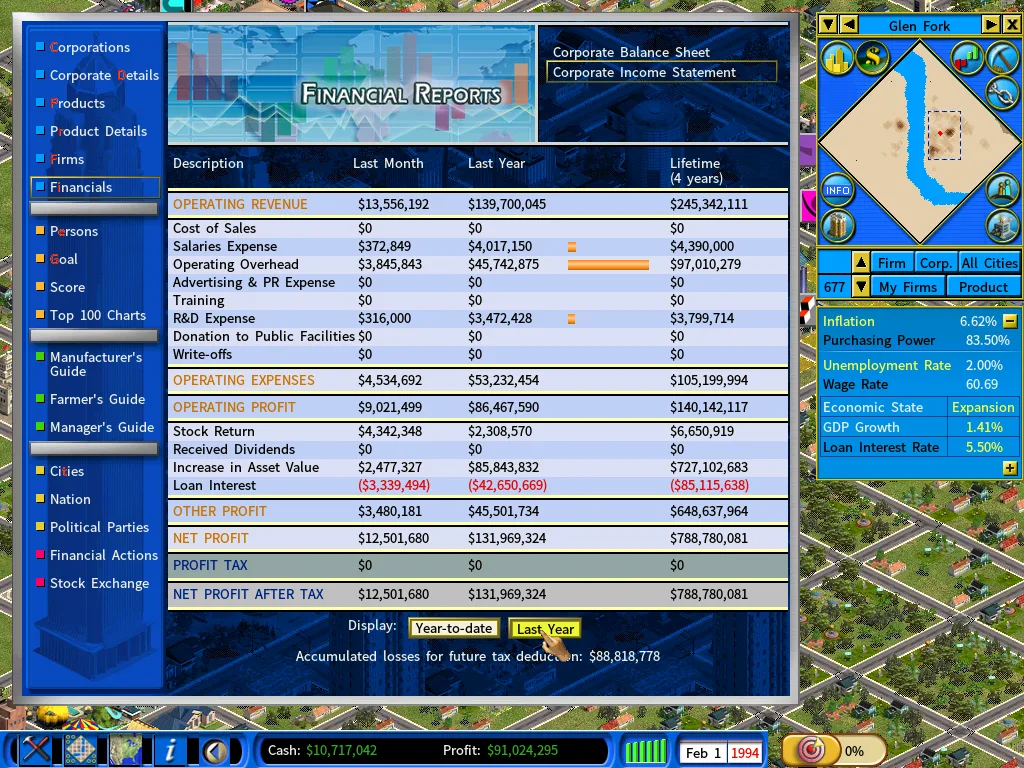
So, it's now February 1994, 4 years after our start, and the company has a stable net income of 5,6 million/month.
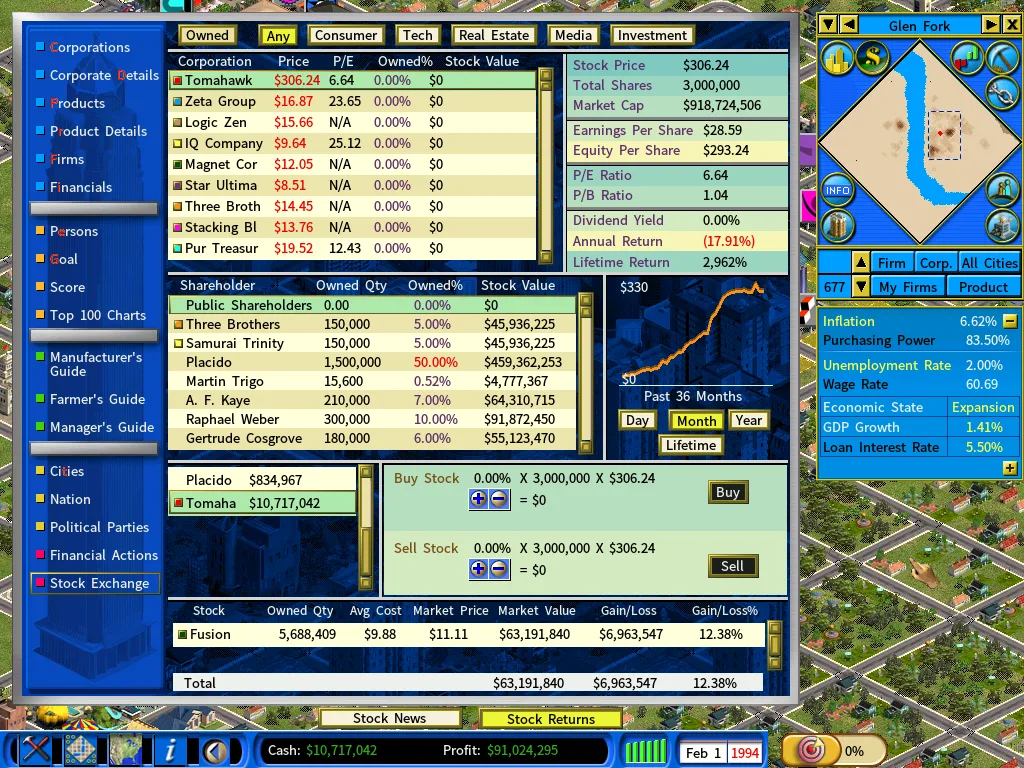
We've been purchasing Fusion's stock and our ownership stands at 25%. Tomahawk Corp. shares have reached a plateau at 300$/share.
The bank has more than 250 million available to lend, so we'll be in the lookout for land development oportunities in the residential sector this same month.
The real interest rate has become negative, at -1.12%. Great time to be indebted.
The overall cost of our lab complex is about 16 million/year (less than previously projected).
I have noticed income from residential buildings owned by the city that pay their setup costs in 5 years. That will be our anchor….
Chapter 11 — 31 March 2018
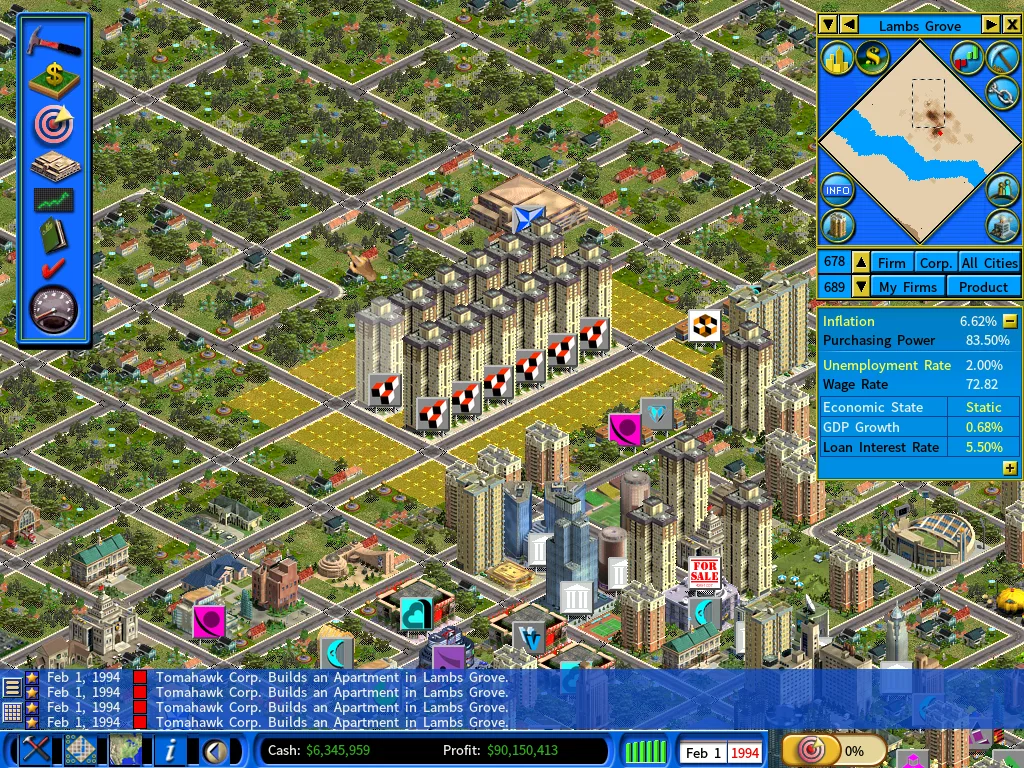
Here's our chosen spot in Lambs Grove with 12 buildings. We took all the money offered and used it fully to buy the max land available around, at once, before placing the buildings. The city conveniences show just a lack of high school services, so the ratings will be fair.
The first building shows a total cost of 10.4 m (land + building) for it and the others show a bigger total cost as the land has increased in value just after we placed the first, then the second and so on. So we'll use that first data as the real cost for each to estimate the profitability.
Estimates here cannot be as straightforward as we'd like because we have to take into consideration the inflation and the interest rates, which we cannot control or know, so we'll use the current conditions, and establish our margins of safety so we don't go under water in the future.
CITY SURVEY:
Cheapest land price: 578k x square
City housing points (total): 62.5(city) + 24(own) = 86.5
Estimated increase in supply%: 24*100/62.5 = 138.4%
Market rent x sqfoot is 23.08 = 180k/month profit (city average, or so)
EXPENSES & ASSETS
Land cost (total): 175 m (extra land bought)
Building cost: 87.4 m (12 buildings)
Total expenditure: 262.5 m
Increase in net assets (after debt): 31.36 m
Increase in book assets (land+buildings): 293.86 m
Increase in book assets (land): 293.86 – 87.4 = 206.46 m
RAW ESTIMATES
Cost per building (inc. land) = 10.5 m average
Rent due in 5 years to cover costs: 10.5/60 = 175k/month
Market rent x sqfoot (own, average) = 21.18$
Market rent x sqfoot is 23.08 = 180k/month profit
Projected income (x own building) = 165k/month x 12 = 1.98 m/year (at 100% occupancy)
Projected total income (yearly) = 165k x 12 x 12 = 23.76 m/year (at 100% occupancy)
FINANCIAL CONDITIONS
Yearly debt payments x building: 577k at 5.5% rate
Means 1.4 m/year net profit (after debt payments)
Means 7.5 years to cover costs (at 100% occupancy)
Yearly debt "repayment" as inflation: 651k at 6.62% = 16.13 years (no principal paid)
Estimated net profit after 16.13 years = 12 m x 12 buildings = 124 m
Estimated net profit after 32.26 years = 124 + 16.13 x 23.76 = 507.25 m
Profitability of investment: in first 16.13 years = 98%
Profitability of investment: in second 16.13 years = 305%
Profitability of investment: in 32.26 years = 403%
Chapter 12 — 6 April 2018
Hey, thanks for reading. I'll try to write a new post tomorrow. I have played one full year ahead… and already scuttled the residential district
I was already wondering if I could give away genuine tips, so feeling more at ease after reading about your experience.
You are welcome to play a part and comment. The saves are posted regularly.
Chapter 13 — 7 April 2018
FEBRUARY 1994 – FEBRUARY 1995
Ok, fast forward 1 year, to february 1995.
The building of the residential district in Lambs Grove boosted the asset valuation of our company, so the bank has been happy enough from that moment to keep buying our project.
We decided this time to decrease the scale of the construction in each of the cities, and instead adding up as soon as we had the cash. So we have been buying small lots of land in each city, then a couple of buildings, and so on, until we run out of cash.
We did notice good opportunities close to our commercial districts so we did buy the land and built on it accordingly.
To do so has two benefits: One, we increase the appeal of the offices, so they fatten our revenues; two, we increase the value of the land overall more efficiently, by building point blank, and so our assets inflate and both bank and investors, our financing actors current and future, feel happier and safer to own us.
Here are the city views:
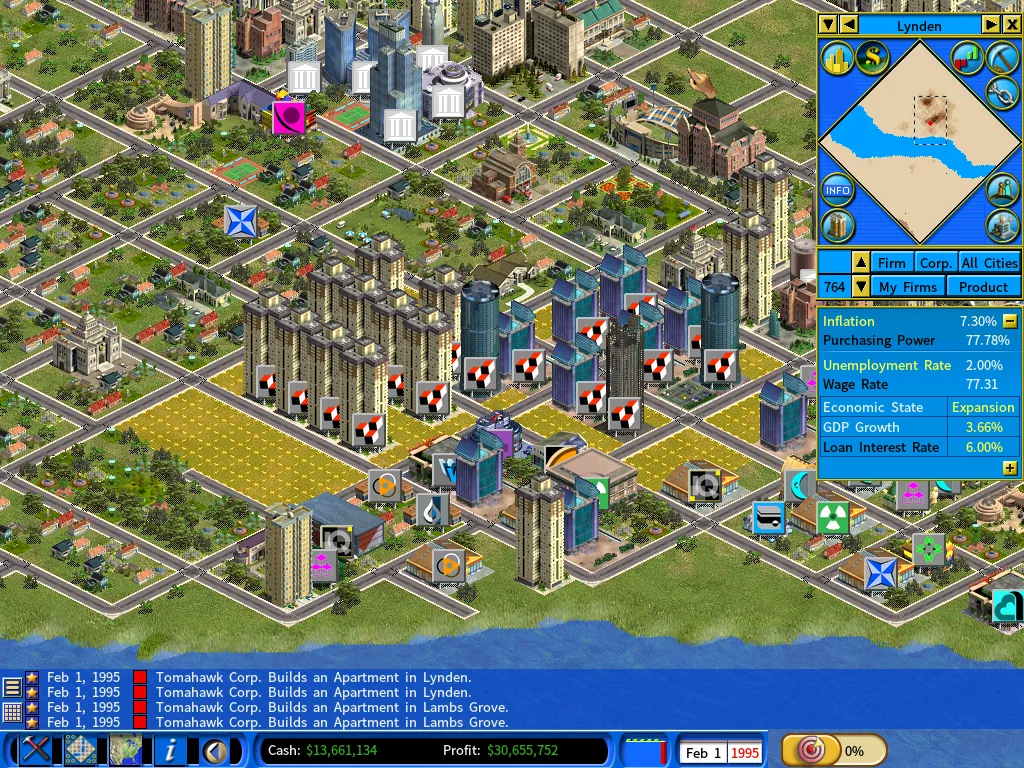
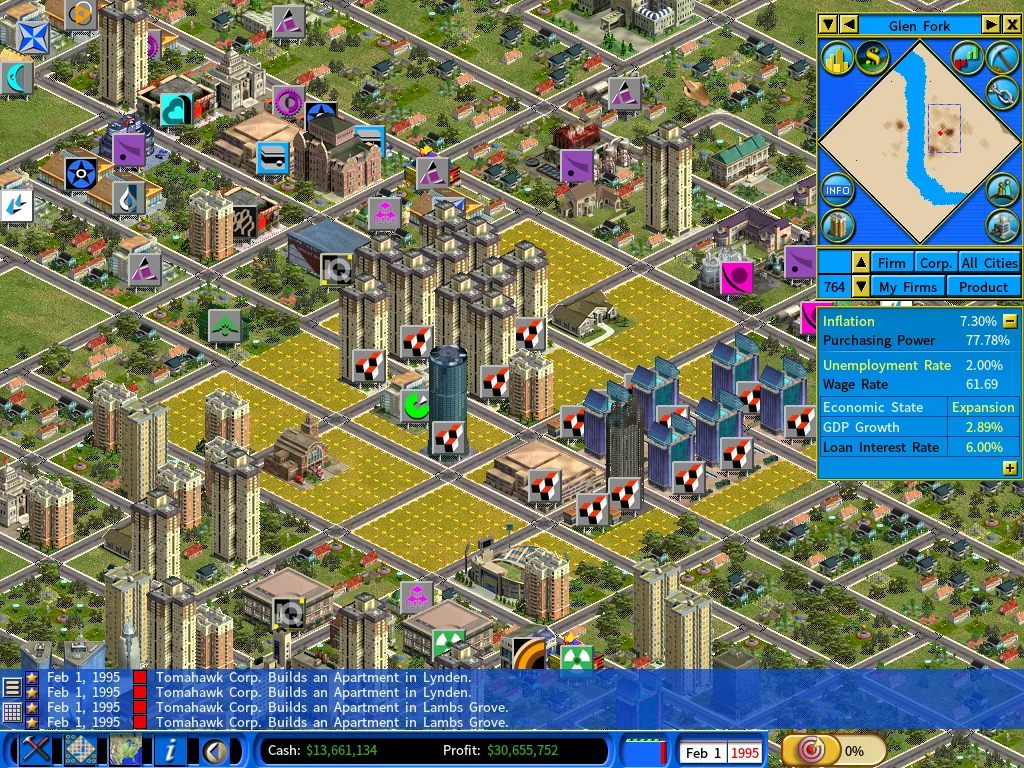
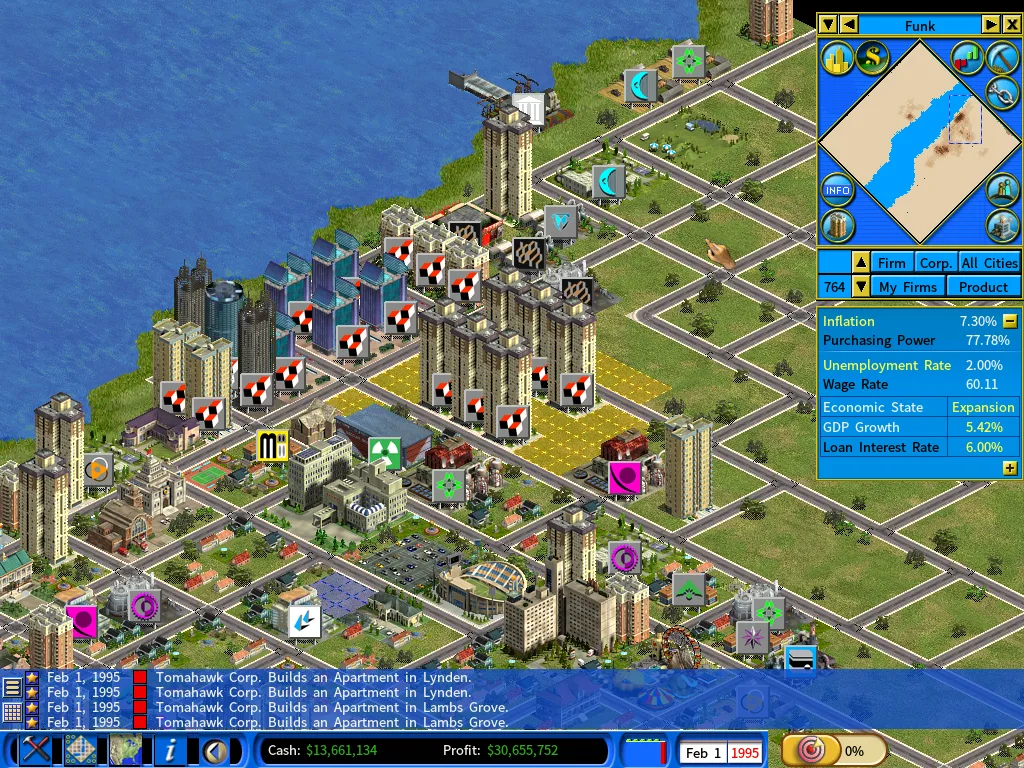
To mention:
As soon as our residential district in Lynden was built the CDB flipped towards it.
There has been an increase both in inflation and interest rates, but the real rate is still negative.
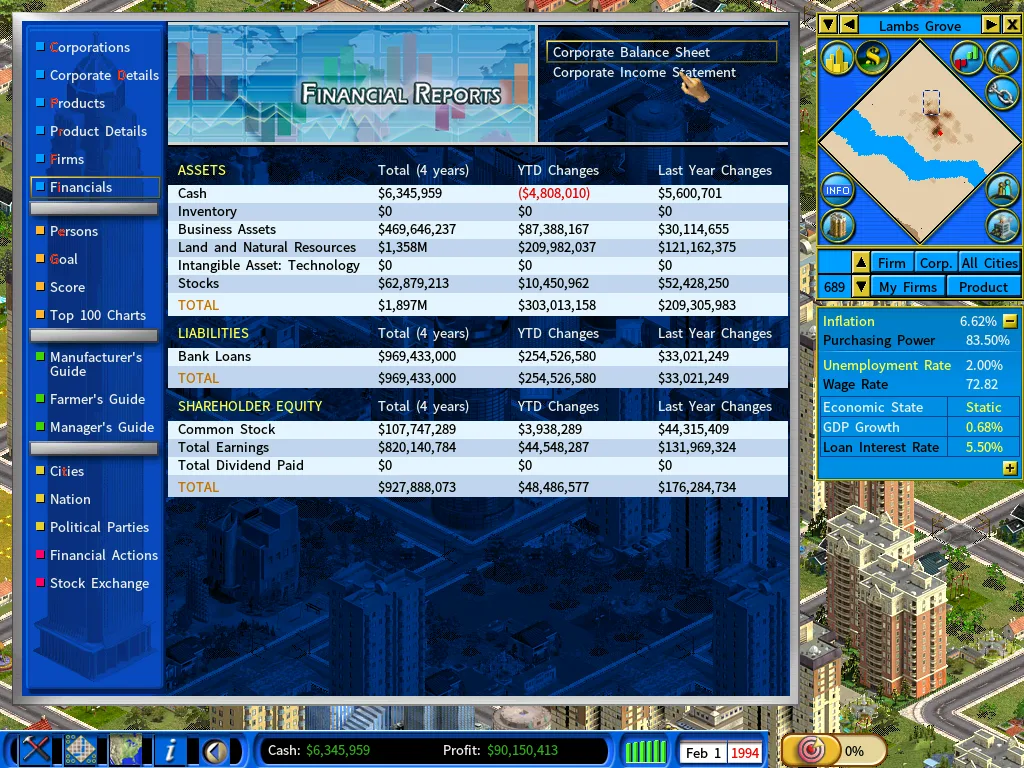
The net income from our residential districts is negligible, as seen in the Income statement report. In february 1995 it stands at 1.625m/month, net q just above 0/month after loan interests.
All available shares of Fusion corp have been bought by us. Next we'll wait to see if current shareholders shed their take and we can increase ours.
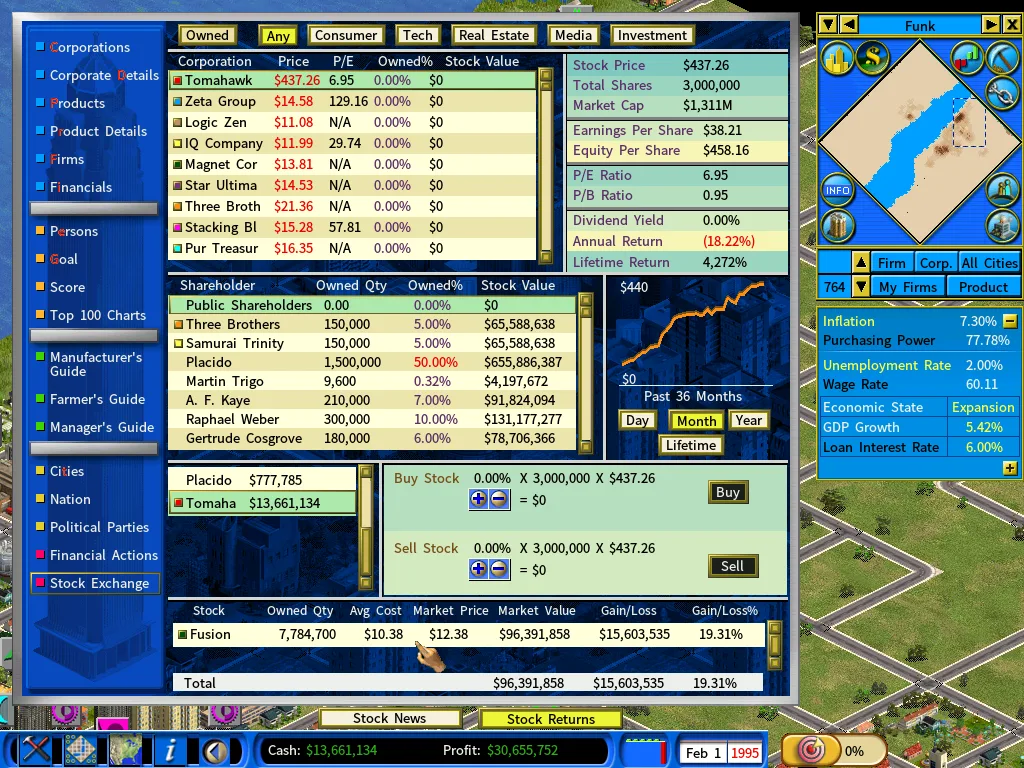
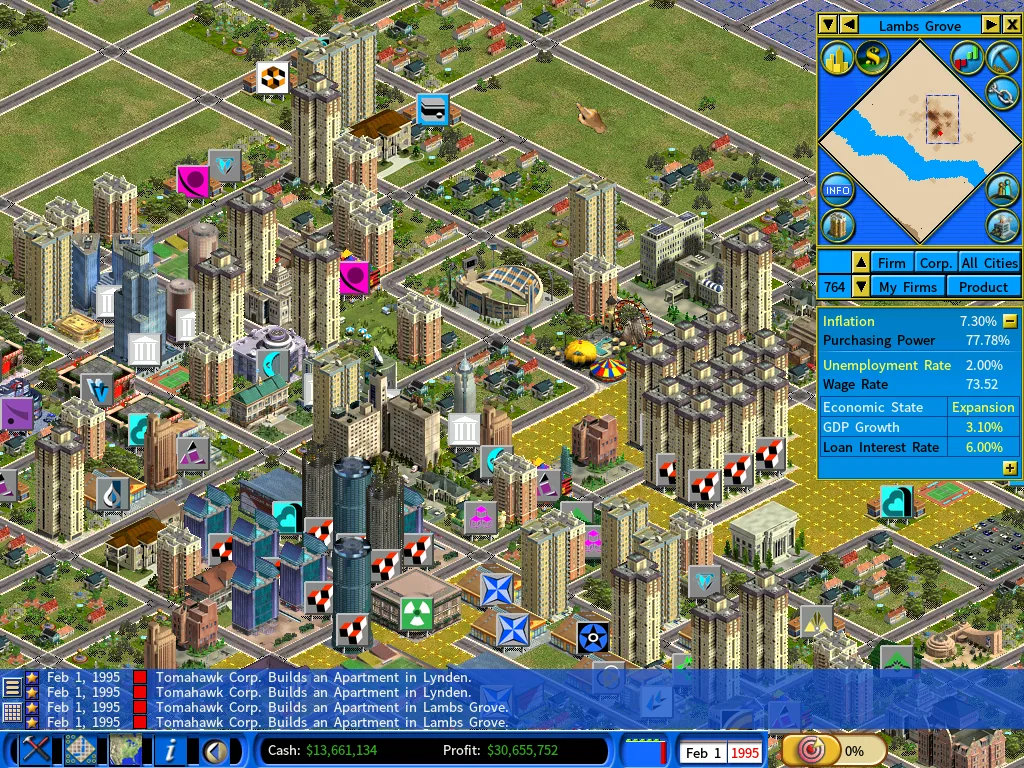
This same february 1995 we decided to scuttle our residential district in Lambs Grove (the first we built). The reason is that almost 100% of the residential buildings in the city have better ratings than ours and we cannot compete with them at this moment. So, having served its asset inflating purpose we move on to greener pastures. In the city view you can see a part of the bare plot in the north where it stood, and its new abode. Incurring:
Net profit of 29m (included 1yr loan cost)
New district cost of 306m (invested the whole sale to buy extra land)
AIMS FOR NEXT YEAR:
Increase the demand for office space, encouraging city growth by building residentials. Keep building offices.
Increasing the value of the district increases the income from rents. Build concentrated.
In Funk: the residential district purpose is to increase the appeal of our commercial district. The income from rents barely pays. Spots for possible residential downtown have costs of 12m x building and low relative rents so they remain a second tier opportunity.
To have small amounts of cash because of the 7% inflation, and to keep away from repaying loans until financial conditions start to change.
TO WATCH:
The increase in land price: Know how much we can sell to pay the loans in the future.
The increase in population, to drive the demand for new buildings.
The livelyhood ratings in the cities. We expect not to decrease them too much.
Ratio income/expenses: Evolution of real rates and their possible impact on our budget. Currently we can withstand a 9% real rate with just income from offices.
Stock Market: Possible acquisitions will be valuable companies: Good retail sellers with little competition or undervalued asset companies.
AI real state competition. No move so far.
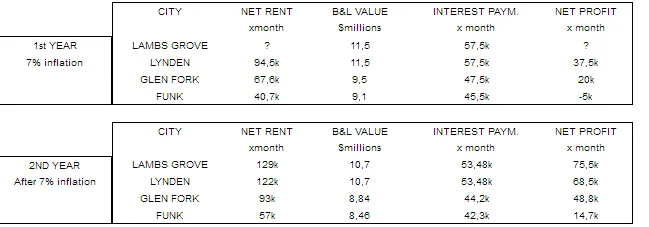
NUMBERS for residential districts: (to take with a pinch of salt)
The two rich cities of Lambs Grove and Lynden have potential for good apartment districts in rent terms.
Glen Fork has a moderate appeal.
Funk the worst.
Lambs Grove:
Land and building cost (current average x building): 11.5m
Current income from buildings: 0/month (new neighborhood)
Interest payments x building at 6% (covering land and building costs): 57.5k/month
Income due to cover costs in 6 years (inflation 0%): 160k + 57.5k = 220k
Income due to cover costs in 8 years (inflation 0%): 120k + 57.5k = 177k
(inflation 0% means no change in loan interests, as inflation won't eat up principal, lowering costs, and we don't pay down principal either. So worst case at 6%.)
Lynden:
Land and building cost (current average x building) 11.5m
Current income from buildings: 950k/month
Interest payments x building at 6% (covering land and building costs): 57.5k/month
Income due to cover costs in 6 years (inflation 0%): 160k + 57.5k = 220k
Income due to cover costs in 8 years (inflation 0%): 120k + 57.5k = 177k
Glen Fork:
Land and building cost (current average x building) 9.5m
Current income from buildings: 675k/month
Interest payments x building at 6% (covering land and building costs): 47.5k/month
Income due to cover costs in 6 years (inflation 0%): 131k + 47.5k = 180k
Income due to cover costs in 8 years (inflation 0%): 99k + 47.5k = 146k
Funk:
Land and building cost (current average x building) 9.1m
Current income from buildings: breaking even
Interest payments x building at 6% (covering land and building costs): 45.5k/month
Income due to cover costs in 6 years (inflation 0%): 126k + 45.5k = 172k
Income due to cover costs in 8 years (inflation 0%): 95k + 45.5k = 140k
The balance sheet and Income statement.
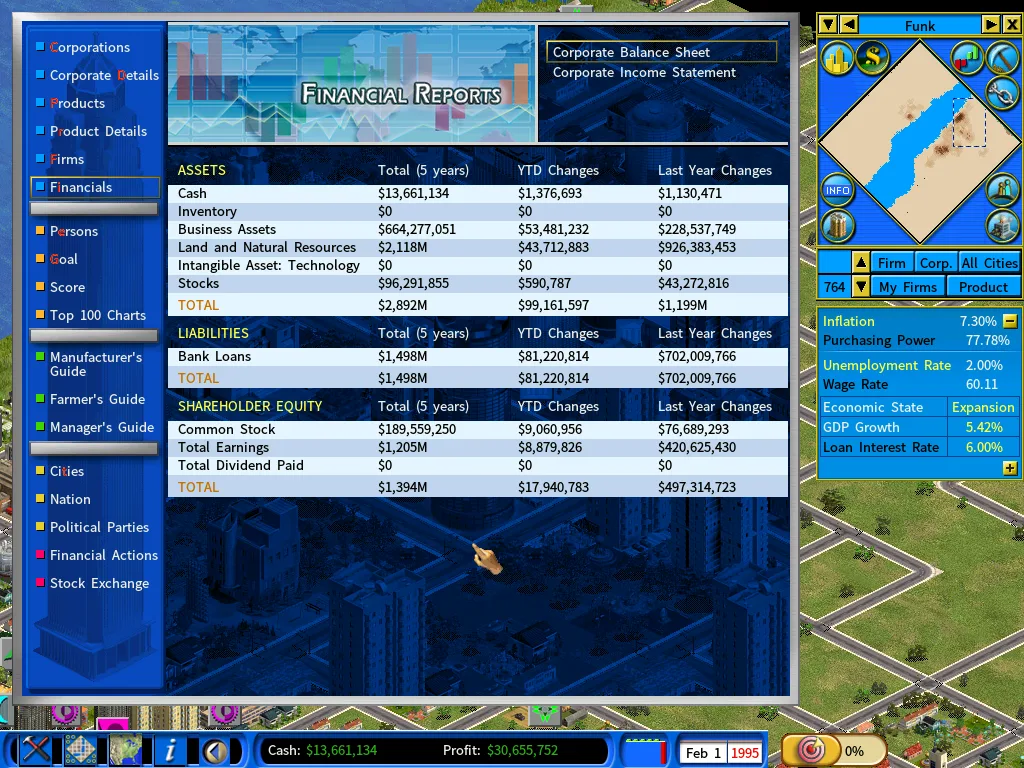
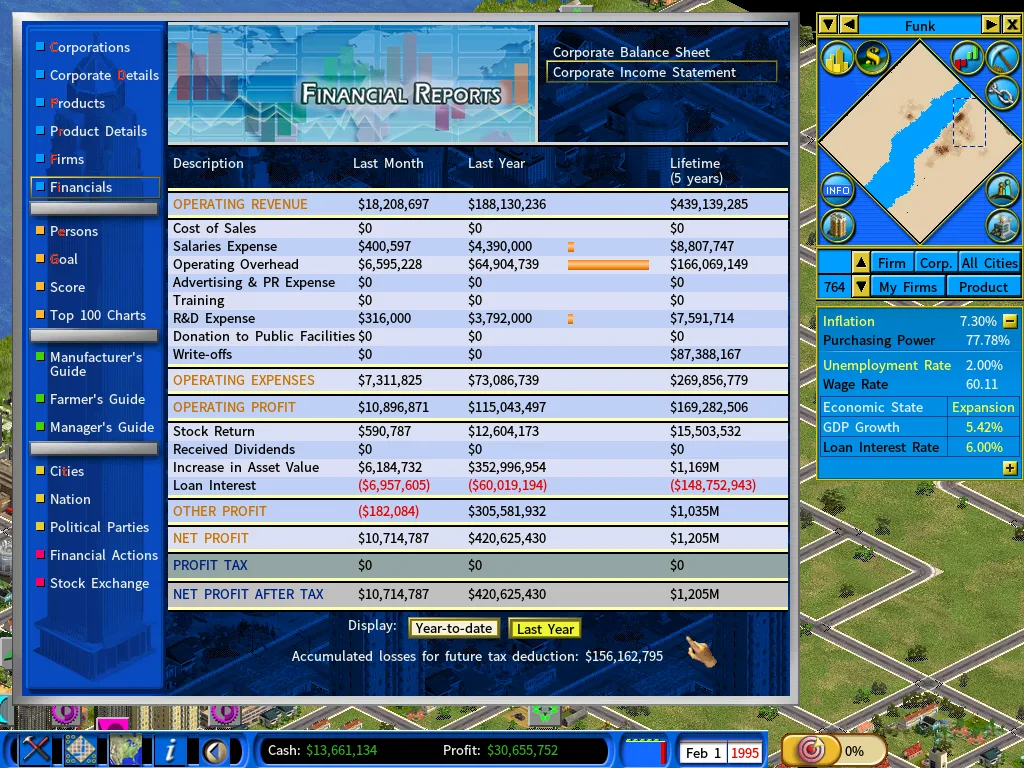
Chapter 14 — 9 April 2018
Here's something resembling what could be implemented as a detailed Income Statement and/or Balance Sheet for our real estate expansion.
We can easily spot where's the money coming from (or isn't coming from) taking a look at it, so we can expand & manage our districts accordingly.
I've ommited occupation and won't be able to post percentage changes YoY as it would be too much for my layman's abilities.
Any suggestions to improve it and/or lower the labor costs to create it will be very welcome.
Chapter 15 — 11 April 2018
FEBRUARY 1995 – FEBRUARY 1996
Following our aims from february last year we've built offices in all cities, and a few apartments in Lambs Grove, Lynden and Glen Fork. Not in Funk.
We've made good use of our already purchased land to build there, sold some squares where expansion wasn't deemed feasible and bought some in the opposite case.
We've kept the supply of residential buildings 30% above demand, and offices 10% above demand.
The Housing and Community Facilities Ratings have increased in the cities where we've built new apartments, meaning we've built in good areas where sevices are available, and other city buildings have had tenants moving out to us.
As more apartments of quality have been made available, the cities have been receiving people from the outside. We cannot set the limit for new migrants as we cannot influence town politics yet, but it seems that all possible migrants are arriving so far.
Funk is the exception, as we have set supply lower and the city hasn't grown as much. We might have plans for that city further down the road.
We've increased our debt 16,5% by 250 million.
Our land&building assets have increased 27% by 569 million.
Our profits have increased 76% by 99,1 million.
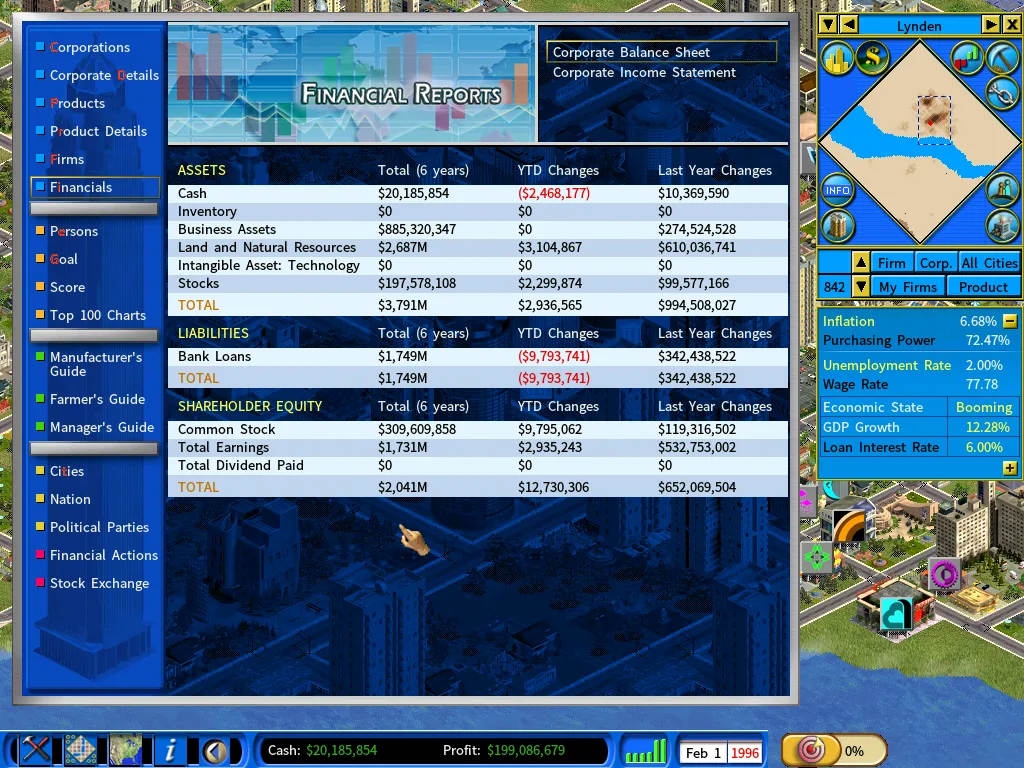
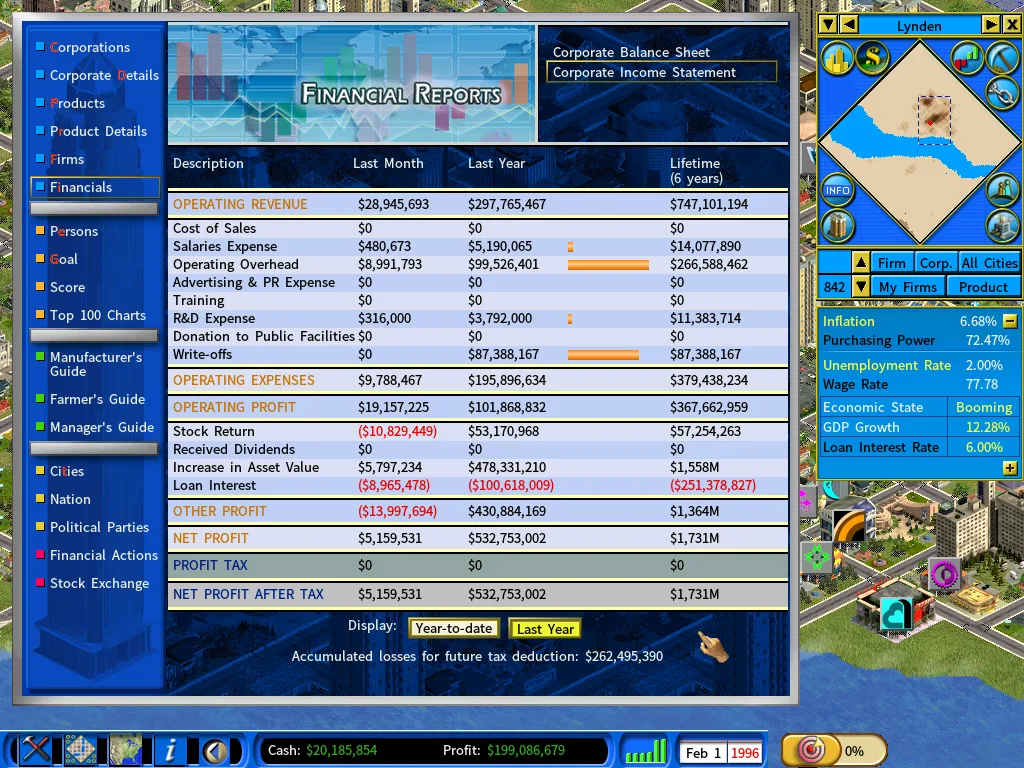
Here's the city views.
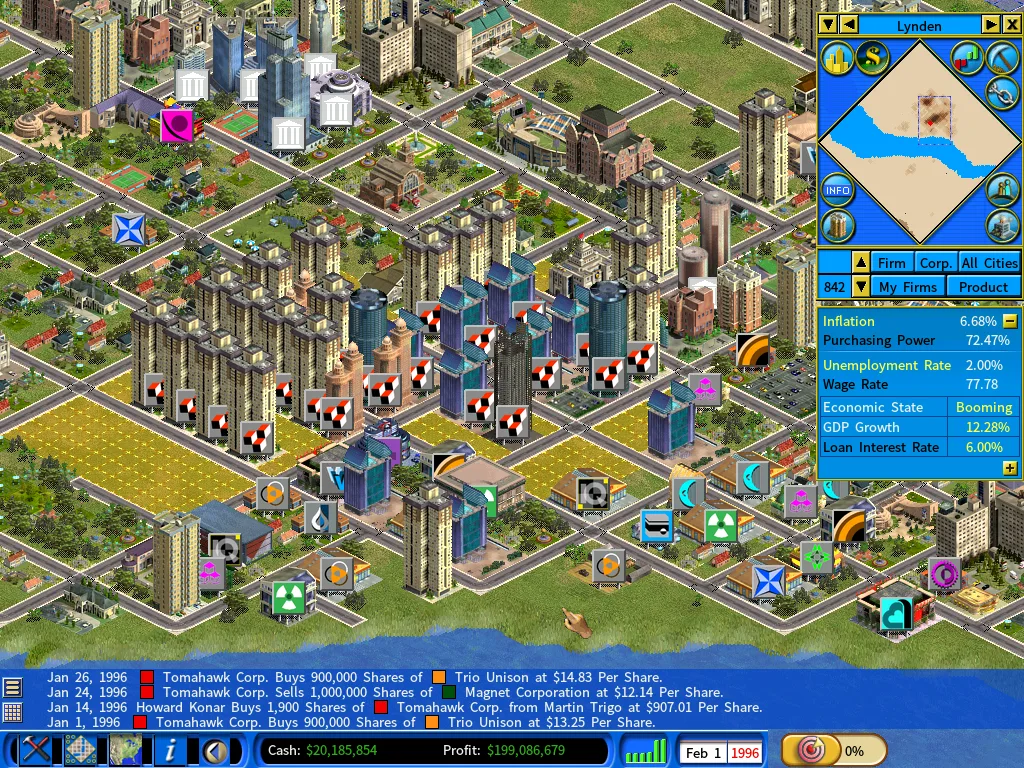
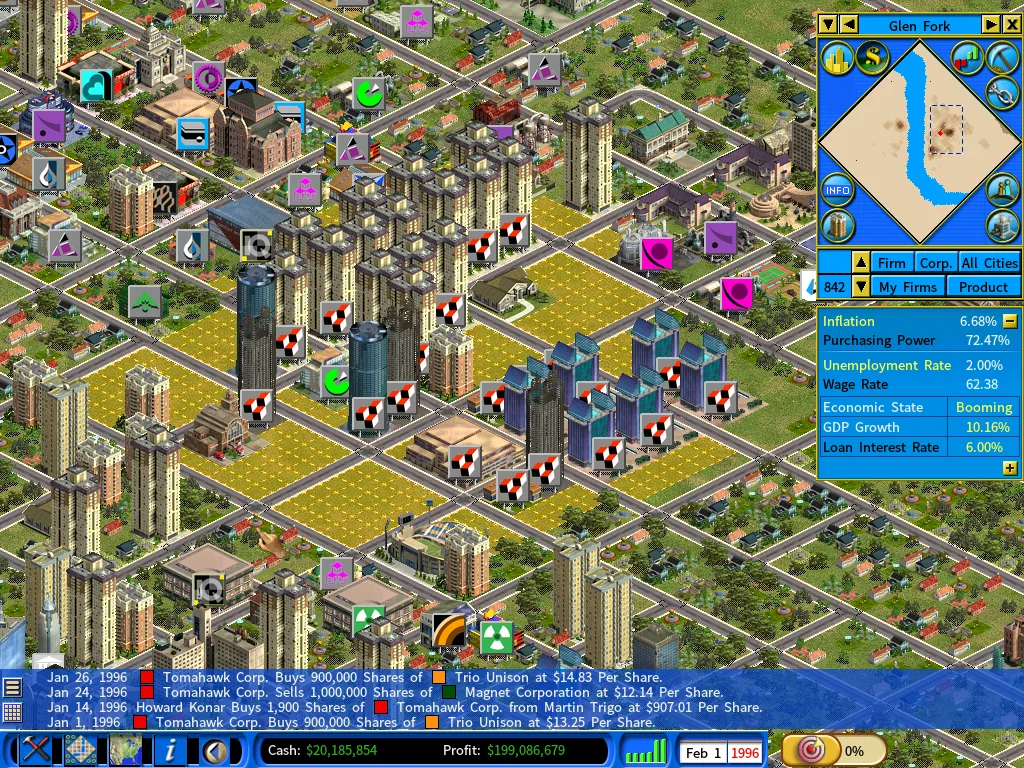
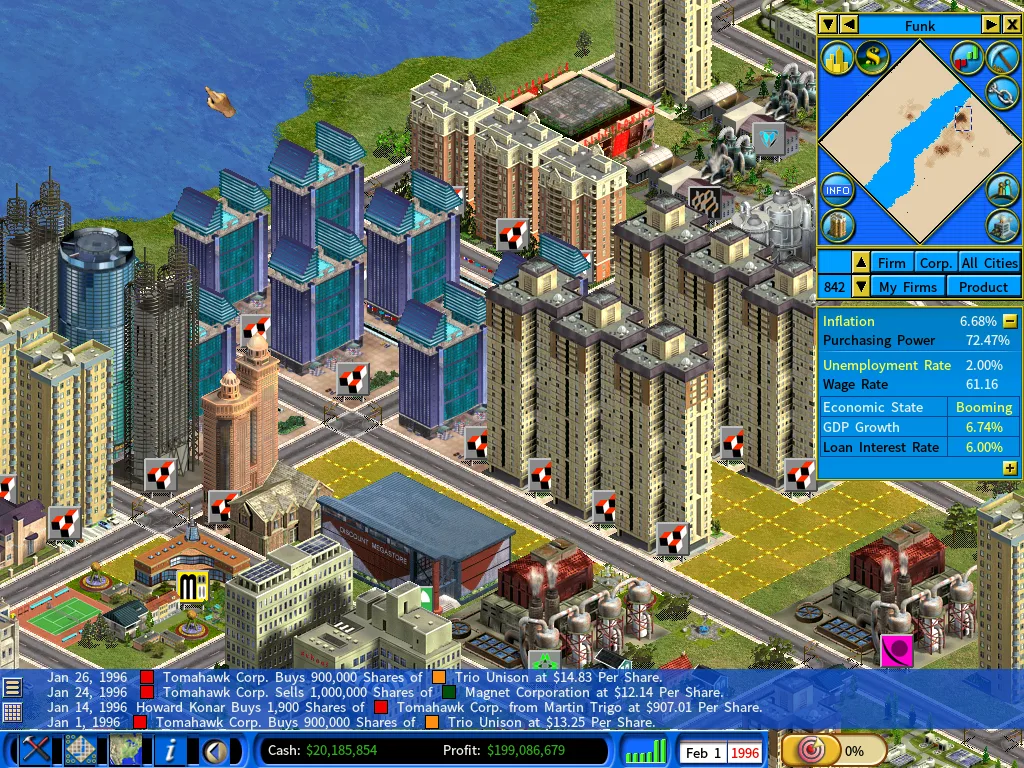
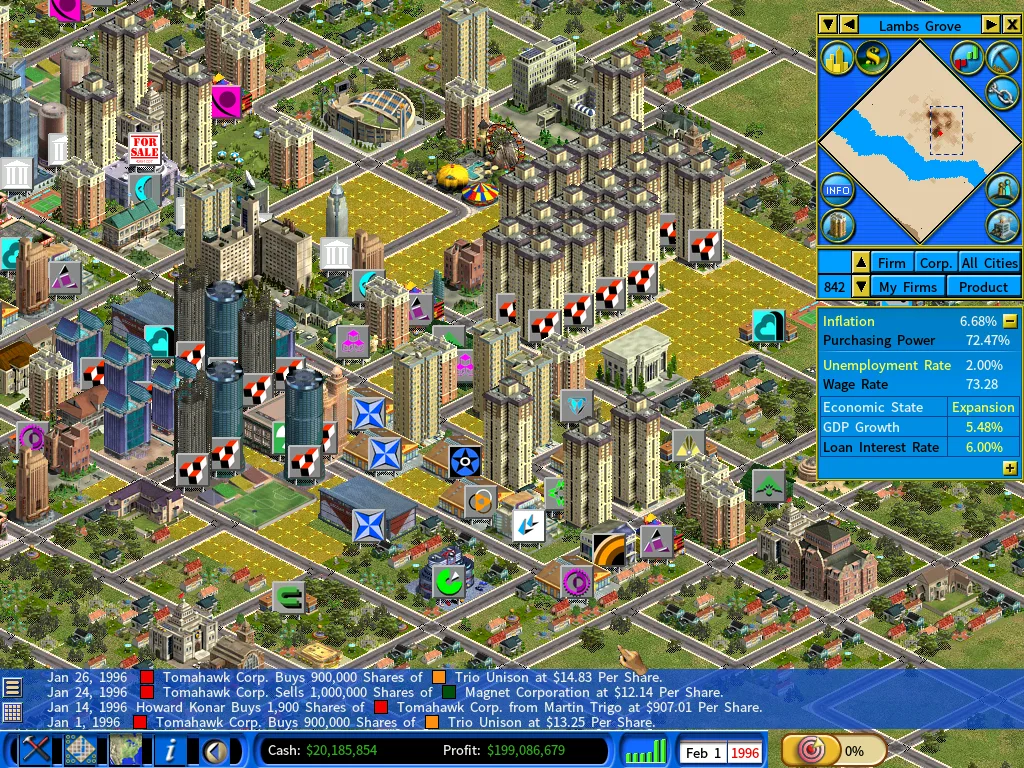
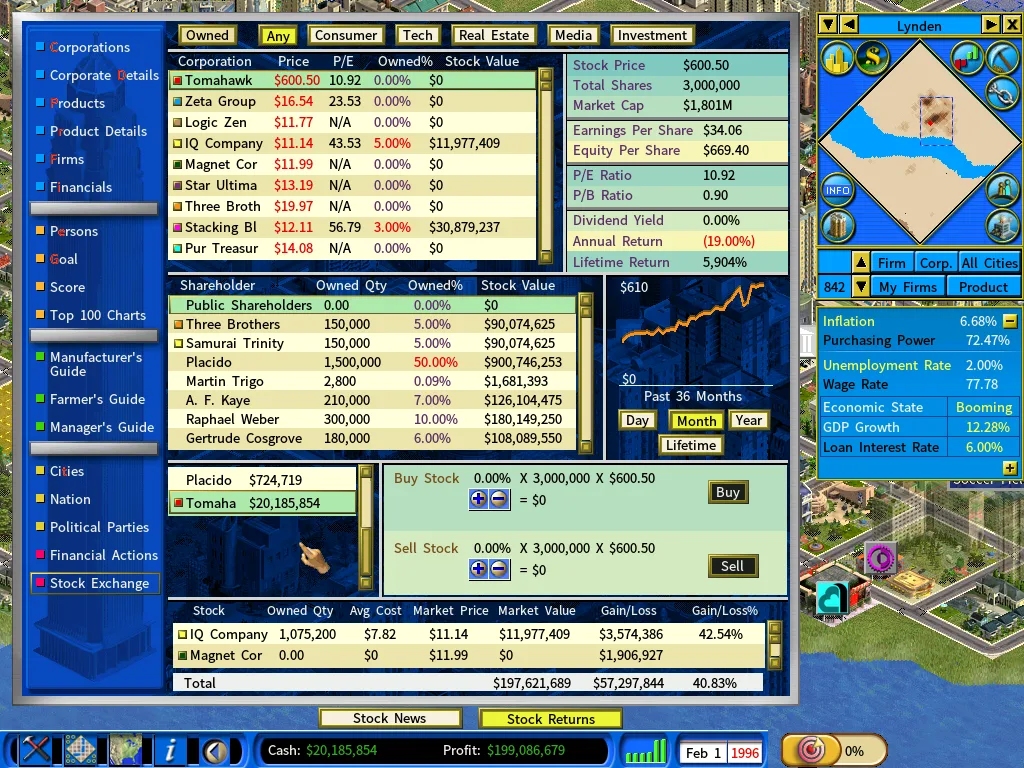
Also, we've been playing a bit the stock market as we had to put our available cash somewhere (we said we'd keep small amounts of cash), so we've built small stakes in a few companies for the short run.
I'll hire a real estate manager to create a new detailed Income Statement & Balance Sheet. We need to know our margins and where's the money coming from in more detail.
I'll also discuss possible aims for next year in the next post.
Thanks for reading.
Chapter 16 — 12 April 2018
I didn't know that one could have it harder at lower difficulties with this strategy. I'll try some time and see what happens.
Anyway, when you have a friendlier retail strategy I don't compete with the AI, but buy their shares and strike it rich…
When I said I was going to play with the hard level I meant what you said, yes, a "generic" level.
I believe what the developers had in mind with the CES was city building mainly, so one must go arm deep into real state if one plays that DLC.
When you say you can build an unlimited amount of apartments in CES, I'm not that sure. Cities don't grow past some point just by building apartments.
My intention in writing this was, apart from letting people know that real estate can be fun, and enjoy writing it myself, to point to some possible "exploits" and their possible tweaking IMHO, like "liquid" land, RS-AI passiveness, lack of taxing, etc. But I was leaving that for the end. In the meantime…
My apologies if I'm not genuine enough. Hope you enjoy my article anyway.
Chapter 17 — 12 April 2018
Here's the Improved IS&BS for february 1996 with a small change: the data for the old buildings (>1year) is considered apart, also.
I don't remember if the rent per square foot in the old sheet was taken correctly, so probably I messed it up and we cannot make a reliable comparison at this time.
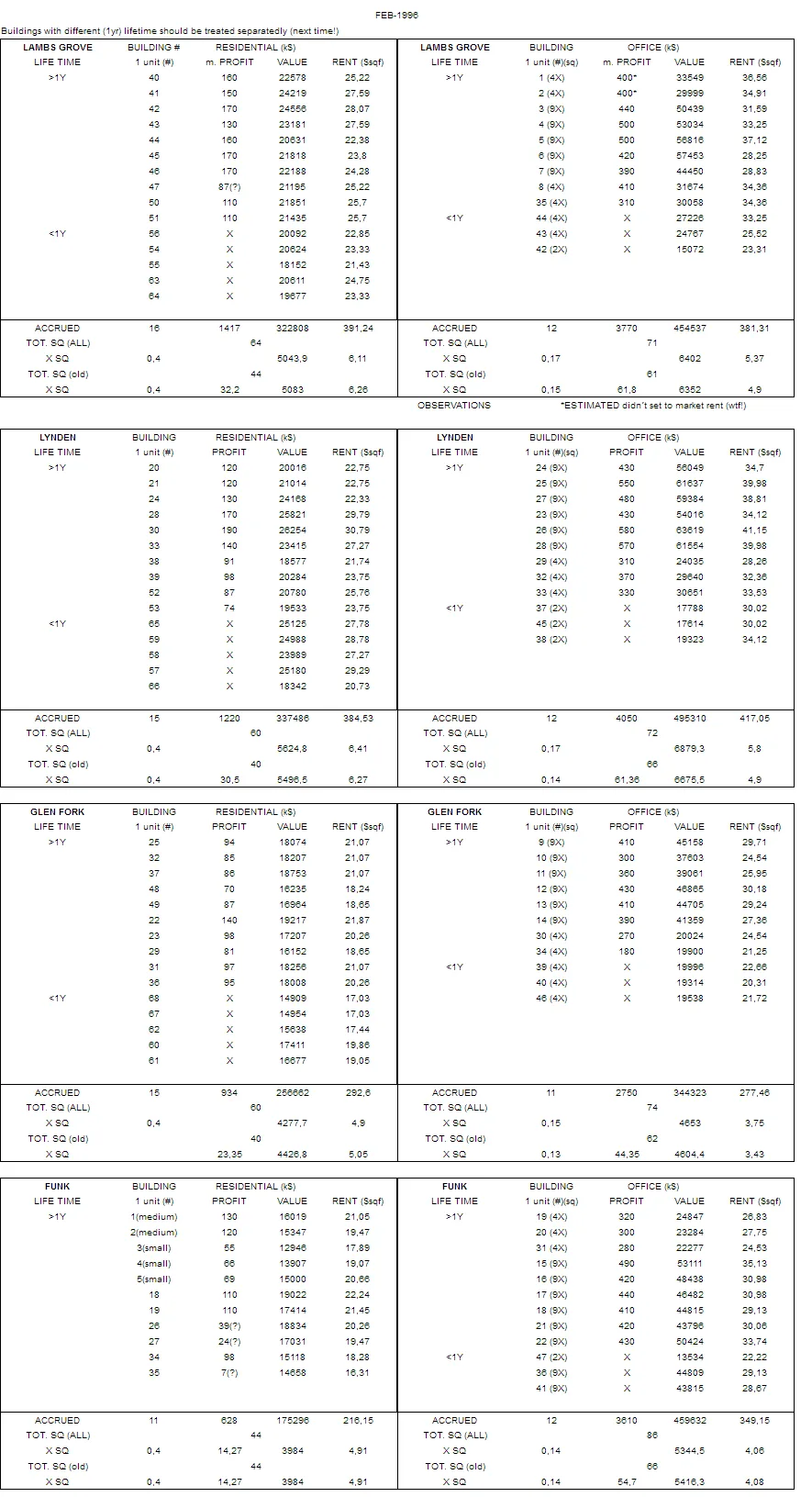
Here's our humble follow up for measuring the profitability of our apartments.
The total value of the buildings and their land is 2.846.054.000
The value of our "liquid" land is thus:
+ (total assets) 3.791.000.000$
– (buildings&land) 2.846.054.000$
– (cash) 20.185.854$
– (stocks) 197.578.108$
– (land in HQ + labs)(est.) 60.000.000$
Liquid land +667.182.000$
We add the price of the stocks :
+ (stocks) 197.578.108
+ (liquid land) 667.182.000$
Saleable assets +864.760.108$
We substract our total debt:
– (total debt) 1.749.000.000$
Debt to worry about -884.240.000$
The provisions necessary for this year:
– (Interests 6%) 108.000.000$
+ (Friendly inflation 6.5%) 57.700.000$
Real interests -50.300.000$
We calculate the cash available for this year:
+ (Projected income) 240.000.000$
– (Real interests) 50.300.000$
– (Labs) 9.000.000$
Cash estimate +181.000.000$
We have also 370 million available to borrow from the bank, so in total we'll have about 530 million to finance our next project this coming 1996.
And now knowing our hand, let's view our possible plays:
The overall aim will be to make the cities grow, so we can keep expanding our office & apartment districts.
Beyond keeping supply high and improving the life ratings, we'll have to focus on job creation, sooner or later, and for that we'll have to make the cities competitive in order to export merchandise abroad.
Maybe too soon at this juncture, but we have been researching the cosmetic products (no one else has, seemingly) so we could "spin off" a subsidiary to start selling them, and see how well it does.
Also, Fusion corp. has a CEO with good research capabilities within the furniture products, and there's no other firm involved in that category. We could double our "spin off", but at what cost? We could start positioning for that.
We could also begin planning the construction of a new city, as the conditions to stay indebted remain.
One thing's sure, and that is, that we'll keep the supply of buildings high in all cities, until something breaks.
Any ideas?
Thanks for reading.
Chapter 18 — 13 May 2018
FEBRUARY 1996 – FEBRUARY 1997
Fast forward to February 1997:
Overall we have restrained our impulse to draw on more debt this past year, so we've been living off income from our RE firms. The exception was the 100 million loan to set up a spin-off in the cosmetics/body care area, starting February 1996 (plus 50 million from Tomahawk's cash).
Welcome Lulu&Lala Inc. with Gina Santanna as CEO. They have one lab running and the CEO hasn't done much more apart from drawing her salary from the company's treasury for the whole year. We'll see…
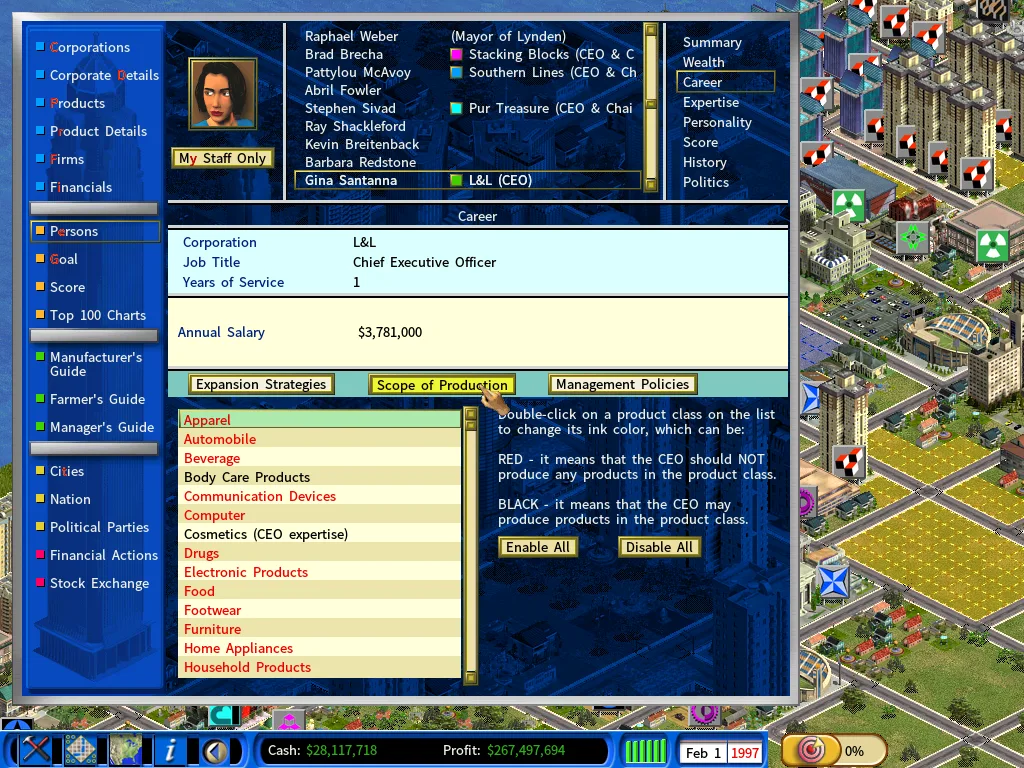
We plan to have a hands-off approach to our subsidiaries to see how well they manage by themselves, and esp. to avoid micro management hell and other "micros" which turn our attention away from the "macros". We'll keep throwing some more money at them in following years in order to capitalize them properly and that'll be it for now.
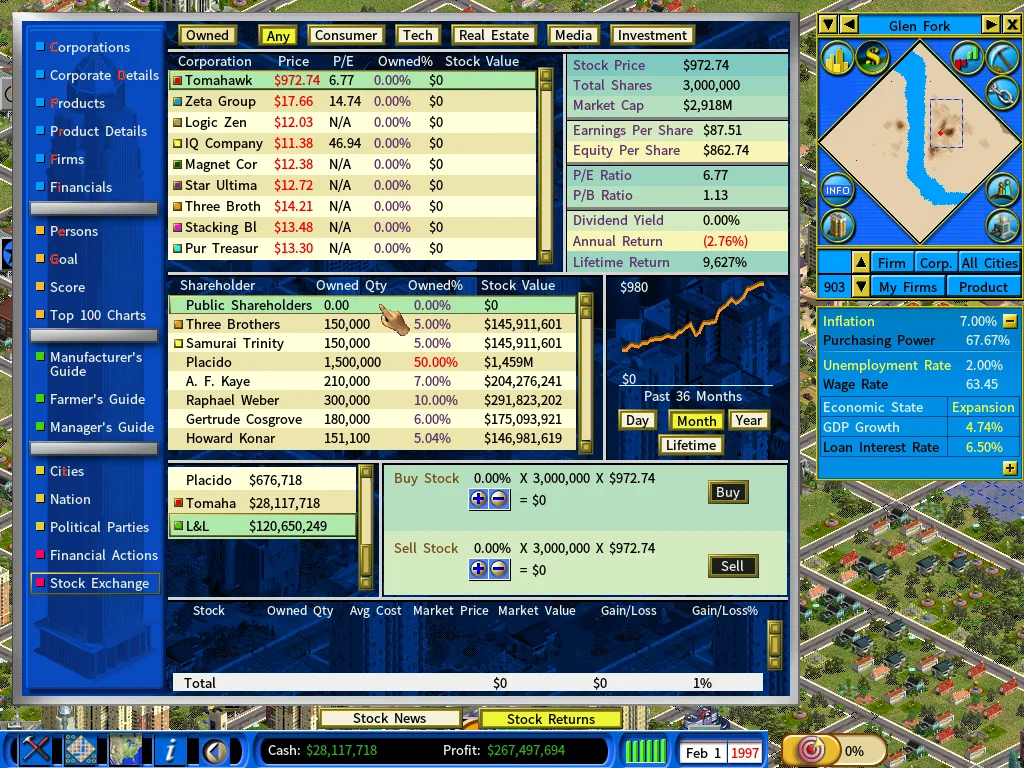
We've been buying and selling a few stocks as oportunities arose, for the short term, to keep too much cash from falling prey to inflation. Companies are still overvalued and just a few making money, so no plans to begin stocking shares yet. On the other hand our stock price keeps climbing, now nearing 1k$/share.
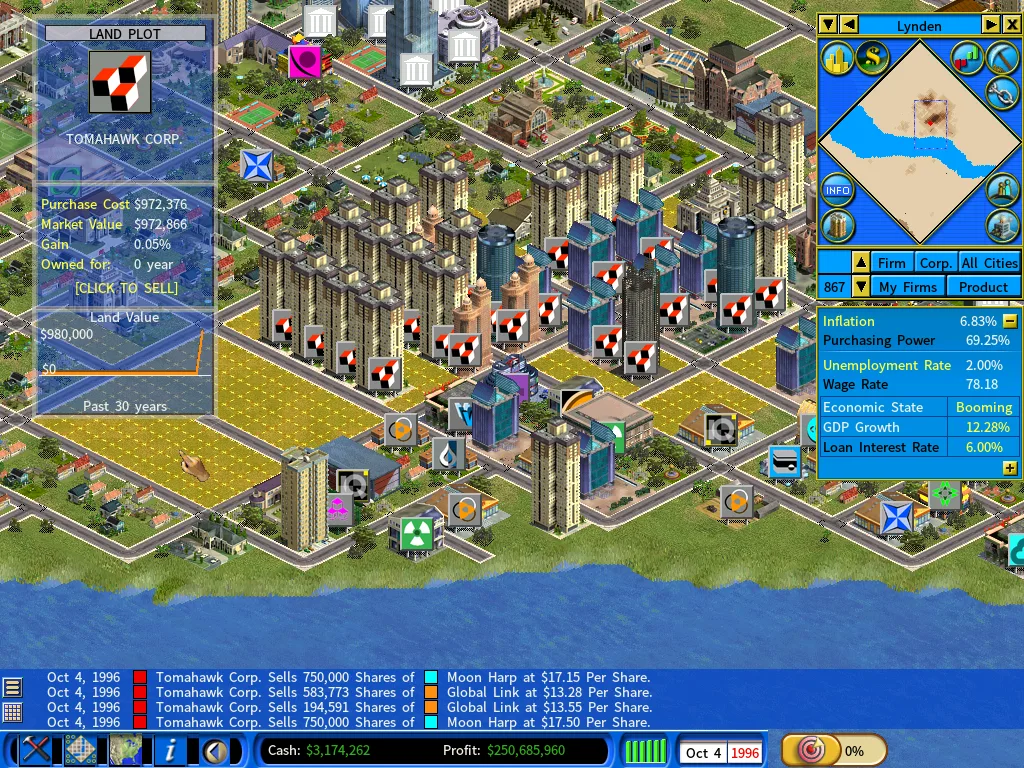
We have kept most of our land assets: did most sales in Lambs Grove to raise cash as needed, and bought a new lot in Lynden to begin cornering that city's CBD, as seen in the picture below.
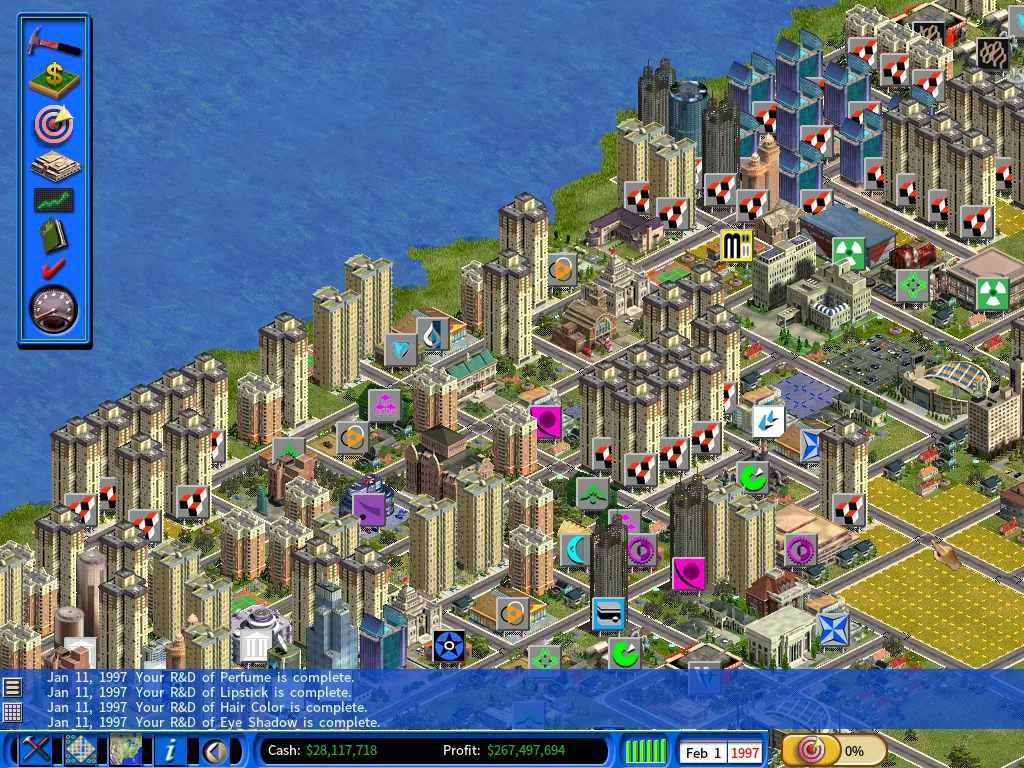
We've built between two to four new residential buildings, and one or two office buildings in each city, keeping supply high as planned.
But in Funk we've decided to get finally involved for real in the residential sector. In order to do so we've bought land in three parts of the city and developed two of them. I'll call these 7-central beach and 9-sixters. In these two areas the cost of the land was 1 million per square plus 6 million per building for a total cost of about 10 million each unit, so we can have a neat approach to calculate their profitability. The ratings of these new buildings are quite good so we've sold some land around our old "east filth" residential district to fund the expansion, as we don't plan to develop that side any more.
The area still undeveloped south is even cheaper in land terms but we don't think it will score such nice ratings as the other two.
Inflation has risen a bit and stands at around 7%, and interest rates ticked up once to 6.5%, so we have negative real rates of -0.5%.
How my not monetizing Tomahawk's assets will adversely (for us, down) affect inflation is something I'd like to see, as I don't think the other corporations ever incur any debt at all.
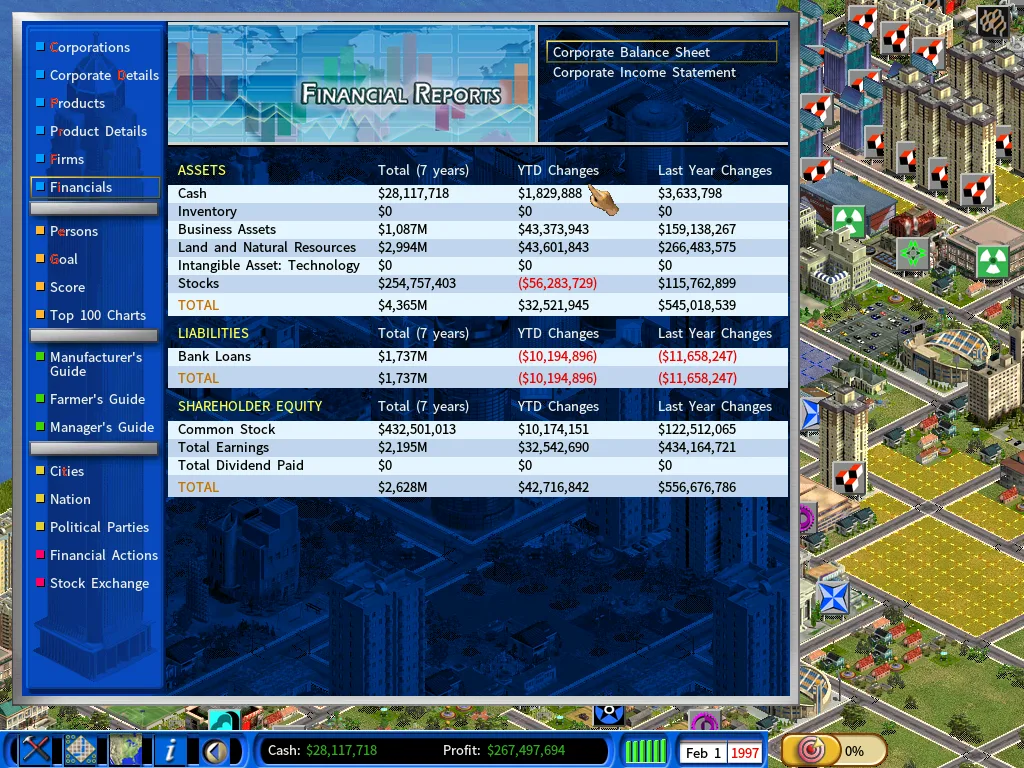
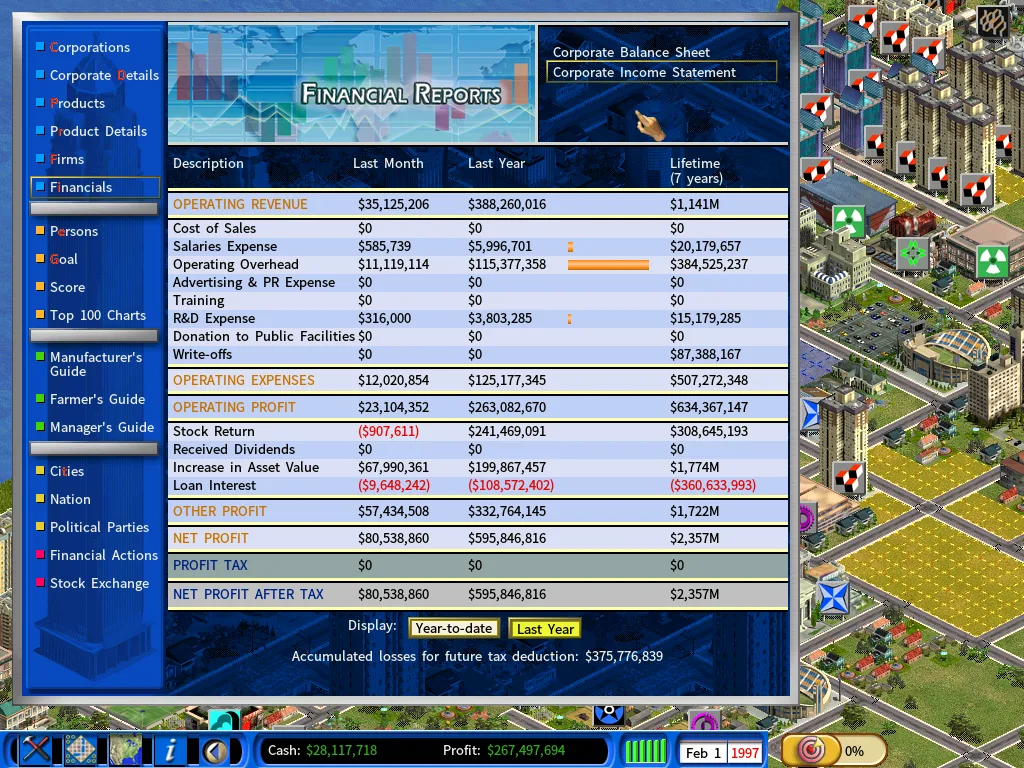
Net assets have increased by 587 million for the year to 2628 million, and the monthly profits by about 4 million/month to about 23 million/month.
Now, to the big picture:
Competition between corporations, altough being "bad for profits", create a competitive atmosphere, and so exports and jobs in the game, as businesses will try to place their seasoned manufactures abroad. These new job openings in turn will attract new residents, who will demand new housing and will encourage further business activity. And so, inflation & demand for more office space, which is our main concern, is attained.
We don't consider the same applies to RE business as we are happy enough to have a monopoly there.
But in case an opponent appears we have now attained enough girth to try and suffocate them. Raison détre…
Keeping that in mind we'll try to encourage competition and avoid mergers, and so our first spin-off is born and more will come down the road. We'll start keeping an eye on the evolution of the cities from now on and we'll let it dictate where and how we allocate our future stream of profits.
Thanks for reading.
Chapter 19 — 14 May 2018
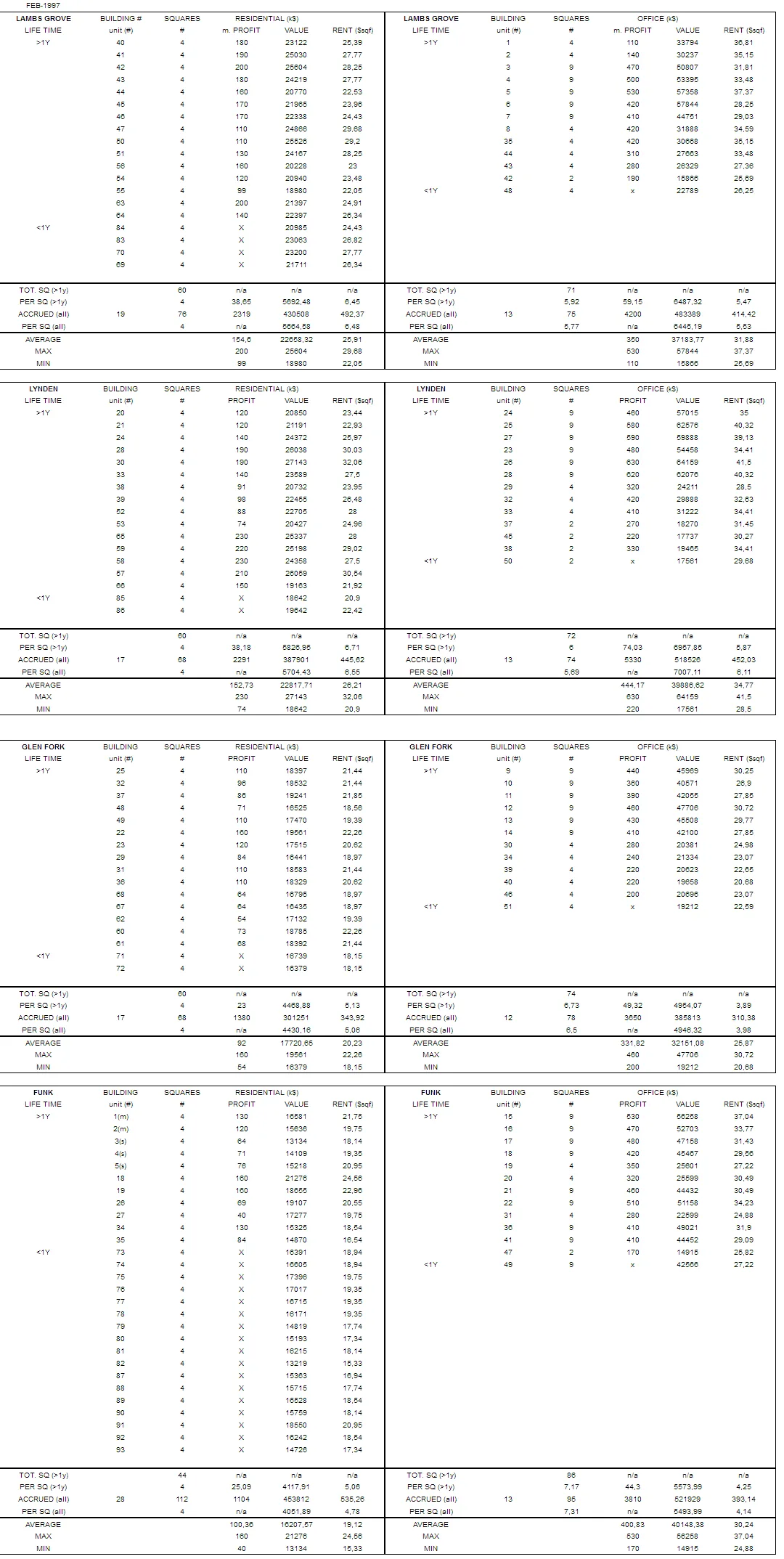
Alright, here's the Improved IS&BS for RE firms.
I added a few lines here and there and removed others as needed. I guess I'll keep getting more ideas to better it as time goes on…
The biggest surprise to me has been to see how well the office district in Funk is performing… and how I forget time and again to set office buildings #1 & #2 to market price.
Chapter 20 — 15 May 2018
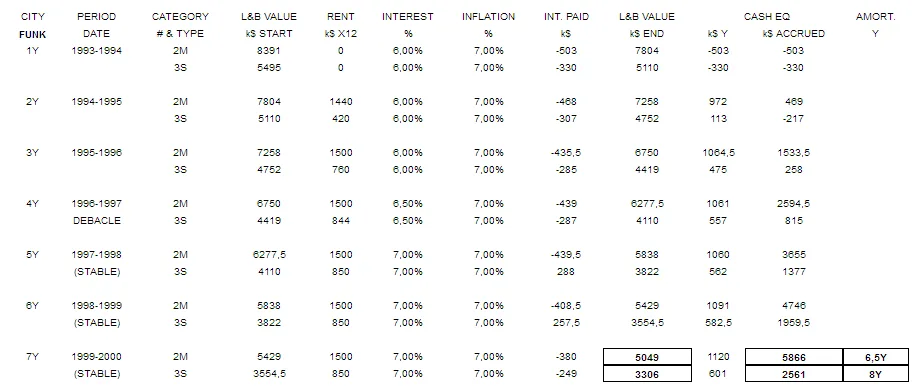
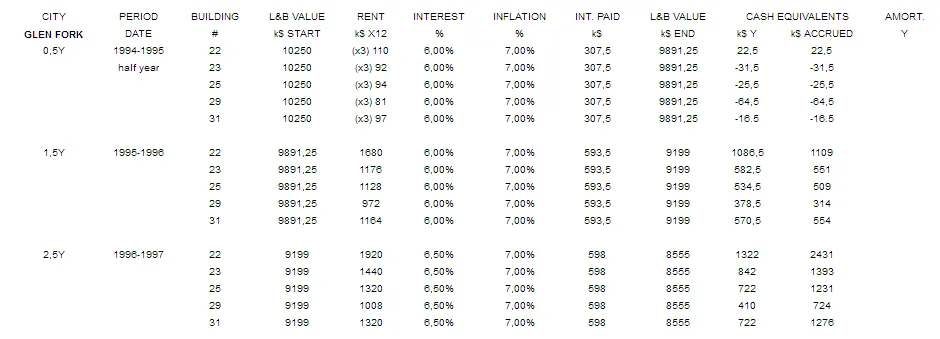
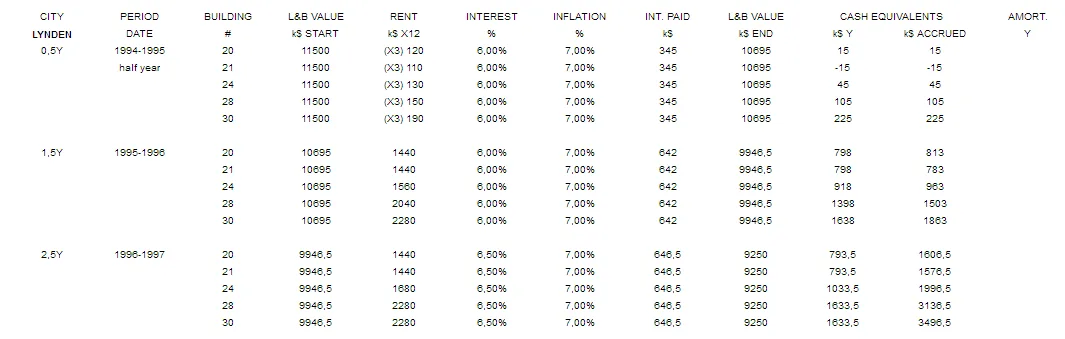
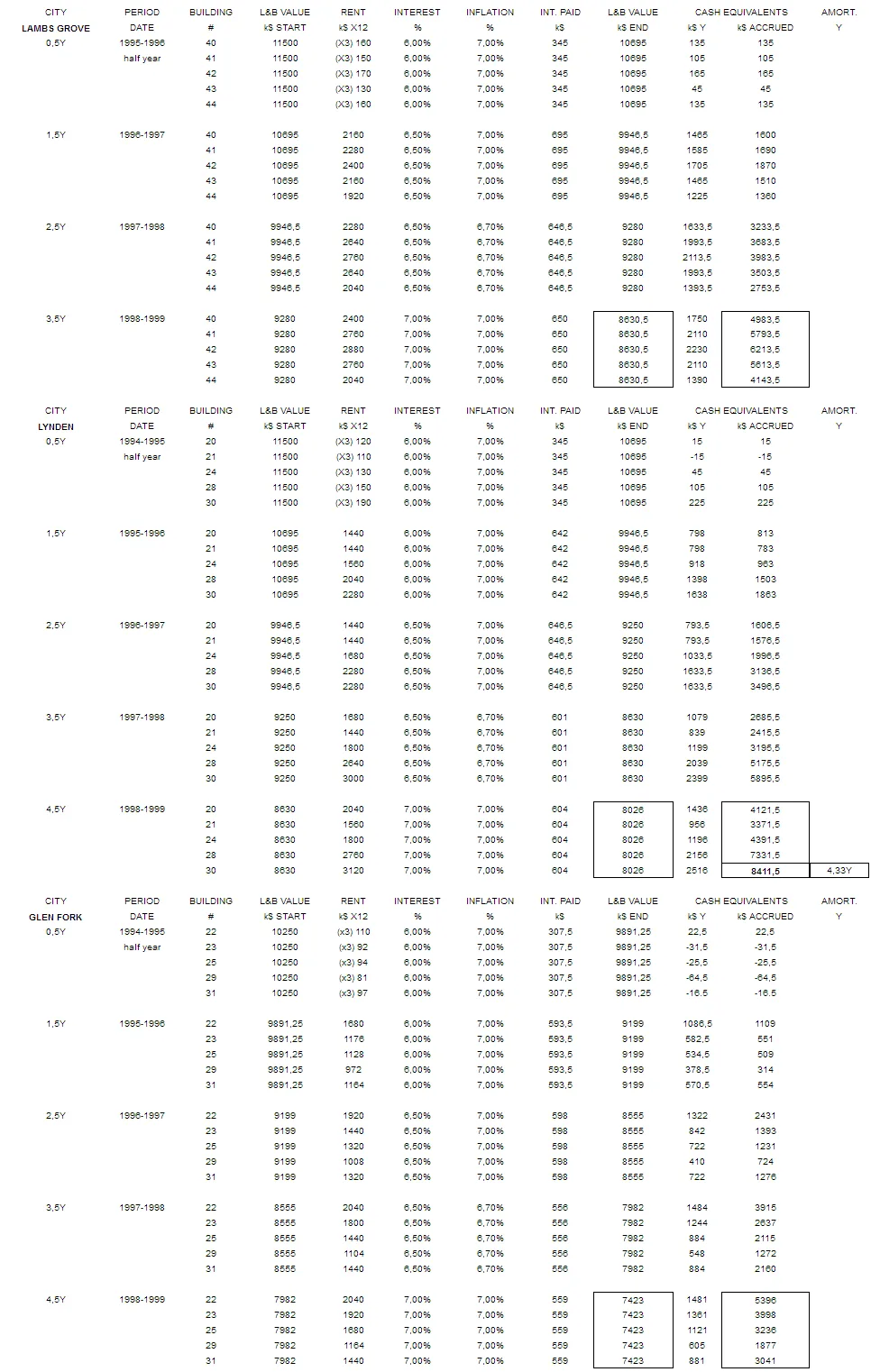
Here you can take a look at the sheets where we will measure how profitable our first apartments are, as the previous one was too flimsy and will be discontinued.
We've considered for this humble approach the first five buildings already on foot constructed in each of the cities.
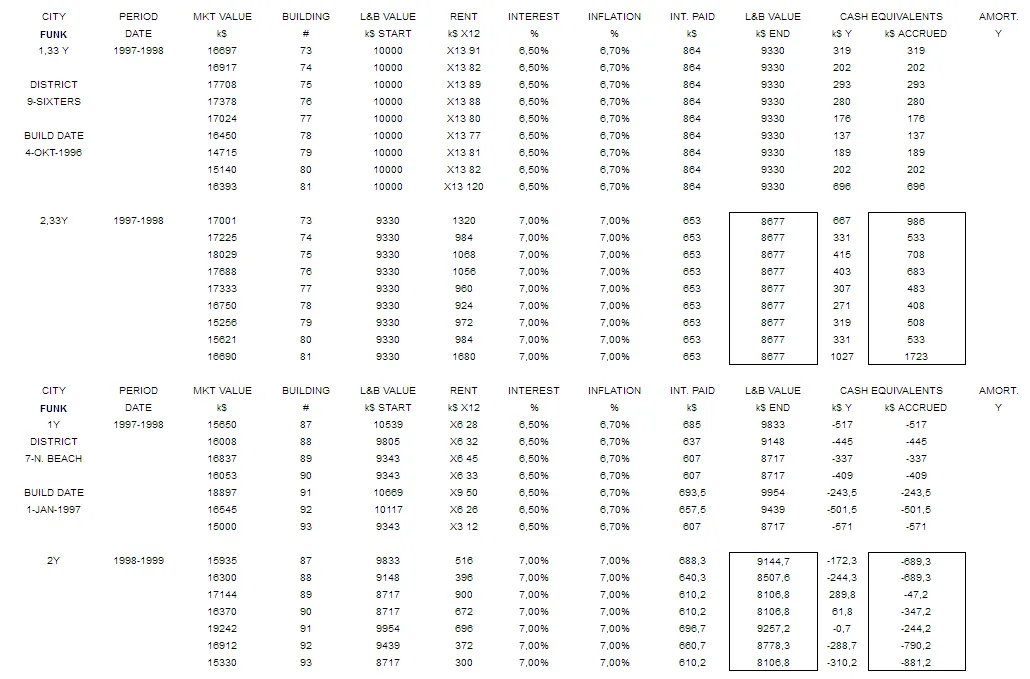
In Funk we have two types of apartments: 3 of small size and 2 of medium size. In 1996 the building of the new districts has destroyed their profitability, so since that time I've estimated the future under benign conditions so we have something to hang on to. Next time I'll use the apartments in the new districts.
Their net rent for the first year of existence has been assumed to be zero, as can be seen in the pictures below, from the firm's profit graph curve.
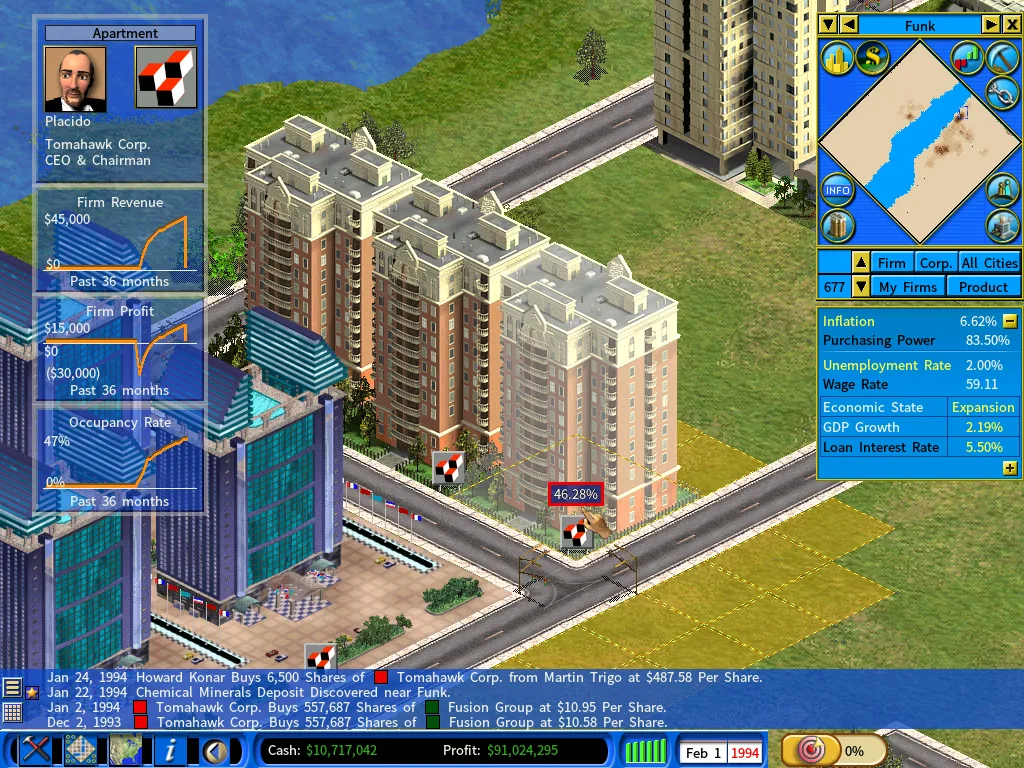
Actually the medium size buildings seem to make a profit the in second half, but we haven't considered it.
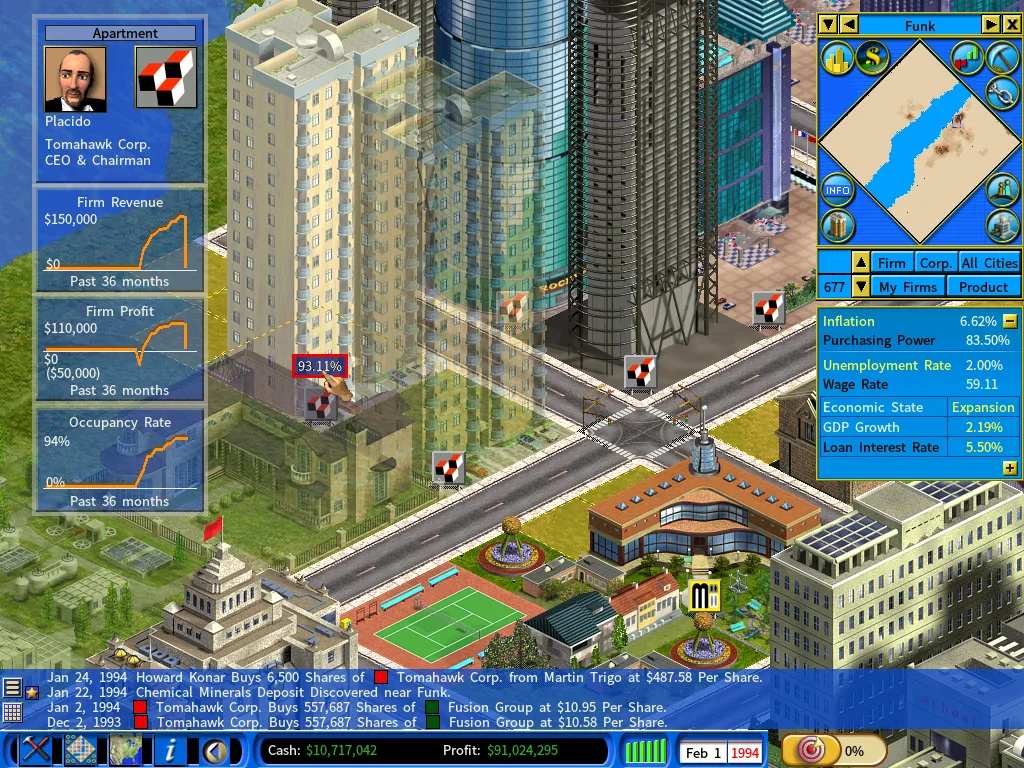
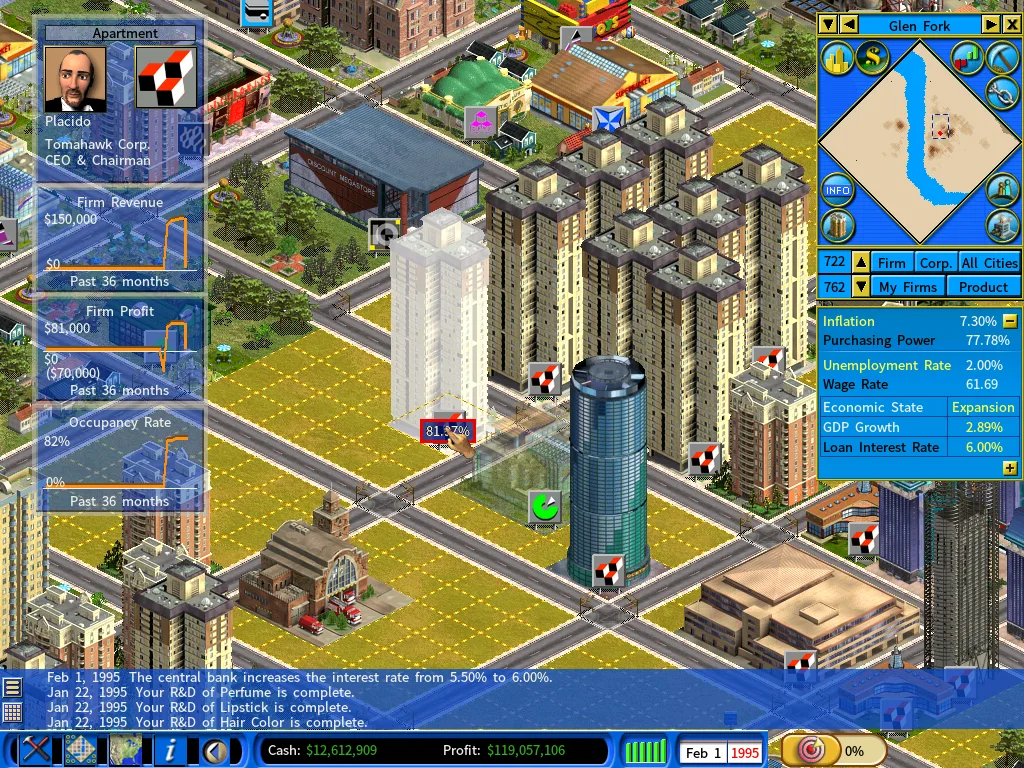
In both Glen Fork and Lynden the apartments were built in August 1994, so the first year considered is just a half-year, and so the net rent for the first three months is zero. For the next three months it's positive, as can be seen in the pictures below, with a very steep curve, in the firm's profit graph, since inception.
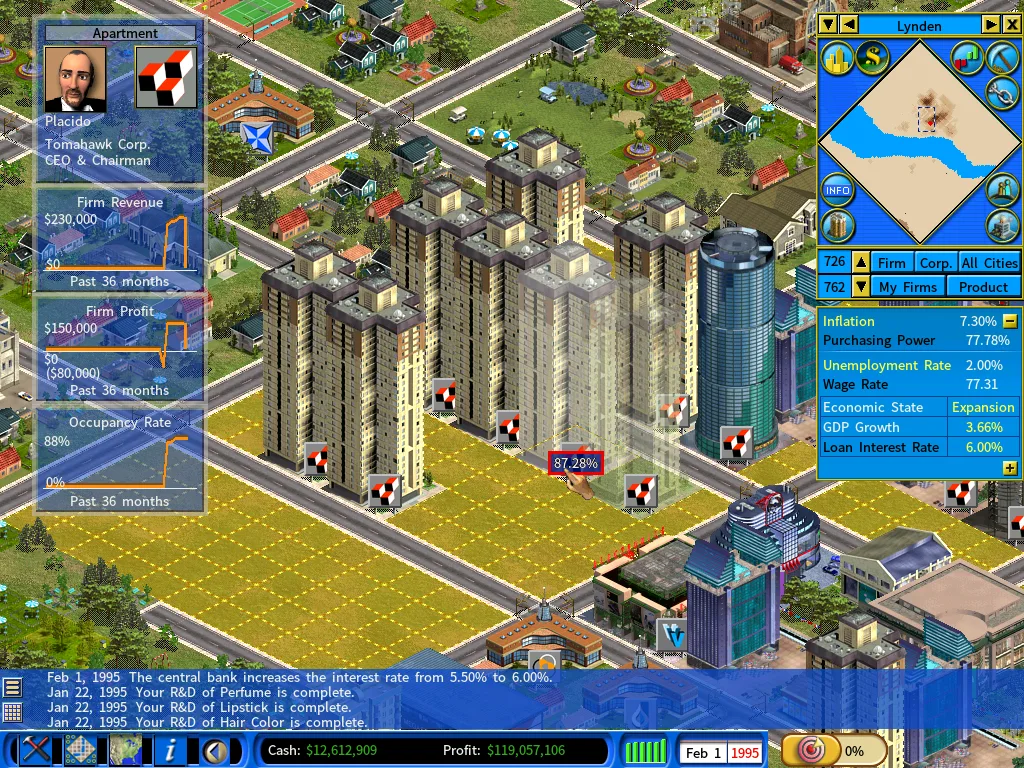
Lambs Grove's apartments are the late comers as the first district was demolished one year after inception because of bad ratings. The current district was built in August 1995. The same applies as the other two cities in terms of calculations.
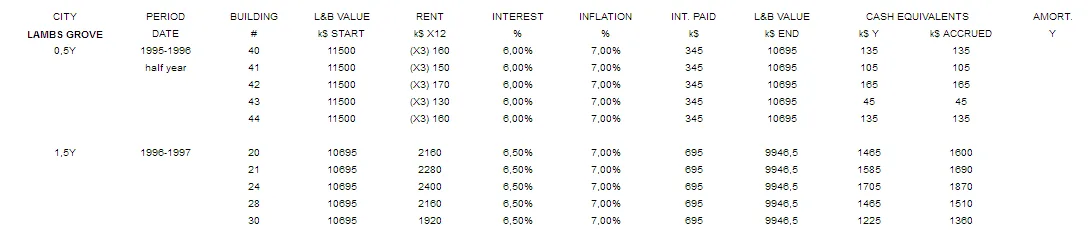
So, here's the approach to the sheets:
We take a loan to buy the underlying land and construct the building.
We both start paying interests and drawing income from rent. First few months we have a negative income from the firm (fixed costs).
The loan gets eaten up by inflation (YoY calculus), and so the interest payments become smaller too with time.
We use the rent both to pay the interests of the loan, and keep the surplus as cash equivalents (We work so it keeps its purchasing value).
When the loan value matches the amount of cash equivalents we (should) repay the loan fully.
Finally, we sum the years the process takes until completion.
Chapter 21 — 19 May 2018
FEBRUARY 1997 – FEBRUARY 1998
I forgot to post the save file last time. Here's one after the change in our research department was made for February 1997.
NEW RESEARCH FOCUS:
As you might recall we have a new subsidiary focused on the health care mega-class, so we have discontinued research there after finishing our current projects, and instead decided to invest our efforts in getting an edge in the auto industry. We've kept only one lab focused on the cosmetics area so we don't lose too much of our advantadge.
We fired Howard Konar starting 1997 and hired in his place Martin Trigo as new head of research. We hope we'll be able to give Mr. Konar a position as CEO somewhere, sometime.
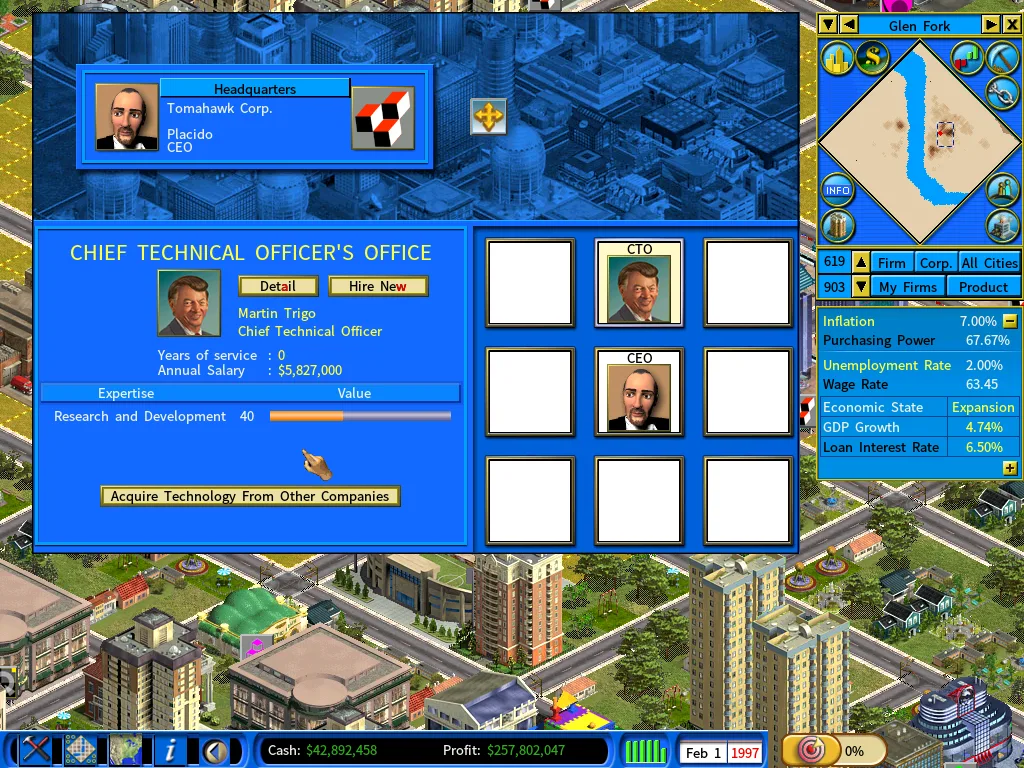
We also bought the latest auto tech from our "partners", and very willingly sold at a discount, as you can see in the picture below, news at the bottom.
One might argue that our research at this juncture is being a bit expensive, as I have thought before. We'll keep investing in R&D as it's for the long pull and only the future will prove us right or wrong, but any comments will be appreciated.
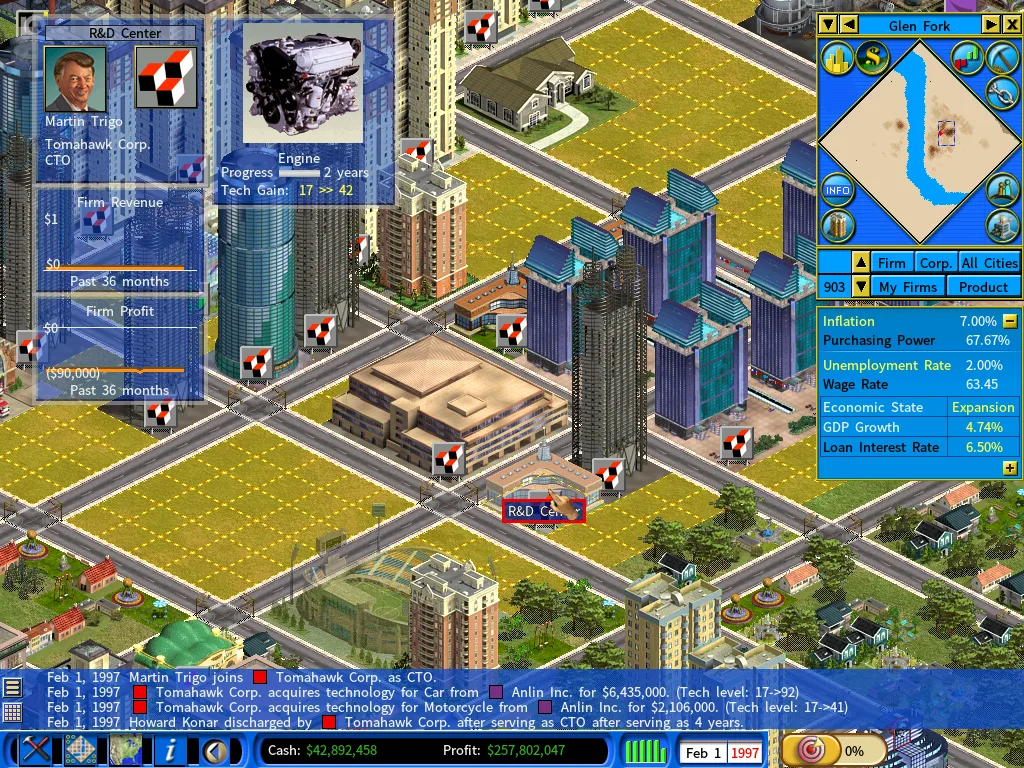
Two other companies are currently engaged in the auto business in Glen Fork where our research facilities are located, so there's some activity already there to start with: The city competitiveness in the area is 20,84, so we get a nice boost to our new research.
Anlin has all its five factories and its R&D firm in Glen Fork and Target Strike has its R&D in Glen Fork, and divides its production between Funk and Glen Fork.
Also, it seems the "World" at large is not too focused on producing vehicles, so we'll try to export these in the future. For that, of course, we'll set up a new subsidiary when we deem appropiate.
NEW SUBSIDIARIES:
Welcome Saratoga Mills and Cotton Thread. They join our venture starting Feb 1997, both focused in each of their area of expertise: the first one in the food mega-class and the second in the fashion category.
As I mentioned in an earlier post, we are interested in making our country rise as an exporter, and for that we need lots of competition, to harden our businessmen and season our merchandises so that they can compete as well at home as abroad. We'll discourage any monopolies in the nation by any means necessary, except ours.
Also, it seems that these guys keep our money relatively safe against inflation, and as we still have negative real rates, we have taken advantadge of that to capitalize them with 300 million each (total) with new issued debt, from 150 million at the beginning of the year.
Or if you prefer, we've monetized our assets through the bank to fund our new venture, once more. You can see the value added to our firm in the balance sheet, Stocks category. Hope that will increase the inflation a bit.
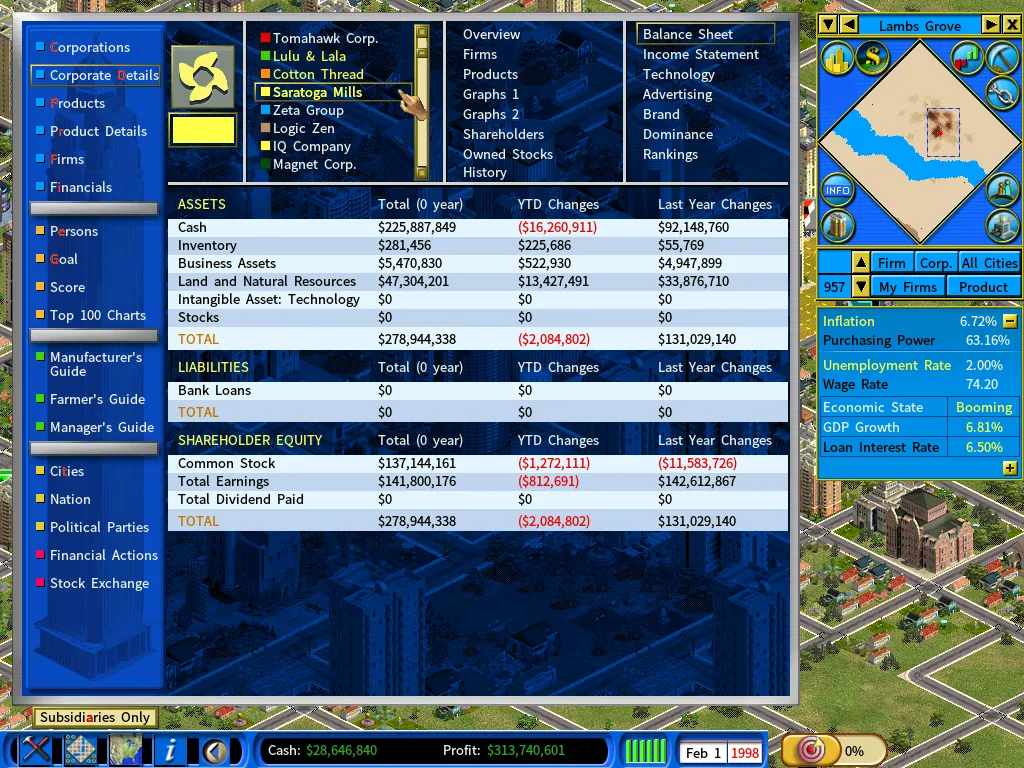
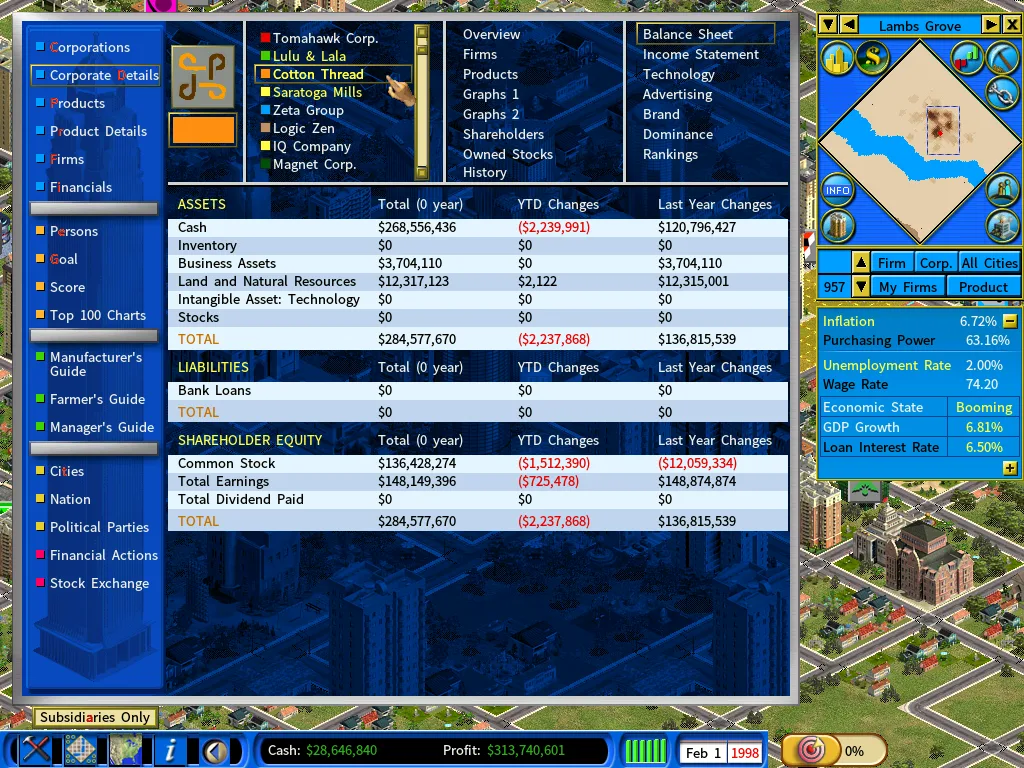
To mention, all three subsidiaries have the corporate brand marketing approach, and Saratoga Mills is currently engaged in manufacturing.
NEW REAL STATE AIMS:
We have adopted a somewhat passive approach this year in the RE area. The apartments are still being filled with new incoming residents and supply is still quite high, and in the office space area we have new plans for both Funk and Lambs Grove.
In Funk we plan to expand the office district West, and for that we've been purchasing expensive land in the area around the police station. We hope that once we develop that area and the value of the land appreciates the CBD dot will finally come to sight, as we calculate it's now very close to shore around that part of the city.
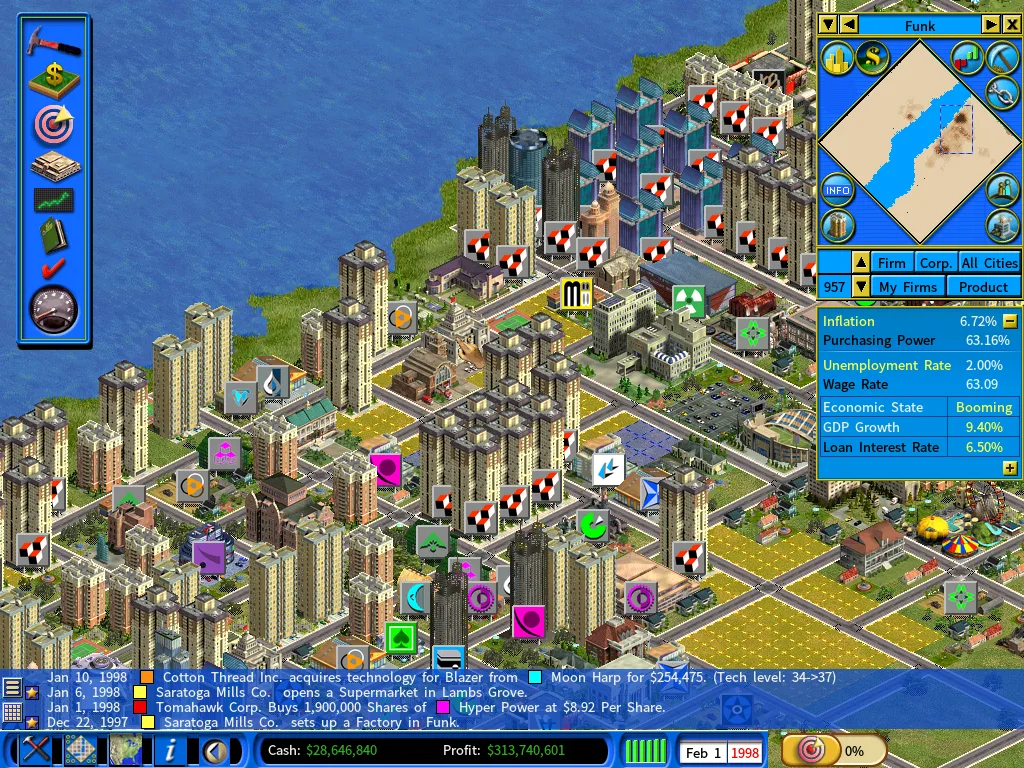
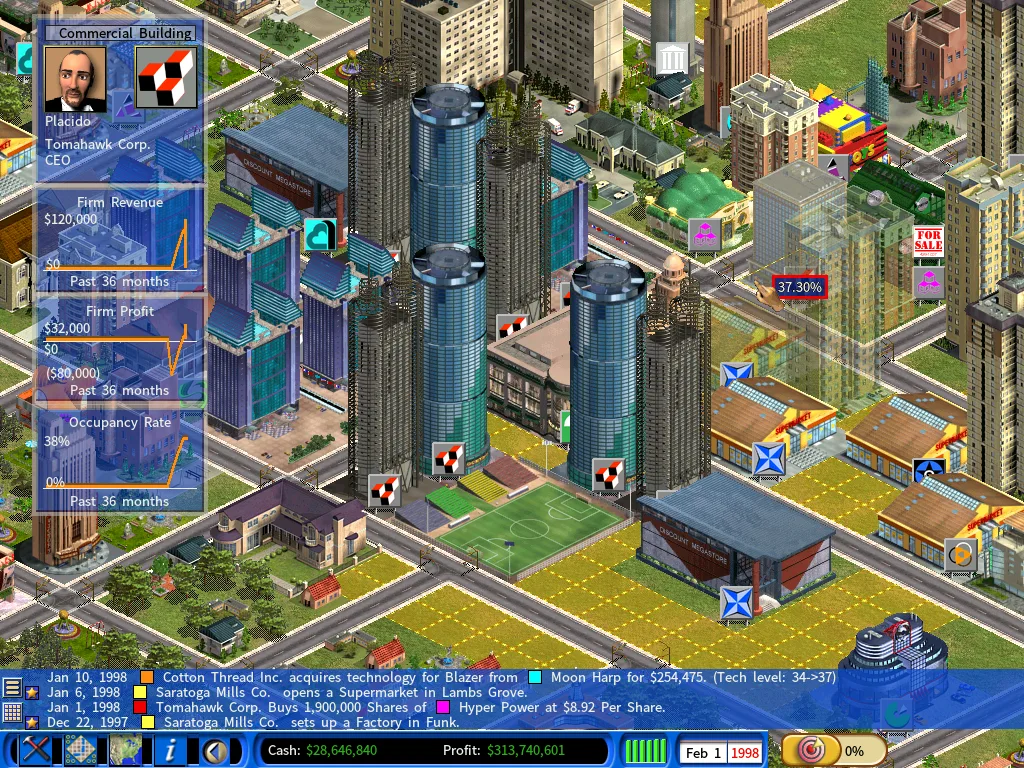
In Lambs Grove we find the chain of stores south of our office district finally spoiling our best chances to do business in that city.
As we don't have the option to make a bid for them, we tought of all the prime land they take and how little they deliver in return. So we have considered that the best option is to lobby the major to intervene and find them a new home. So we'll do our best until then.
Chapter 22 — 23 May 2018
Hello Gorillatore. Thanks for reading, and the praise.
I get the data from the game, I don't know what you mean.
With each RE firm's profits I try my best guess. There are in-game filters so one can surf between firms quickly. The windowed mode also contributes to mining the data easily to a spreadsheet.
About the faces, I guess they come with the last patch.
Chapter 23 — 23 May 2018
I've considered not reporting the Improved IS&BS for RE firms this year, and do it in the next, with a view to know our current position regarding our big pile of debt.
Here are the missing files I needed to post for February 1998:
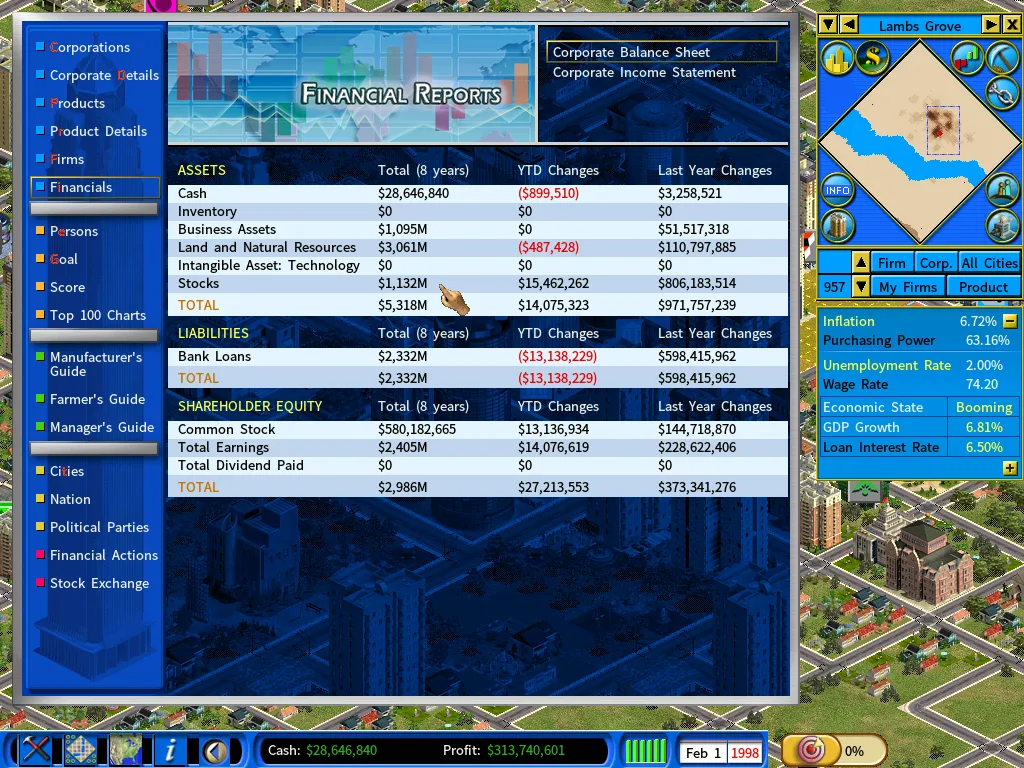
Increase in debt: by 535 million to 2332 million
Increase in net assest: by 238 million to 2986 million
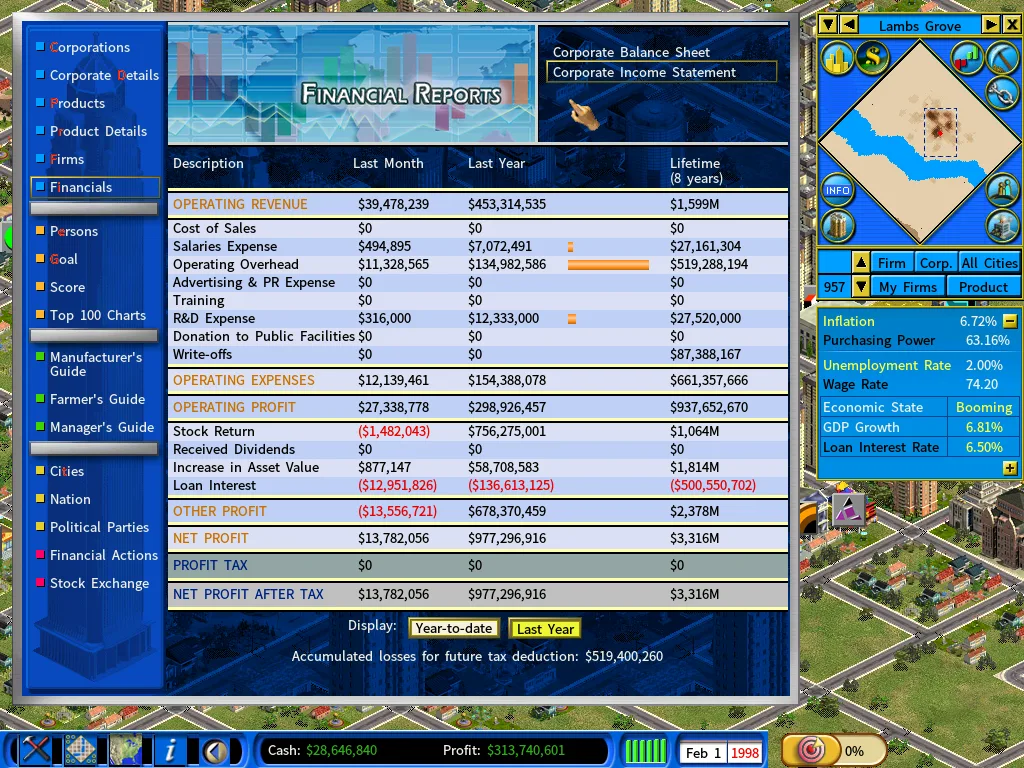
Increase in the operating profit: by 4 million/month to 27 million/month (328 million/year)
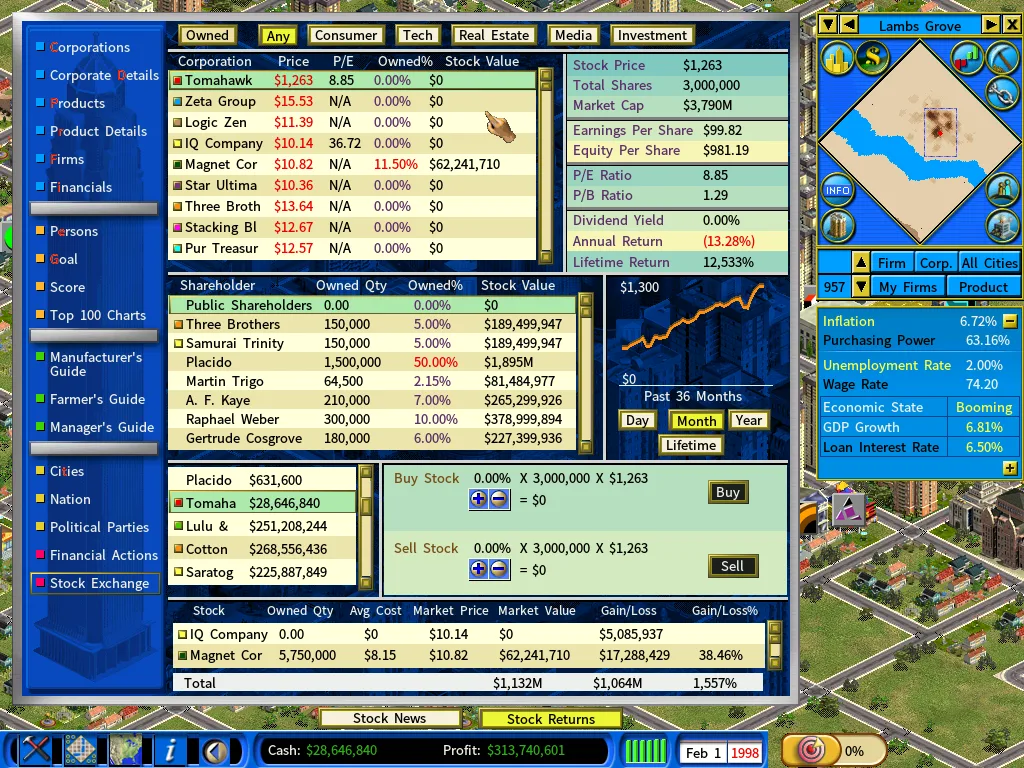
A 30% increase in the performance, to 1263$/share, from last year.
Here's a view of our current, very modest, ownership of the competiton.
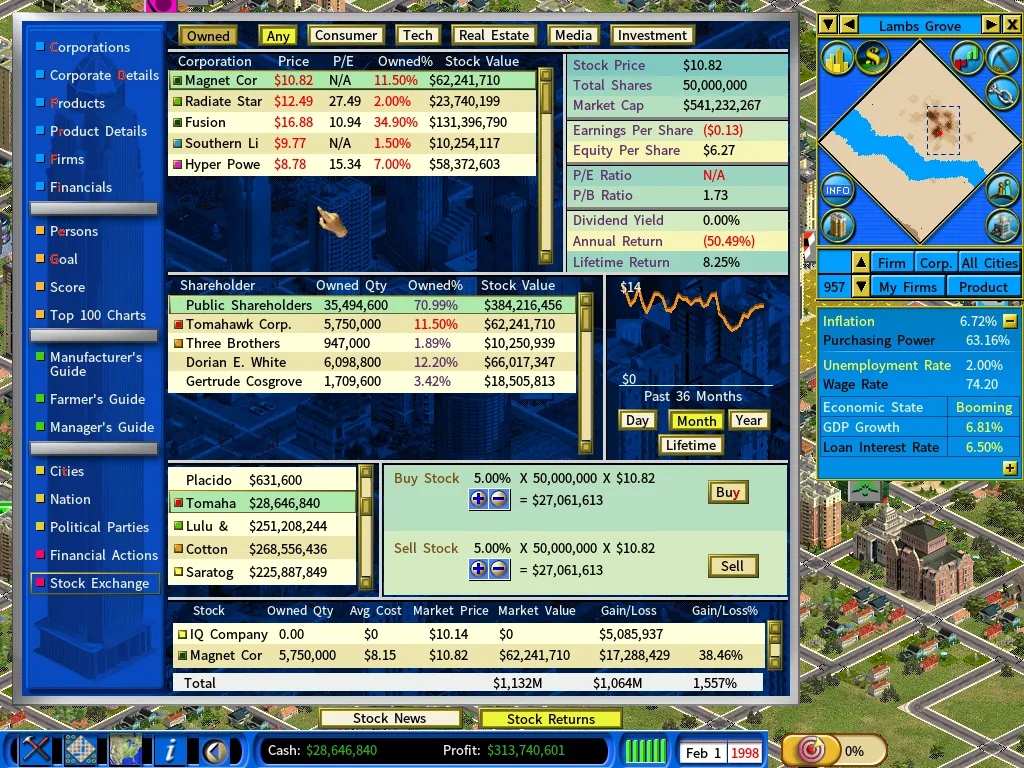
Here's the apartment profitability sheets, updated for the period 1997-1998, and 2 new sheets for both new districts in Funk.
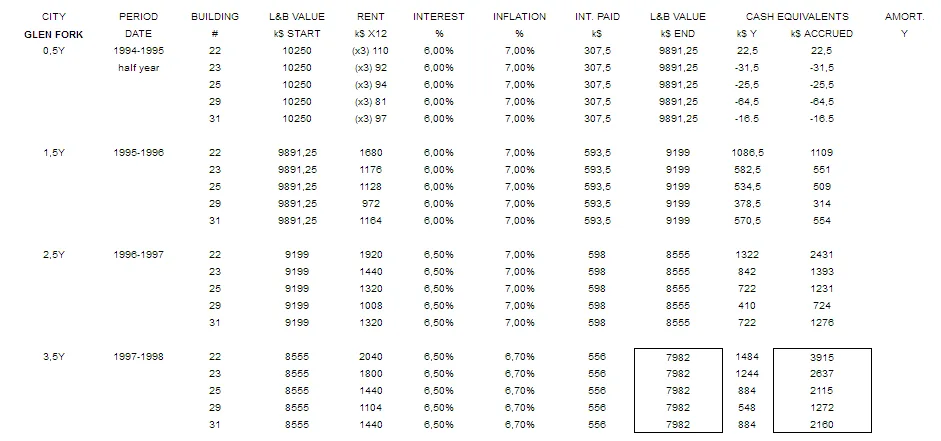
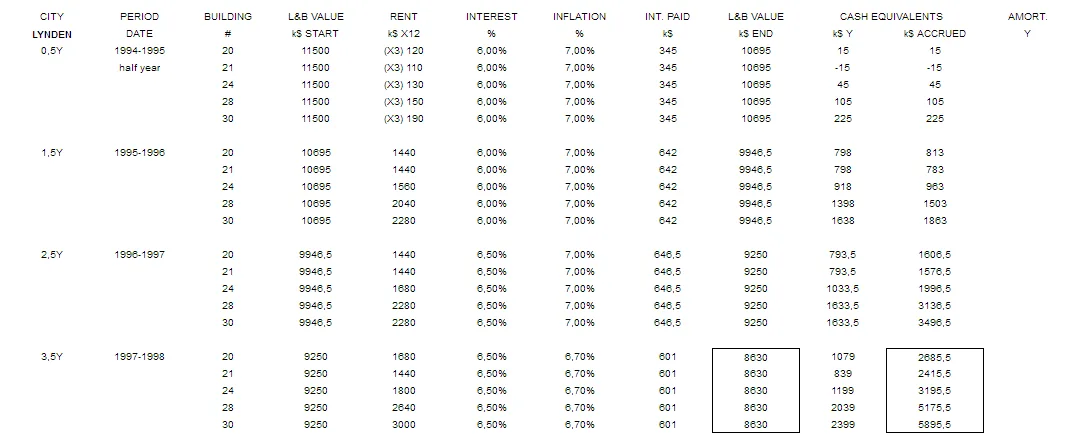
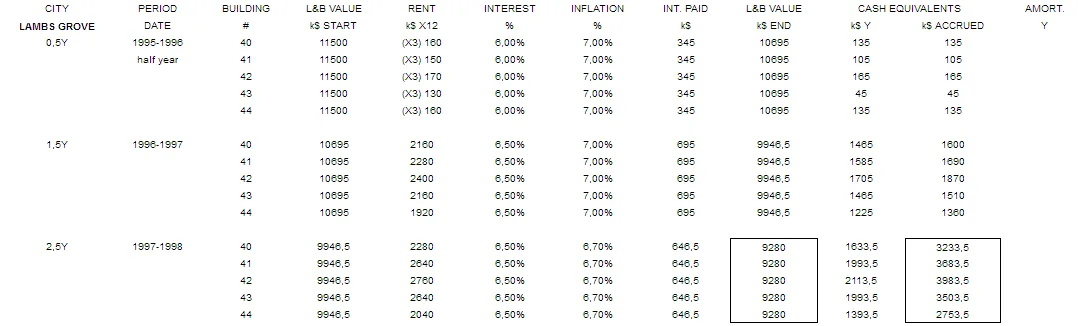


And last but not least, the save file so anyone can play and speak their minds, as we're always happy to learn and we'll consider seriously new possible angles to this now public game.
Chapter 24 — 31 May 2018
FEBRUARY 1998 – FEBRUARY 1999
SUBSIDIARIES:
First of all, we have a new subsidiary, so welcome Falcon Industries, focused on the electronic product mega-class. We capitalized it with 350 million of new money (we monetized our assets, once more) starting 1998, so at this moment the corporation is one year old. We used 50 million of that money to fund a new political party. So from now on Falcon Industries will be the political sponsor.
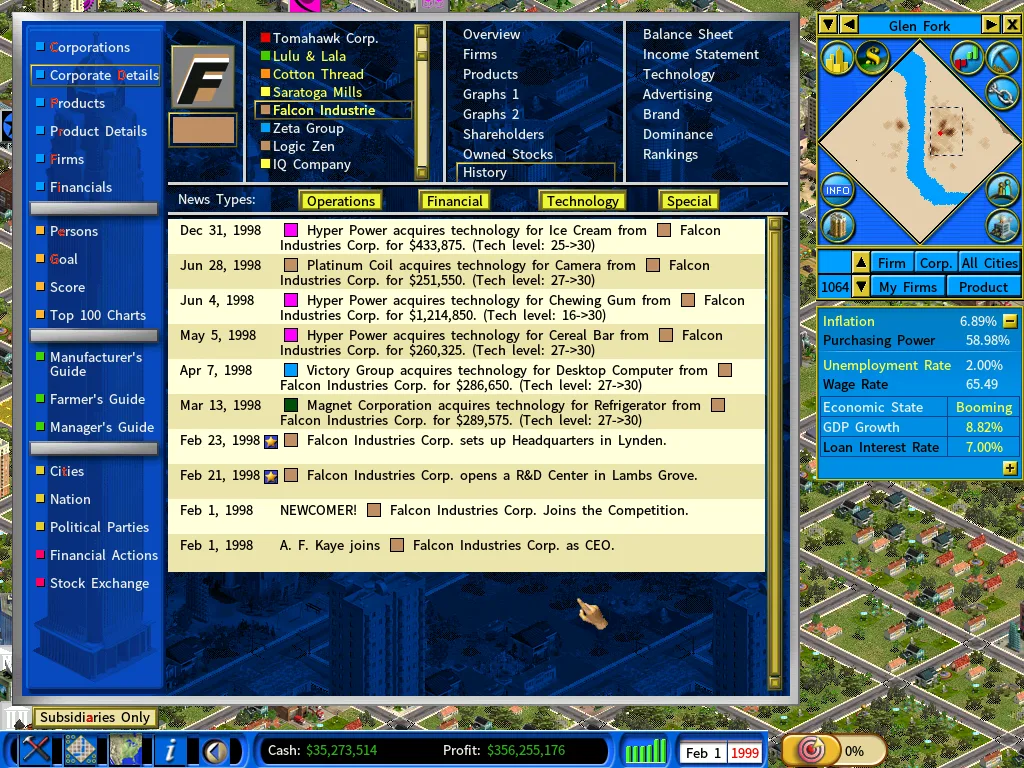
With this we have almost finished the first part of our subsidiaries program: creating a new venture to develop each one of the product mega-classes (food, fashion, electronics and health care). We might enter the jewelry area in time.
If future conditions allow, we'll continue setting up new corporations, but this time aimed at each one of the "mini-classes" and also at each class inside the mega-class. The proper way would be once we make the big four (five) public through an IPO, and after offloading part of our ownership for cash. Otherwise getting a high price for them would be rather difficult as the new set-ups will naturally increase the competition, eating up part of their market share, and profits.
We'll have to strike a balance between our need to cash in the subsidiaries and our need to build up the nation through increased competition. The same way we refrain from issuing new Tomahawk Corp. shares to pay down debt, because we believe we can get a higher price, so we'll have to consider timing the IPOs and the new "mini-ventures" as best we can.
Of course, our new ventures could prove to be a disaster and we might lose quite some money, but that's the way it is.
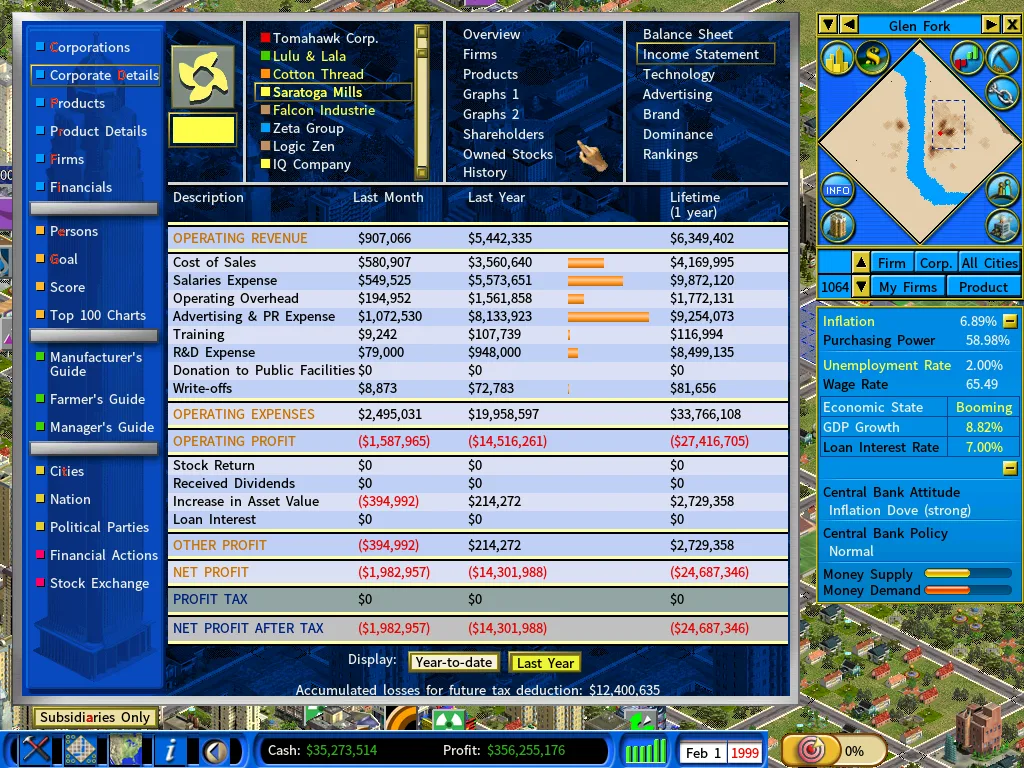
FINANCES:
Inflation has gone from 6,7% to 7,2% and back below 7% again.
The banking cartel has increased the interest rates to 7%, so real rates are about 0%.
In case some people wonder why we talk about monetizing our assets, that in our opinion is the proper way to look at debt. We just use the expresion "take a loan" and so on as it's the common parlance. But we prefer to be more precise, as to monetize our assets first the bank values our property, and then puts new money, according to the valuation, on our hands for a temporary change in the ownership, plus interests.
At this time these interests are in fact 0%, so the cartel, the only people with the keys to new money, is helping private hands develop the country through asset monetization.
As long as we have a big asset to sell (temporarily) to the banks any venture of any size that makes the slightest profit (above real rates) can be funded through debt and held with ease.
We hope the current situation will last a while longer.
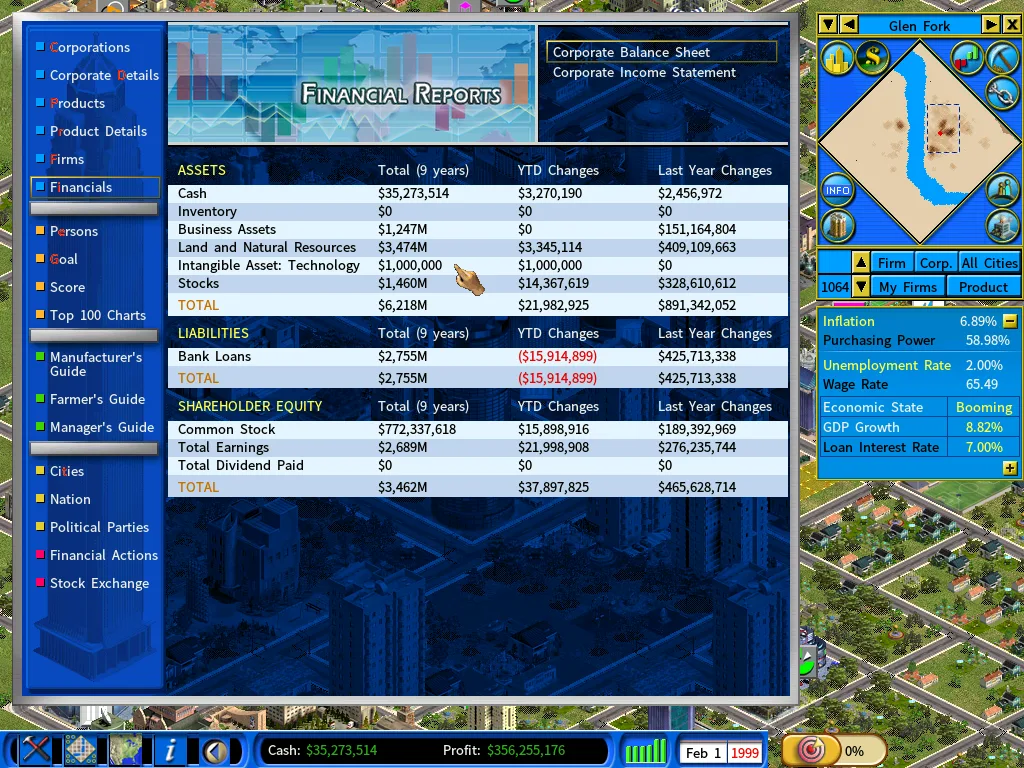
We increased our debt by 423 million and our assets by 476 million. We used our debt to capitalize the new subsidiary, buy land, stocks and to build new offices and apartments in all cities.
The "liquid" land available on our books, as well as the number, location, value etc. of the old and new RE firms, will be reported as soon as we create the Improved IS&BS for RE firms for 1999.
Notice for the first time a technology asset in the balance sheet, albeit small-ish.
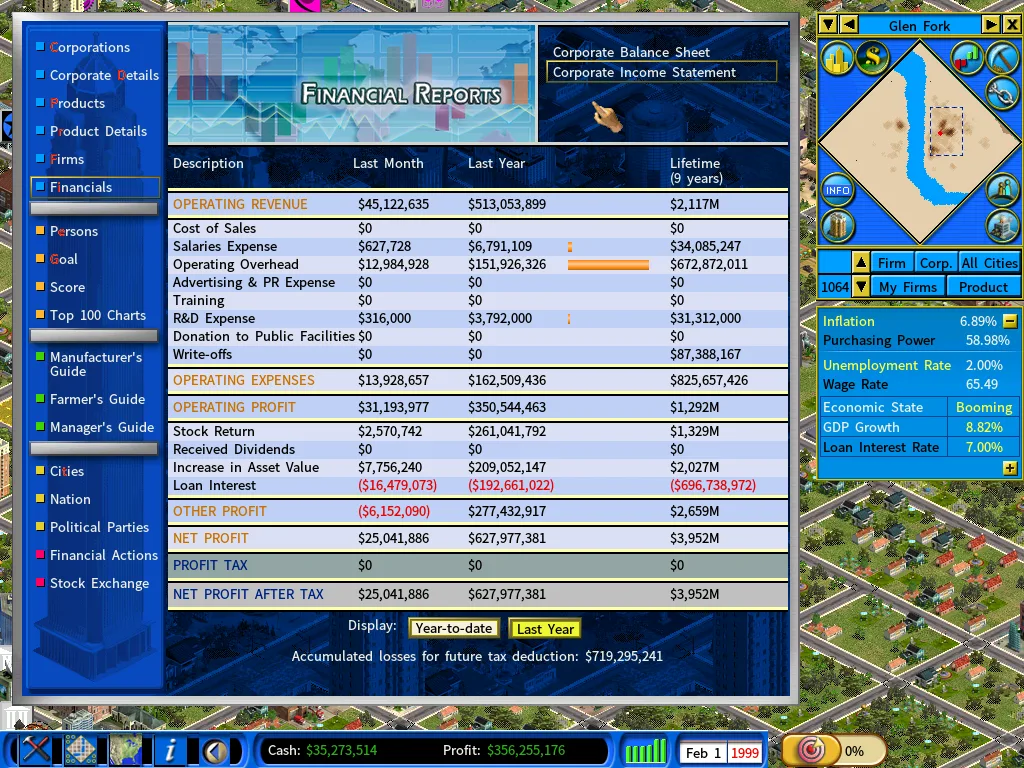
Our profits from running the RE firms increased by 4 million a month to 31 million a month. Increasing quite steadily.
More than 50% of it goes to pay down our debt.
The stock price has decreased YoY for the first time. As we have increased both our net assets and profits we believe it will be a small bump on the road and that it will re-enter its natural path, upwards. We still don't consider issuing any new shares yet.
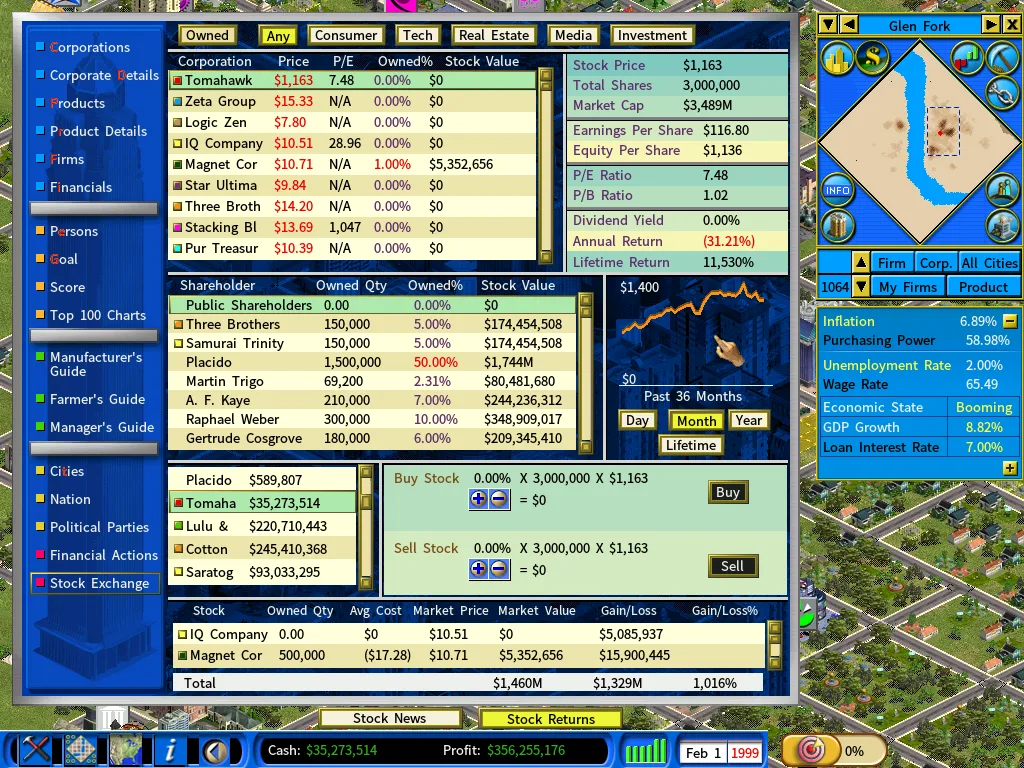
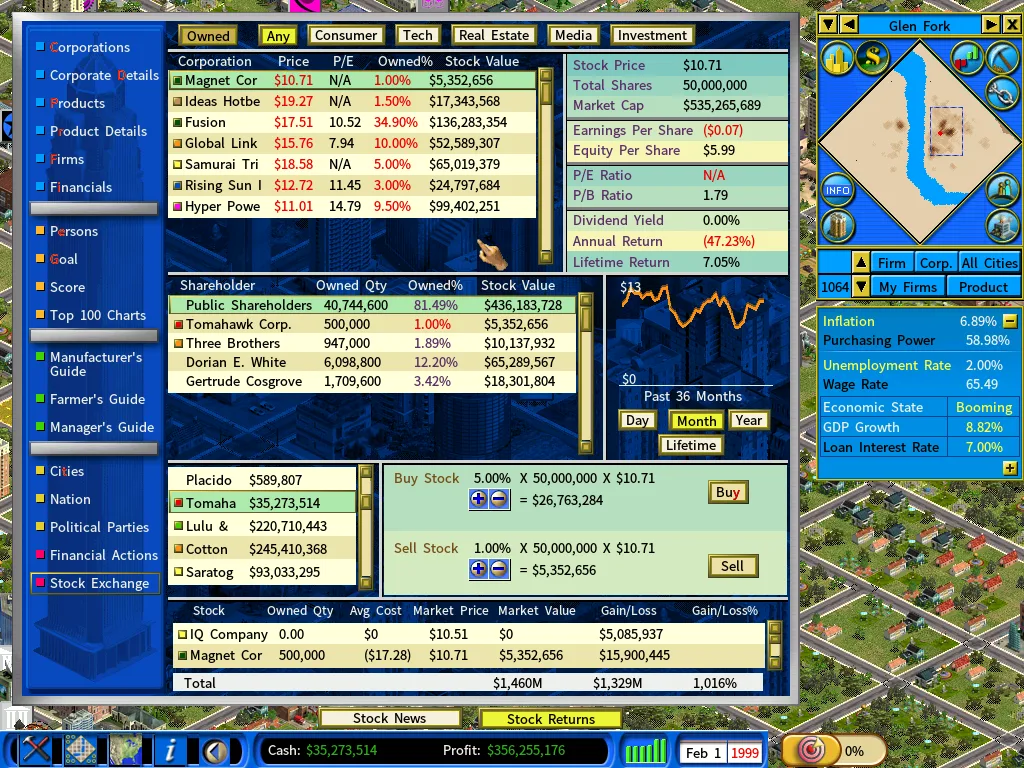
You can take a peek at our current holdings below. Still quite modest. We like to see sales in their reports and the ones held show just that. The exception are Samurai Trinity and Ideas Hotbed which are centered on stock investments and are held as cash equivalents.
Overall, all public companies are still overvalued and we don't want to stack too many shares on our books.
Chapter 25 — 31 May 2018
REAL STATE:
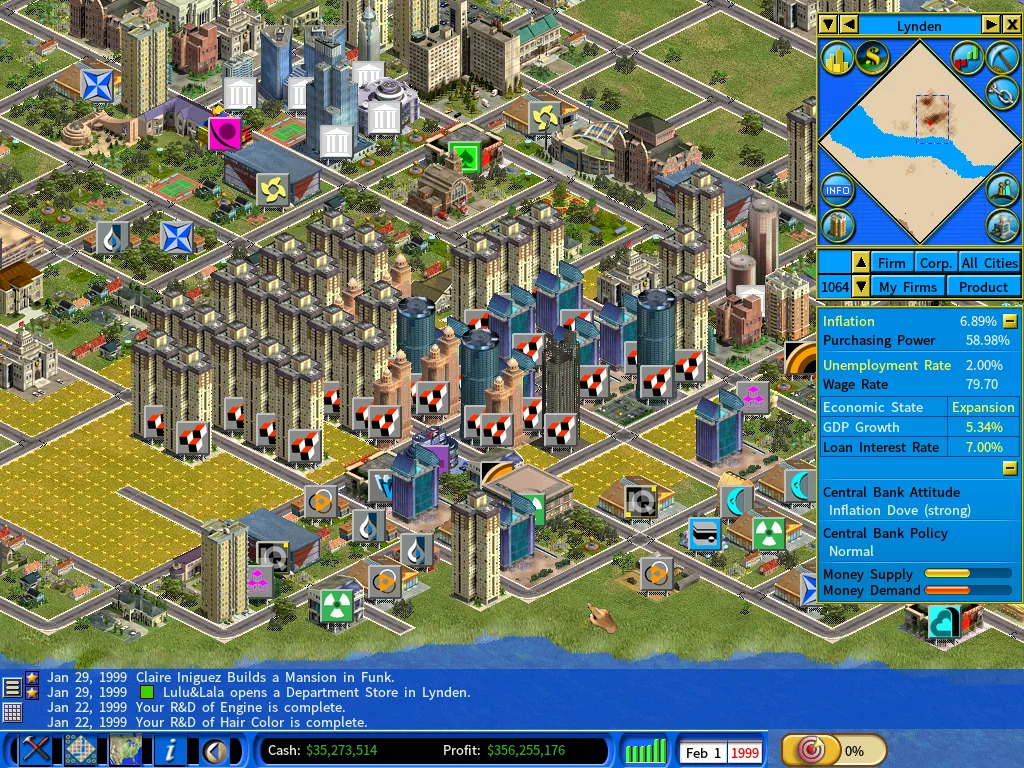
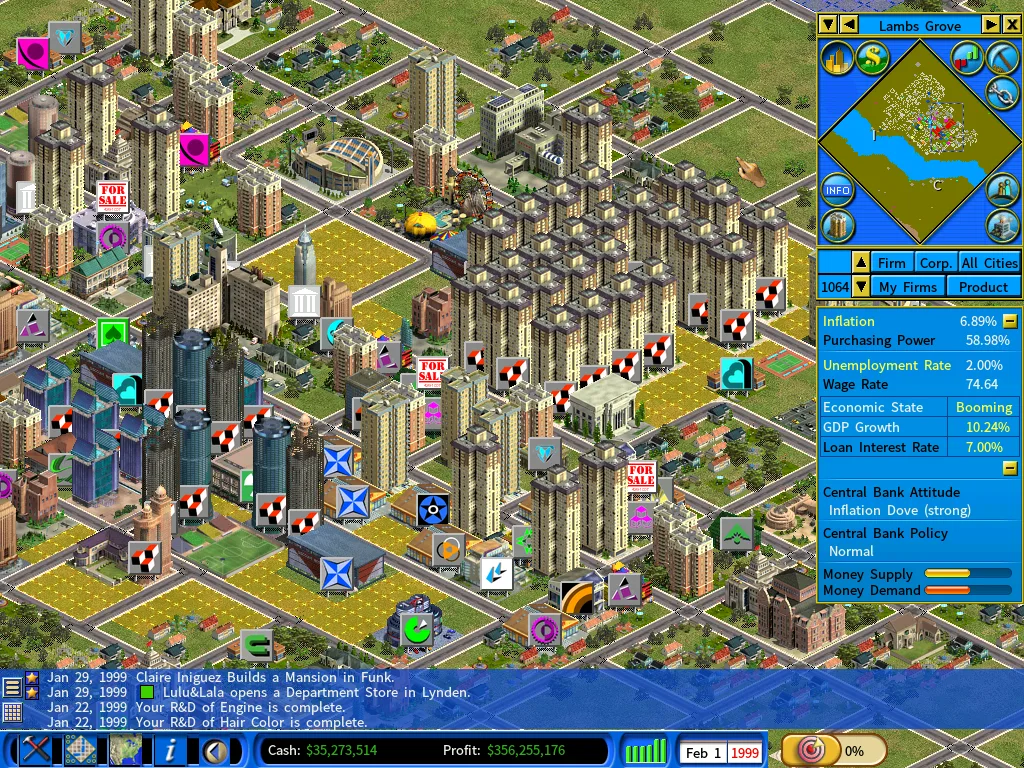
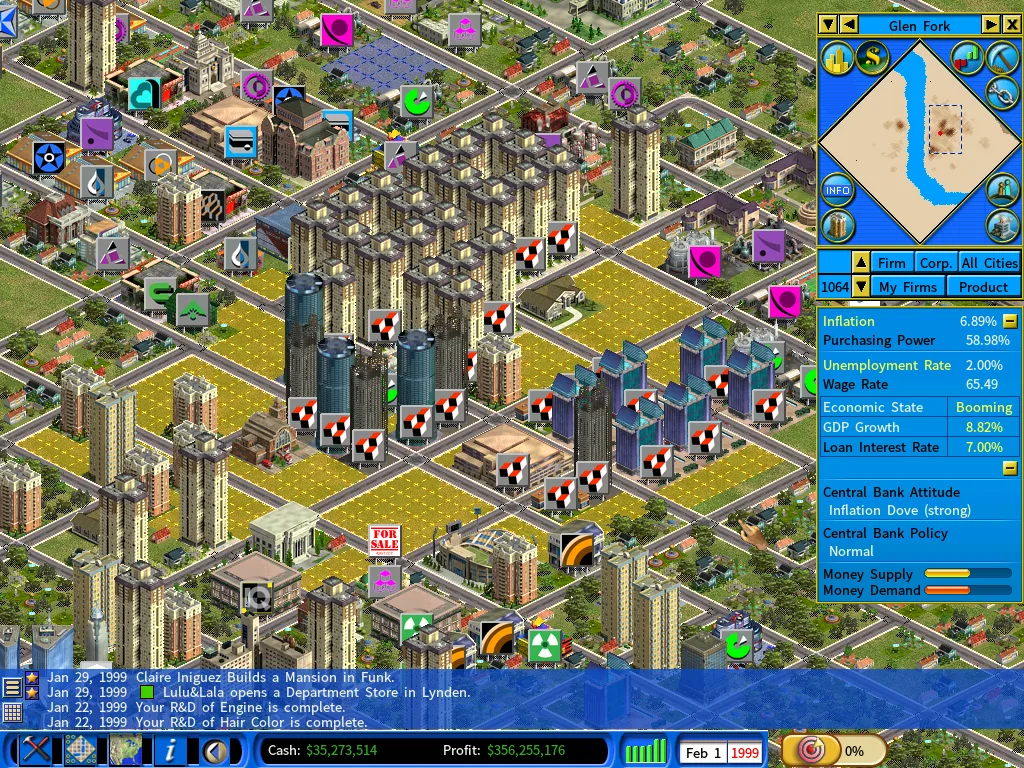
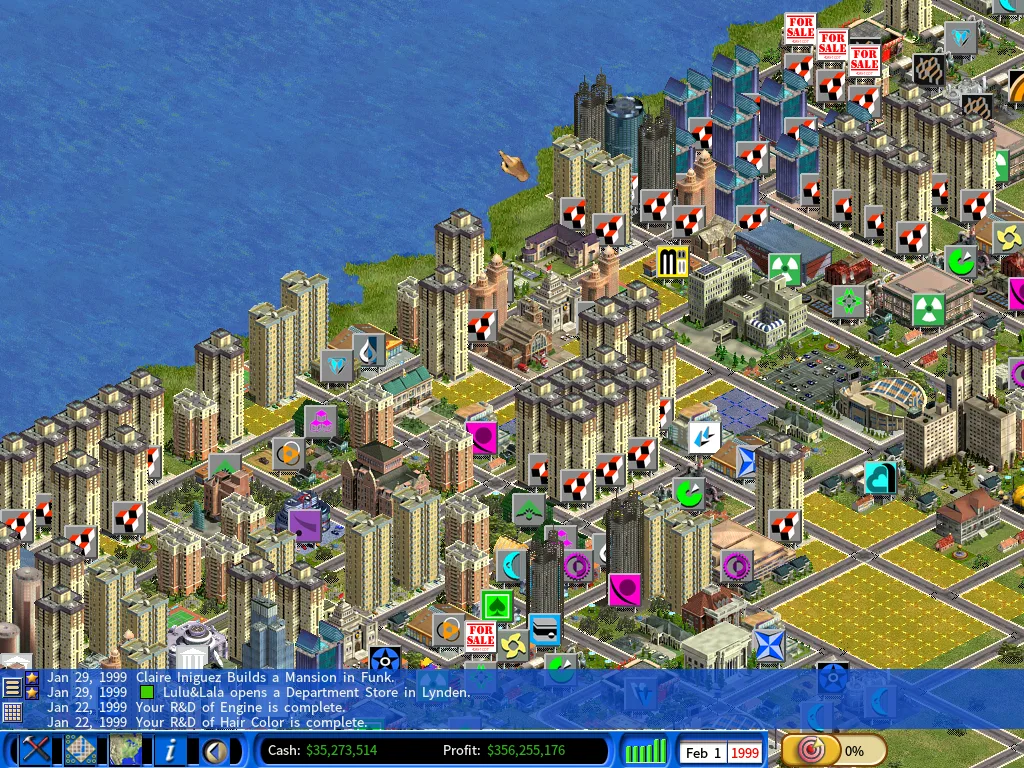
You can see the city views below for a quick appraisal. We have held supply high as our plan mandates. Started building offices in Funk downtown (two small) and new buildings in the center and periphery of our core lots in the other cities. For a detailed view we'll supply soon the Improved IS&BS for RE firms as promised.
As for now we can provide the apartment profitability sheets, which we have merged in two. And we have a winner in Lynden (apartment 30) that has already covered costs in a record time of 4,33 years. The apartments in Lambs Grove come with one year delay, but we have another candidate (building 42) that will probably show a similar profitability.
ELECTION YEAR:
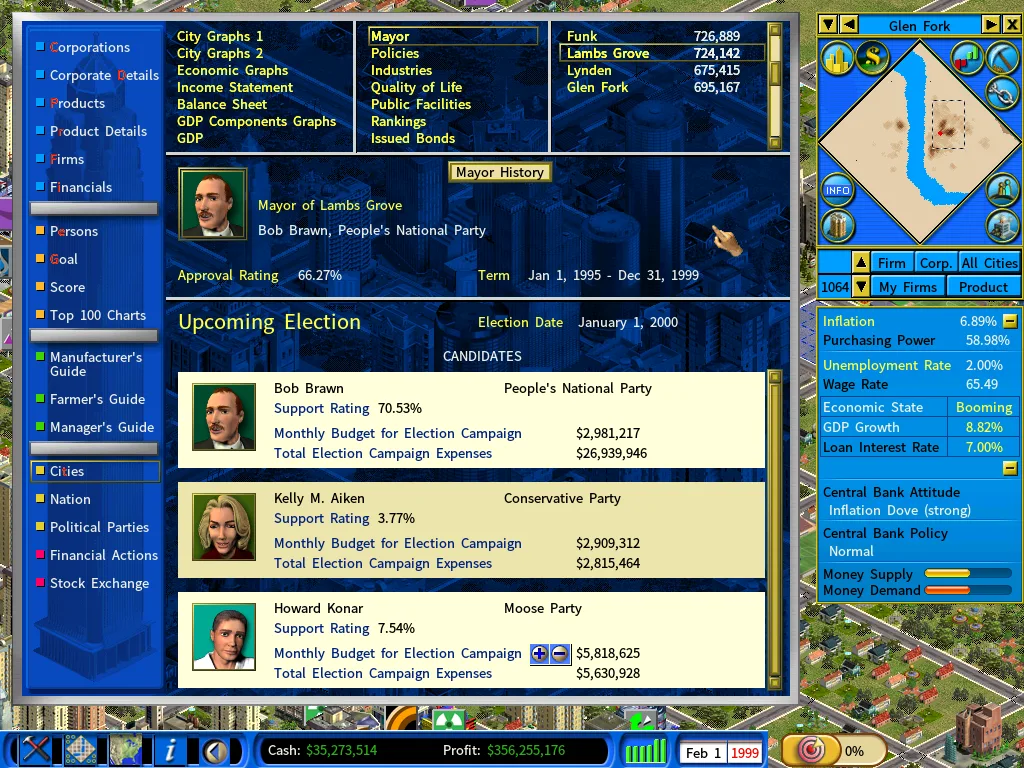
So, too good to believe but we have a candidate running for Mayor in Lambs Grove. We intend to spend the 70 million from our party budget campaigning there and we believe we'll be able to make Howard Konar (we found him a new job already!) our man in the City Hall. As you remember we wanted to lobby the Mayor there so we can clean up the messy net of supermarkets on the CBD.
We'll also have a chance to take Funk if the other parties overspend spreading their cash campaigning in all cities. We'll see.
Thanks for reading.
Chapter 26 — 31 May 2018
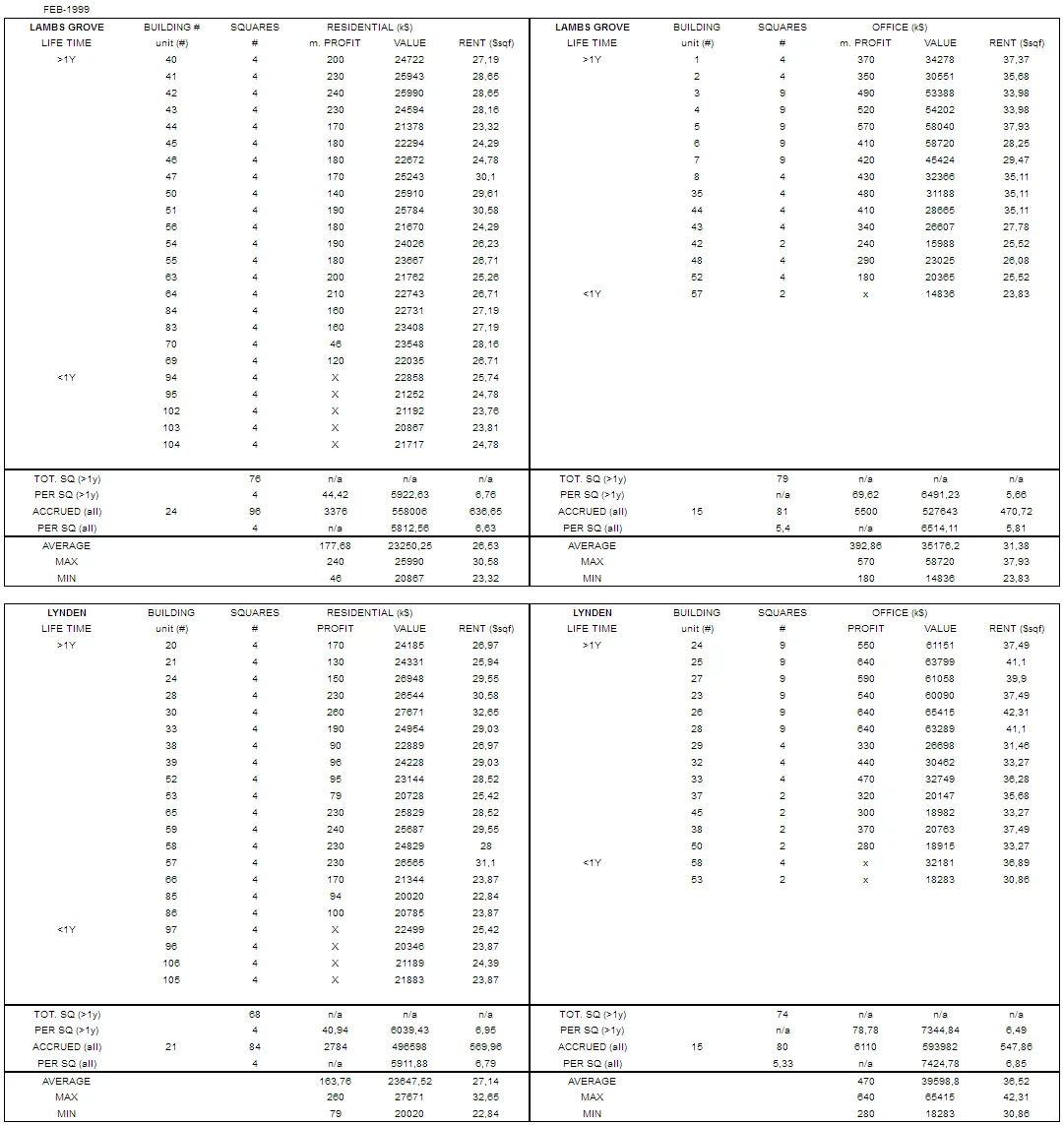
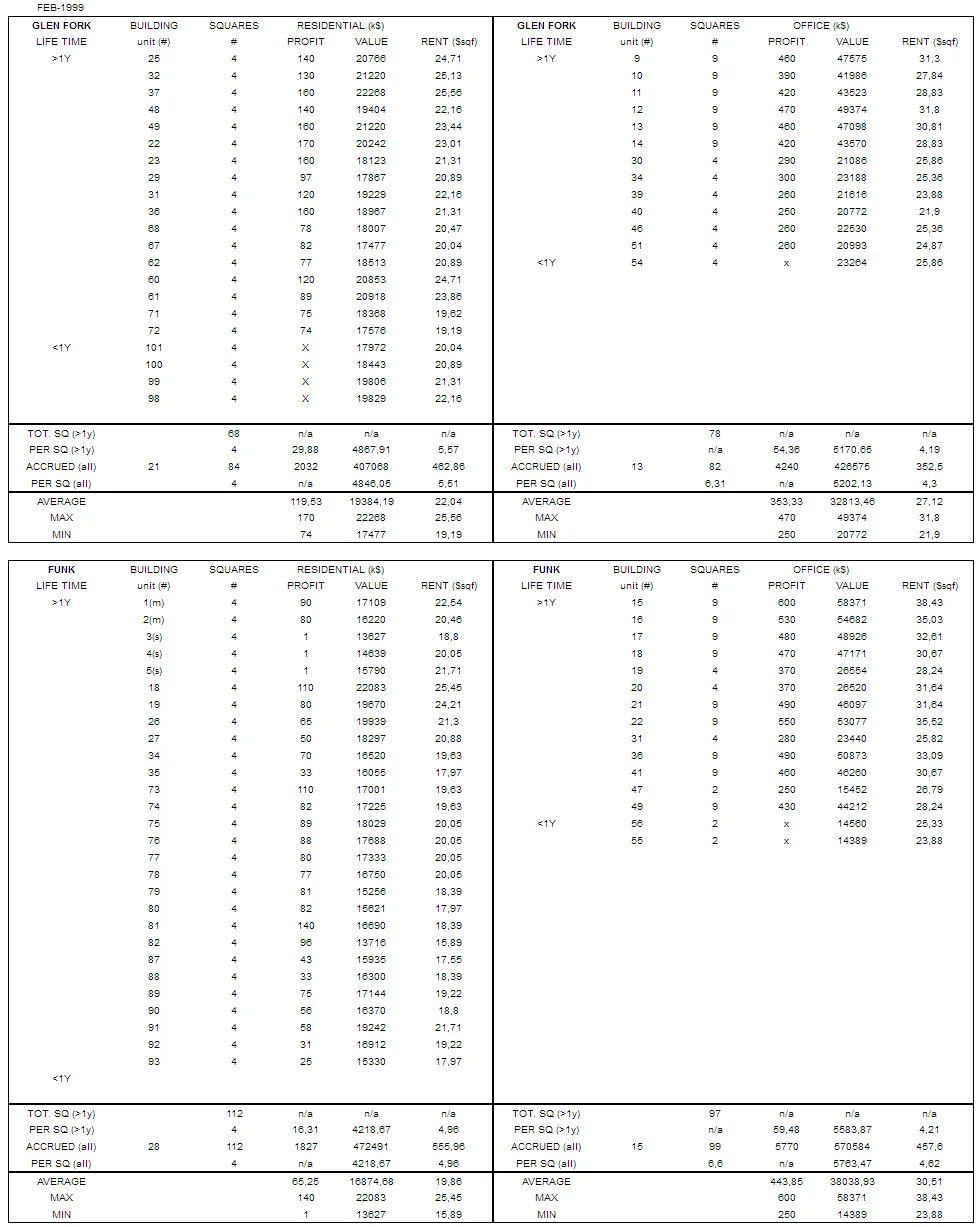
Finally, the report on our RE firms. We have split it in two as it was becoming too big.
Lambs Grove and Lynden (rich cities)
Glen Fork and Funk (not so well-to-do cities)
And also I wanted to add a review on the riskiness of our current debt. For that I have created a simple sheet:
At the top you have the variables (inputs) and where you can locate the numbers (i.e. B.S means Balance sheet, report that I publish every year).
Below you find the outputs:
1- How our debt would look like if we'd sell now all our saleable assets
2- A projection for the end of this year.
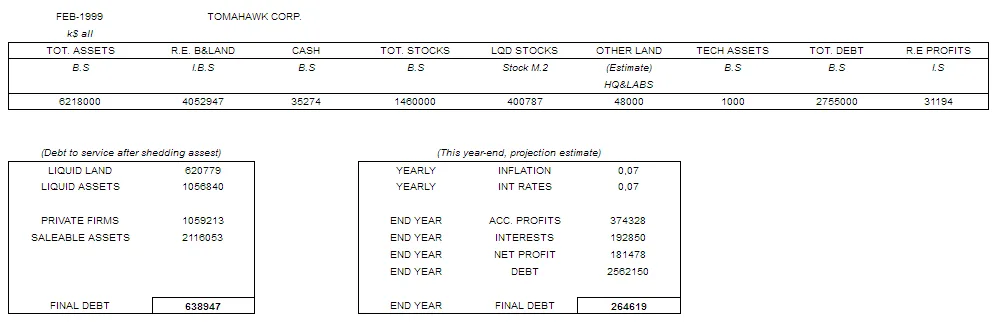
As you can see, our debt remains quite manageable.
Edit: added the save file. Version 5.1.33 (previous version to current one)