
Community Let’s Play · Real-estate AAR
Office space — Part II
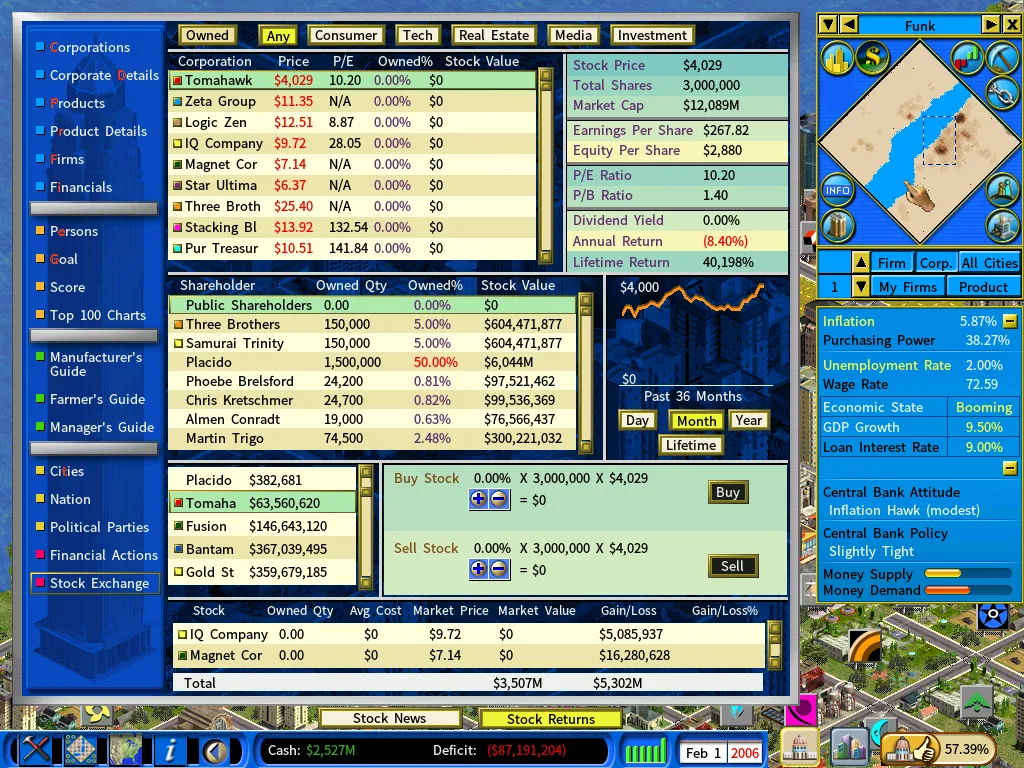
In-game 1990–2006. The story of Tomahawk Corporation, a real-estate empire built on debt in the little country of Sylvania.
Continued from Part I. Originally posted by colonel_truman; reproduced in the author’s own words.
Chapter 27 — 3 June 2018
FEBRUARY 1999 – FEBRUARY 2000
FINANCES:
After 10 years of easy financing, the banking cartel might have decided already it's time to reap the fruits of their fellow's labor: The chairman of the central bank has been replaced, with a view to increase the interests received for their buying of assets.
We don't get financing directly from the CB, but through the commercial bank of Sylvania, our main investor. The loans we get have no maturity and are subject to floating rates, so the whole of it will get influenced by this increase in money rates.
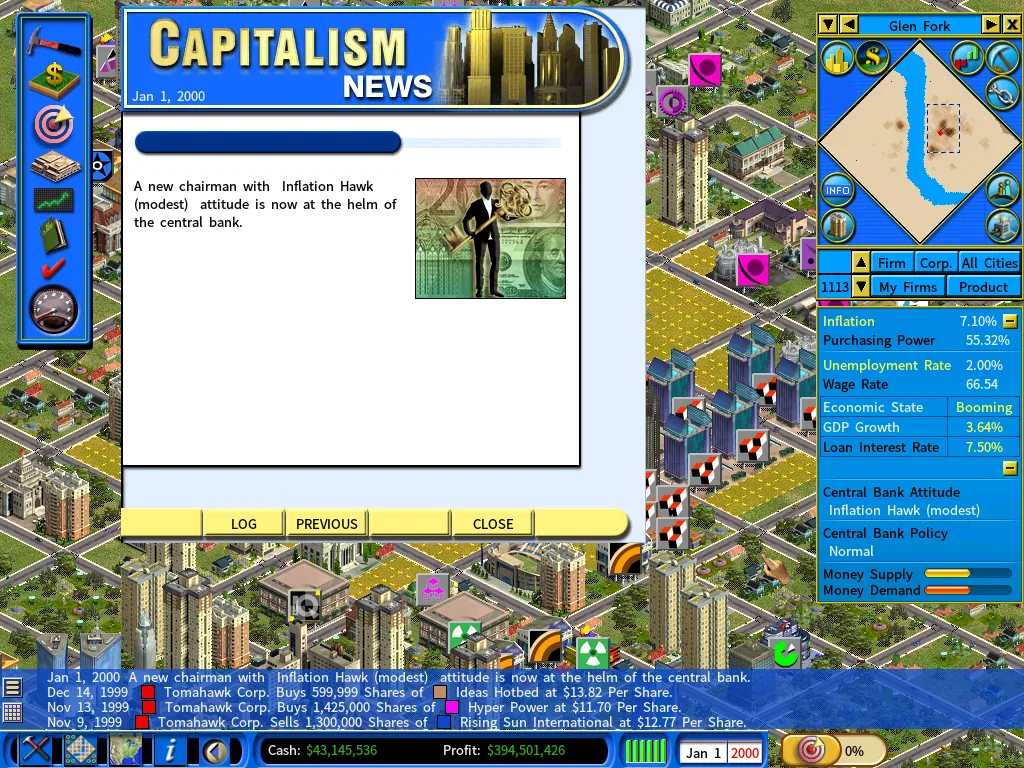
We decided (feb 1999) to be bold and monetize 1 billion of our assets, with a view to expand our business, mainly by capitalizing further our private firms.
As we still find a high enough level of inflation and there's plenty of money around (most corporations have big cash reserves) we think our sale was justified. Altough, we'll be in the lookout for further changes: now we know the trend is reversing.
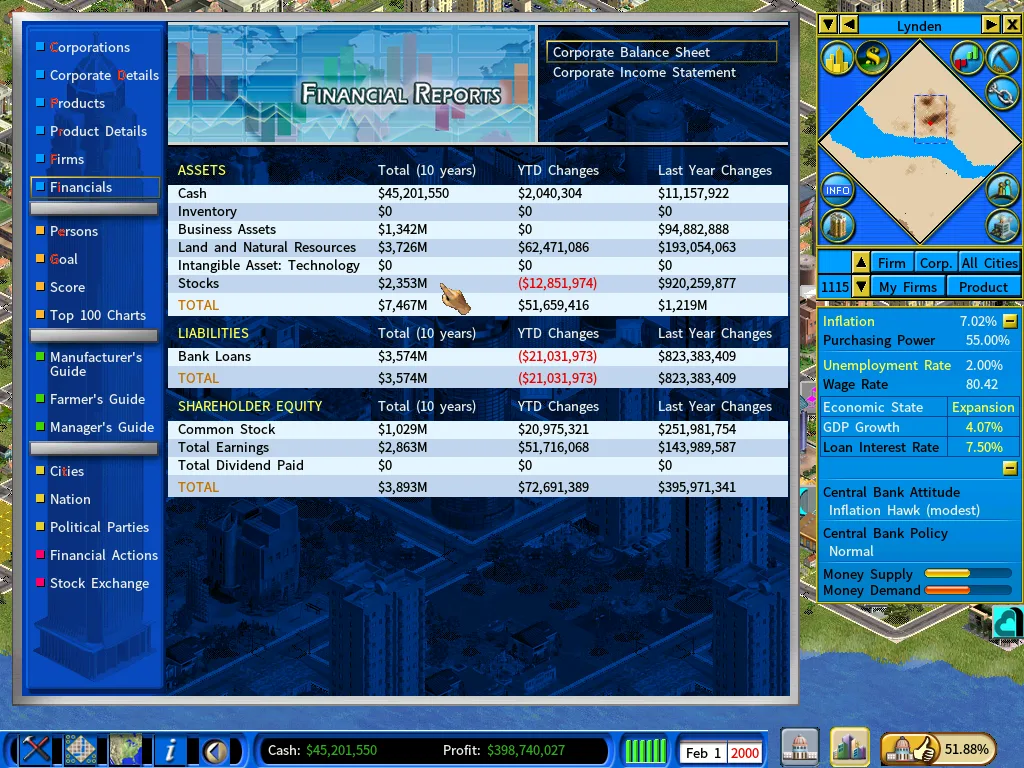
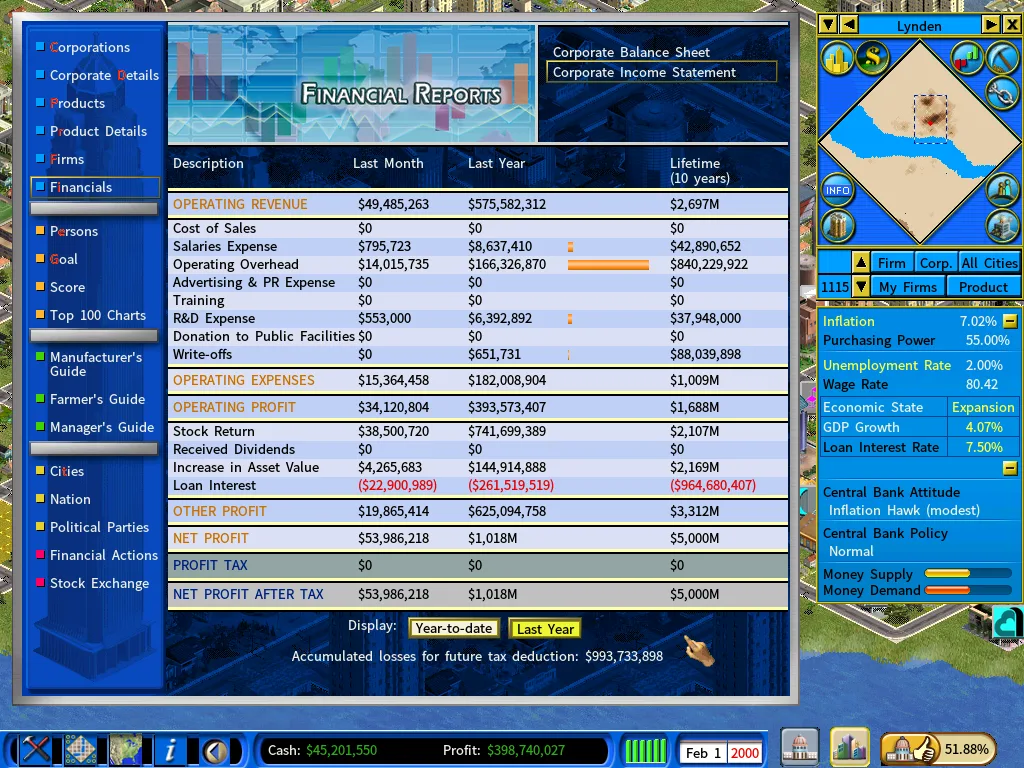
At the end of the year we find the fluctuations on our IS&BS as follows:
Increase in net profits by 3 million (still quite steady).
Increase in net assets by 431 million (notice the increase in the value of our stocks, due to placing most of our new loan there).
Increase in debt by 819 million.
SUBSIDIARIES
No new subsidiaries this year. We Increased their available cash by 200 million to 500 million each and 2 billion total (for the record).
STOCK MARKET
We've been watching how some public companies have increased their debt. Some of these have used it to grow their business, others to try and get out of the mess they're in. So, we have invested accordingly a part of our income.
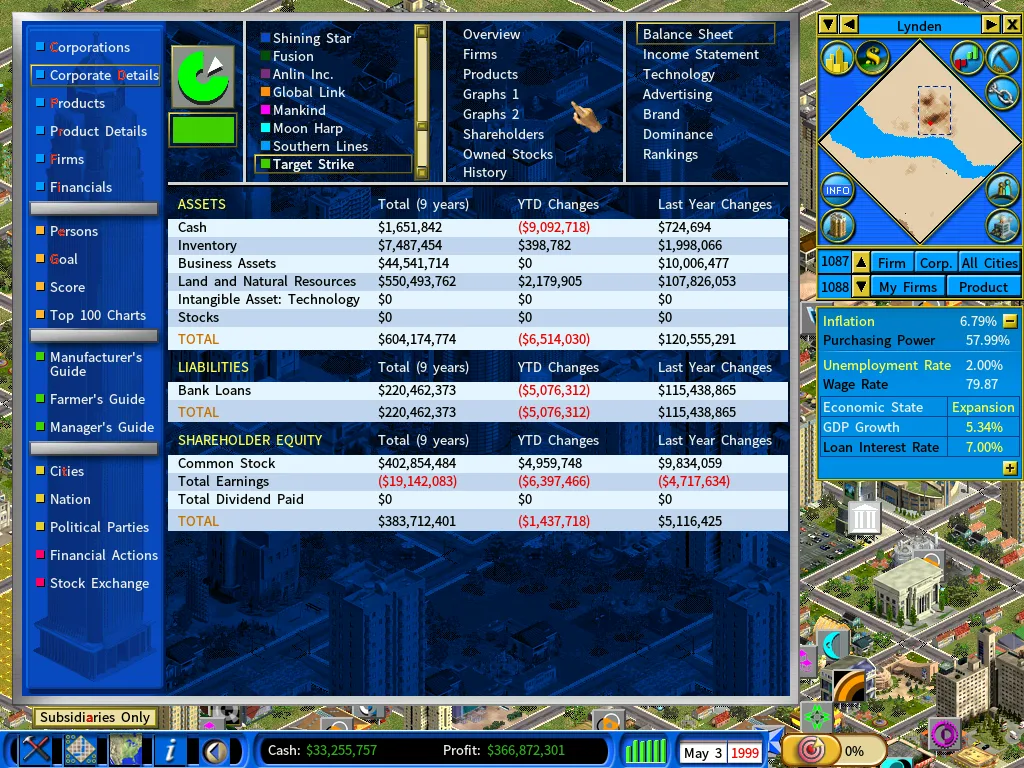
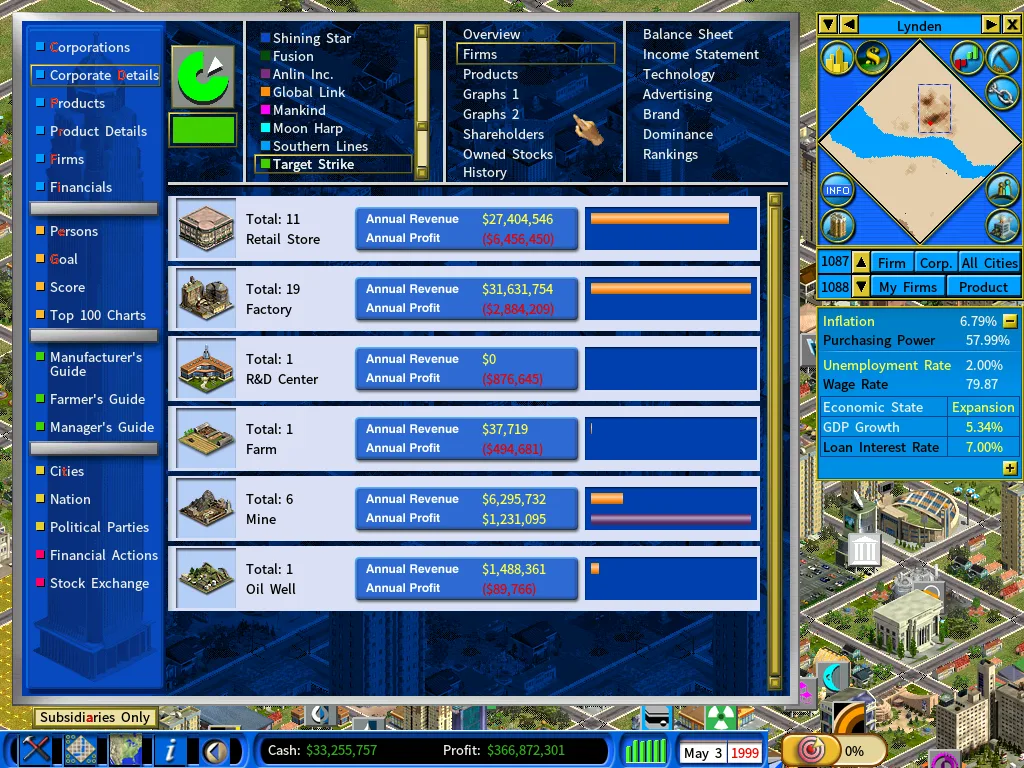
Target strike, one of the automobile manufacturers, is finding itself in a dire situation. The company has many firms running but poorly managed, a big debt for its size and very low cash reserves.
We'll wait and see how the situation develops as we might find a chance to acquire its assets cheap. The problem is, there's a lot of money circulating and it might take some time until they break down.
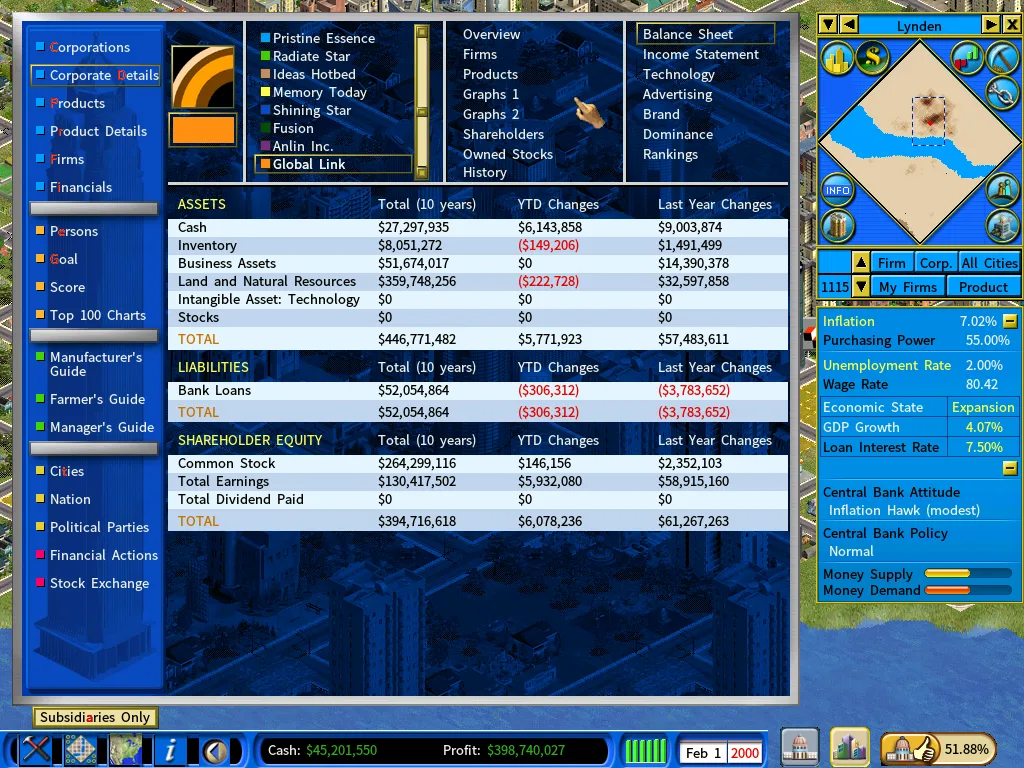
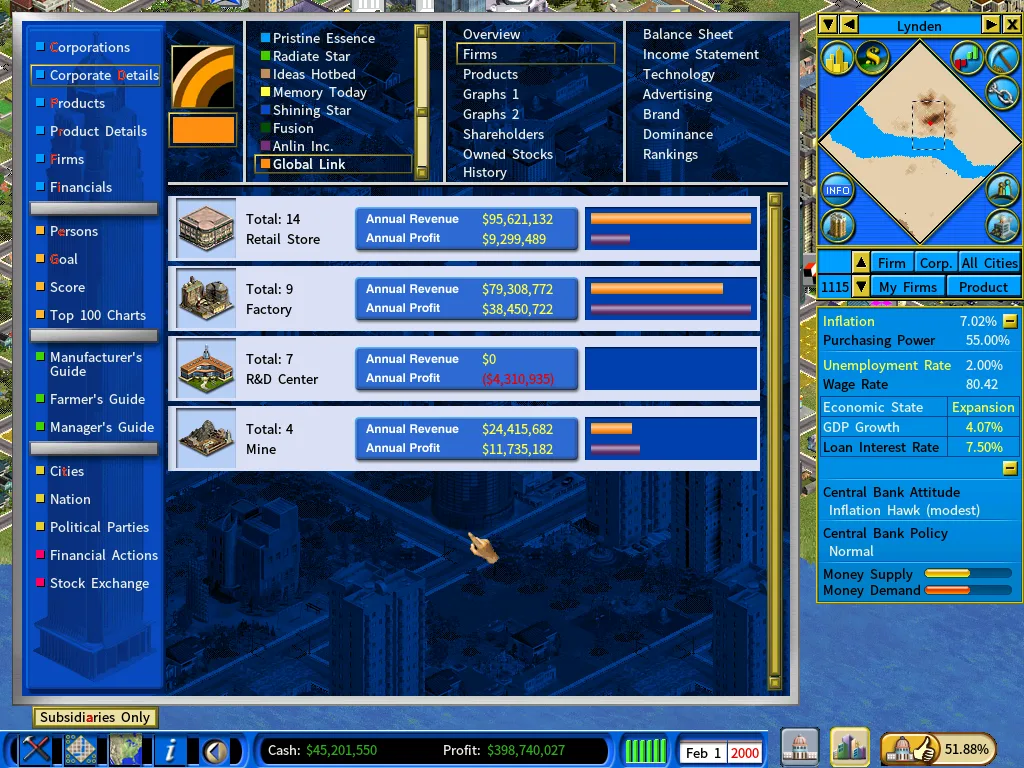
We've increased further our ownership of Global Link, a growth company focused on selling watches. We believe they will use their income with good judgment, reduce their debt and expand their business without diluting the stock. Our take is at the moment 21% of the total shares.
Also, comment that Fusion corp. started issuing new shares (raised 4 million cash by now). They have enough cash for their operations so we believe they've planned expanding somewhere. We'll decide if we shed our stock (34%) by bits in case they expand where we think they shouldn't. Until now they've been a profitable retailer, selling 2nd party merchandise exclusively.
ELECTIONS
We finally got our men in both Lynden and Lambs Grove (rich cities), but the Conservative Party was too strong to be beaten in Funk and Glen Fork.
We'll try to find some time later to comment a bit about the RE situation and the state of the cities we now govern…
Thanks for reading!
Chapter 28 — 4 June 2018
R&D
We have built two new facilities next door to our previous ones in Glen Fork to start researching the jewelry products (our CEO's expertise) and one to start developing a new car frame. We're still mainly focused on the automotive industry.
CITIES
In Lynden the previous mayor was too easy with taxes (actually so easy it encouraged the set up of an industrial base). Now we find it has very low cash reserves and pretty soon we'll find we have to borrow to keep the city functioning. Our first policy then will be to balance the budget by raising taxes at an adequate level to fund all current city infrastructure, without building any extra. Maybe raising corporate taxes will hurt the boom in the food industry, but we have no choice.
Second, we'll lift up the immigration quota and let the natural forces dictate supply and demand.
Third we'll relocate public facilities if we see they are servicing empty locations and they presence is needed somewhere.
Fourth we'll deal with public RE firms: we'll demolish "redundant" public office space, and far-off apartment buildings (the ones without access to services).
And last, we'll clean up the CBDs so Tomahawk corp. can take over and develop the area.
In Lambs Grove we'll do the same but leaving taxes as they are as the city has a billion in cash reserves and a steadier budget.
Once that's done we'll keep an eye on the budgets and make minor adjustments until we see a small surplus. As you see we'll adopt a conservative management approach.
We also believe our corporation will benefit tremendously after the acquisition of the CBD's land. Quite a bounty….
REAL STATE
We have built overall 9 new apartment buildings and 2 new commercial buildings in the cities, 6 of the apartments forming a small neighborhood in Lambs Grove, East of the Stock Exchange. We did notice a big influx of people coming there so we increased supply.
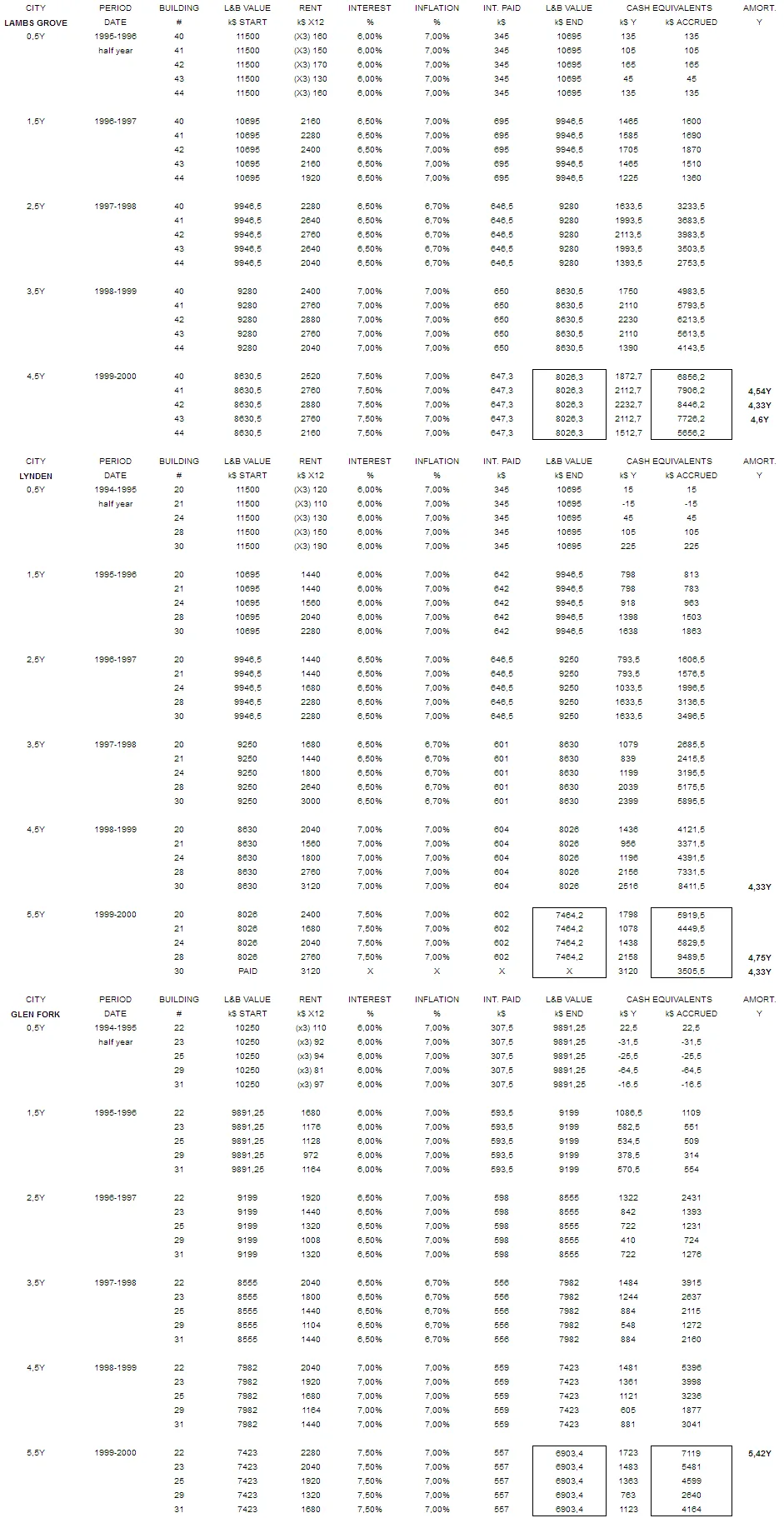
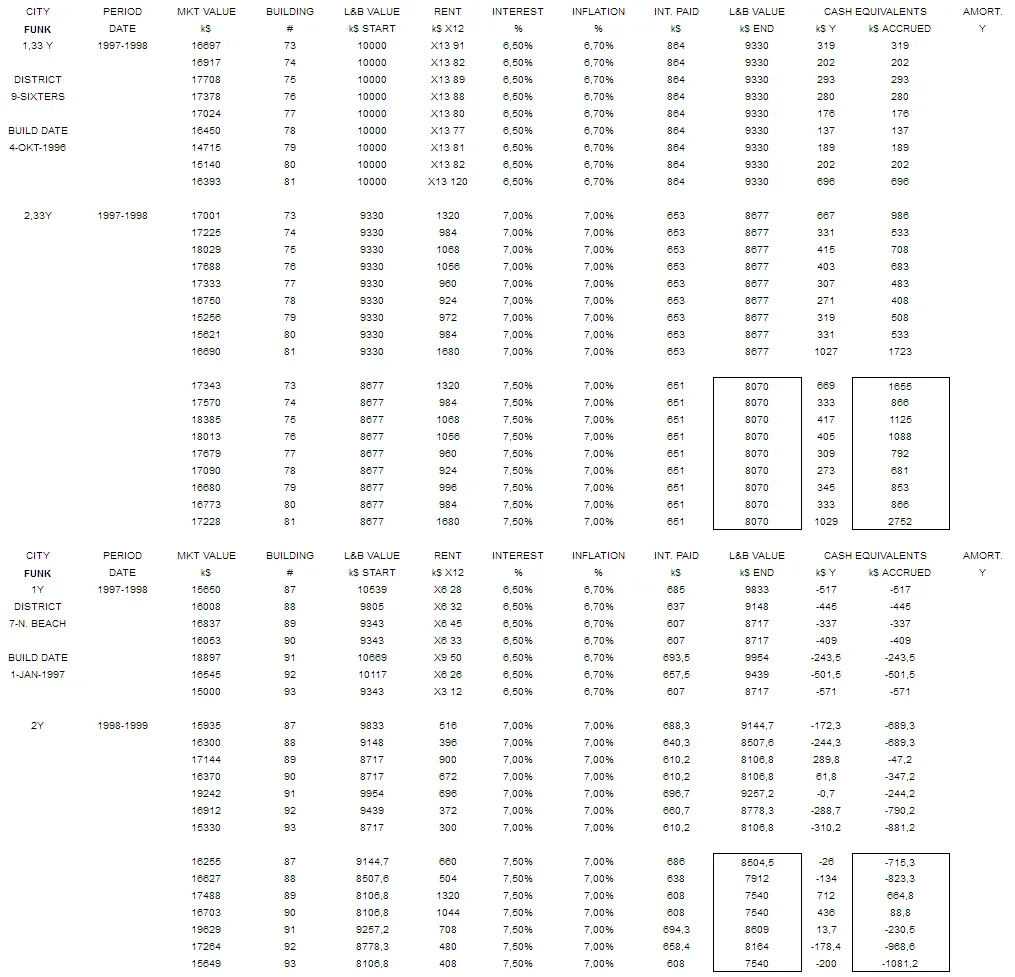
Also, we have updated our profitability sheets:
We have new buildings that already paid off their set up costs in three of the cities.
In Funk we have the beach resort still in the negative for the third year, overall. 9 sixters is doing much better.
We'll keep updating it.
Edited: Added savegame.
Chapter 29 — 10 June 2018
Still February 2000.
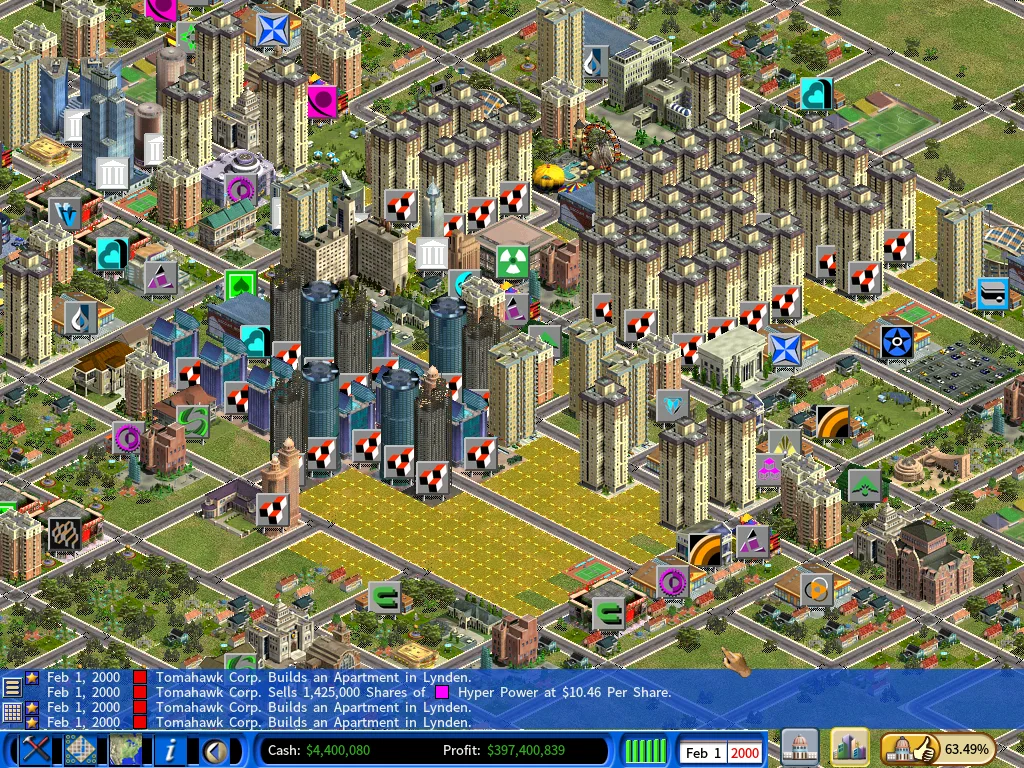
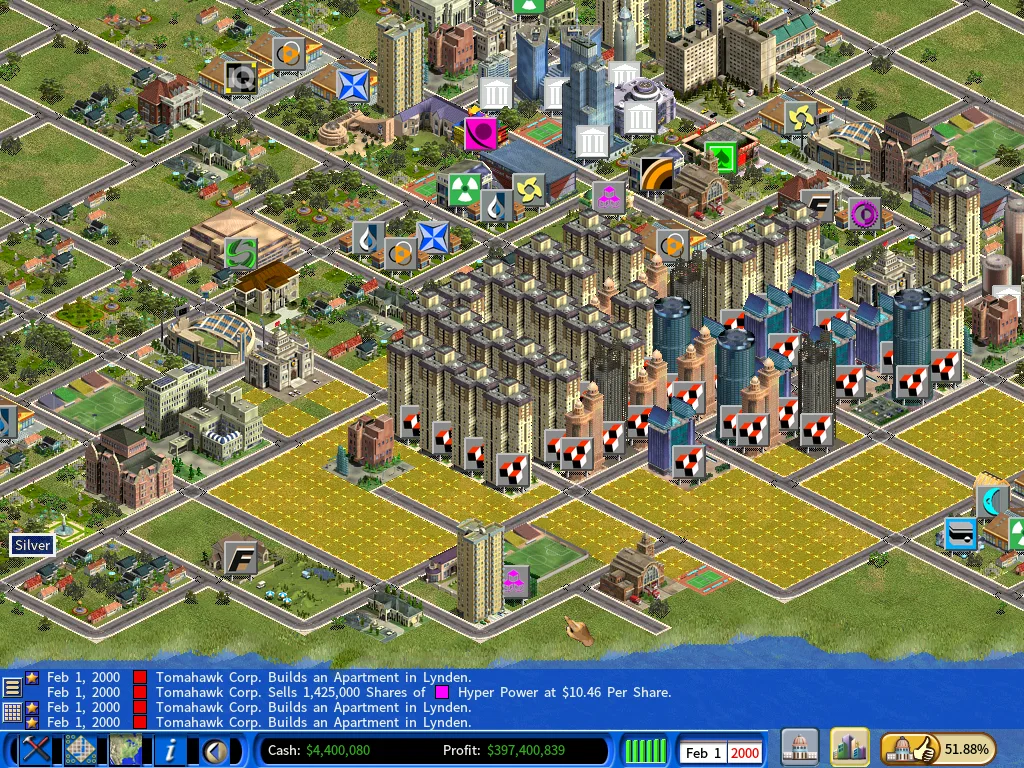
The Mayors gathered all officials from the firms that had to be relocated from around the CBDs and offered them better locations for their stores (all stores, no factories nor farms were involved in the deal). Public office space was scuttled as well as far-off public apartments, and Tomahawk corp. was granted 'carte blanche' to develop the new open areas.
We decided to give it a try and purchase the land in the two cities we govern without any new loans (meaning we bought the needed land by selling other lots, as we have very limited amounts of cash while in a high inflation environment).
Total new land purchases and sales estimate: 240 million, changing hands between Town Halls.
In Lynden we built new public facilities to increase the appeal of our projected new apartment expansion (to the west), so we'll be able to improve our revenue there, as low appeal forces renters to demand much lower rents that average, and that was one of the problems we were finding to make them make a decent profit.
Last, we established new agricultural zones in both cities and an industrial zone in Lambs Grove, as well as expand the city core so no more factories come too close to the residential area.
Here's the city views:
Next, we'll decide if we use a new loan to build new office space and a few extra apartments, as well as increase our stock position in Global Link, or merely our current monthly income plus some cash equivalents sales, as inflation is still high and the new chairman of the CB will probably aim for a 3% real rate (our guess).
Chapter 30 — 14 June 2018
FEBRUARY 2000-2001
So, first things first, we report the four sheets "de rigueur", as every year: Balance sheet, income statement sheet and stock market performance&holdings.
They speak by themselves, showing in numbers the current standing of our corporation, so our comments here, altough provided, are a bit irrelevant.
Inflation went down to about 6% and interest rates up to 8%, so net about 2% RR.
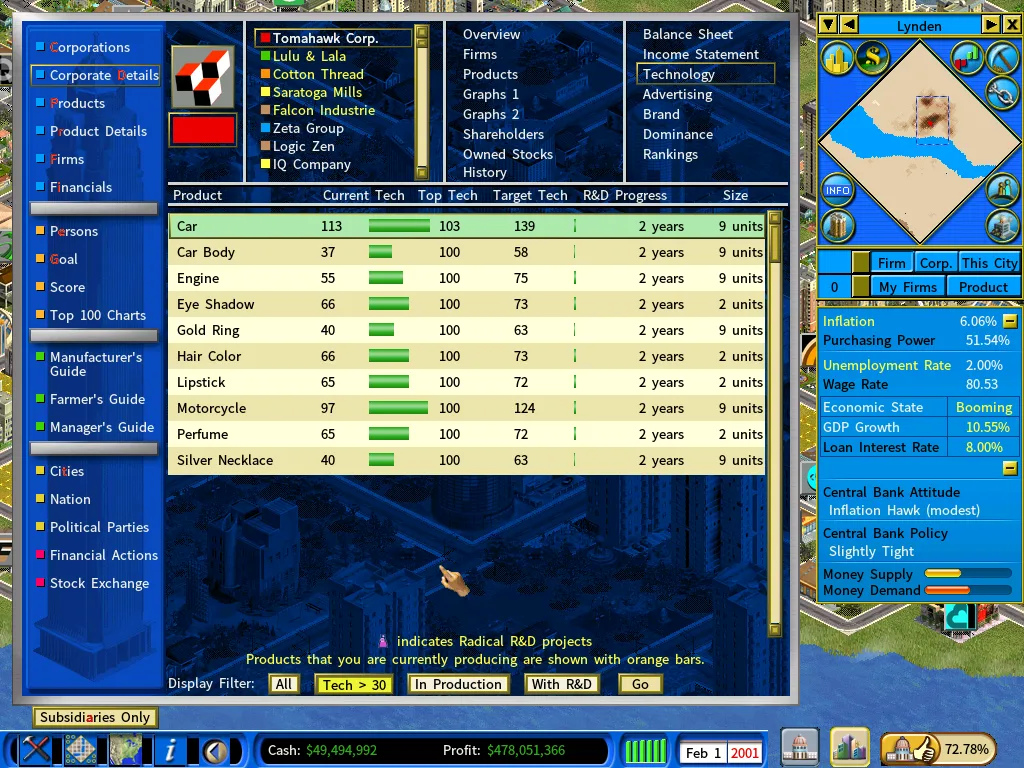
There has been no changes in our R&D department. We're still focused on the automobile industry (thanks to the CTO's expertise), the jewelry industry (our own CEO's expertise) and have one lab trying to keep our advantadge in the cosmetic product class (struggling there, actually).
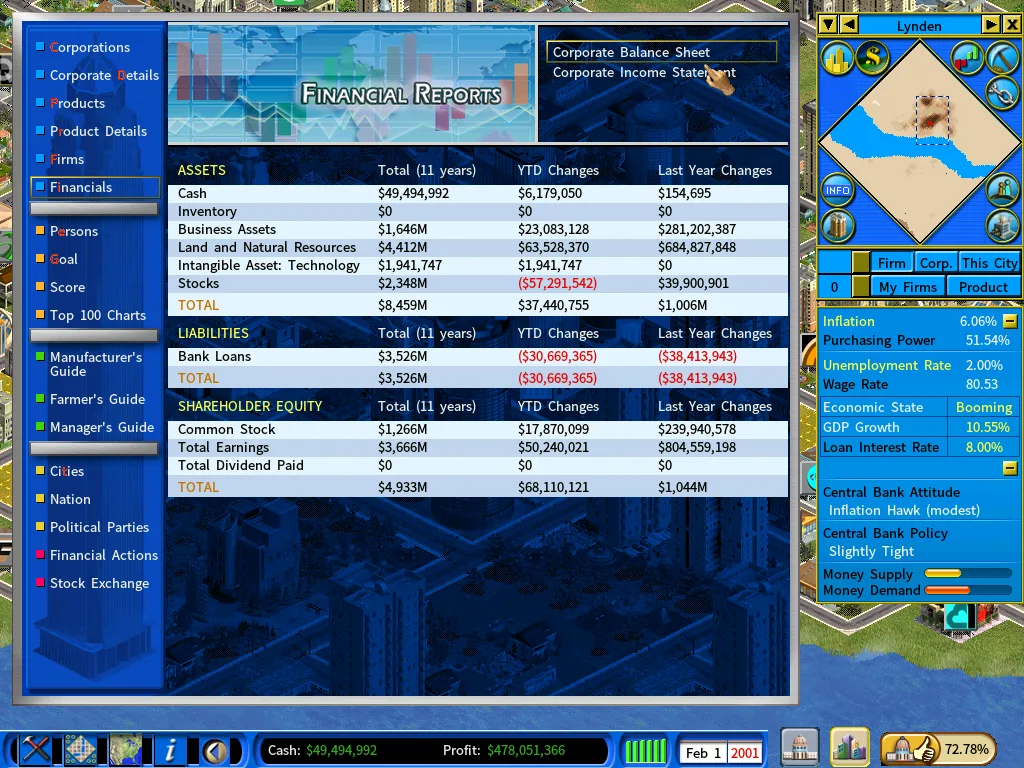
We took a small loan at the beginning of the period to build some office space, but the amount was quite small.
Overall our total debt has decreased a bit. We haven't started paying it back.
The cracking of the CBDs has proved very profitable indeed, so far. Our net assets have increased by 1 billion due to the increase in value in our land&land income-bearing firms.
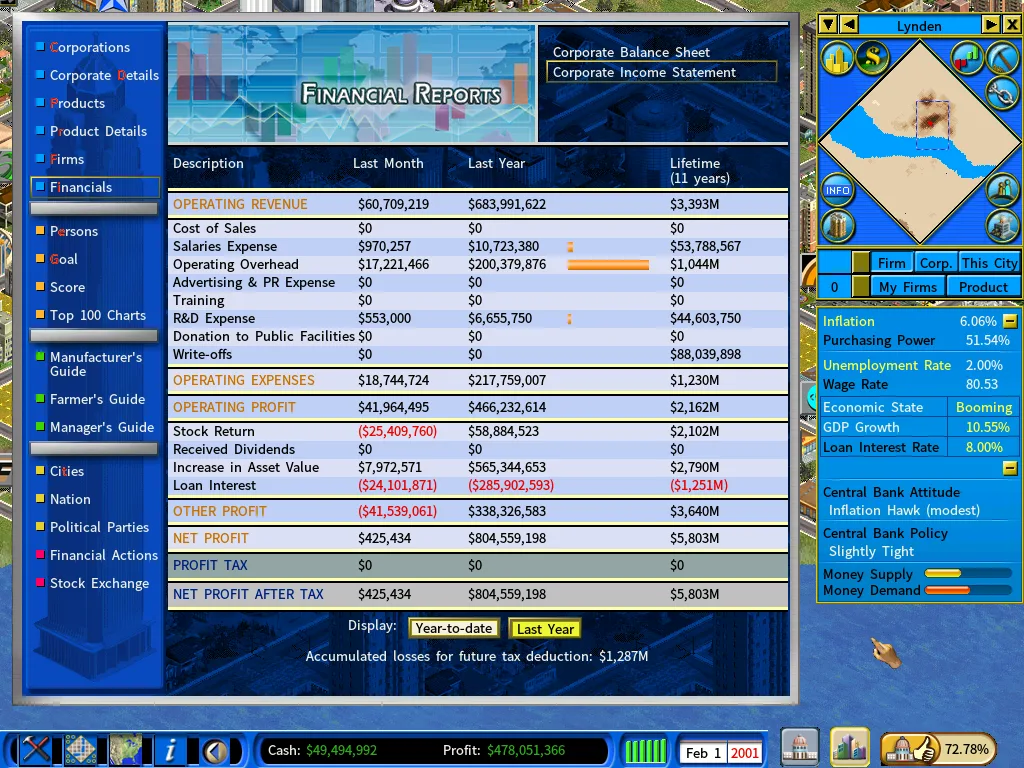
Our monthly profits have increased abnormally too, to 42 million/month. Once we publish our IS&BS for RE firms we'll see in detail where the money's coming from.
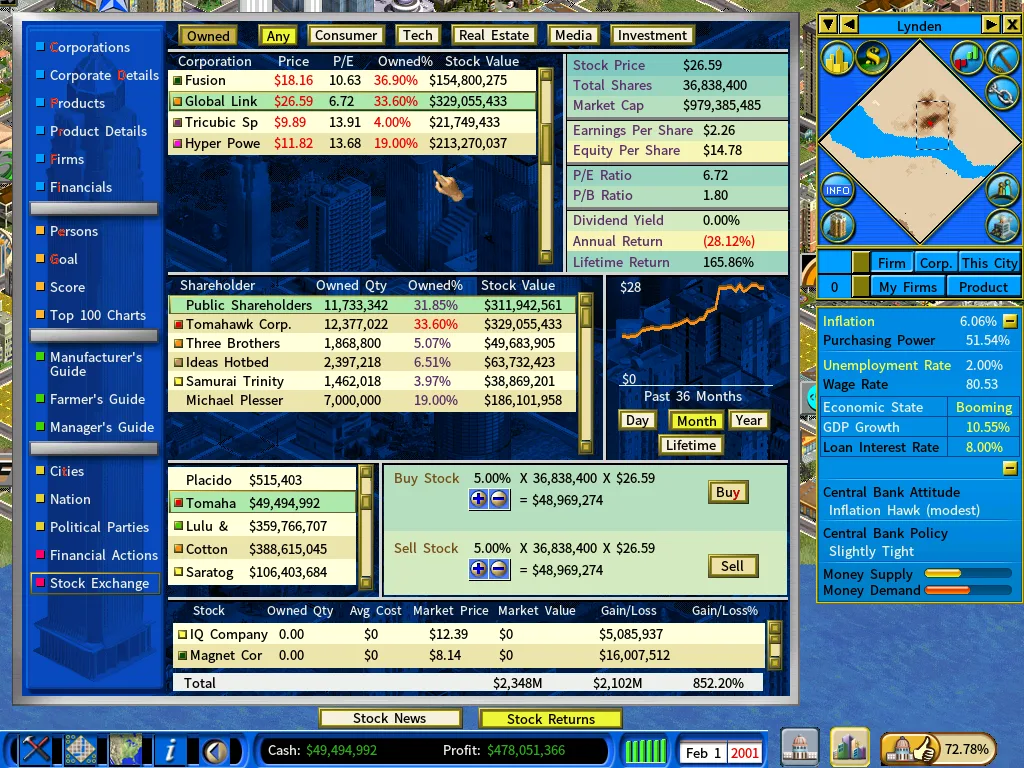
All this has been reflected in the stock market performance, reaching this year a market cap. of 6.5 billion and a price of 2135$/share.
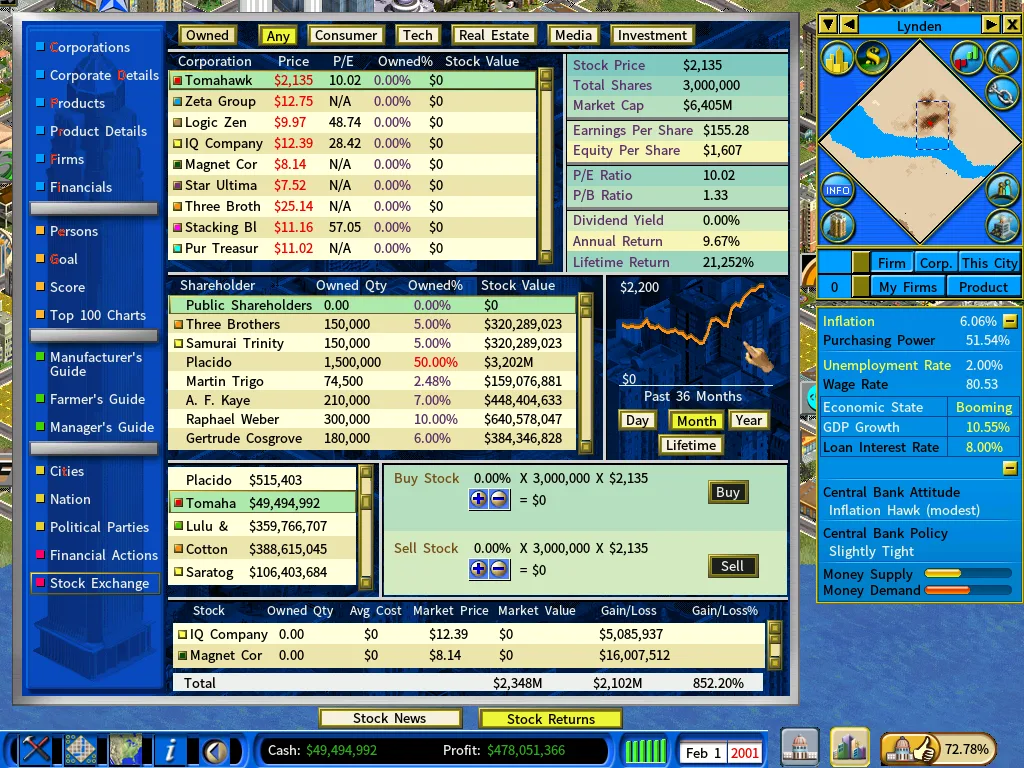
About our stock holdings, notice the sharp increase in our ownership of Global Link. They repaid their debt and are indeed using their revenue to buy back their own shares and to further expand their business. As mentioned before, they focus on selling watches and some jewelry, and have no competitors around.
About our private firms, just Claire Iniguez, from Saratoga Mills, has got the 'animal spirits'. The rest still look quite spineless.
In the next post I'll report the changes in the RE area: profitability, city views, IS&BS for RE firms, and the current state of our debt.
Chapter 31 — 15 June 2018
I feel like I might be making the posts a bit tedious with so many charts. But, the series demands it.
Until now we have found just tailwinds and the corporation has used available credit to go deep into a market without competition, quite succesfully. How far we can go depends mainly on us, on our ability to forecast future conditions properly and allocate our stream of revenue in accordance.
As you well know we're studying how profitable it can be, to build RE firms with "free money". One can always guess how profitable the building of an extra apartment or an extra office could be. We planned to unveil the dynamics of such little investments with some numbers.
So, lets see how we are doing so far with a bit more of detail.
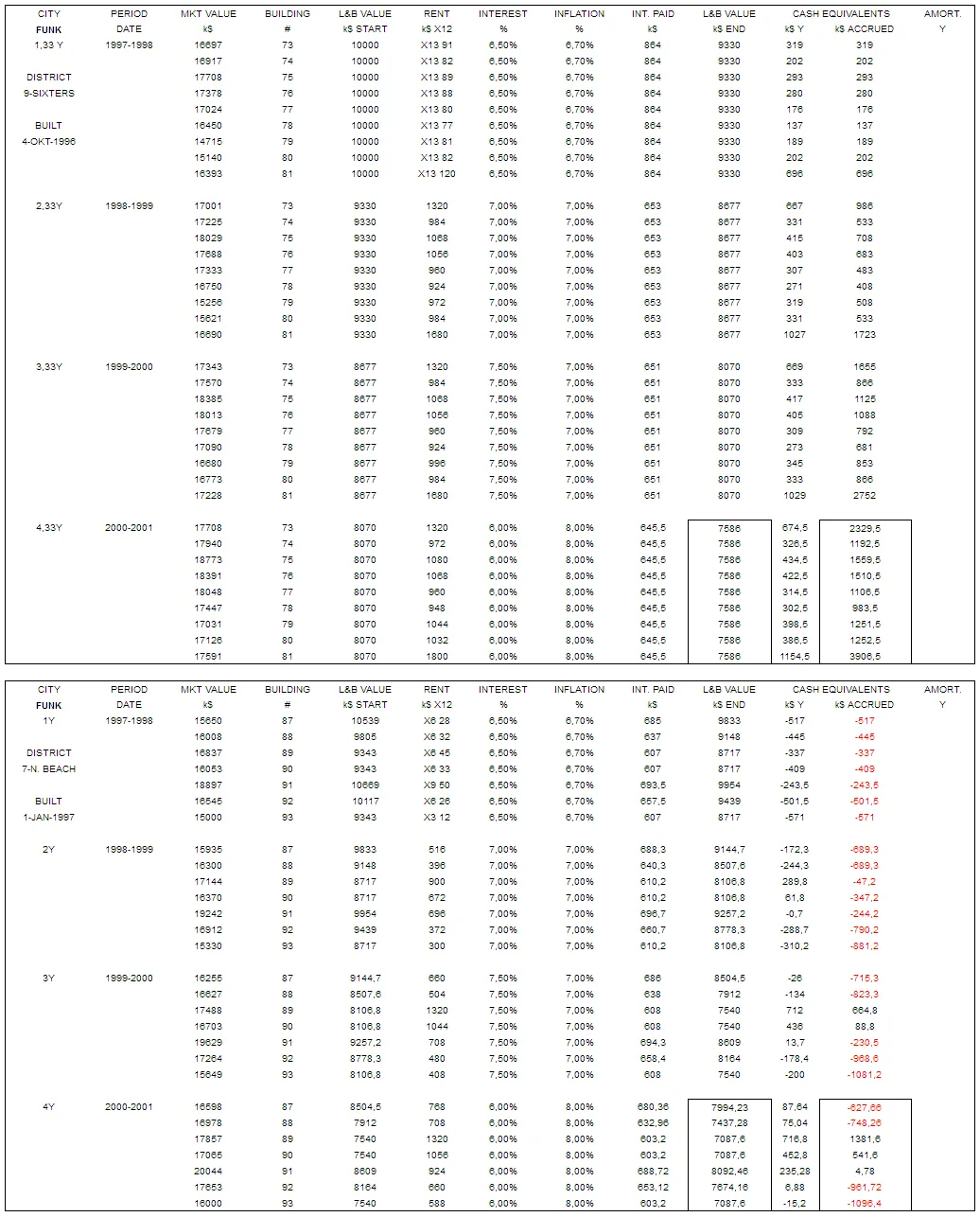
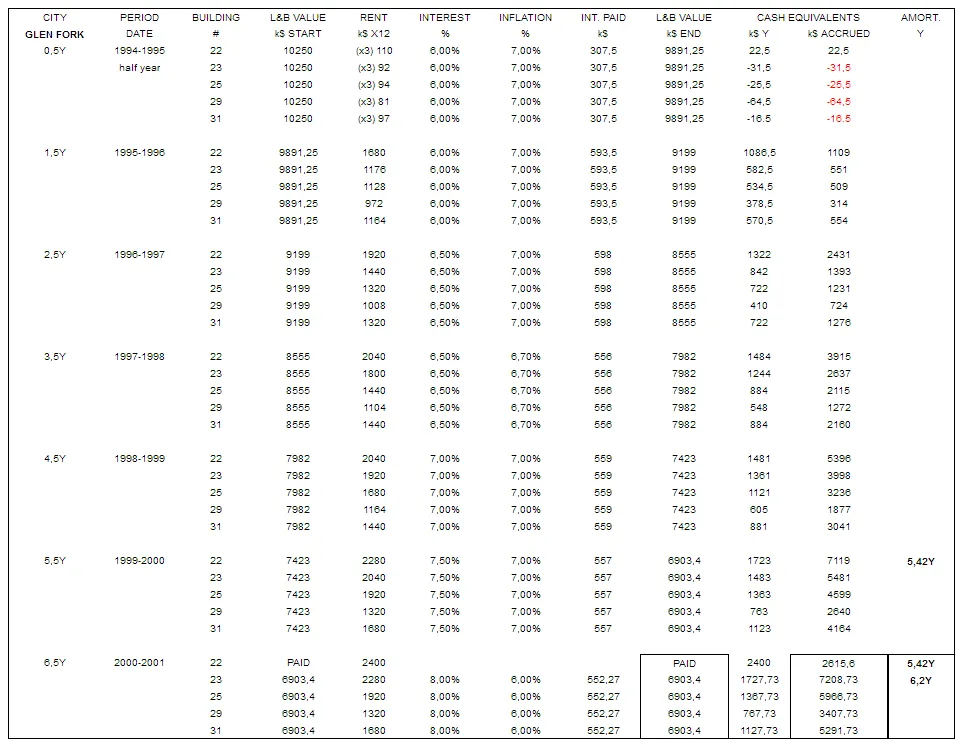
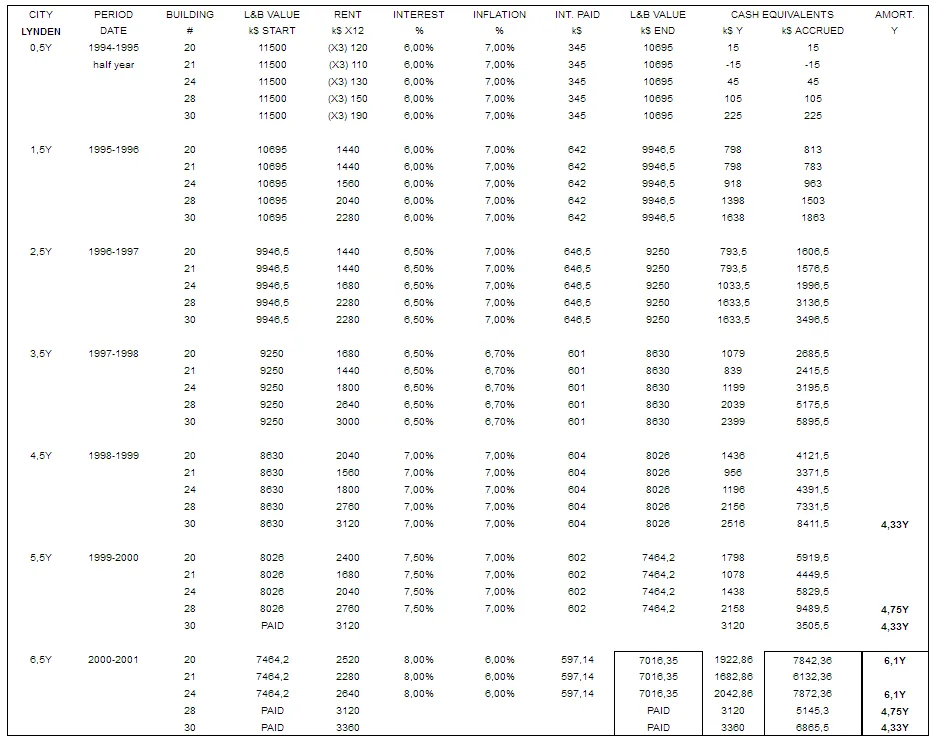
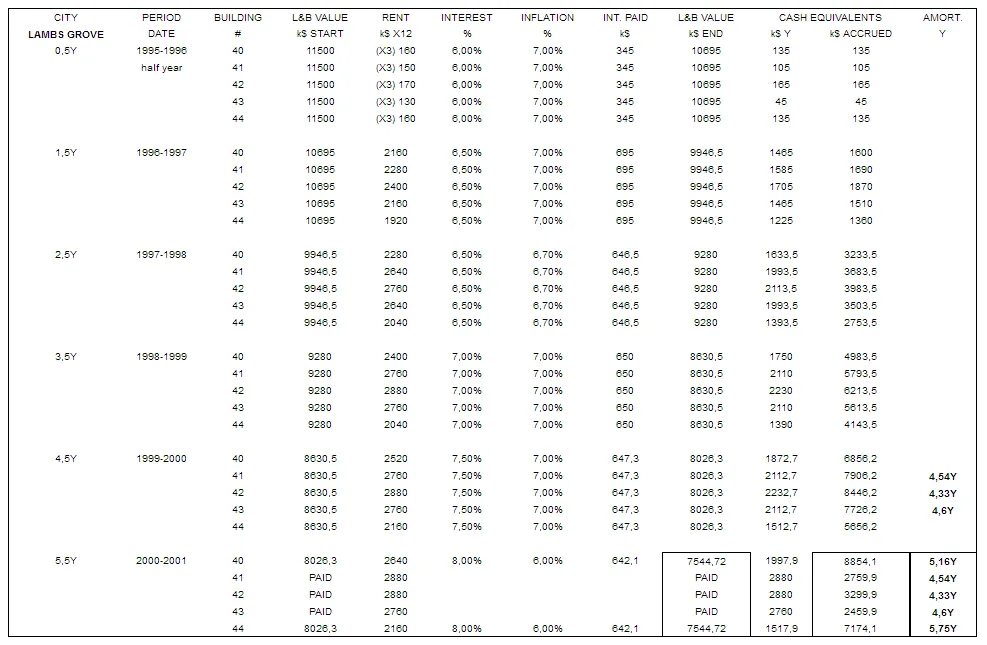
The next four charts show the progression of a few residential buildings built in each of the cities with the so mentioned "free money". The rent derived is used to pay the interests of the credit used, and the surplus "stored" until there is enough to repay the principal fully.
Most of the chosen buildings (the first ones built in most cases) are, after 6 years, showing a net profit. From this point on, the quality of the investment changes from risky venture to steady annuity.
You can see too that there's a district having some difficulties. We'll deal with that later, as such underperformance shouldn't be taken lightly considering our total current liabilities.
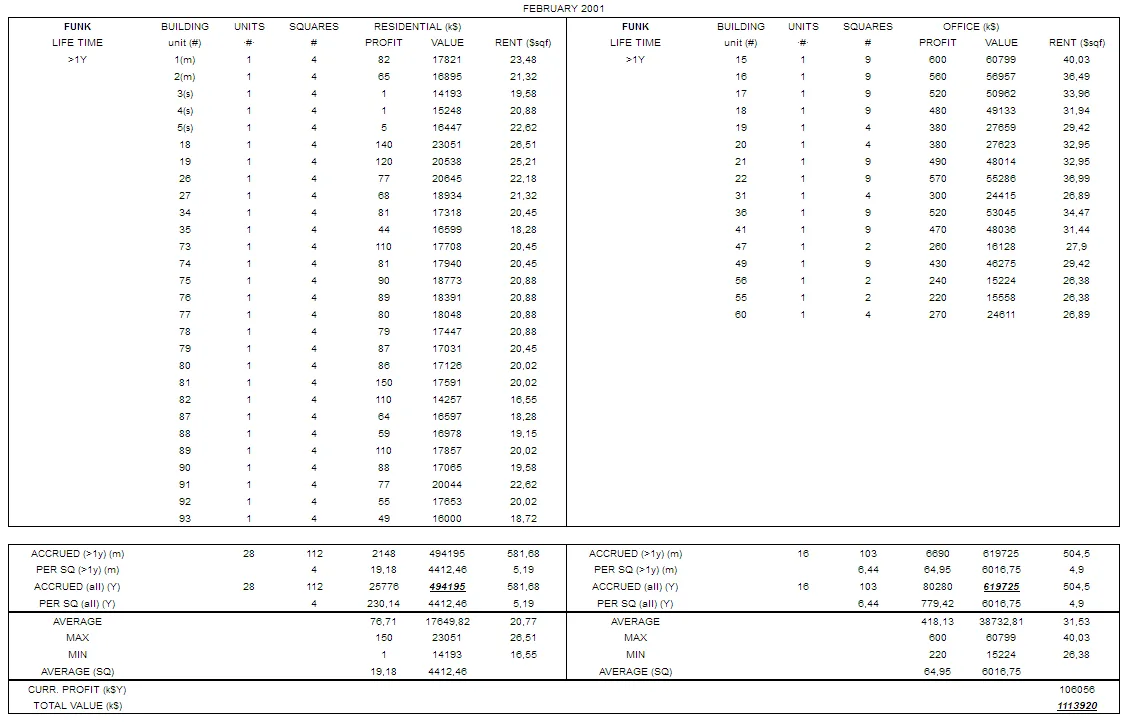
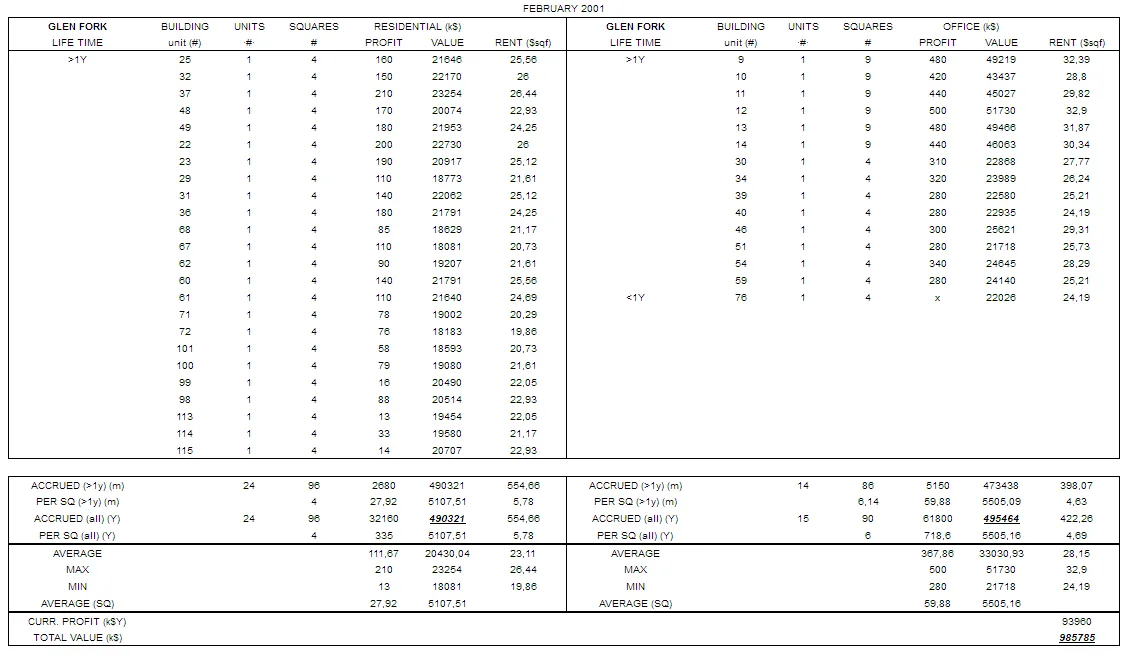
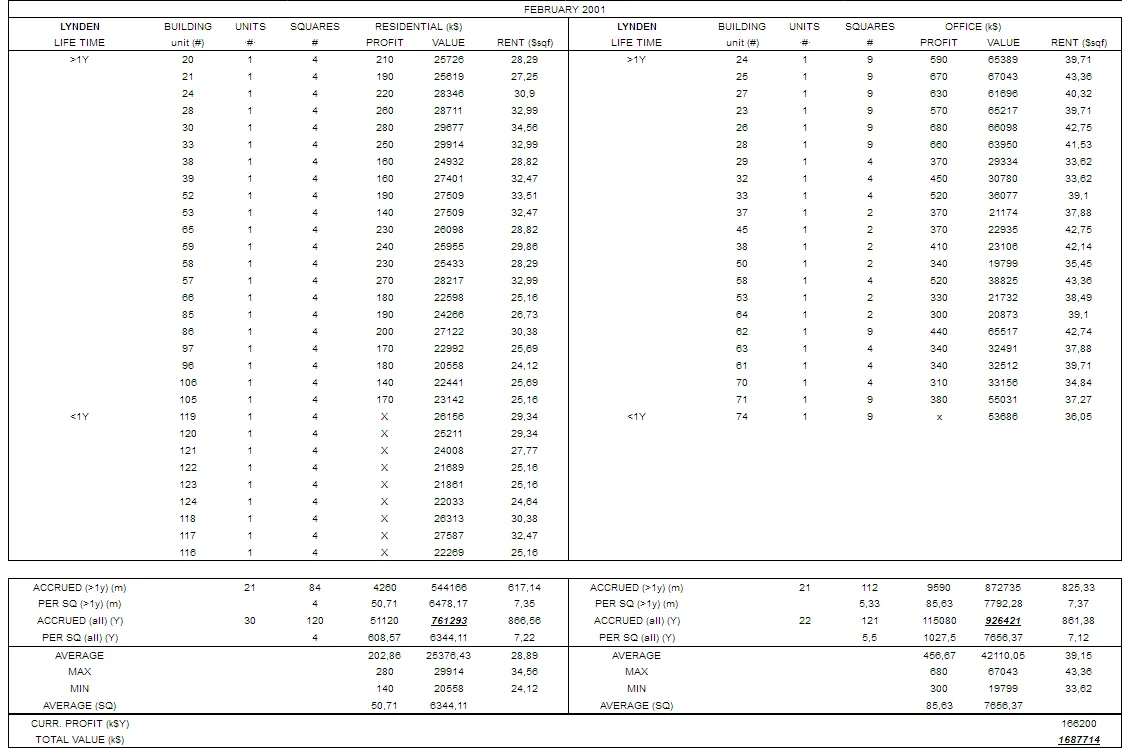
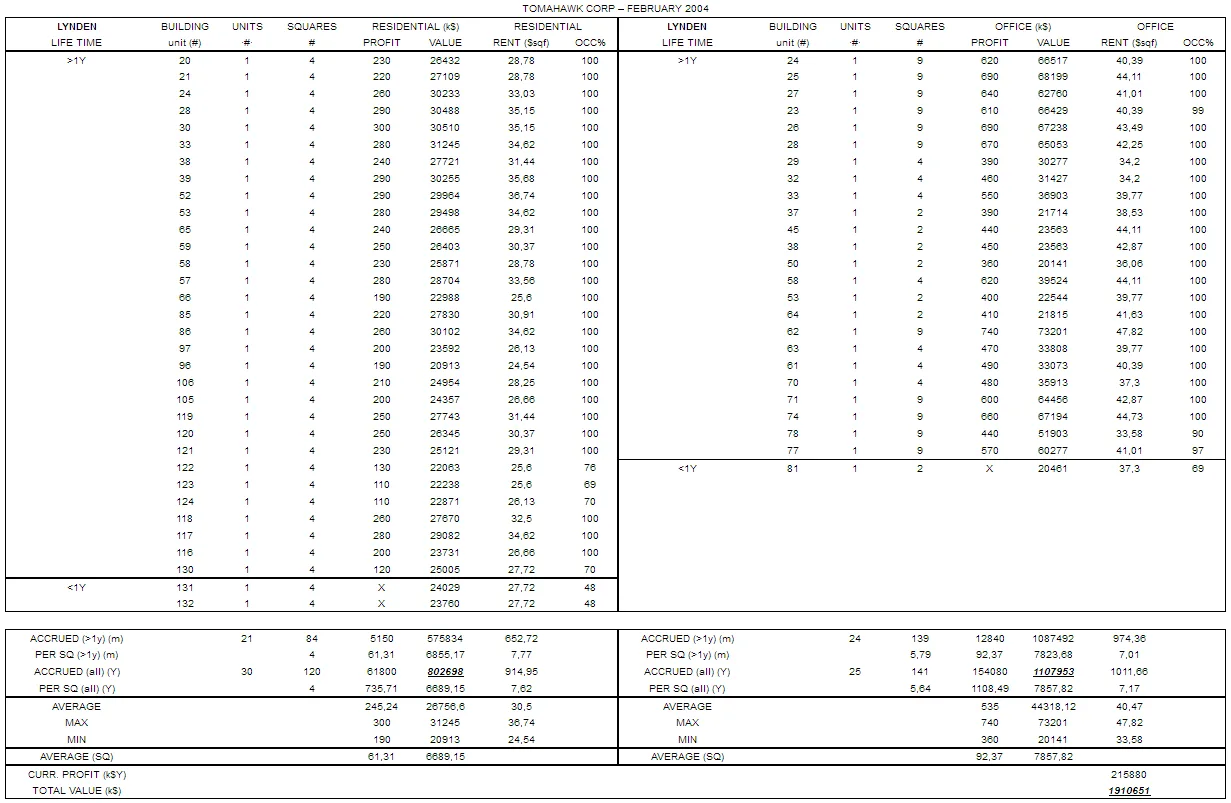
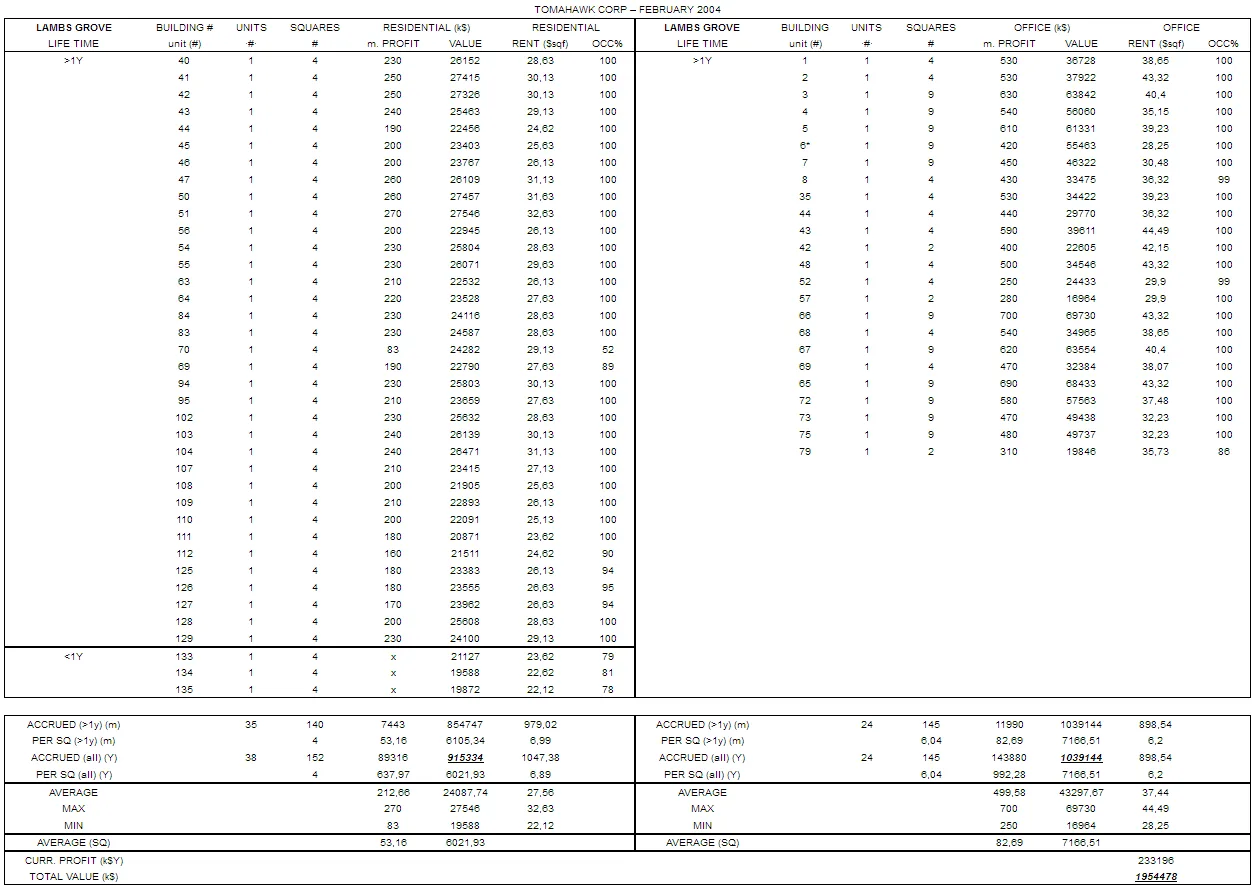
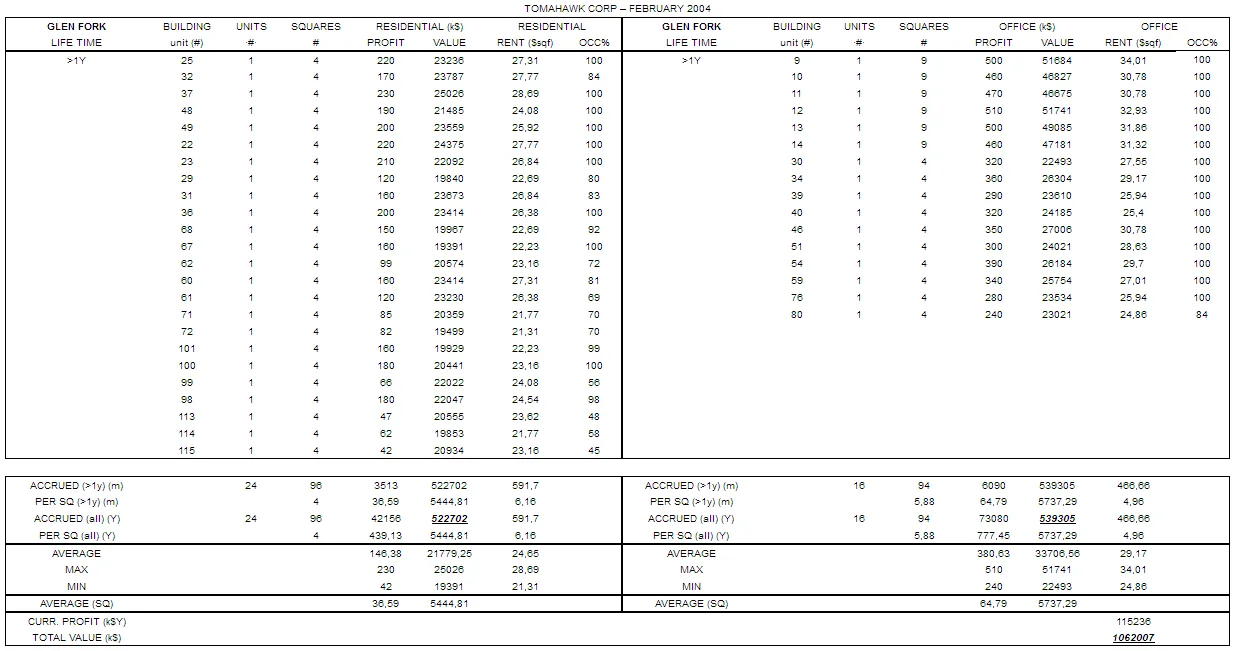
Next, we offer a detailed summary of the performance of all our RE buildings in all cities (the IS&BS for RE, as we call it), by city. Being the two most important parameters profits and value (assets), we focus on them.
Apart from showing oddities, which we can try to correct visiting the firm in question, the data helps to understand our profitability in terms of our assets, also by making the information available per square of land. Finally we get to know how much land we have available for sale (the "liquid land" we mention) in case financial (global) conditions turn against us and we have to start selling it.
(note: we have improved the structure slightly from previous posts).
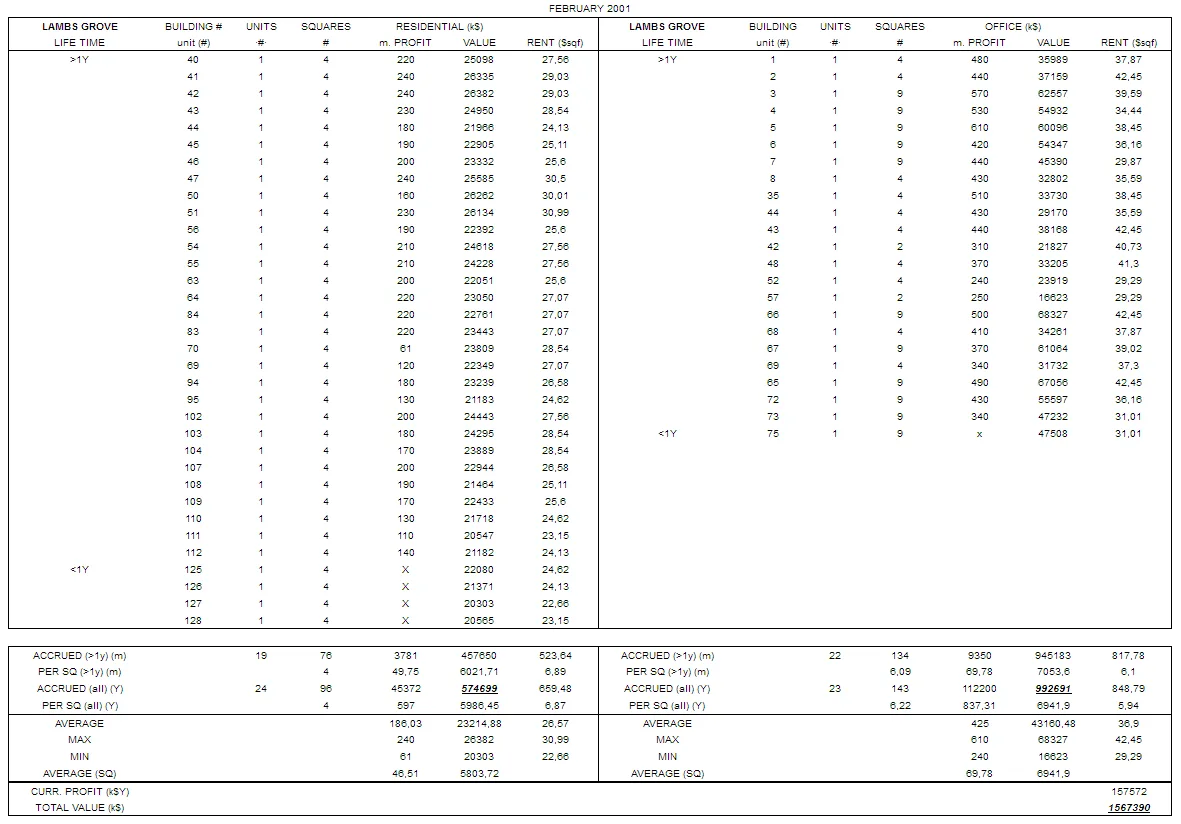
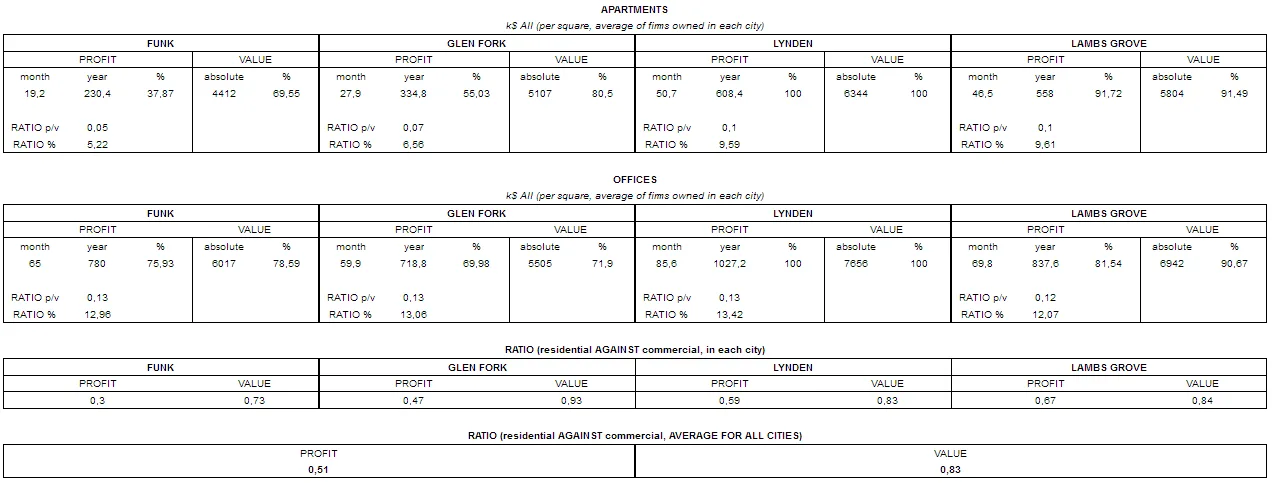
This new chart shows the average profit and value we get, per square of land, in each city, as well as compares the performance between cities and between apartments vs offices.
The ratio% value would be the "dividend" we get each year in each city per class of building.
The data is gathered from the IS&BS for RE.
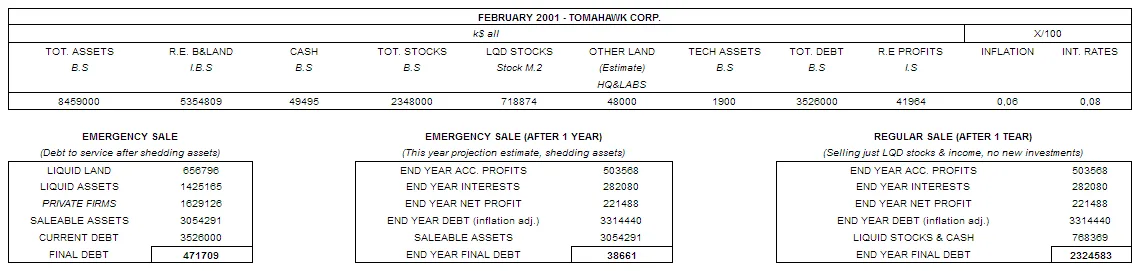
Finally we have the financial situation chart, to understand our "real" current position regarding our liabilities, and how we could best deal with stormy weather ahead, considering three different approaches: an "immediate" sale campaign (maybe I went too far by including here our Private firms); next, a sale campaign for next year; finally a conservative course.
Chapter 32 — 17 June 2018
OK, so what to do next? Where's the next money maker and how could we participate?
We've been saying before that conditions are changing, from cheap to expensive money. Also, inflation will be constrained, as loans will become both harder to come by and service, and so money available to invest. New projects financed through debt will have to show higher margins of return and current ones will find they must make "adjustments" to stay profitable. Those already unprofitable will probably go under.
We have no saying there so we must accommodate.
As proven in our last post, our debt remains manageable. We just have to detect when servicing it will become the most profitable investment around.
What's our current return, from the value of our invested money? For now, we can take a look at the comparison sheet (last post) and see very decent returns everywhere in most of our RE firms. The lowest being the apartment districts in Funk, with a 5,22% return on value, so we'll focus there. Next is the apartment district in Glen Fork, with a 6,56%. But debt has not been considered…
Assuming we get higher real rates in the future, these apartment districts will become a burden unless we can improve their profitability: We might rise the rent to squeeze the current tenants or lower it to attract new ones. We could adjust some buildings on the one side and others on the other and see both reactions. Time is an issue so we must compromise.
Another option could be to "package" them into an "investment vehicle" and sell them to willing investors. They will become subprime if real rates widen too much, but shhhh…
Let's see:
Current public corporation's quoted prices are 1.5 times book/value, easily.
We have about 500 million in property value in apartments in both Funk and Glen Fork: 11,63% of our total assets.
That could be about 1.5 billion worth, if made available to the market.
If we reduce our debt by 1.5 billion we save 120 million/year. by 1 billion we save 80 million/year.
Current yearly profits of both "packages" are 57 million/year. We assume we use 11,63% of debt payments to service them (33,5 million/year).
If inflation remains at 6%, the 11,63% of our apartment packages assumed debt, 410 million) decreases by about 24,5 million, this year.
Interesting puzzle.
Aren't they subprime already?
Also, in case we proceed, we'd like to make them available to investors one year before they become subprime, so there's ample time to become a target for the investment companies money-shuffling, and to use some public relations to enhance their perceived quality.
Opinions are welcome. I'll try to work out an answer.
Thanks for reading.
PS: the save file. Version 5.1.33 (sorry)
Chapter 33 — 17 June 2018
I've been playing a bit with some numbers and this could be the answer to our worries (another sheet, for your amusement).
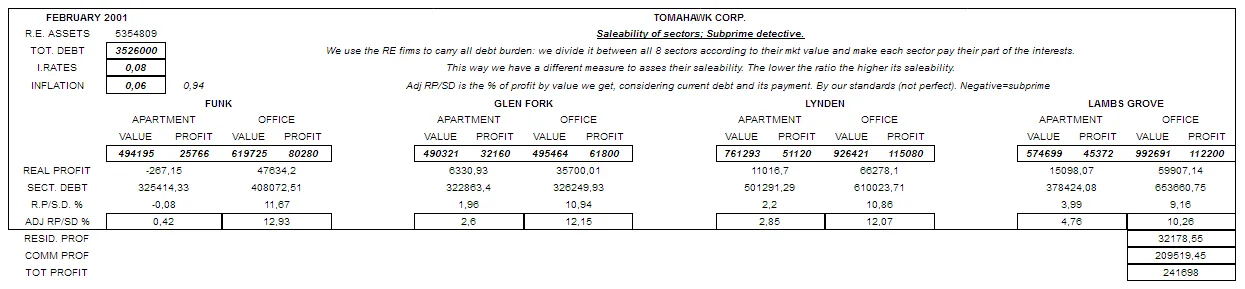
We've called it the subprime detective.
A brief explanation, as shown inside the sheet:
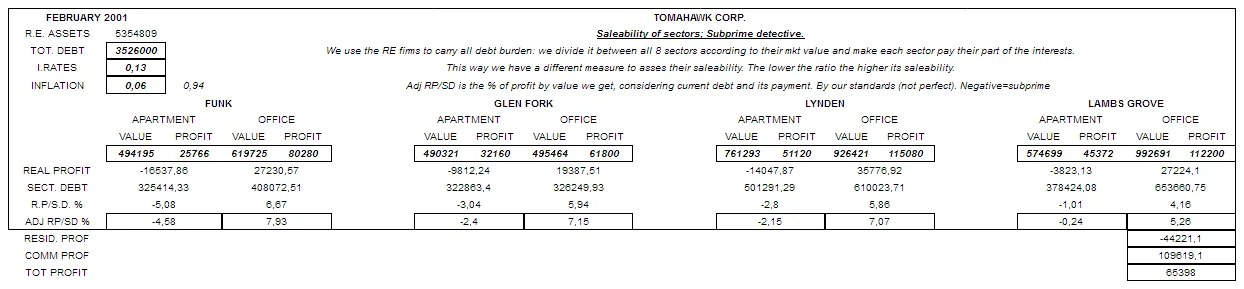
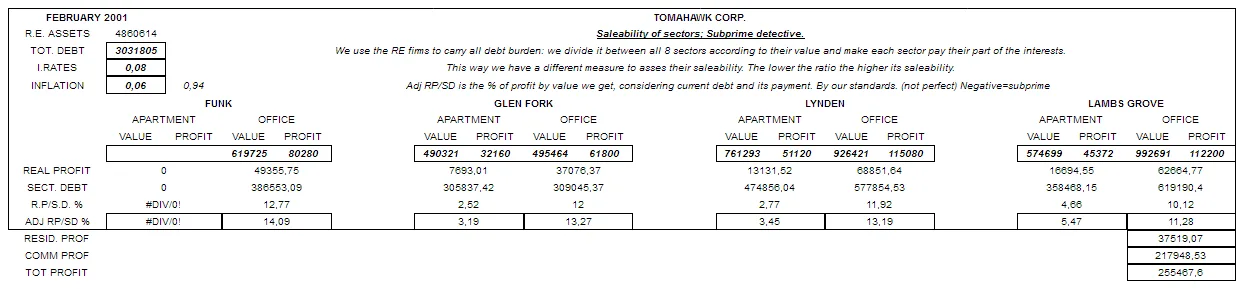
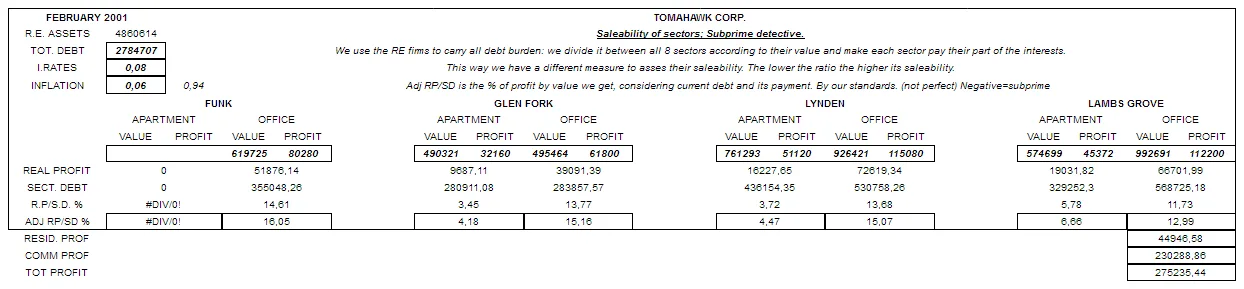
We use the RE firms to carry all debt burden: we divide it between all 8 sectors according to their mkt value and make each sector pay their part of the interests.
This way we have a different measure to asses their saleability. The lower the ratio the higher its saleability.
Adj RP/SD is the % of profit by value we get, considering current debt and its payment (adjusted for inflation). By our standards (not perfect). Negative=subprime.
We use the label "subprime" when current income cannot cope with debt incurred.
This one is for current conditions. IR=8%. Funk's residential district is bordering subprime.
This other is to simulate what level of IR (13%) turn all our apartment districts subprime. Offices are much more resilient due to their higher profits, but affected nevertheless.
Next one shows how the sale of the Funk apartment district (debt reduction) will affect (NOW, in case it's sold immediately) the rest if sold at 1 times its value. The other at 1.5 times value.
We'll proceed with our plans with this data in mind.
Chapter 34 — 21 June 2018
FEBRUARY 2001 – FEBRUARY 2002.
I'll start this year by showing graphic data about one of the cities: Funk.
Then, I show the reports of the Frankenstein we've created…
This is how the city looks like:
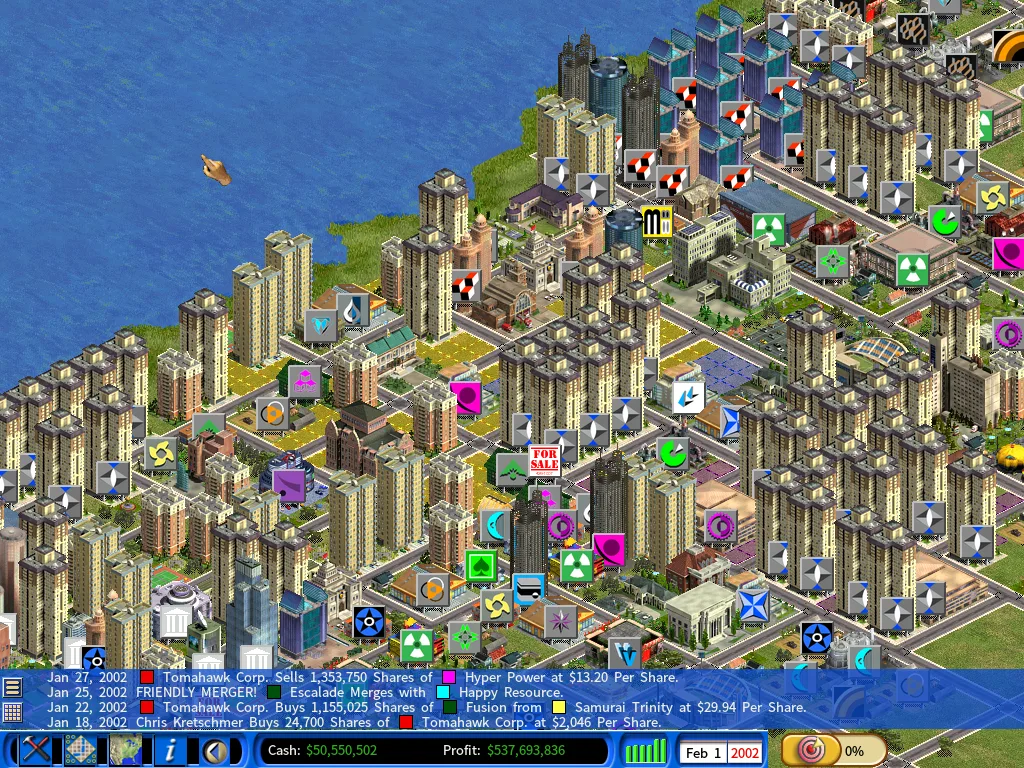
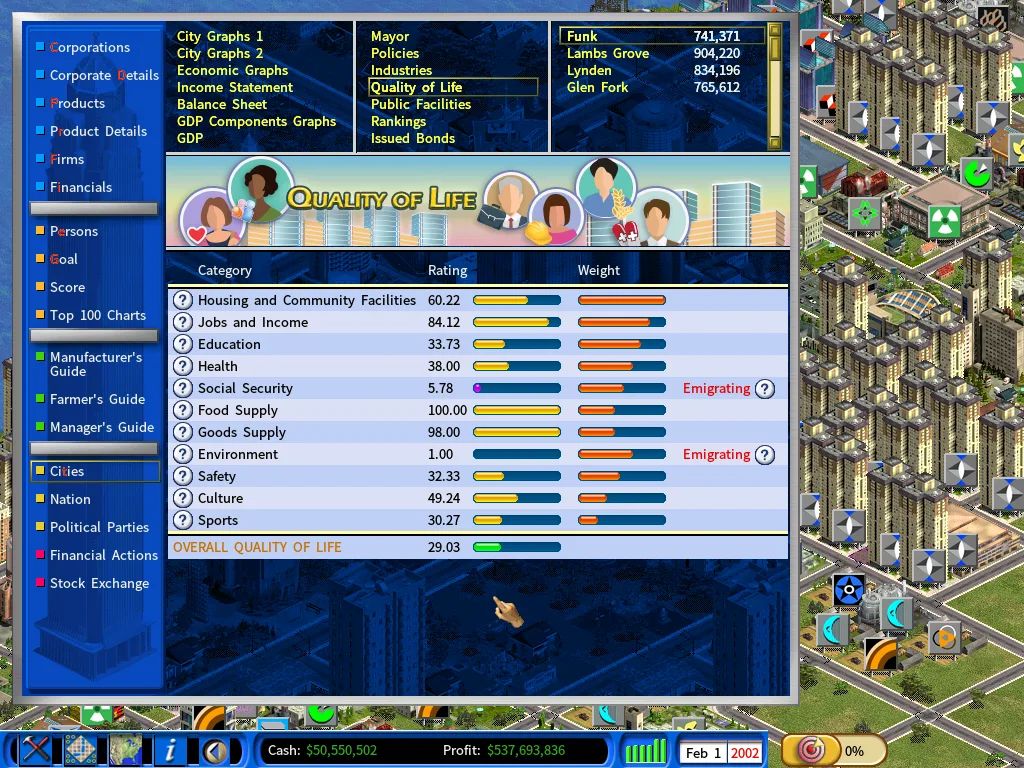
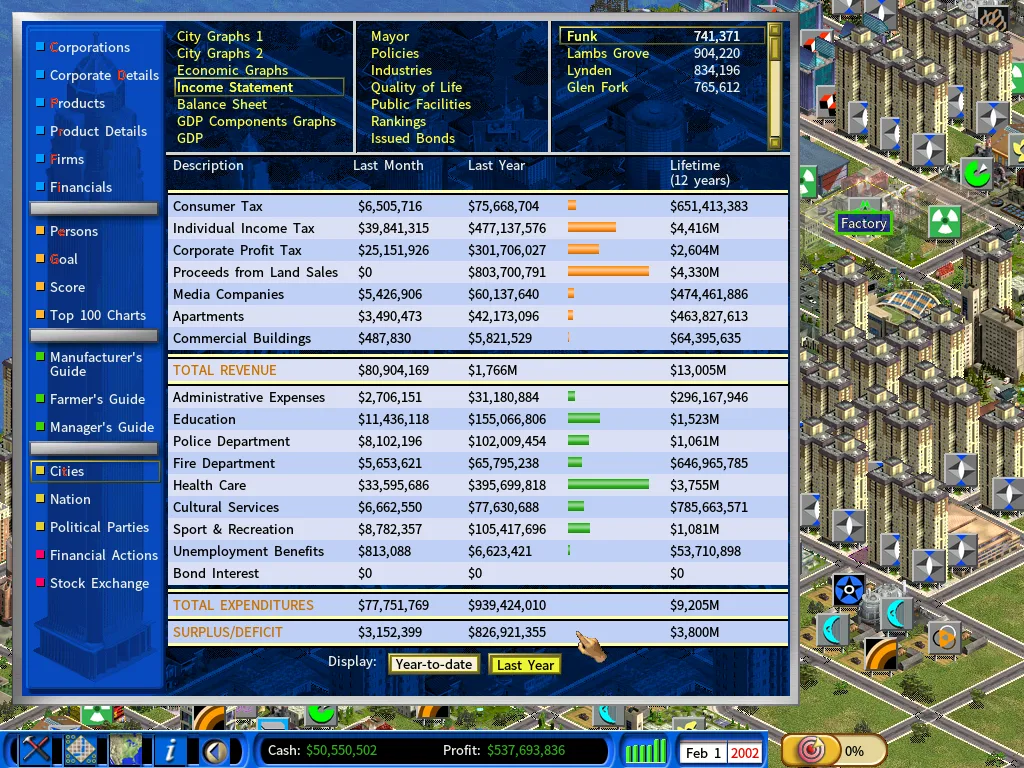
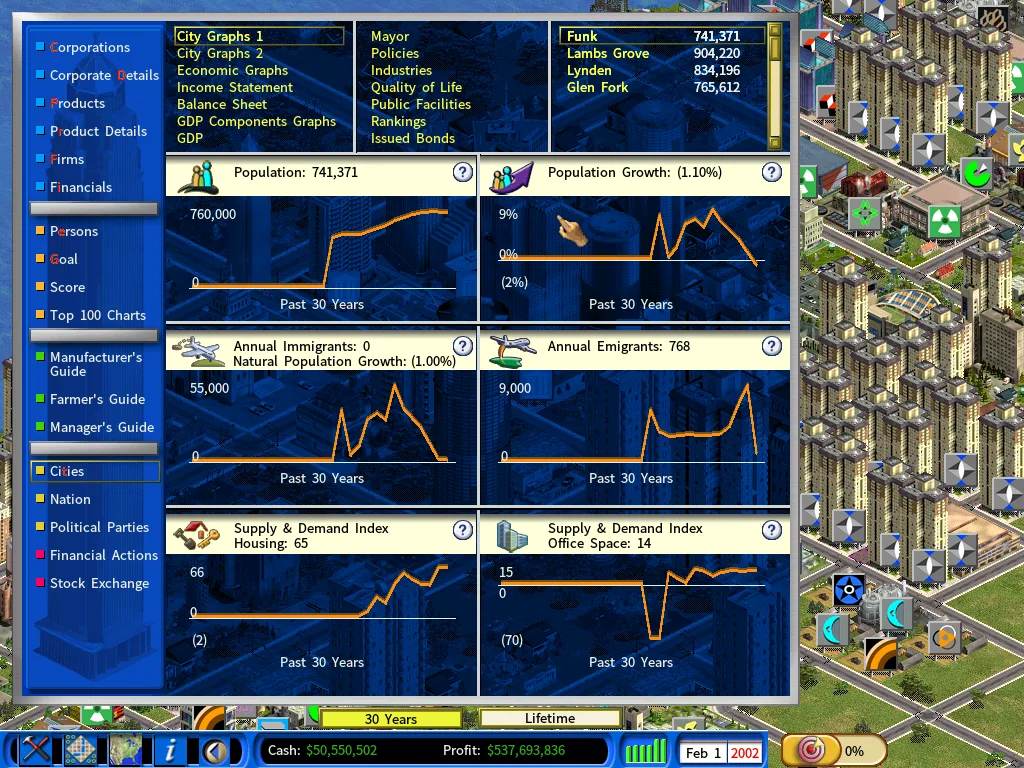
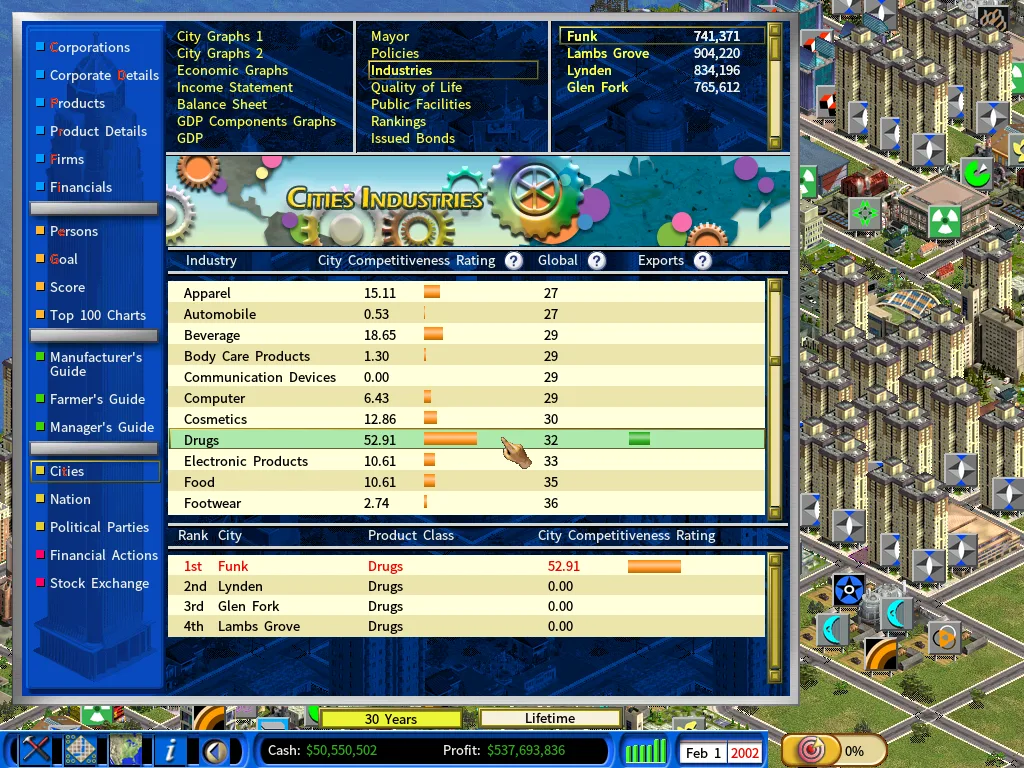
These show how the city's doing:
Our subsidiary, Funk Apt. Holdings (FAH)
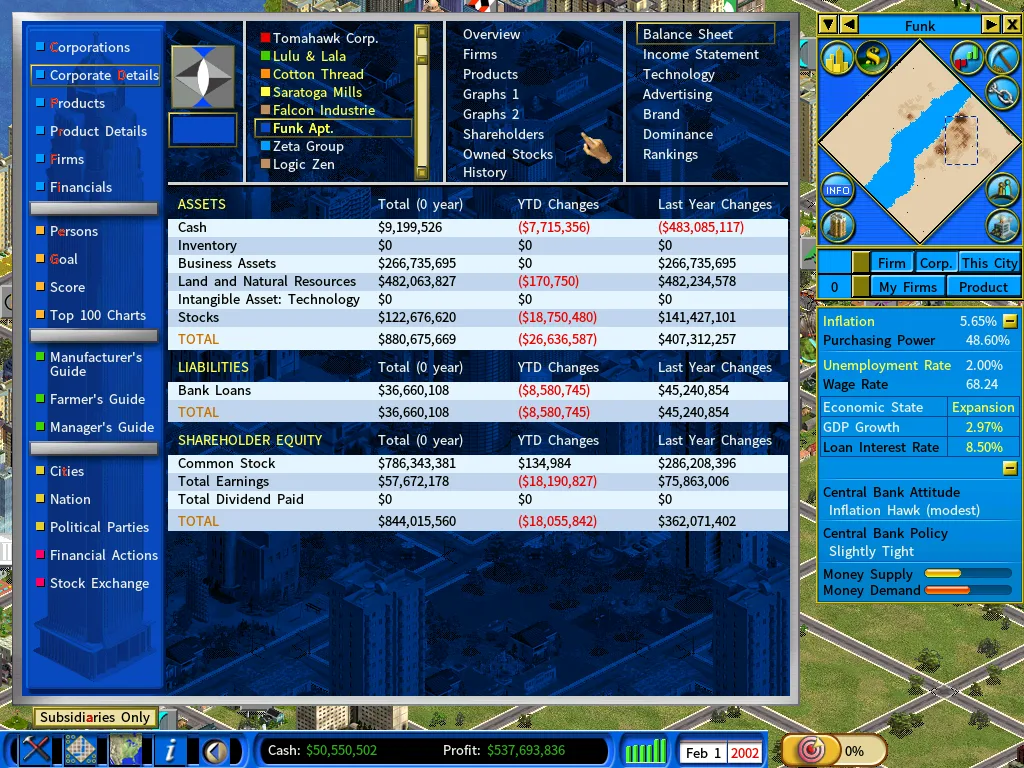
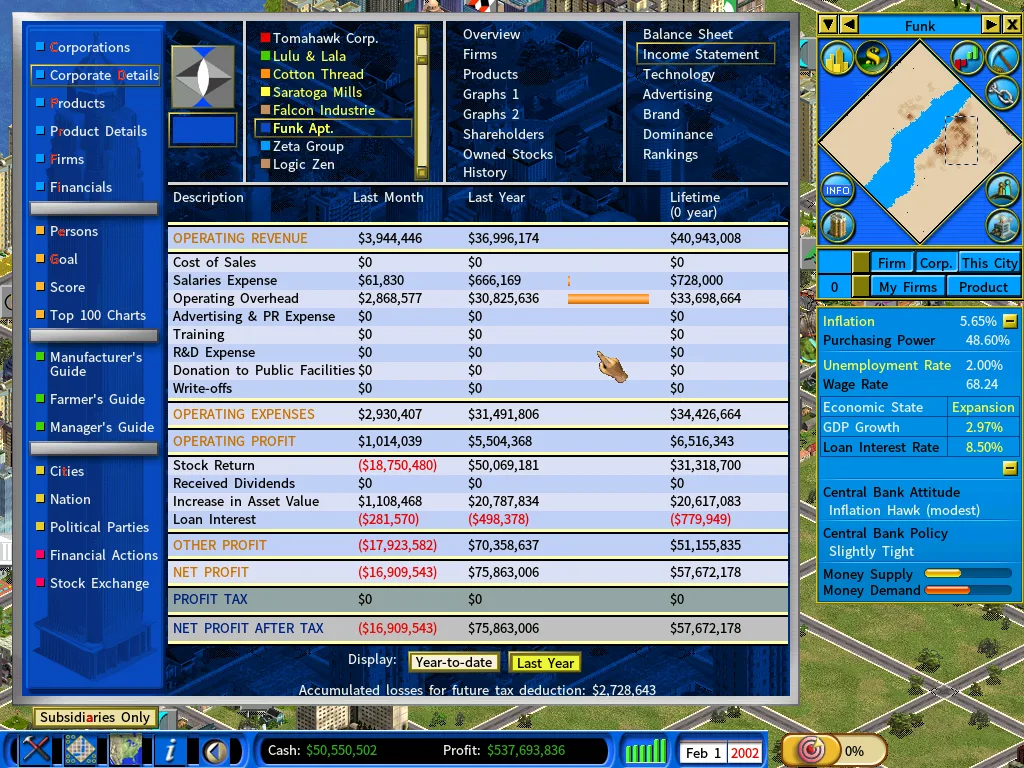
It's already public, with 95% owned by Tomahawk corp. and 5% by its own CEO.
Chapter 35 — 22 June 2018
A brief summary about Funk:
There's a huge supply of apartment buildings, and the population is leaving because of pollution and lack of public services spending.
The Mayor's a miser, keeping all funds idle in the city's coffers.
We can deduce then that demand for housing (and so, for offices) will shrink in the years ahead in case present conditions remain.
About Funk Apt. Holdings: Our attempt at getting rid of our ownership in a potential subprime venture.
First, mention that it sits on assets valued at 850 million and has a profit of 6 million per year.
Observe that we merely transfered our residential assets in Funk city to it, so zero cost to us in terms of cash. We have to consider lost revenues of about 26 million for that this past year.
We chose Brandon K. Lell Sr. as a figure man because we know he has a tendency to buy back shares. That might be a plus once we lose the majority shareholder position.
When we transfered the property, we detected a decrease of 20% in value to their book (100 million) and we couldn't figure out why. Their loss was recorded in Tomahawk's book as asset appreciation. As we are trying to sell them and not us, we decided to do something, bold, it seems…
We IPOed the Frankenstein and with the proceeds (297 million) we bought land and built even more apartments. You can verify a total increase in asset value of just 20 million last year in FAH's income statement, and that was our aim: to make them show a book profit.
The flip side is that the new apartments might never be profitable, hurting revenues. As we're selling value (valuation), we might be justified, but we don't know if future investors will agree.
Then, with 25% of shares in the hands of the public, the price of the stock started falling. Tomahawk bought back 20% and Mr. Lell used his life savings for a 5% stack.
Now the company quotes at 8,8$/share, and that means over a billion in market cap, 1.22 times book value.
At that price the sale would be quite a killing, but we fear that pretty soon the price will start falling again.
We've also used some of their cash to buy a stack in the public investment companies, and hope (crossing fingers) that their price gyrations will affect FAH's price too, and so will in turn help us unload at decent levels.
Our other plan to hire a PR man to allure investors to buy remains off the table at the moment, as with such meagre income the company will have a negative cash flow.
———————-
Inflation now stands at 5.65%, and interest rates at 8,5%. That means a 3% money rate.
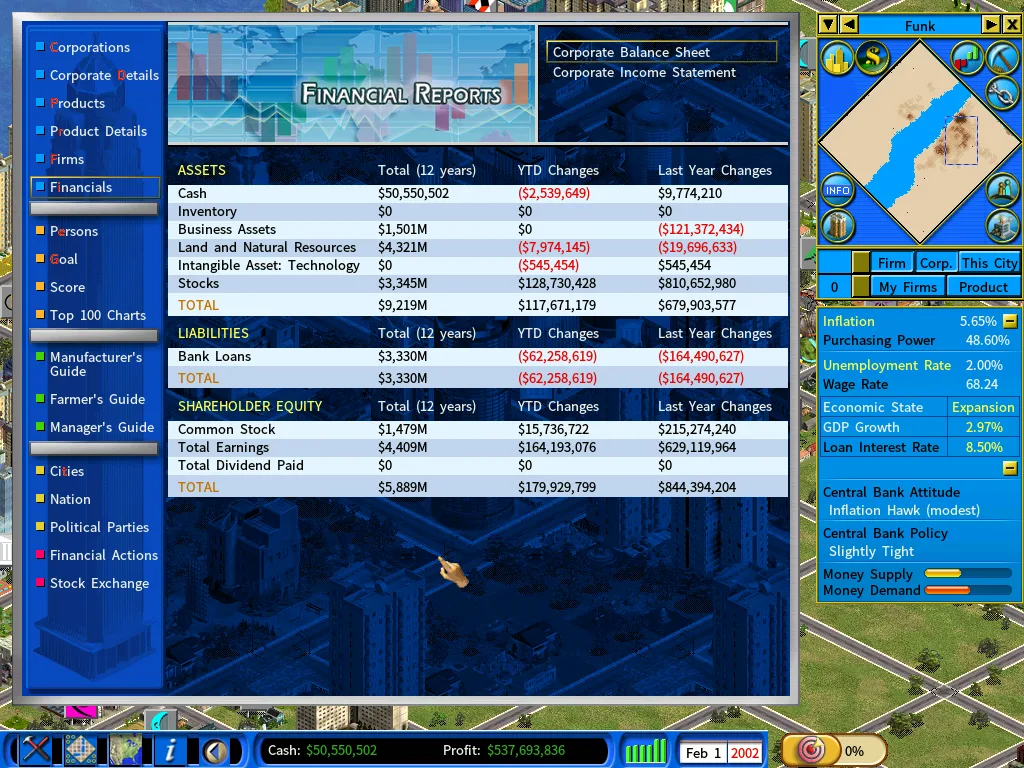
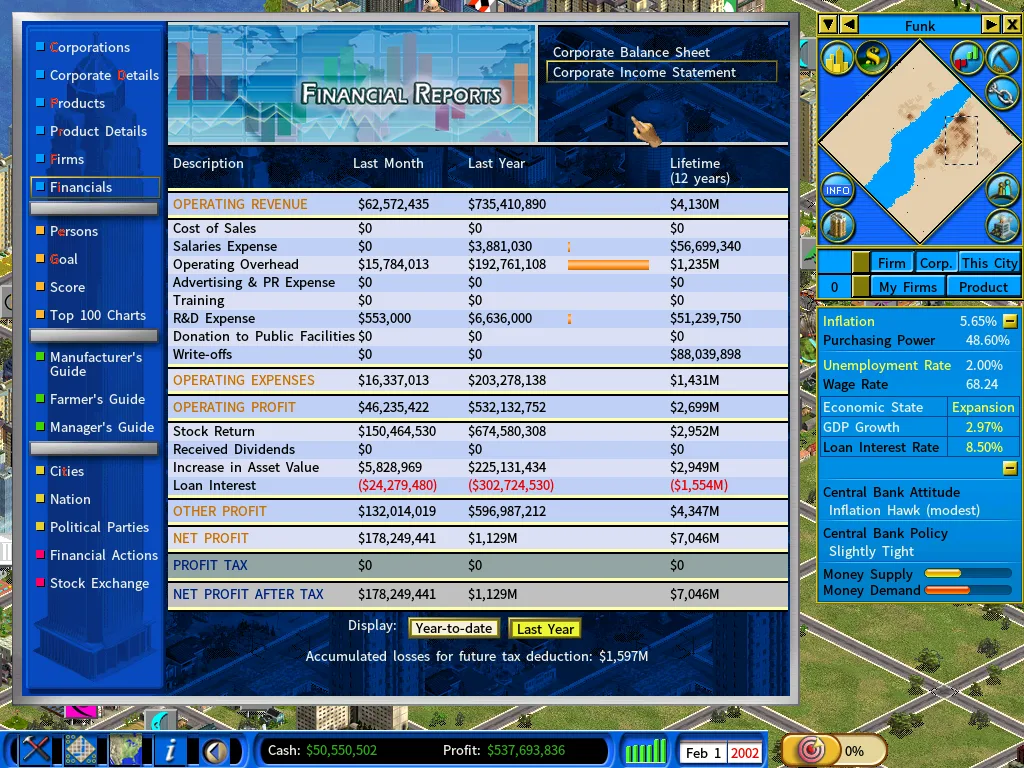
Having said that, we publish our company's files for February 2002:
BALANCE SHEET
An increase of a billion in net assets, due mostly to increases in our stock in public companies. Half of it in our subsidiary, FAH.
A decrease of our liabilities, due mostly to inflation, of 196 million.
INCOME STATEMENT
An increase in net profits of 4 million/month to 46 million/month.
STOCK MARKET
We've become the majority shareholder in Fusion corp. by buying shares at a premium from Samurai Trinity (about 125 million spent), so now we can use our weight to demand an increase in the floating stock of the company, with a view to hold 75% of it and then making it our furniture subsidiary.
Also, we've kept buying the Swiss watch-maker Global Link, as they're still showing an appetite for growth in a market without competition and decent margins.
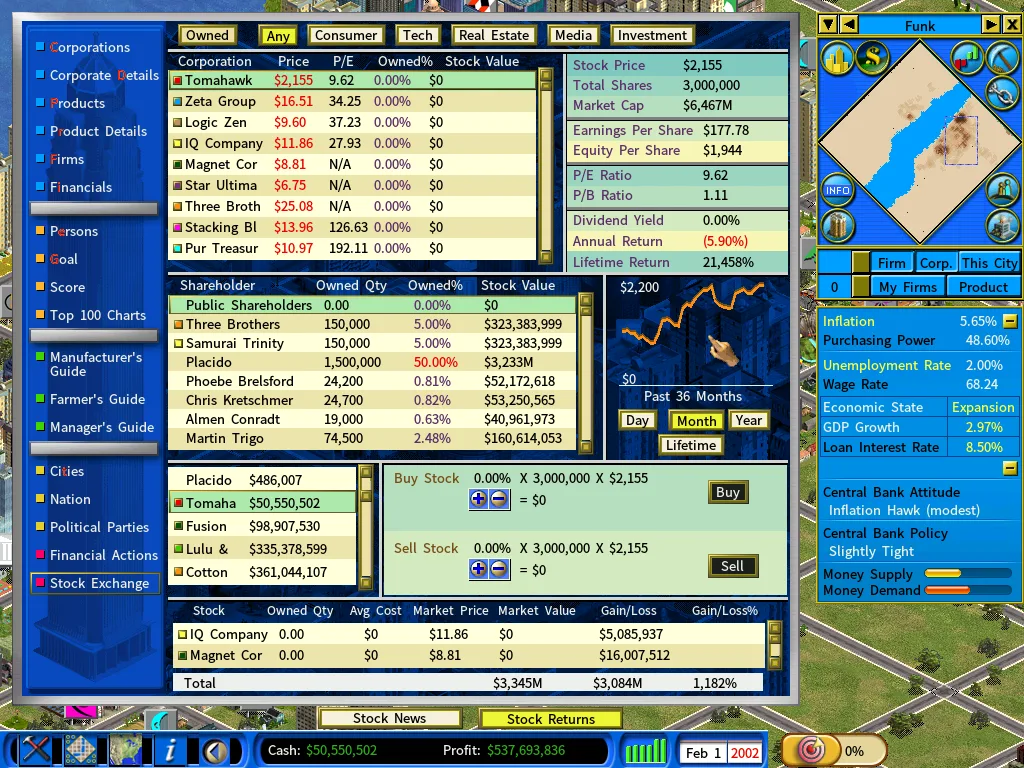
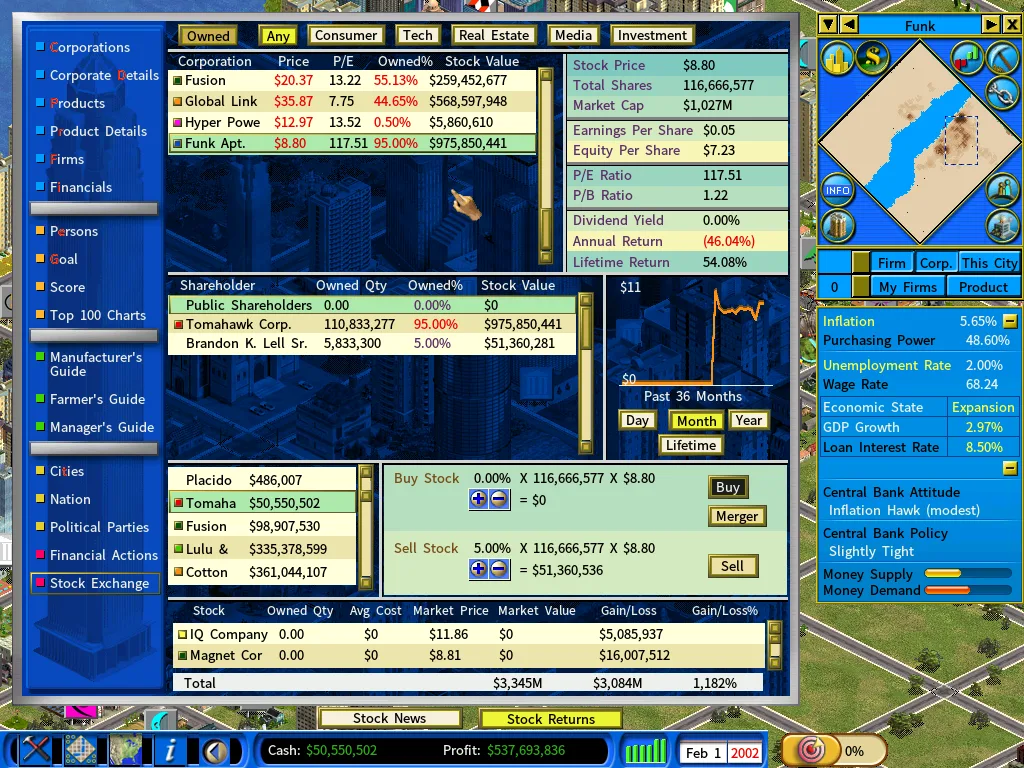
Any comments are welcome.
Thanks for reading!
Chapter 36 — 26 June 2018
A summary of different sectors, with a view for the use of next year's money:
REAL ESTATE
The supply remains ample in all 4 cities, so we'll be filling it as they grow, but not in Funk, where population growth is now negative and we don't see profitability there. We won't use the bank to finance new RE projects as conditions remain neutral and the bankers might be plotting to raise rates further. We will remain cautious.
Also, we've plenty of good urban land to develop already, so if we purchase some more it will be to consolidate, in that case, our cores.
CITIES
Both Lynden and Lambs Grove, where our men call the shots, are decidedly in for expansion and growth.
Income taxes were increased to balance the budget, and public land sales create the surplus to finance the building of new public utilities. Quality of life stands at around 70, so there's good supply for newcomers. We have an open borders policy and jobs are available.
The universities in both are fully engaged in research in different industries, so we hope to encourage new firms to set up home there.
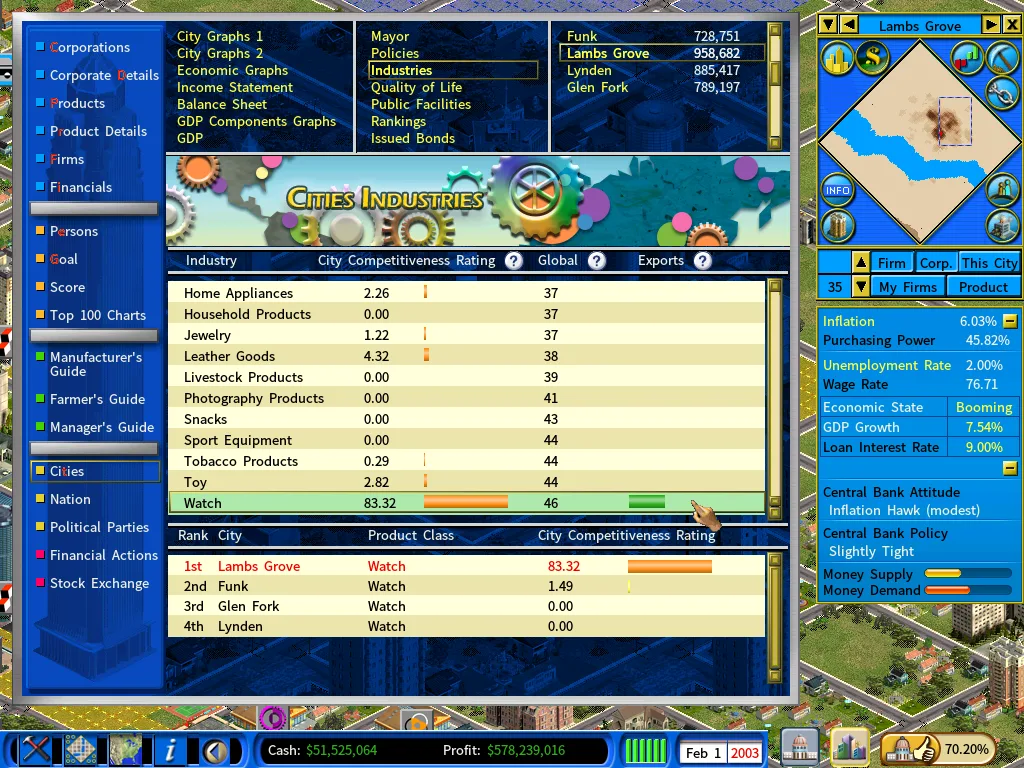
In Lynden there's a thriving food industrial structure. In Lamb's Grove there's luxury goods. We hope to participate there next year or so through new research facilities.
STOCKS
We'll be focusing our purchases in the Swiss watch-maker and in Fusion corp.
The first will be probably receiving much of our revenues as they have the ability to make them grow further. We'll sell it if the spread between inflation and IR becomes too wide (meaning, if debt expenses get too big to our taste) and the stock price stops rising.
The second, we'll attempt to take over and make them our subsidiary. As you recall, the CEO has an expertise in the furniture area and our country imports all of it from abroad. It won't be cheap but we look ahead. In case it becomes prohibitive we'll cancel our plan. At present they are just retailing 2nd party merchandise.
The rest of the public companies are still too expensive for the returns they generate.
R&D
Our last CTO resigned as we didn't want to raise his pay, so our current projects are being directed by our CEO. Next year we'll finish them all (I believe I published our tech research in a previous post) and we'll be closing half of the labs in Glen Fork, keeping our trained scientists only, and will open new labs in Lynden and Lambs Grove to hire their university graduates that, we've heard, are coming out geniuses.
LIABILITIES (meaning, our debt)
We expect inflation to eat up 185m. next year.
The sale of Funk Holdings could mean 1 billion cash if it goes well, and that's almost 1/3 of our liabilities.
We still see more profitable areas to invest at the moment.
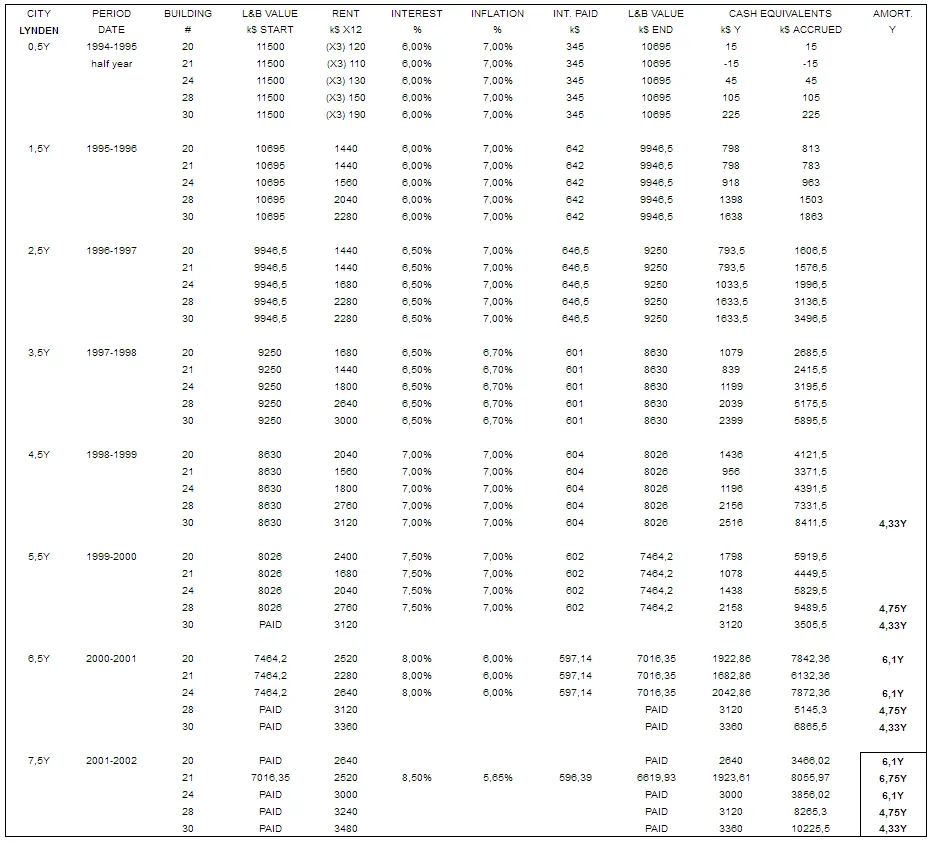
Now, to our residential districts report:
This will be the last year we publish it, as all except one building have covered costs already.
The one in question being number 29 in Glen Fork, and we worked an estimate for it.
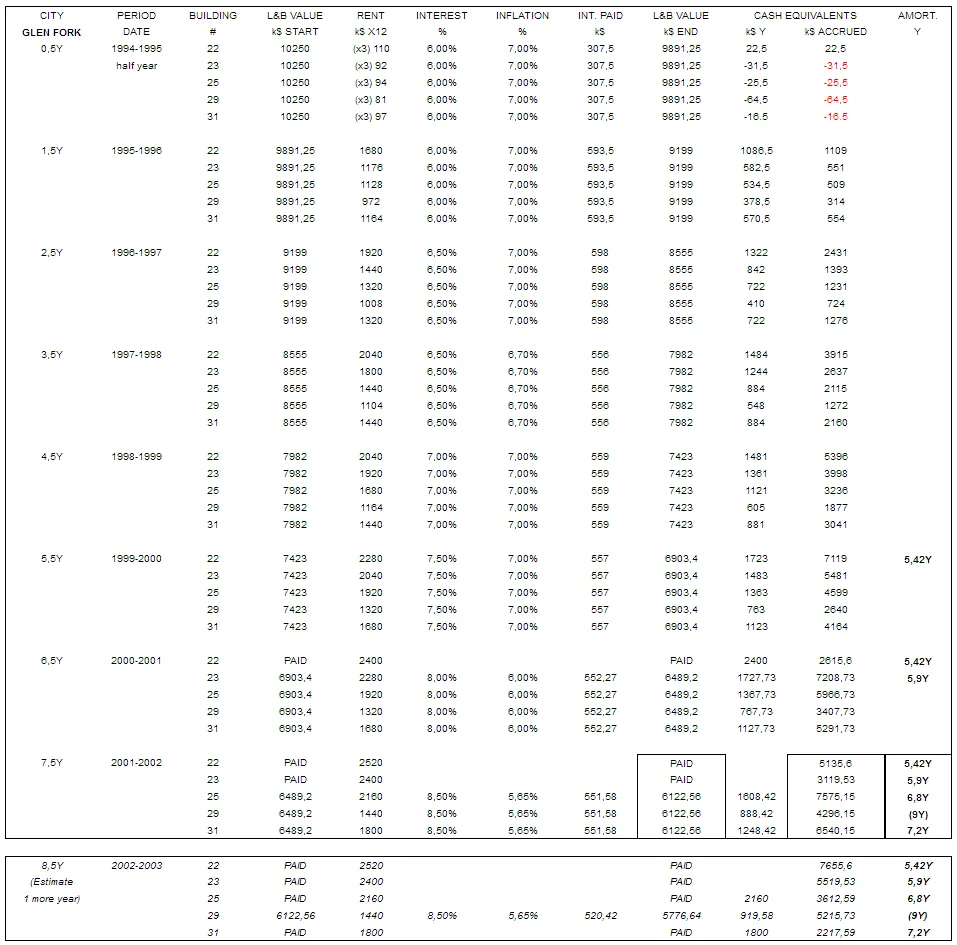
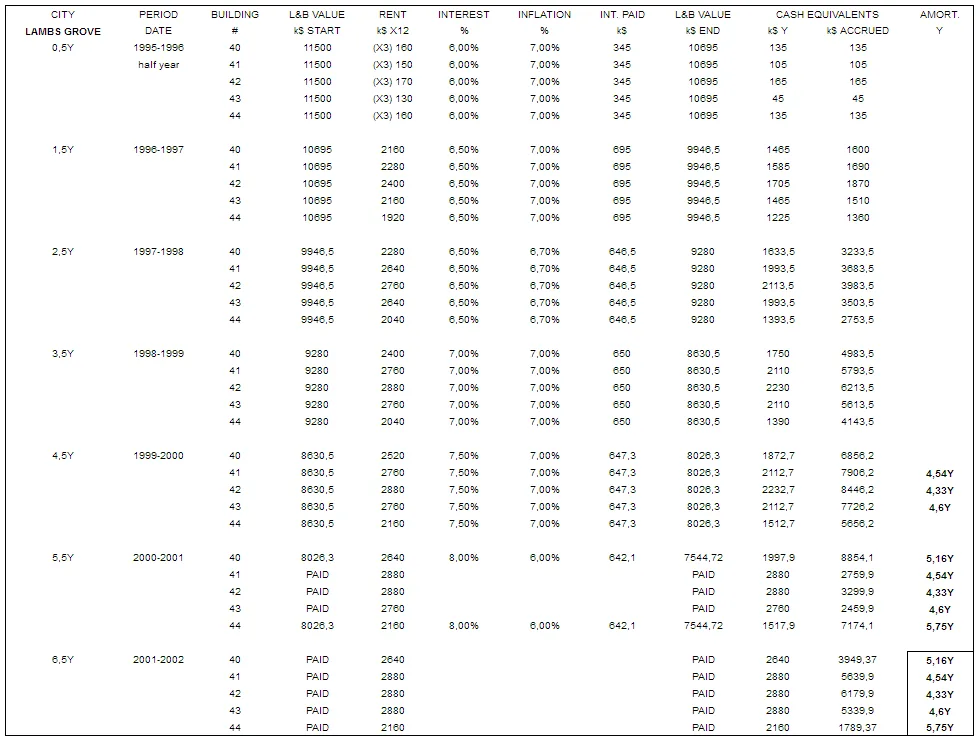
Chapter 37 — 27 June 2018
Hey bdubbs, glad to know you're enjoying it.
Yeah, I think the CES would improve a lot if the cities would come with pre-zoning, from the beginning. That would change things the way you mention.
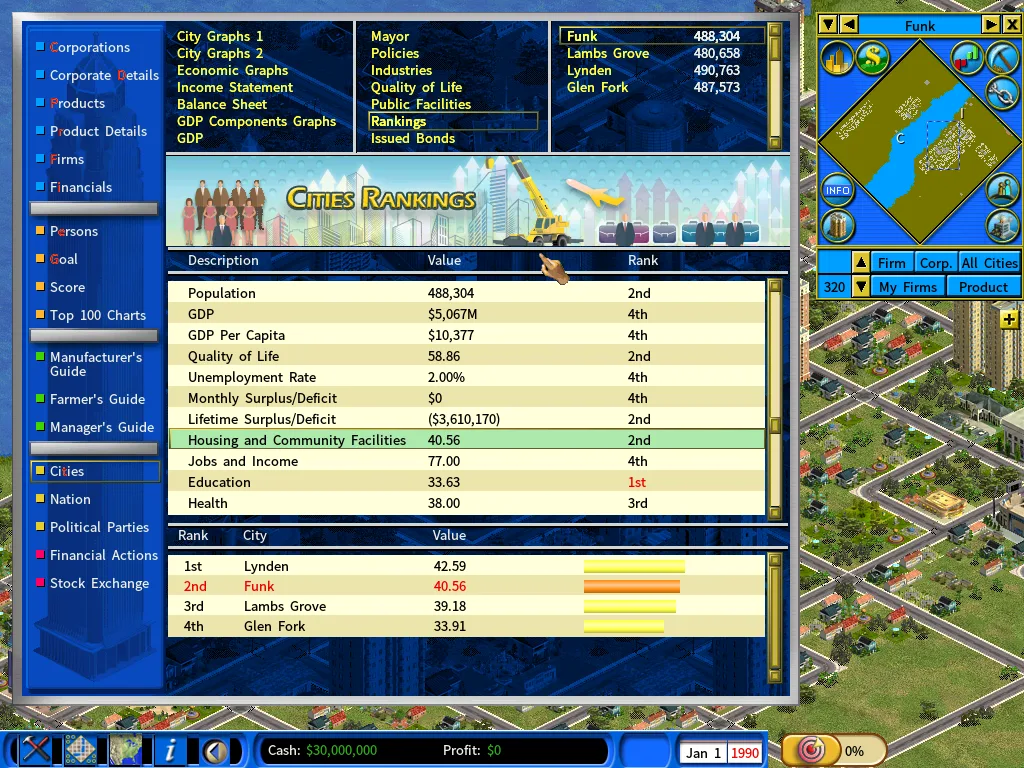
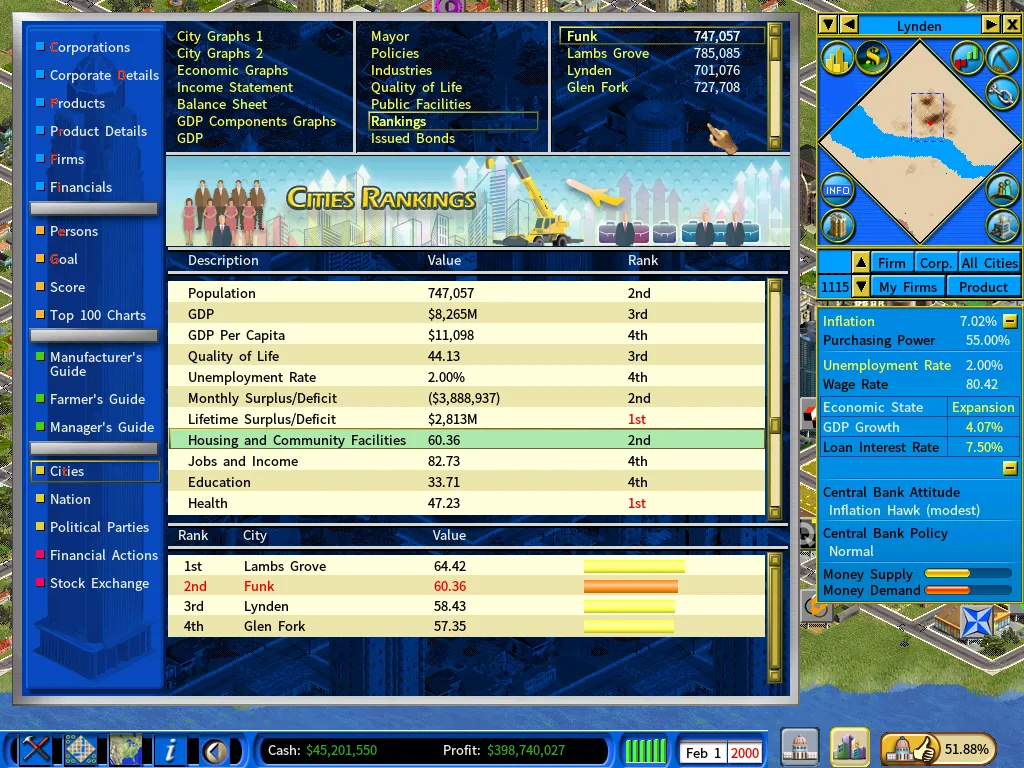
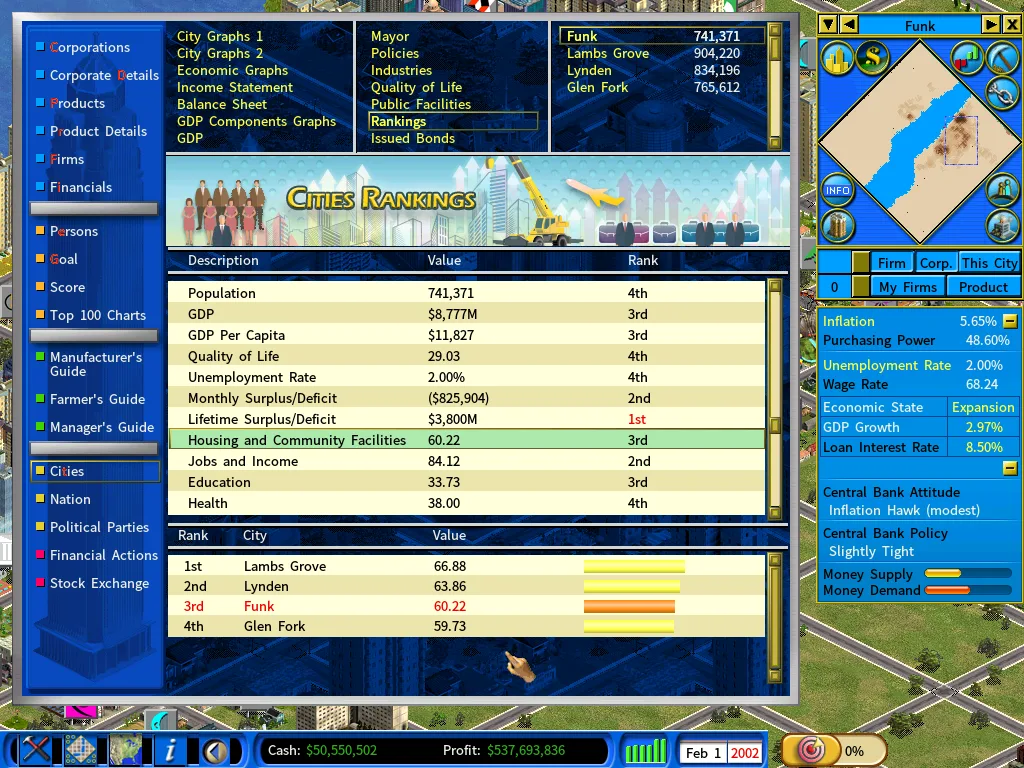
You just pointed to something important I've overlooked, so I'll post three pictures to show how the population has changed from 1990 (beginning), then 2000 (mayors) and 2002 (now).
And, a small observation: We can always rely on the city budget to build new apartment districts. We want the cities to grow, but not at the expense of our shareholders
Regards.
Chapter 38 — 30 June 2018
FEBRUARY 2002- FEBRUARY 2003
The post for this year will be short. Most of our activity has been centered on the Stock Market.
FINANCES.
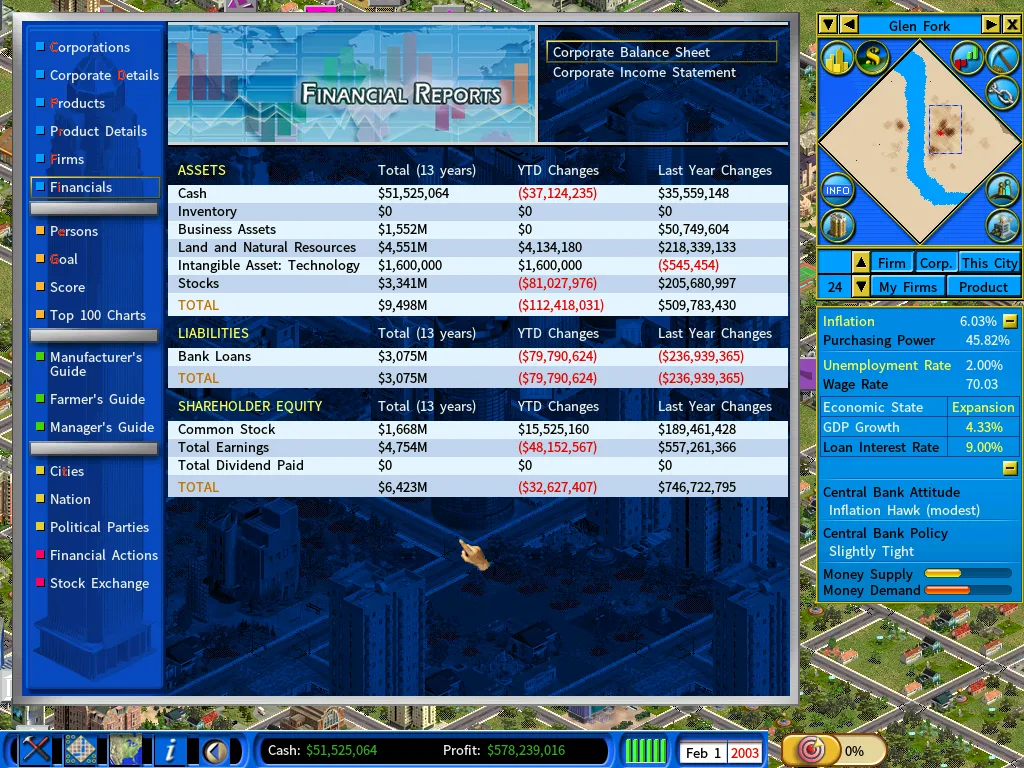
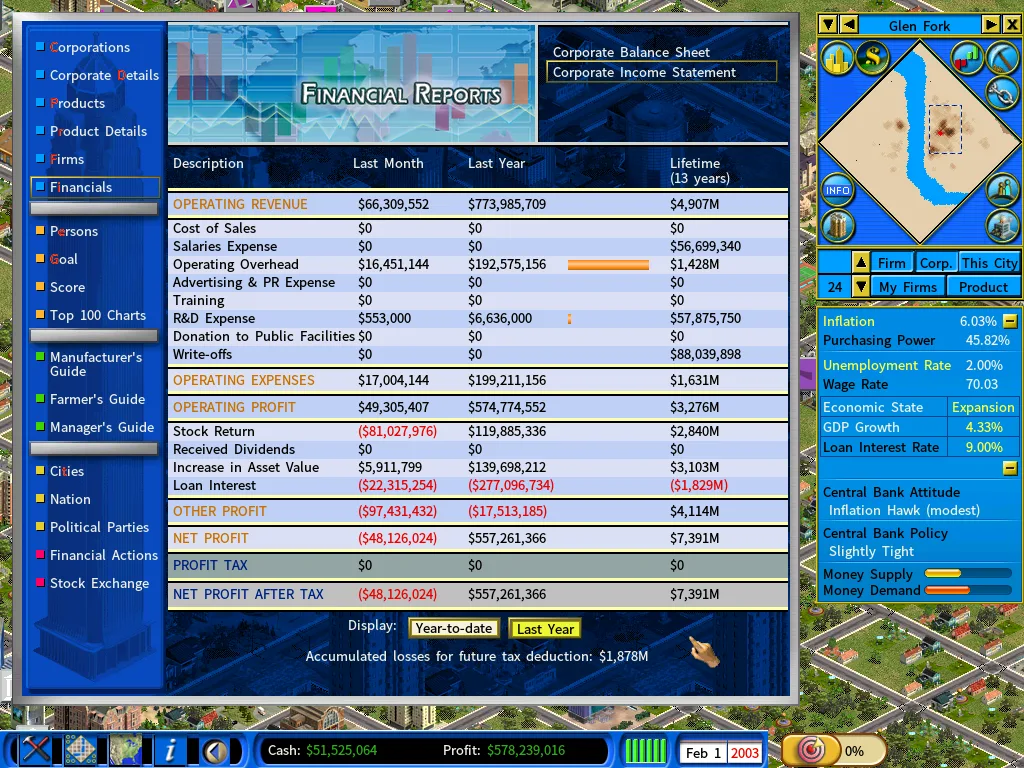
Inflation is actually increasing again, now at 6%, and the CB raised rates to 9% this same month. So real rates remain at 3%.
Here's the Balance Sheet and Income Statement, provided without comments.
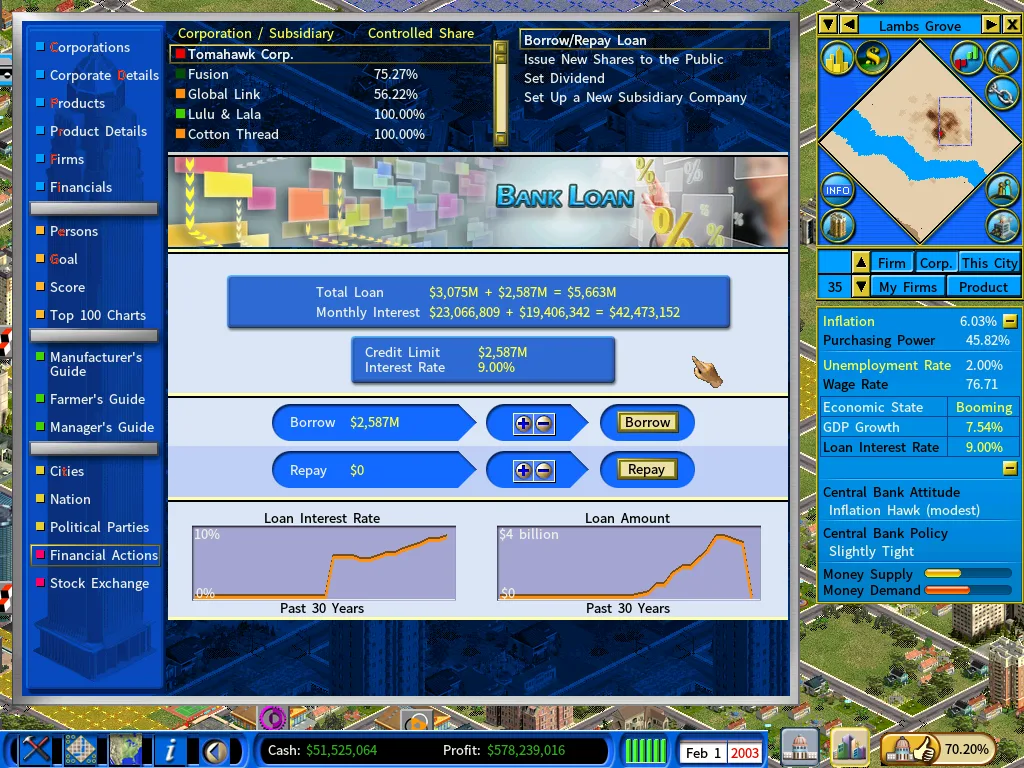
Here's a view to the Commercial Bank's report, on our possibility to further monetize our assets. Good luck gentlemen!
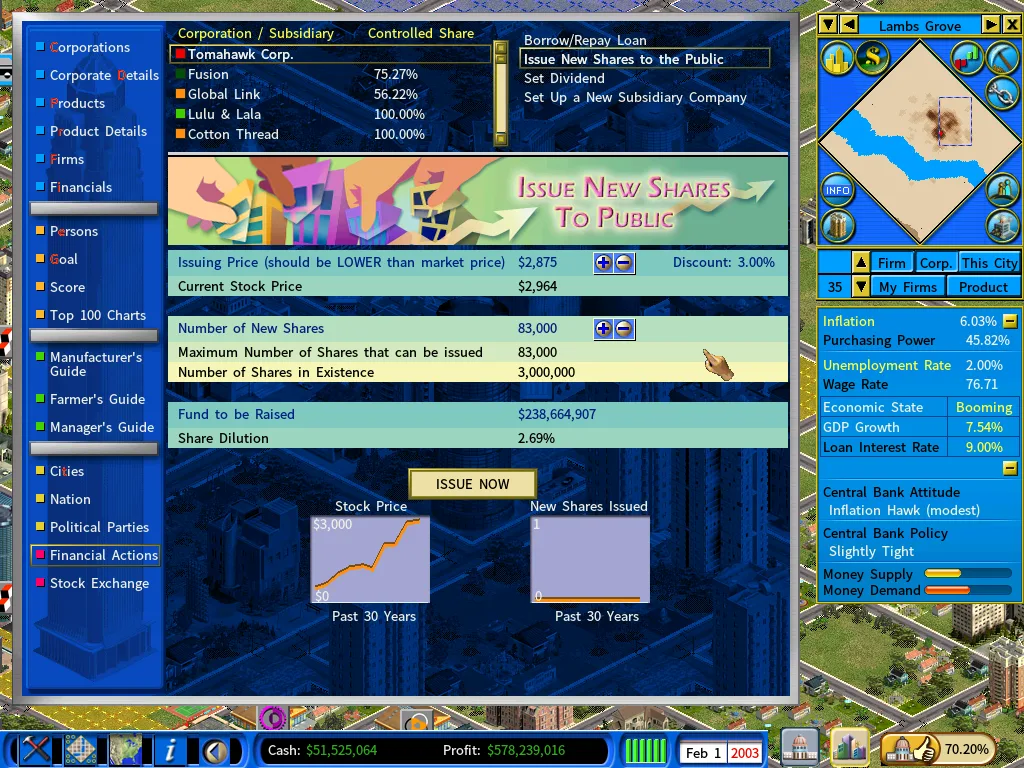
Here's a view to the Investment Bank's report, on our possibility to issue new shares at the current stock price.
LAND& R.E. BUILDINGS.
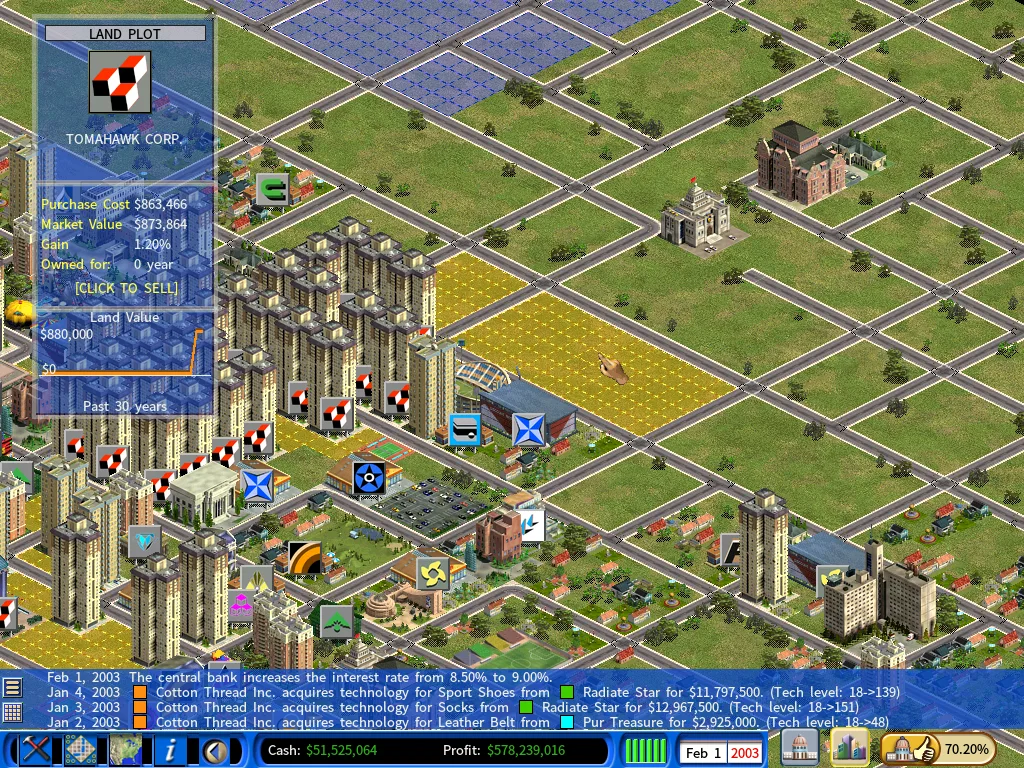
We have constructed two new office buildings and one new apartment building. Demand for new buildings is still growing but supply remains ample. Most of our land purchases have been centered in Lambs Grove with a view to expand our apartment district there, north.
We'll let current buildings fill up before we finish construction in our cores or create new districts.
R&D.
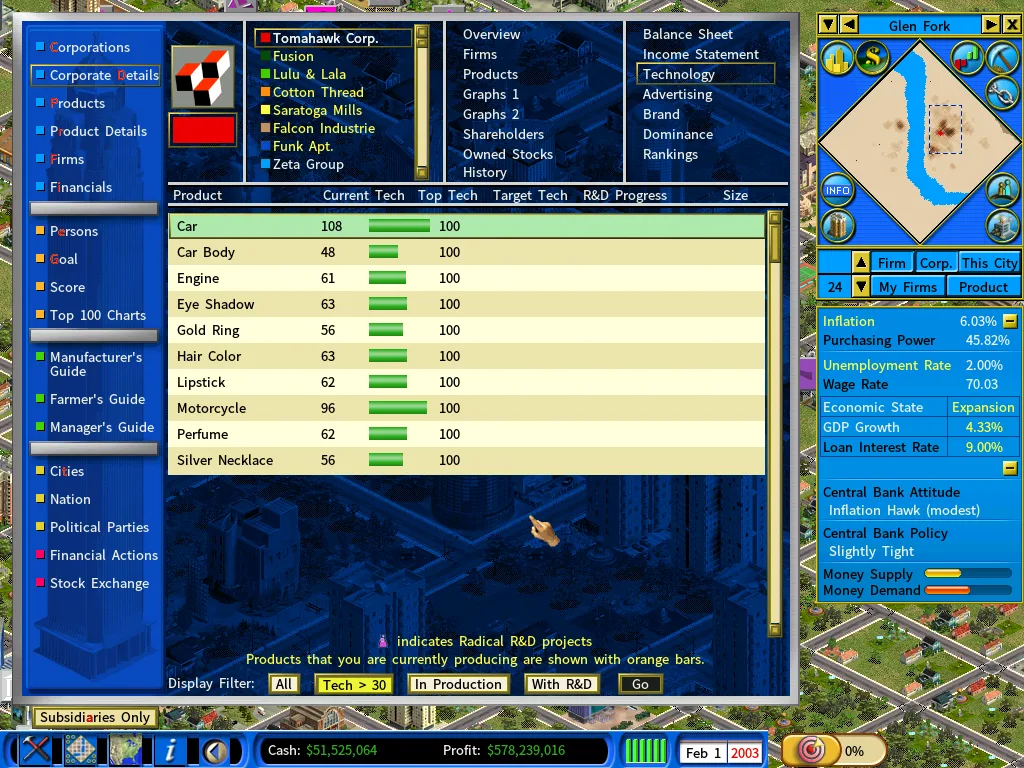
We finished all our ongoing projects in January 2003. This month we'll choose the location of our new labs and, to make good use of our university graduates, we believe their number will be substantial.
STOCK MARKET.
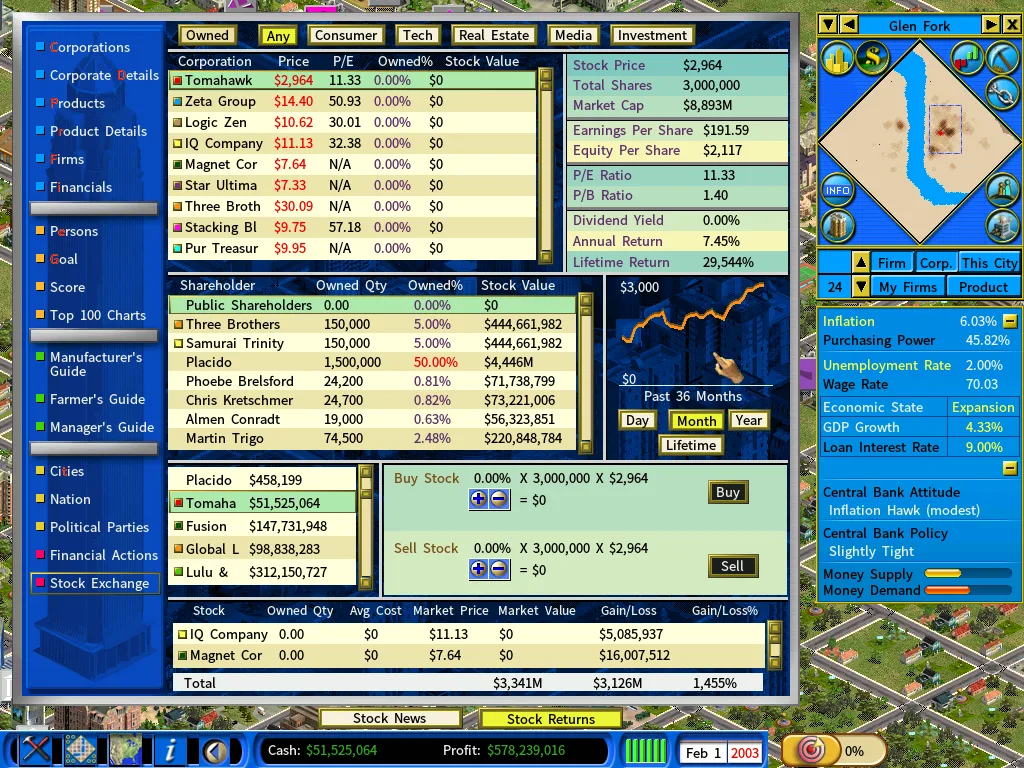
Fusion corp (the furniture expert turned import-merchant).
We spent about 150 million cash, last year, increasing our ownership to 75%.
The CEO caused us some trouble, as he owned about 30% of the company and used the cash we provided (when expanding the stock) to buy shares from Samurai Trinity, the third interest, thus his stack grew at our expense. We had to buy the japanese's stock first at twice its "fair" price before we could complete the acquisition.
After that we directed them to expand into R&D. In a couple of years we'll make sure this new player starts creating new jobs, and as all furniture is currently imported, the profits could be substantial. In the meantime, we'll be offering them fresh capital through new shares issued to the parent company, when/if more cash is needed, preferably at low prices.
Global Link (the profitable Swiss watch-maker).
The company's still looking attractive, earning about 9 million/month, and spending that cash both to buy back their shares and to build new luxury stores.
Our stack there is currently valued at 830m. With almost 20 million shares, that places our ownership above 50%.
The question arises: Should we use this part to reduce our liabilities? If we have to pay a 3% rate on it we are paying 25 million/year for just holding our chips. We expect to see their business keep growing… until we fabricate a competitor. Until then we'll use the stock as a savings account.
Also, there's just 1,5% of "floating" stock left available, so our efforts at revenue allocation will have to look elsewhere.
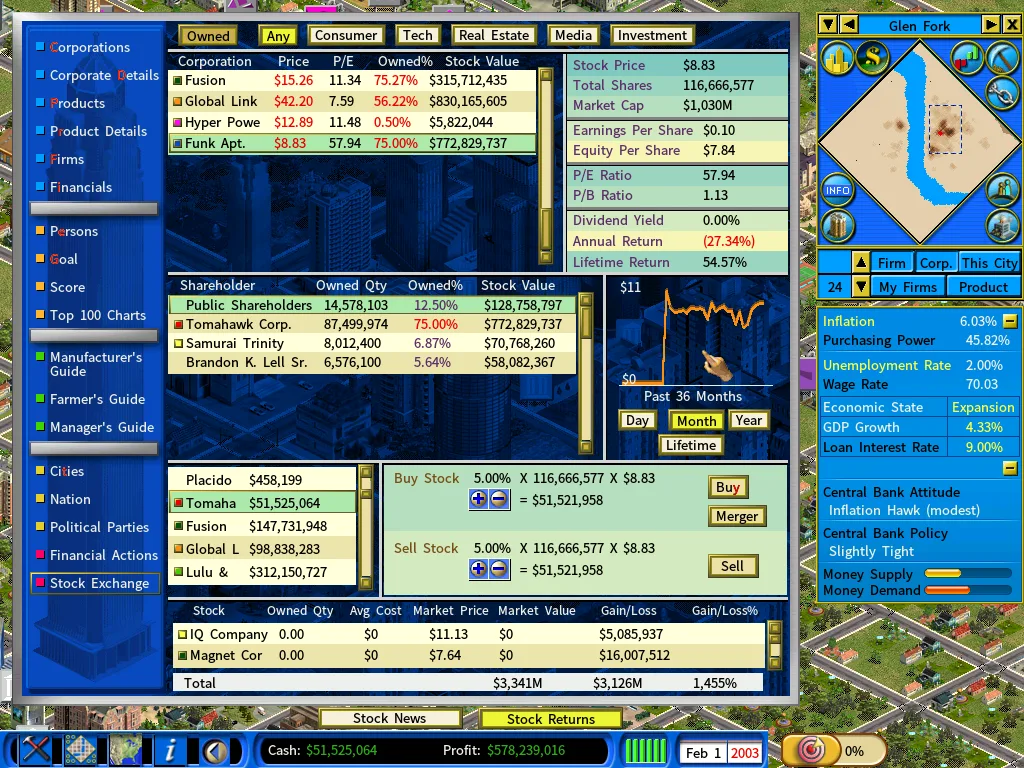
Funk Apt. Holdings (the subprime R.E. corporation).
Our stack there is currently valued at 770m and our ownership in their business stands at 75%.
Our current expenses there are: 26 million in lost revenues, plus 23 million in interest expenses estimated (from present valuation) making about 50 million/year deficit.
We've ordered the CEO to sit tight and do nothing. Once our ownership goes below 75% that same CEO will decide on his own in what avenues to invest, and will probably ruin our plans of keeping this mirage alive. Our ideal scenario would be to see the price rise to 9-10$/share before unloading. And we'll do it, in that case, all at once. For that we've bought for our subsidiary an interest in an investment corporation whose stock price jerks often up and down.
Last year we used 180 million buying their "floating" stock. This year we gained 210 million from selling that same stock, so 30 million profit at the expense of the small stockholders to add to the end profit estimate.
Mergers.
You might remember we were following the demise of a troubled auto-maker: Target Strike. They were deeply indebted and unprofitable and we planned to buy their stressed assets cheap. This year they merged with the other auto-maker: Anlin, creating a de facto monopoly in the automotive arena.
The timing couldn't have been better. Our research in the auto sector finished, we'll procceed to spin off a new subsidiary, selling them our technology, to compete with this newborn giant.
Thanks for reading!
Chapter 39 — 3 July 2018
FEBRUARY 2003 – FEBRUARY 2004
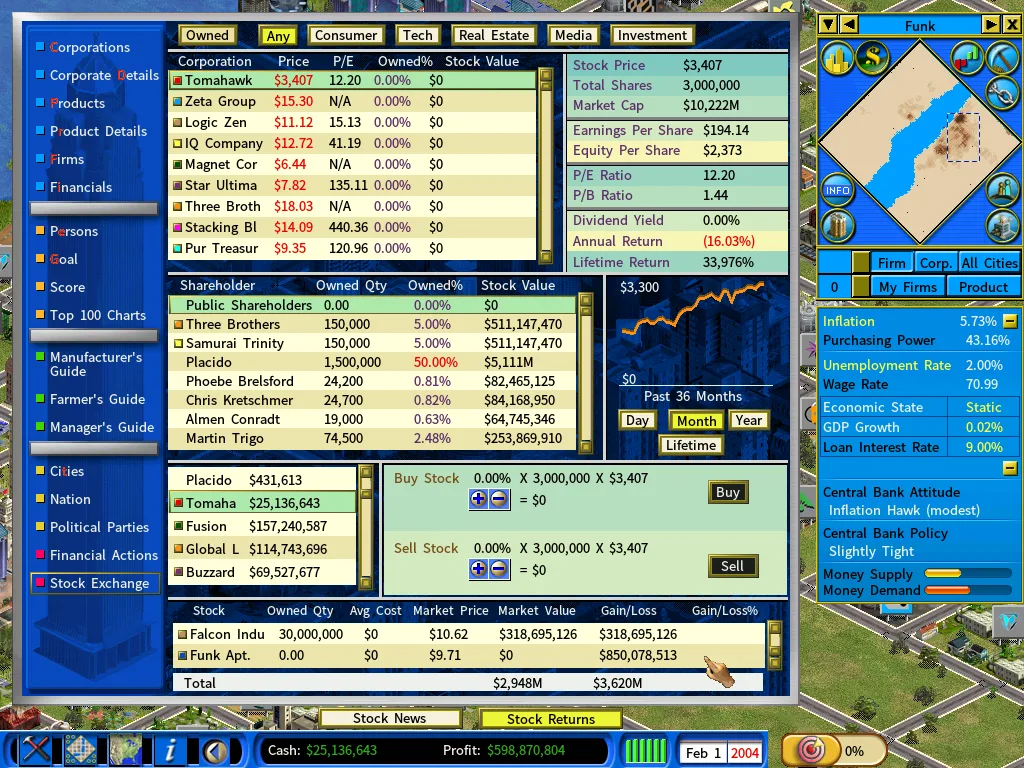
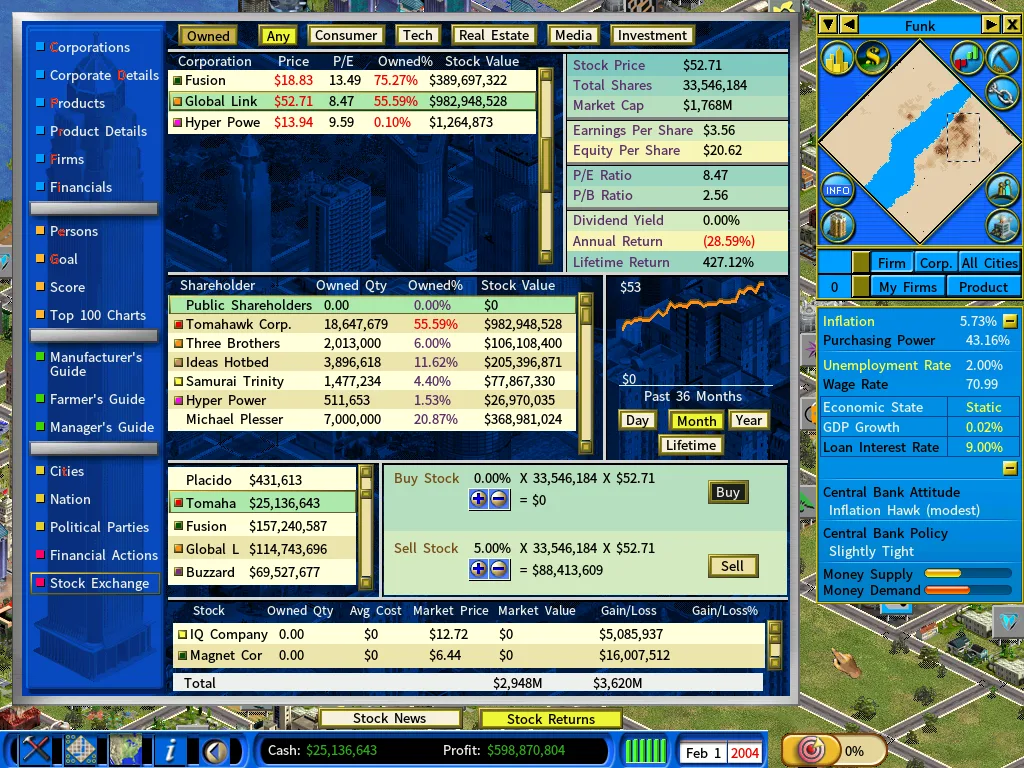
STOCK MARKET
We finished this period by succeeding in the sale of our apartment districts in Funk… at a nice premium!
Let's provide some hindsights and a final estimate:
1- In February 2001 Sylvania's investment bank launched our subsidiary's IPO. The proceeds were used to buy land, and then 16 new apartments, plus the company's HQ.
2- In April 2001 we offered our subsidiary 500 million in cash for the purchase of our 28 apartments, to be bought at the market price.
Their market value was 500 million, meaning 17,8 million per apartment.
Yearly net profits at the time were assumed to be 2,1 million (0,0042×500, data to be found at the Subprime Detective sheet).
3- In February 2004 we sold the last bit of our ownership to other corporations for a total of 850 million, sold at an average price of 9,71$/share
(data to be found at the Stock Market picture, at the bottom).
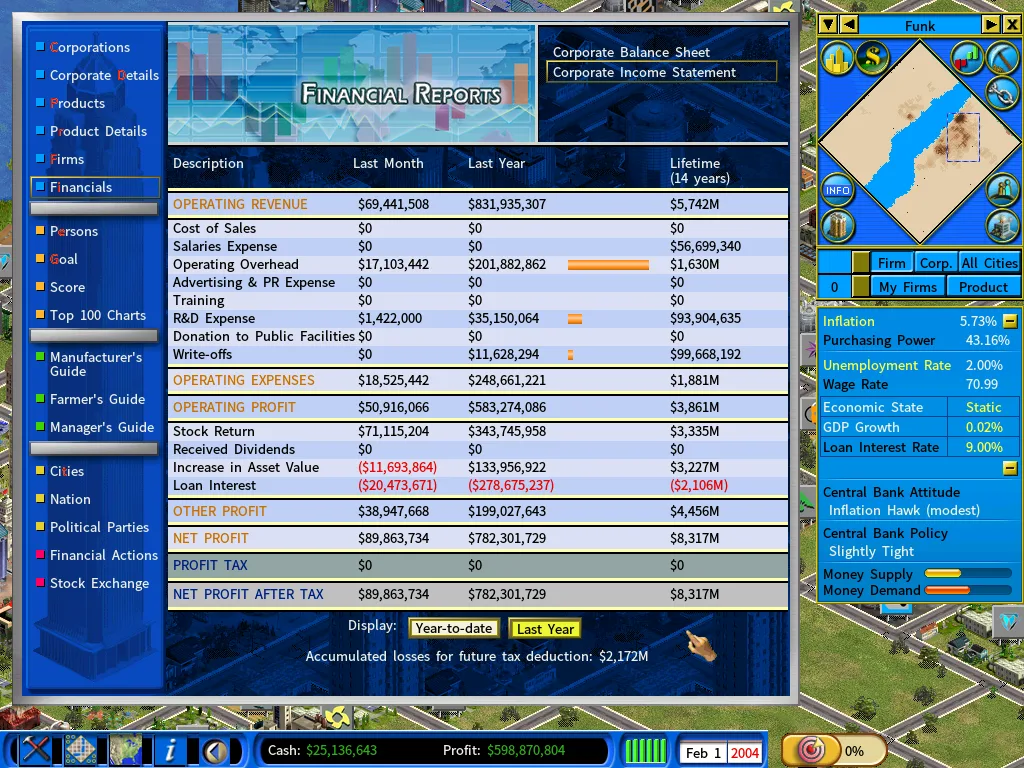
4- We estimate the income loss and the carrying of the liabilities on Tomahawk's book at 50 million/year. For 2,83 years, meaning 142 million total.
5- 850-142 = 708 net profit ; 708/28 apartments = 25,3 million per apartment. A 42% premium.
6- To achieve a similar profit from the beginning, meaning selling all shares in April 2001 and not waiting 2,83 years, the sale price should have been 8,1$/share, 16,5% lower.
We take good note of that and maybe we'll simulate such a sale in the future.
7- We used all the cash to pay the bank.
A final consideration:
Amazingly, it was during the 1st of February of 2004, just the day we stop the game to write a report, when the stock happened to be really "hot" and we could sell most of it. We thought we were going to have another year of waiting for the right time.
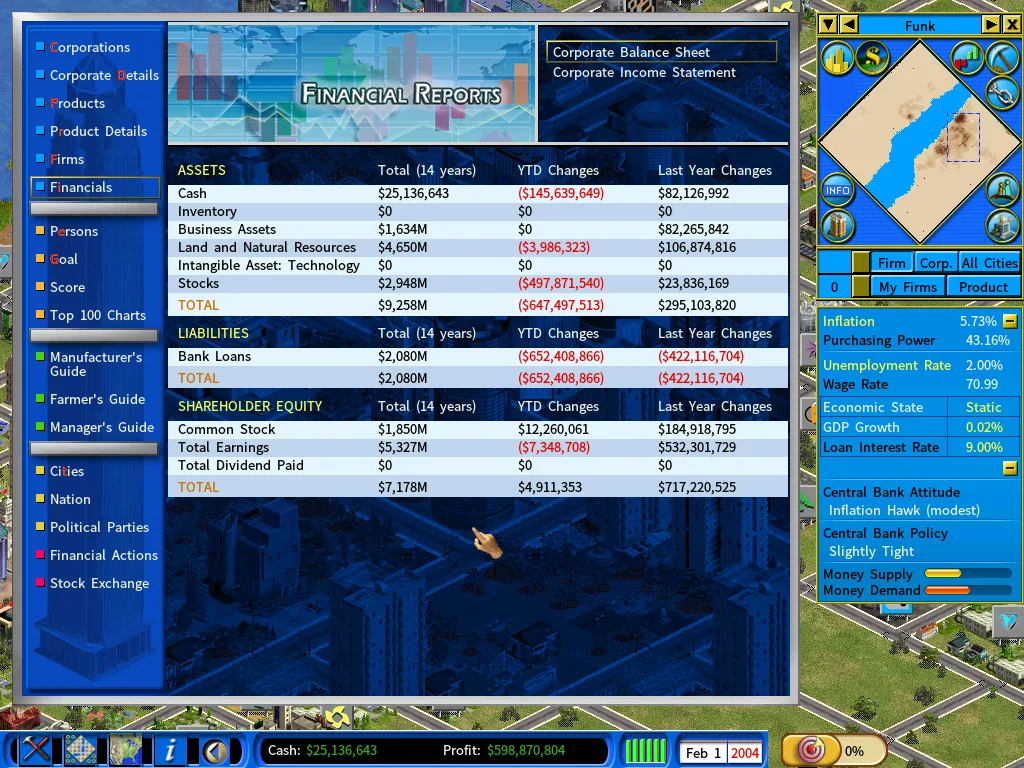
You can see in the Balance sheet that most our debt reduction was made YTD.
As we are playing with a hard difficulty level, public corporations are very often overvalued and harder to acquire.
So, we turned such an obstacle into an advantadge, and cashed in our subprime apartments by making them available to cash rich corporate investors.
Malinvestment turns rampant when money is abundant. We did it first, and will try to allocate our cash more carefully in the future.
R&D
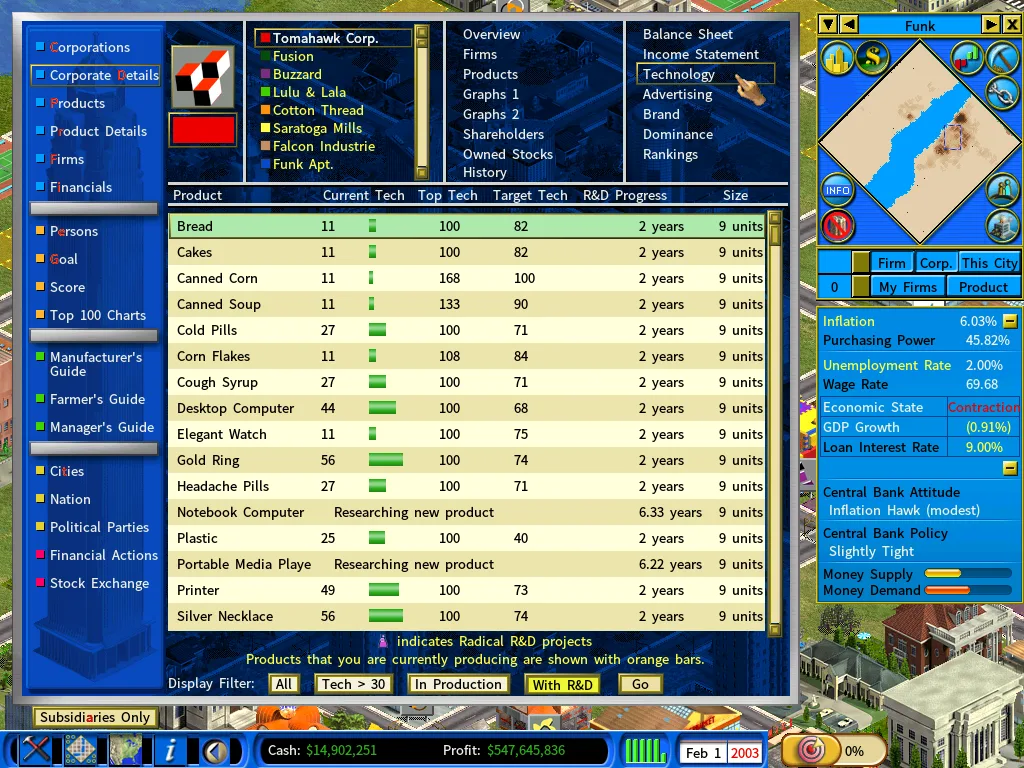
We have now 18 research labs working in all cities. We made use of our off-road land to build them on it.
Here's a part of our current research. Most is due in February 2005.
CITIES
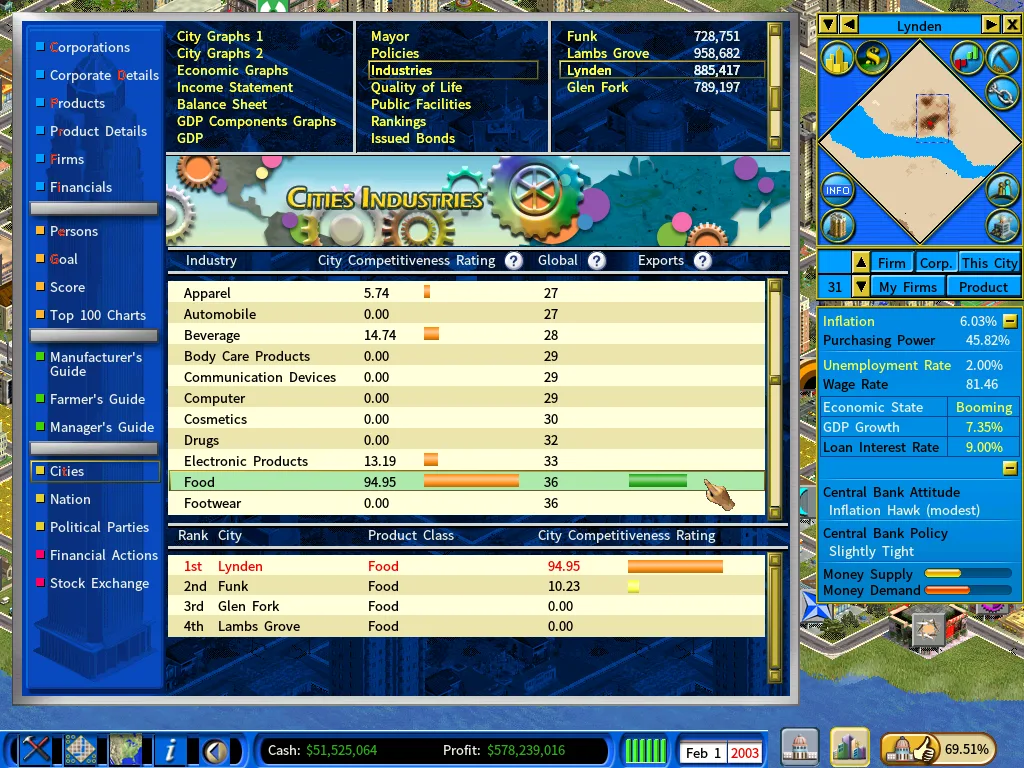
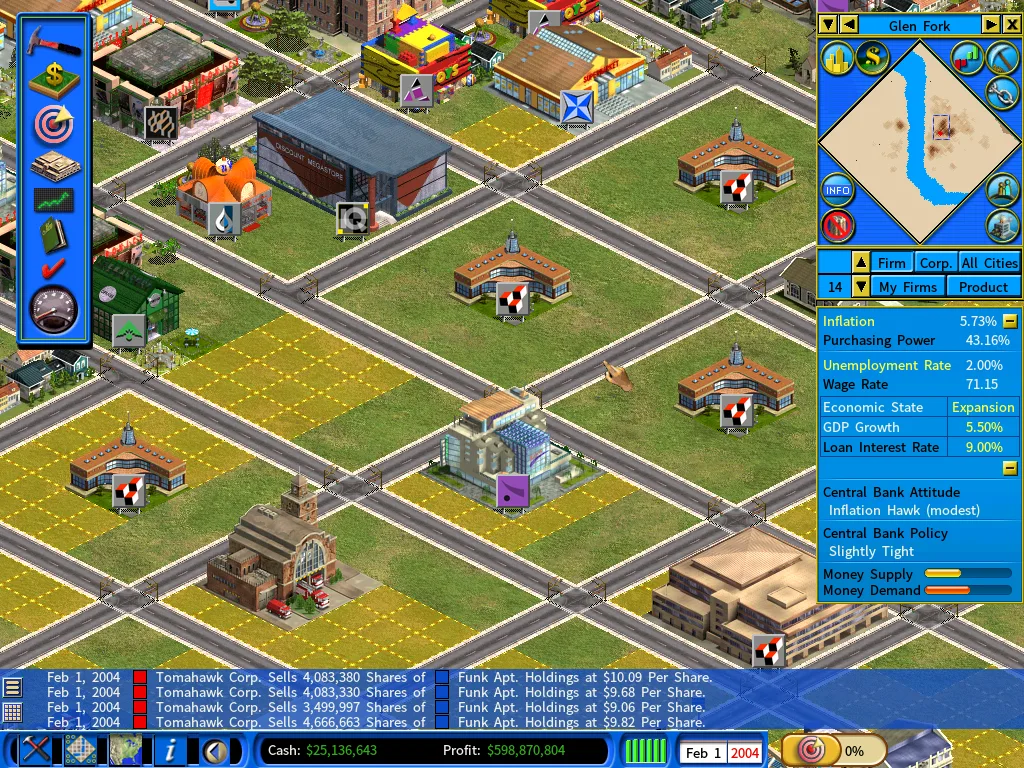
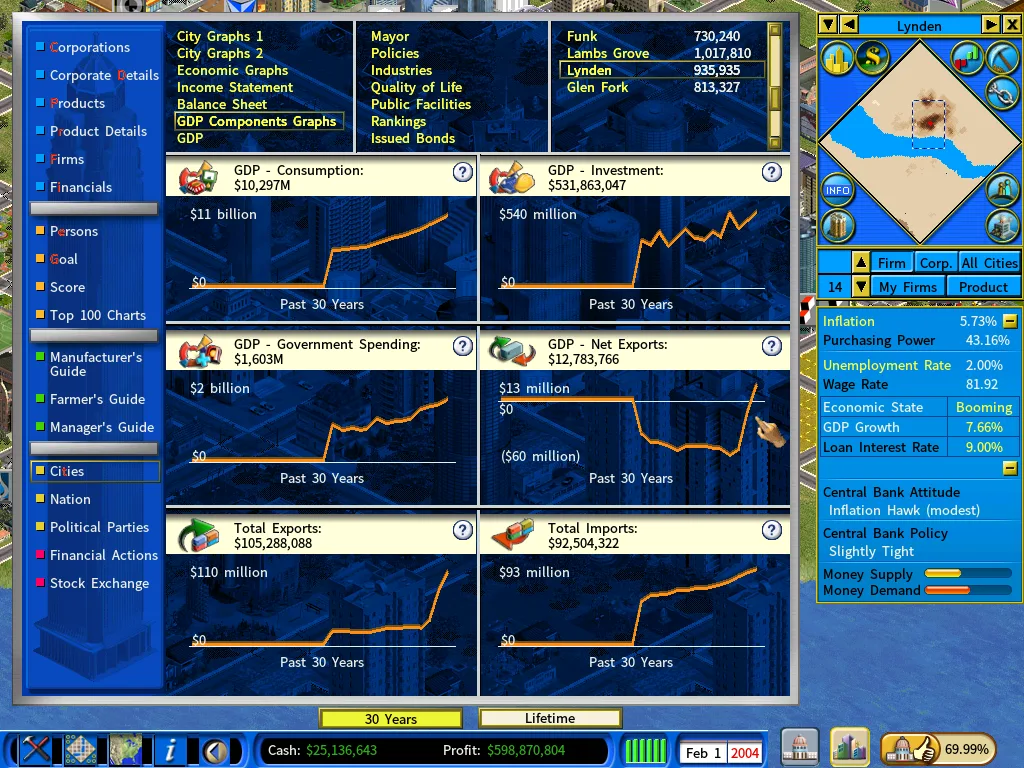
I want to provide a picture of Lynden that shows that the city is currently a net exporter. All exports being in the food category.
We'll look closely to try and see the improvements this small achievement brings attached to it.
Chapter 40 — 4 July 2018
SUBSIDIARIES
Buzzard Automotive.
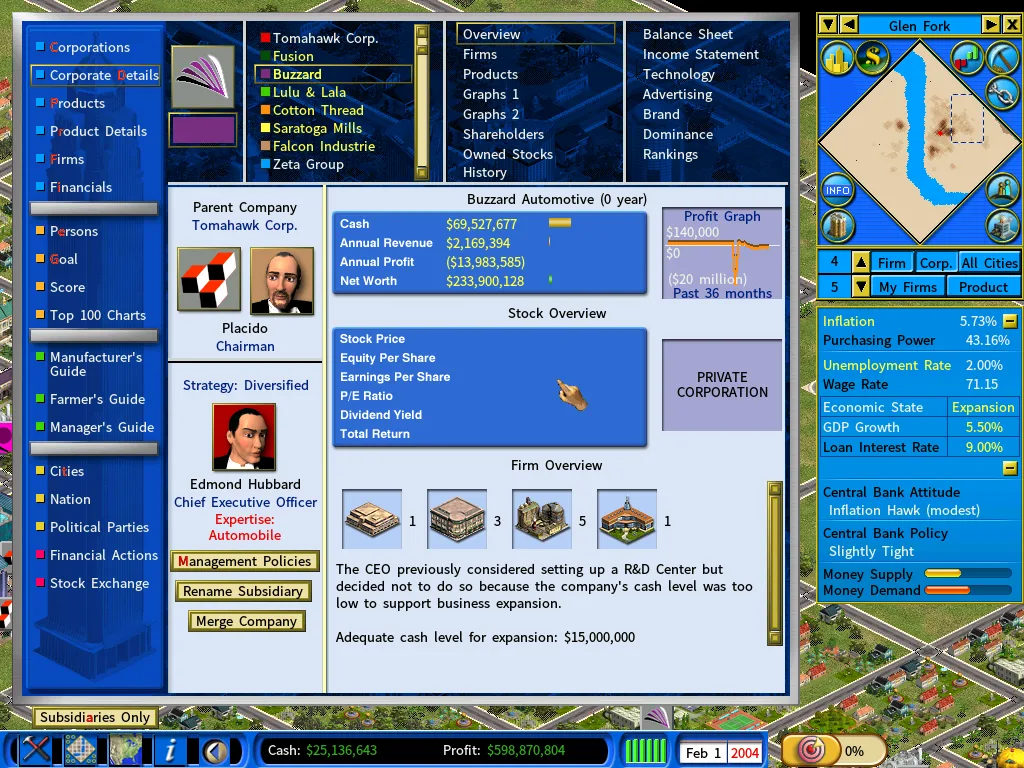
Welcome Buzzard Automotive, our new automobile subsidiary. We created them in February 2003 to compete with Anlin, chose Edmond Hubbard as CEO and gave them 250 million to start their business. They're already manufacturing cars and motorcycles, with all their production located in Glen Fork.
Lulu&Lala:
We're a bit dissapointed with Mrs Santanna.
The company looks very lame: we sold them our cosmetics technology, but they haven't started producing anything and after 8 years they have just one lab and a retail store. We thought they could build a health care giant, but were wrong. They might be too conservative for our taste, so we have directed them to focus solely on the cosmetics area and changed their brand from corporate to ranged.
We'll have to fabricate a proper health care corporation choosing an agressive CEO. Maybe next year.
Cotton Thread:
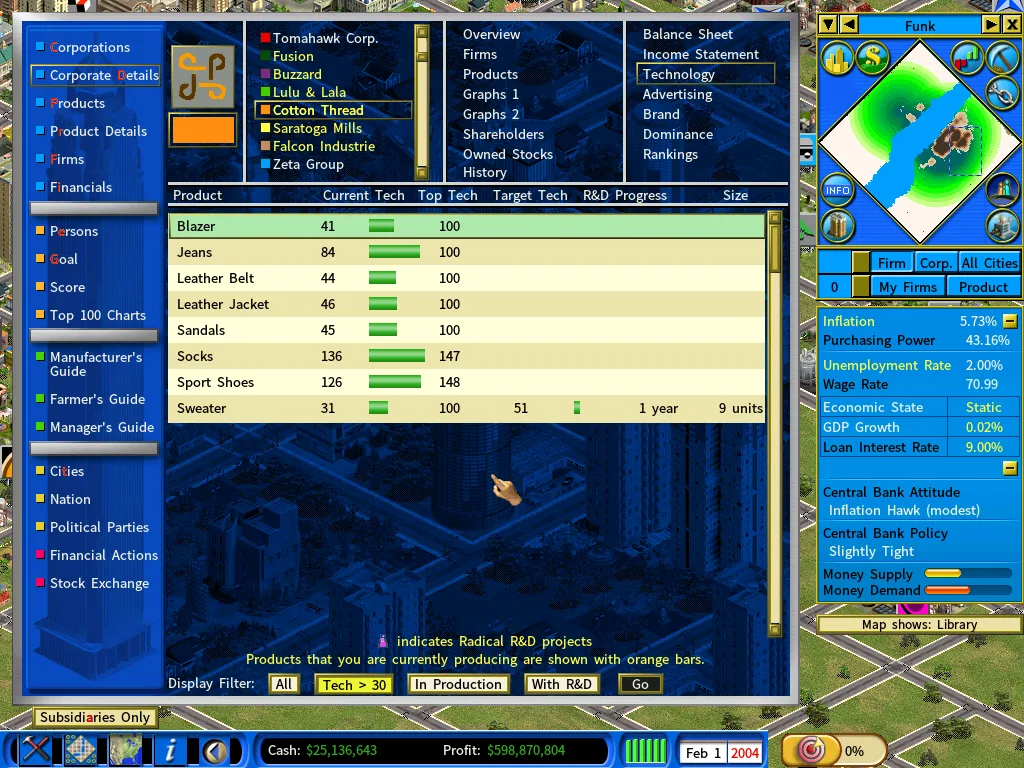
Mr Tanaka seems to be waiting for the right time: They've bought technology in the apparel, leather products and footwear sectors, so we'll give them some time and see wether they engage in manufacturing or not. We prefer they start right away even if by doing so they lose money.
Saratoga Mills:
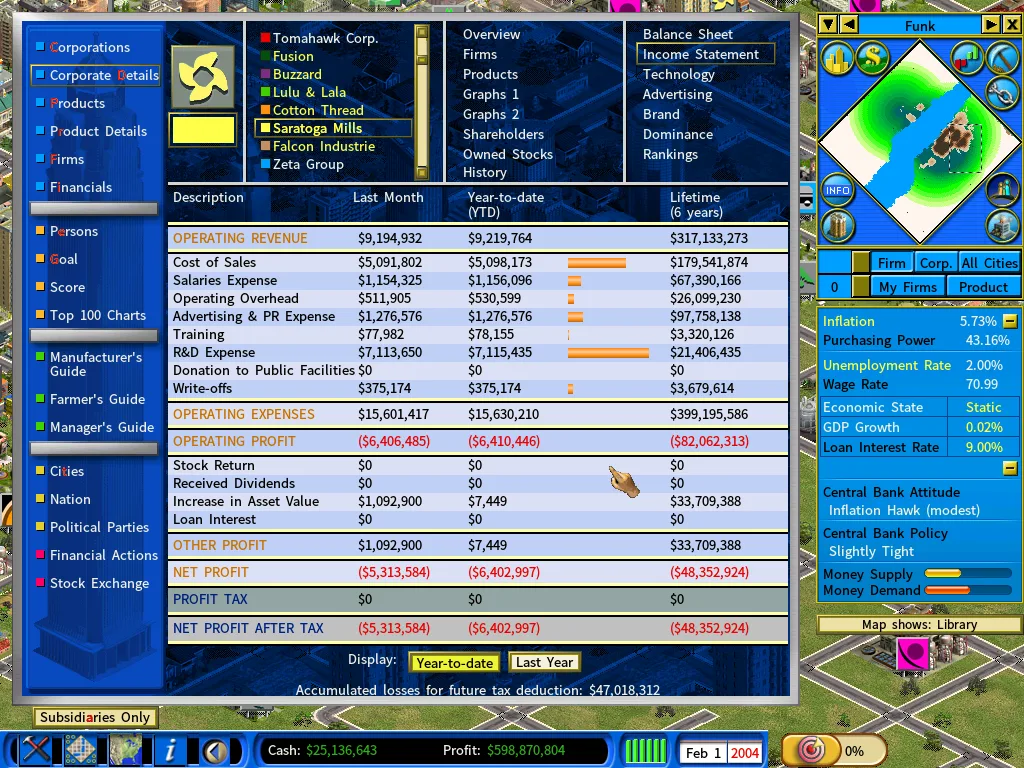
With Mrs Iniguez we fell confident enough: they're a recognized player in the beverage area and might start showing a profit soon, as they've just started selling their own wines.
We are researching all food technologies and will be finishing our first step next year, so we'll be selling them our knowledge and let them decide about the feasibility to materialize it in the market.
We say that because there's currently a price war in the food sector, with some corporations pricing their products at or below cost.
As you can see, most of their lifetime loss is because advertising their corporate brand. With range brand they'd be probably showing a profit already.
Falcon Industries:
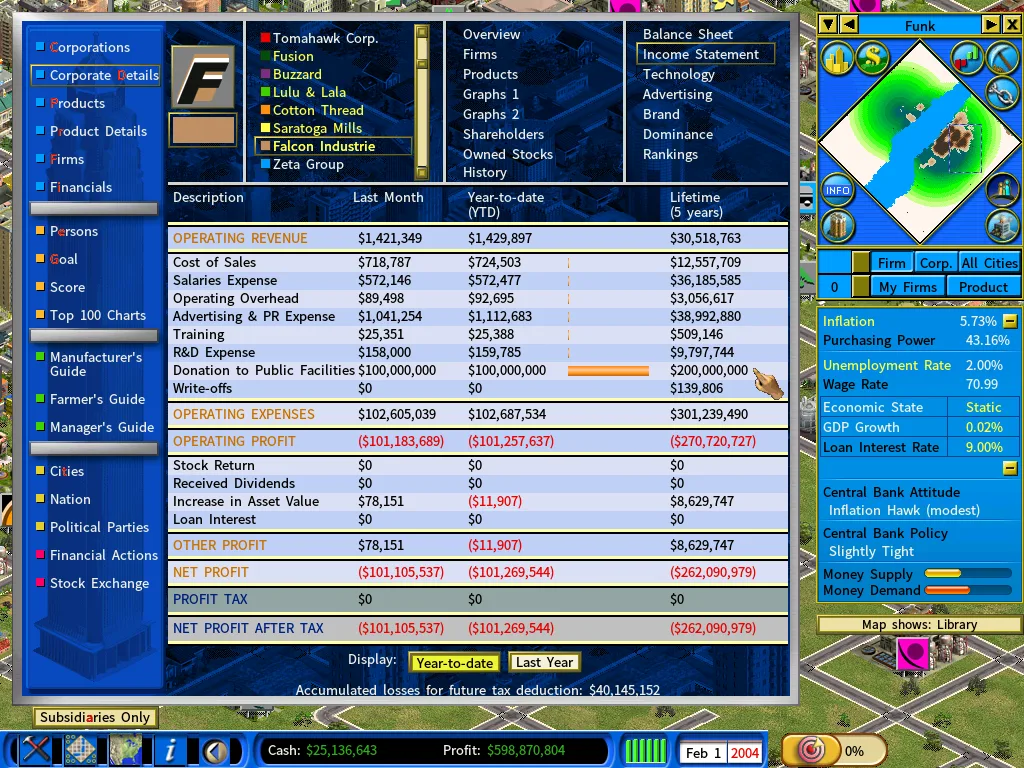
Poor Mr. Kaye is showing a loss of 200 million in their books because of their sponsoring our political party. That might compromise the future IPO, so we'll have to merge with them and remake the subsidiary from ground zero.
REAL ESTATE
This past year we constructed five apartment buildings and one office building. The supply in OUR cities is currently between 5 and 7, and shrinking fast as there's an influx of about 100k new residents every year. In Glen Fork and Funk the supply remains above 10 so we probably won't build anything there until we see that they're picking up in growth.
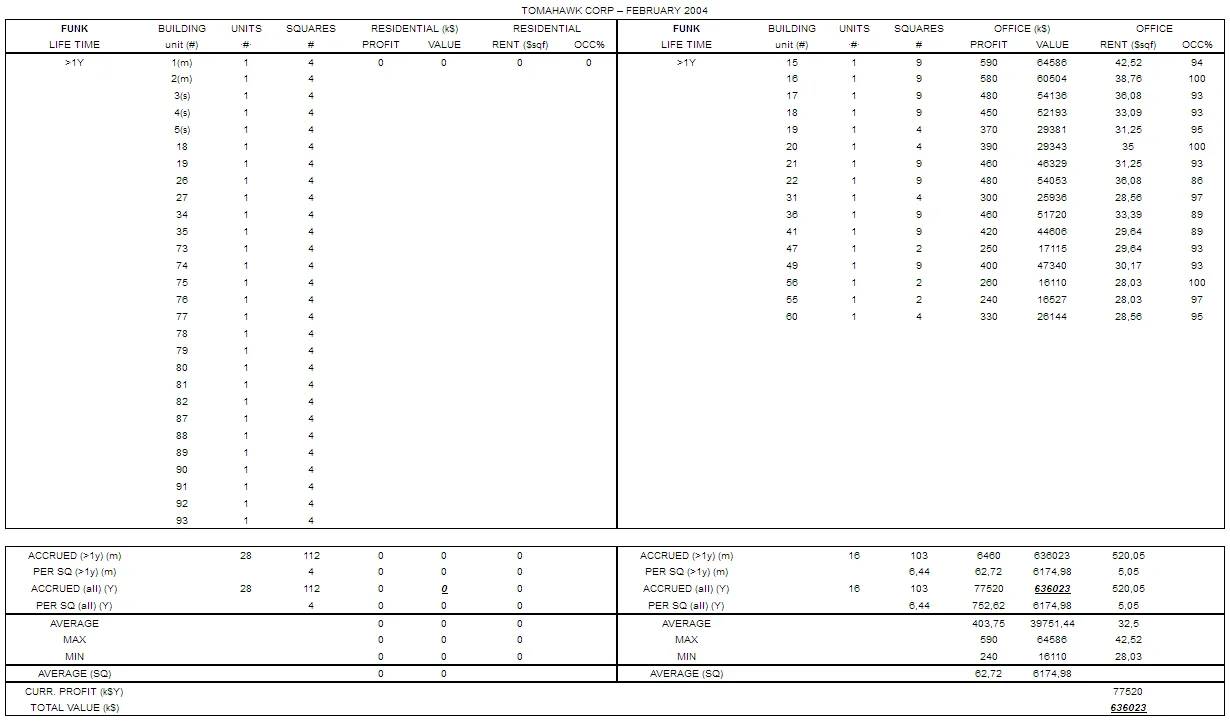
MAYORAL ELECTIONS
This year new elections were called in every city.
We'll expand our party budget to 150 million as we're feeling urged to take over both Glen Fork and Funk. The conservative party is really ruining the stage there. They have quite some money to spend, so, a stipendiary effort will be required to dethrone them.
In Lynden and Lambs Grove our position is strong as our policies are aimed at raising the standard of living and we've an ample support base in consequence.
Chapter 41 — 6 July 2018
Finally, our financial situation sheet and the subprime detective sheet.
As you might have noticed in the balance sheet, our debt now stands at 2 billion, from 3 billion last year.
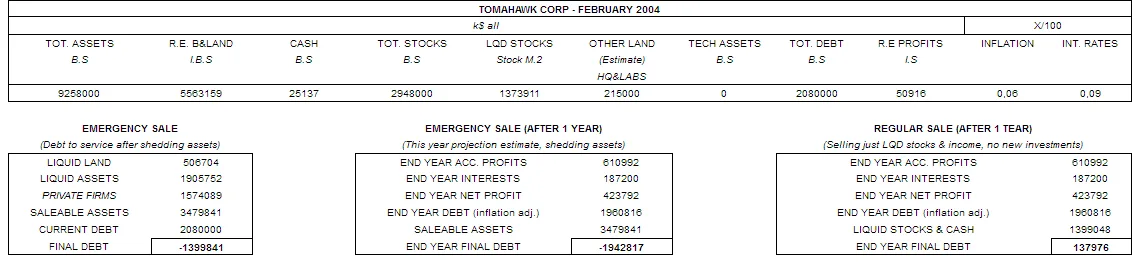
We can see that such amount of debt is not risking the stability of our corporation: we have both 2 billion liabilities, but almost 4 billion in "saleable" assets.
If we'd sell just our public stock holdings and use all income to pay the bank, our final debt would stand at 138 million, beginning February 2005.
If we wouldn't be selling Fusion corp stock, our favourite public subsidiary, our final debt would instead stand at 528 million.
We can see that our RE sector strongholds can withstand perfectly our current liabilities, at current money rates.
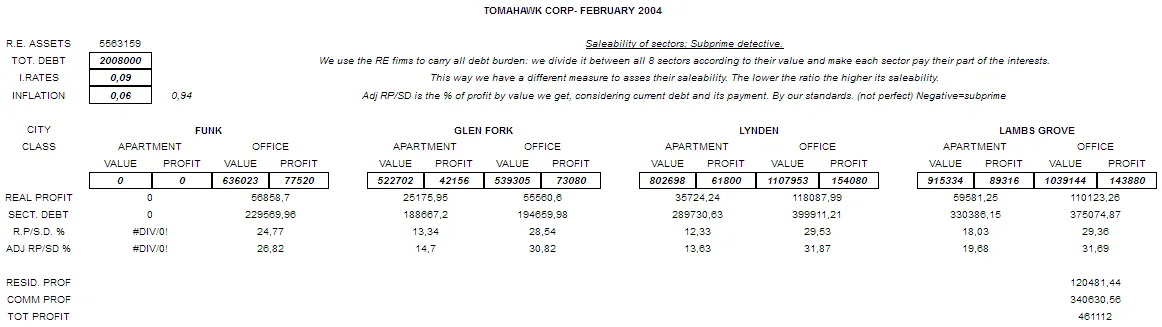
But let's play a bit and ask ourselves some questions, like:
1- How high should rates climb to make us bankrupt, with a 2 billion debt?
2- How high should rates climb to make us bankrupt, if our debt was 5,5 billion (about the max. available from the bank at the moment) instead of 2 billion?
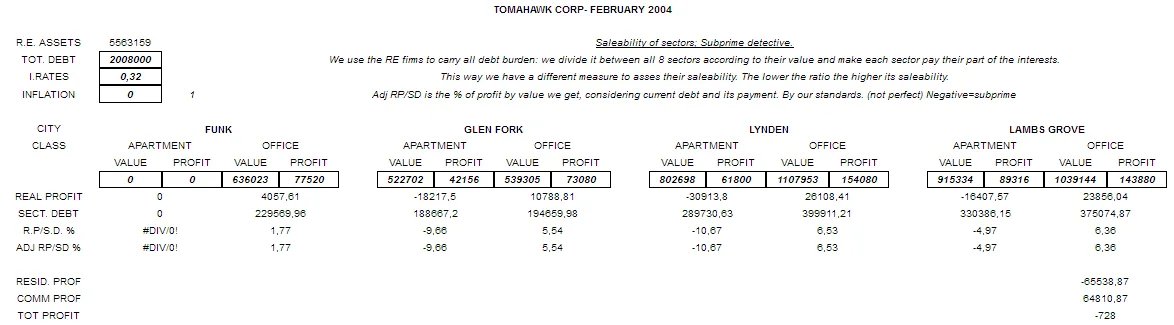
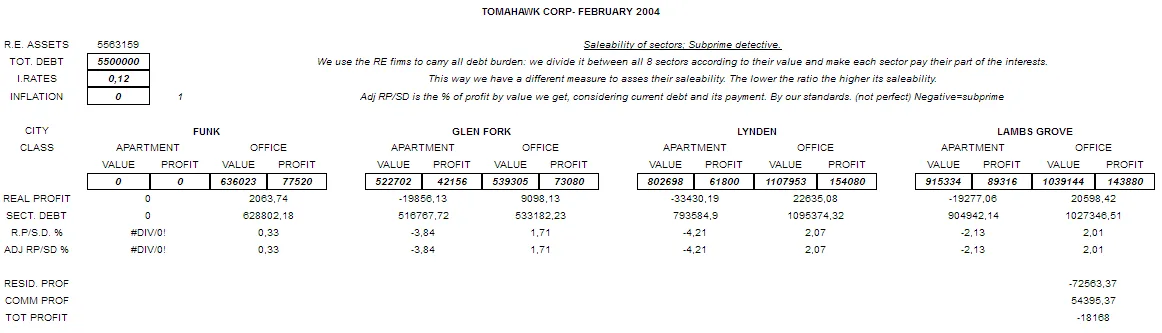
Here're the answers:
Q1- 32%
Q2- 12%
NEXT YEAR:
From now on we'll report every two years, but we can provide somehow detailed plans for next year:
We want to create new subsidiaries and capitalize them properly, but we don't want to increase too much our debt, so we'll strike a balance.
To consider:
First of all, we don't know future trends for inflation nor money rates. We must be cautious as things can move pretty fast.
Second, we're paying a 3,3% RR and that means 66 million lost per year. At 5% RR we'd lose 100 million per year.
We'll merge with both Lulu&Lala and Falcon Industries for the reasons stated before. We calculate we'd get 600 million.
We spent 1 billion in them and used 200 million to fund our political party, so we've lost 200 million, minus some low tech research property.
We'll use the money, thus:
50m to party donations,
50m to stock picks as money-substitutes,
250m each for two new subsidiaries, and
0m for the bank.
We'll use the income from our RE sectors to construct new buildings in OUR cities, and "save" the rest (250-300 million) to buy some land in Glen Fork and Funk once we win the mayoral elections.
We'll then proceed to scuttle public office space there and build our own in their place.
Have a nice weekend.
Chapter 42 — 18 July 2018
FEBRUARY 2004 – FEBRUARY 2006
FINANCES
Real rates stand at about 3%, with nominal rates at 9% and inflation at about 6%. Pretty steady.
Our net assets increased by 1.1 billion to 8.3 billion in two years, by new RE construction and by a further increase in the value of our existing RE assets.
Our liabilities increased by 1 billion to 3 billion.
You might recall that our "saleable" assets were about 4 billion in 2004, so we considered carrying a 3 billion debt manageable.
We have subsidiaries worth 3 billion in our book, so we can think of all our liabilities being carried by them, even more knowing that we used the cash to set up new ventures and to better capitalize existing ones.
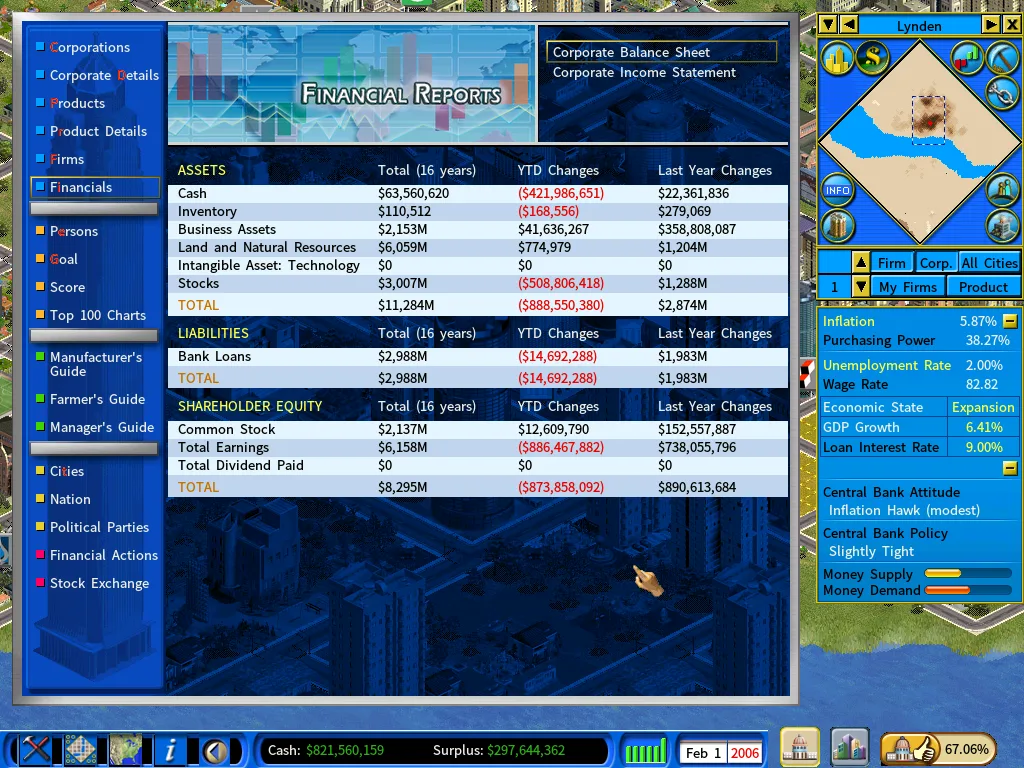
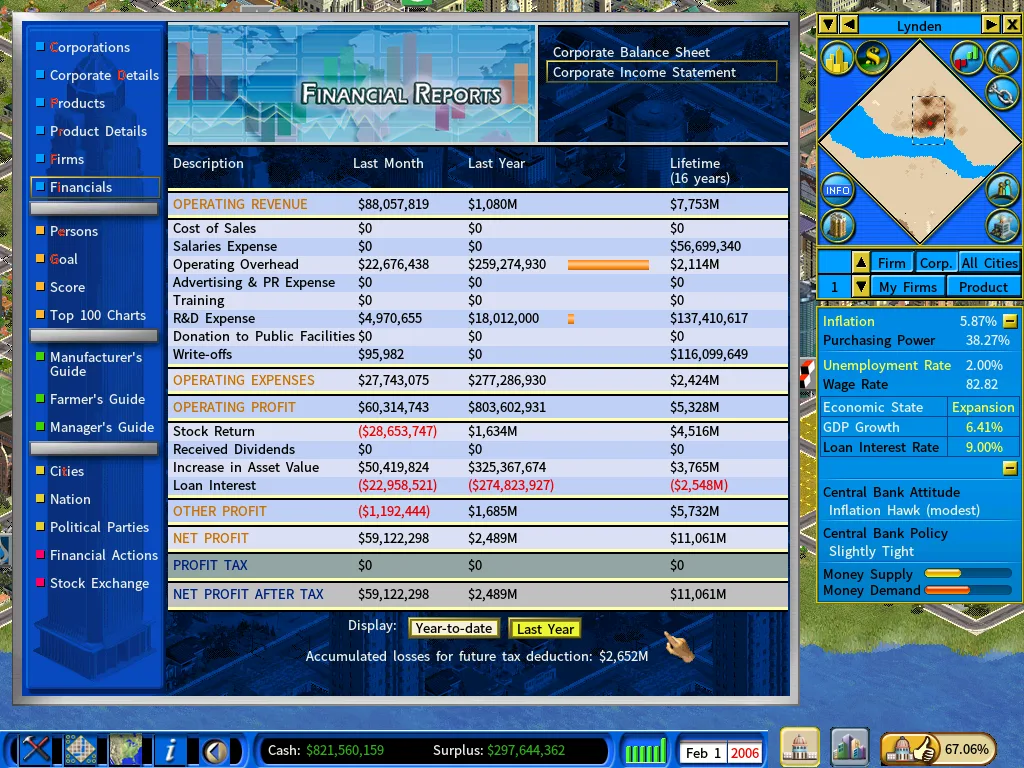
Our current income is about 720 million/year, of which:
180 million is used (automatically, by inflation) to repay principal, and
90 million is lost to the bank.
What leaves us with 450 million net to invest per year.
From now on we'll be less focused in increasing the value of our assets as we were before, for two reasons:
First, we are not interested in having a high stock price, because we don't need it to fund our expansion. We have suceeded in not using it and we don't find a good reason to do so at the moment.
Second, we have enough "free" assets to monetize through the bank, in case we need the cash.
Instead, our focus will turn to income:
We'll start using the small office building more often, as it's the one that provides the max. rent per square of land, and we'll find a time in the future where our commercial districts will have grown too far away from the cbd dot, meaning that the "supply" of the best land will shrink, so we have to start thinking of making the best use of it, the sooner the better.
Also related, about our land usage:
One can think of our old approach as to build one structure and use one side to build the next. We'll now start leaving more areas "free" ("unclaimed" and "expensive") around our districts so the other corporations build their stores there, as we believe the benefits from doing so will accrue in the long run.
Here's a summary of the idea:
1- We 'll take advantadge of cheap land at first to create new "isolated" RE strongholds.
2- We'll use the Mayor to build services close.
3- The land around our new district will appreciate in value, and become "retail friendly": We won't be buying the extra land as we did before.
4- The AI will pay a premium to set up their stores there, thus the city budget will get an extra income (out of nothing).
5- Sales volume in each city will increase, as selling will become easier. So will tax revenues. The money will thus circulate at higher speeds.
6- Competition will increase as good retail land will become accesible to all, as opposed to having just a few good spots in the hands of a few corporations. So, more jobs will become available in every line and category of business, as the last stage of operations (retail) will find any potential bottlenecks removed.
7- Inflation will stay high as we like it.
So goes our reasoning. The health of our corporation is too attached to the health of the nation, so we have to take care of it if we want to keep doing good.
STOCK MARKET
We sold our whole position in Global Link at about 60$/share (about 20 million shares) in the period up till February 2005, and used the proceeds to set up new subsidiaries.
One year later the price has moved to 80$/share, so in retrospective, another mistake. We could have cashed in about 400 million extra in just one year's time (about our yearly net income).
So far, so good, sold out.
We have no public company holdings and we don't plan to acquire any, as they are really expensive (even the ones opearting at a loss are priced sometimes at 2:1 book value).
We might change our prospects if we detect some hidden value.