

Community Let’s Play · Real-estate AAR
Office space — Part III
In-game 1990–2016. The story of Tomahawk Corporation, a real-estate empire built on debt in the little country of Sylvania.
Continued from Part II. Originally posted by colonel_truman; reproduced in the author’s own words.
Chapter 43 — 31 August 2018
SUBSIDIARIES
Just a descriptive summary:
February 2004
We merged with Falcon Industries for the reasons stated in our last post, and created New Falcon Industries, choosing Mr. Kaye again as CEO.
Also, we created Tidy-Mart Corp. to compete with Shining Star in the Household Products category.
February 2005
We created Bantam Pharma to focus on the Heath Care category, after scuttling our failed project "Lulu&Lala". We had some drug technologies researched, which were "transfered" to them at market price. They're already engaged in manufacturing.
We created Gold Stream to compete with Global Link, focused in the Luxuries category (jewelry & watches). They're also engaged in manufacturing.
February 2006, (present time… )
We finally merged with Cotton Thread, our Apparel subsidiary, after realizing Mr. Tanaka wouldn't use the cash we entrusted him to engage in manufacturing. We then procceeded to create New Cotton Thread and chose Mr. Fowler as CEO.
To recap. We have at present 8 subsidiaries, one of them public, covering:
Food mega class: Saratoga Mills. CEO: Mrs. Iniguez, with expertise in manufacture & R&D (30) and Beverage (40). Corporate brand. 8yrs life.
Health Care mega class: Bantam Pharma. CEO Mrs. Marie, with expertise in R&D (80) and Body Care Products (70). Corporate brand.
Luxuries mega class: Gold Stream. CEO Mrs. Suri, with expertise in manufacture & R&D (30) and Jewelry (70). Corp. brand.
Fashion mega class: New Cotton Thread, CEO Mr. Fowler, with expertise in marketing (80) and Apparel (60). Corp. brand.
Furniture stand-alone class: Fusion corp. CEO: Mr. Parets, with expertise in R&D (60) and Furniture (70). Range brand. PUBLIC. 16 yrs life.
Household stand-alone class: Tidy-Mart, CEO: Mr. Baker, with expertise in manufacture & marketing (20) and Household Products (60). Range brand. 2yrs life.
Auto-makers stand-alone class: Buzzard Automotive, CEO Mr. Hubbard, with expertise in retailing & training (30) and automobile (40). Range brand. 3yrs life.
Home Appliances sub-class: New Falcon industries, CEO: Mr. Kaye, with expertise in manufacture & R&D (40) and home appliances (50). Range brand. 2yrs life.
Which ones are making money? None has yet shown a lifetime profit except Fusion Corp. which has been engaged in retailing imports since 1990, for a total of 170m.
When it comes to last year profits, Saratoga Mills shows a modest 1.5m in profits (grape juice sales mostly).
When it comes to last month, we include with the two above Bantam Pharma (a tiny 70k) (just selling bath lotion products with no competitors).
How much have we spent in these? Private ones have been capitalized each with 500 million.
I'll be posting screenshots as they mature, and also by reader's request.
CITIES.
In January 2005 our party candidates won the elections in all cities, so we have ordered our minions (public servants) in Funk and Glen Fork to get to work.
First of all, we privatized public office buildings there (by demolishing the ones owned by the city and then granting Tomahawk Corp. the rights to develop the CBD).
We also demolished some residential buildings in the periphery that lacked access to services and ruined the city's life ratings.
BUDGETS:
To us a balanced budget means a small surplus, but that surplus should not be generated by land sales. Isn't land an asset that the city's shedding?
By that criteria only Lambs Grove can show a lifetime balanced budget and the rest are in the red, so we'll have to change that. The good thing is that Lynden (also) shows a YoY profit since we raised taxes when we took over, and so the city's steadily closing up the gap between total surplus vs total land sales. Both cities show a "net" surplus of about 100-150 million per year.
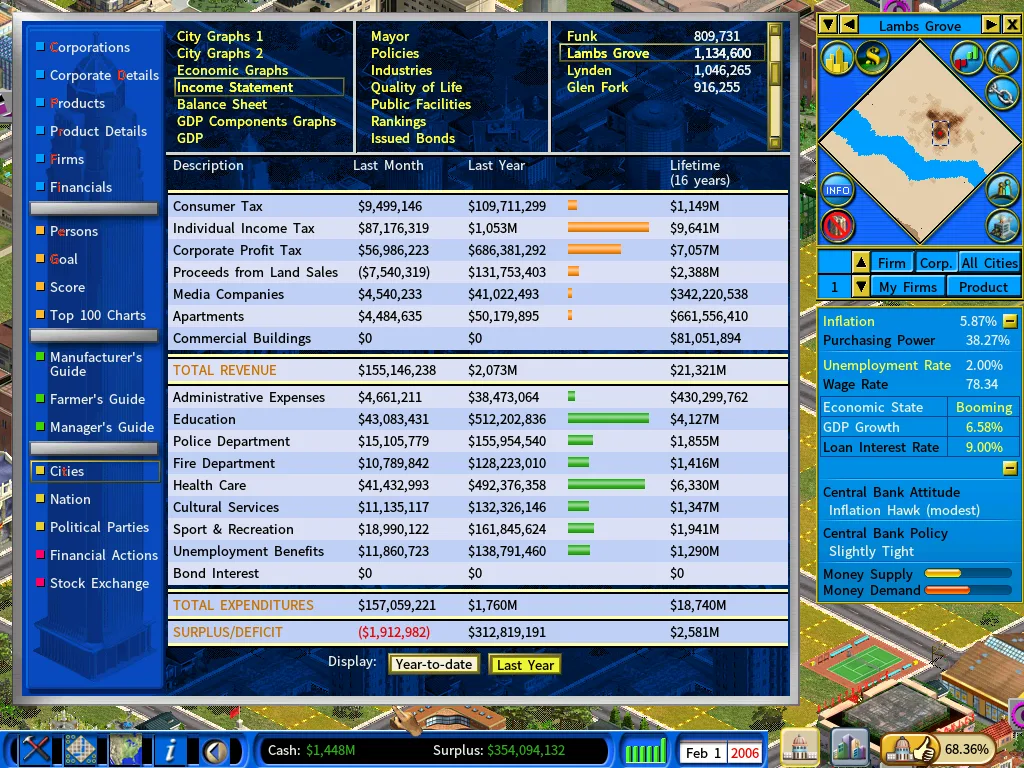
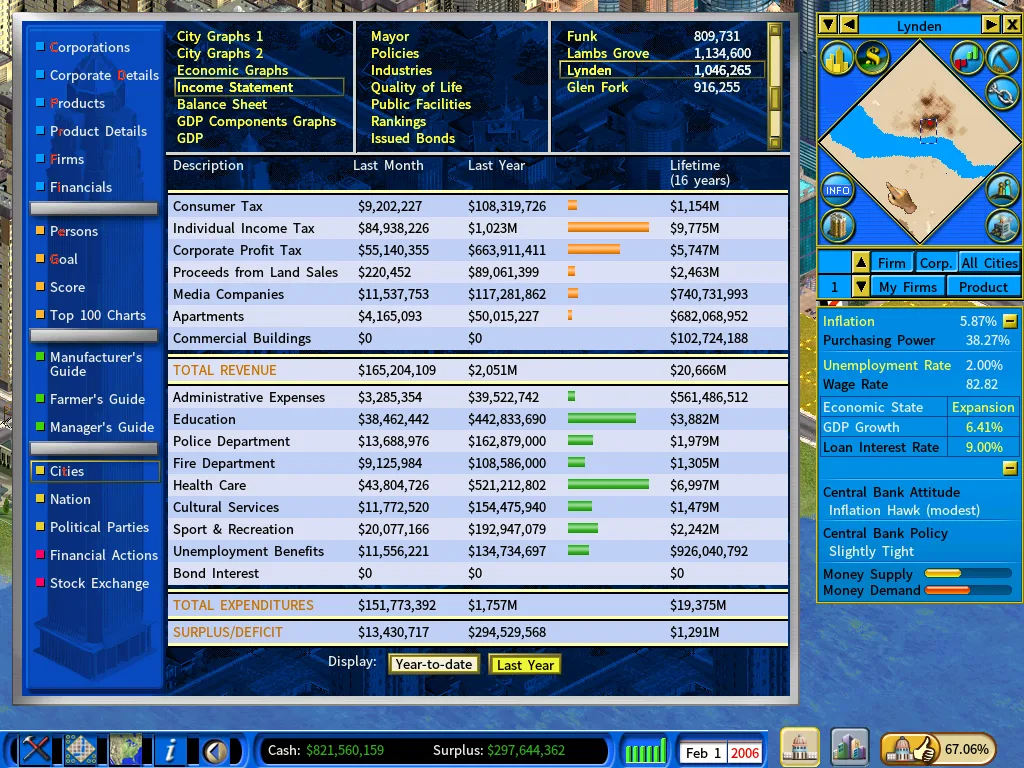
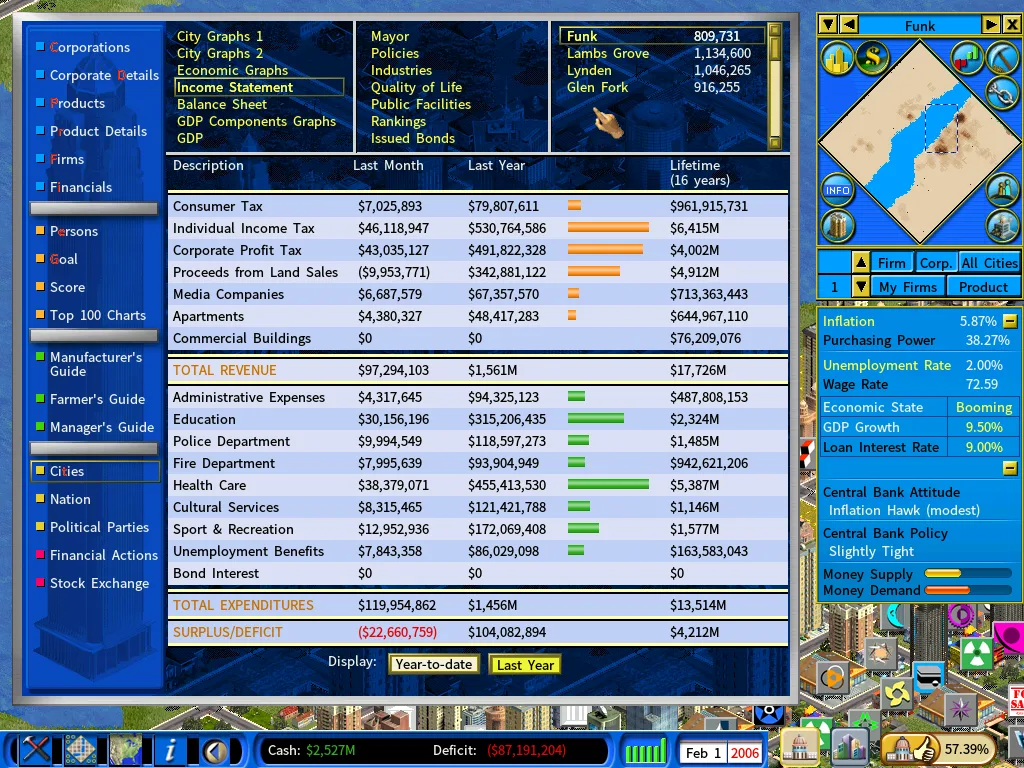
If we turn our attention to Funk, it has lost 900 million since 1990, and last year alone it lost 240 million.
In Glen Fork the situation is even worse, as the city has been living off land sales for the entire game, showing a lifetime "net" loss of 1790 million. Last year's numbers are worrying as the loss was about 307 million. Not only that, but cash flow projections in 2005 were negative…
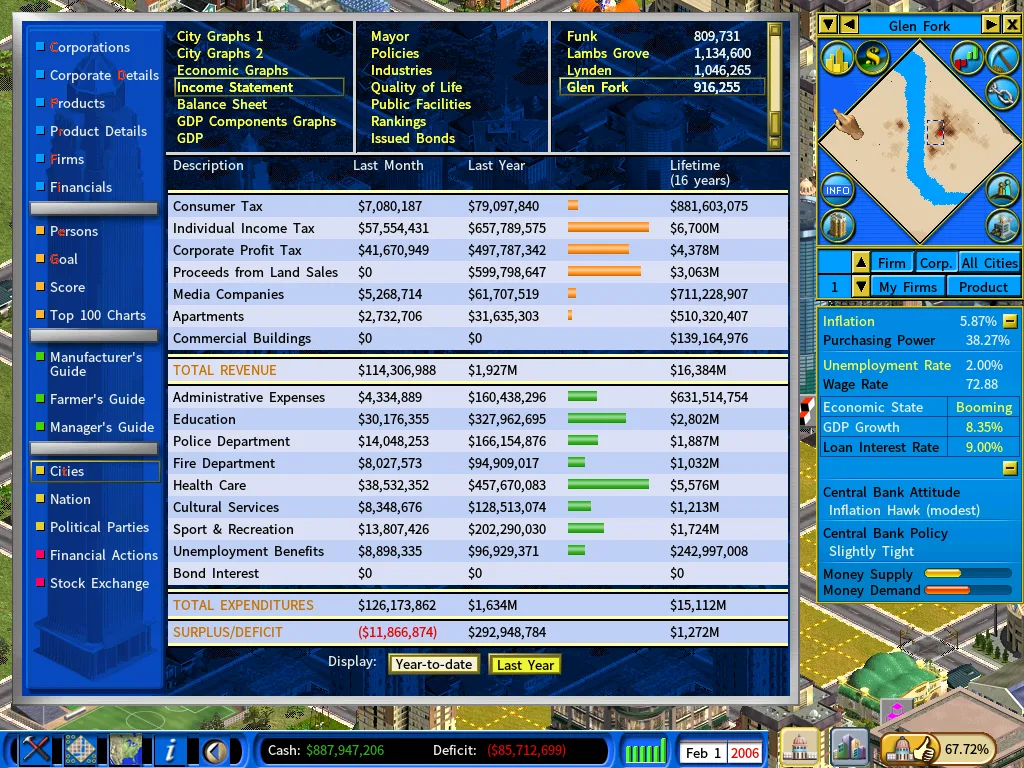
Notice you can see each city's cash levels in the screenshot, at the bottom.
MUNI-BOND EQUIVALENTS:
As cash flow projections in Glen Fork were negative and the cash levels in the city were low, Tomahawk's CEO decided to step in and swap land for cash for a few hundred million as a short-term loan to prevent the city from falling prey to muni-bond investor-speculators. The land will be gradually re-sold at market prices when the city budget sees positive cash flows.
You can see a huge land sale registered in the budget for last year.
TAXES & WAGES:
We have chosen a generic 10-25-20 (+/-) tax for all cities so there are no strong tax incentives to do business in any particular place:
1- If we'd see nice budget surpluses we'd reconsider the VAT.
2- As we did in Lambs Grove and Lynden, Income tax goes to 25% to balance the city budget (and will probably stay there too), esp. in Glen Fork.
3- Corp. taxes in Glen Fork and Funk were a minuscule 10%, so that 20% nation wide rate will hopefully level a bit future industrial developement across cities.
Funk has a 22% corporate tax (move the damn factory tax).
And, by the way, such a tax scheme didn't succeed much in creating jobs in Glen Fork, but a 20% rate did in Lynden.
Wages are steadily rising & leveling across cities. Currently:
Lynden: 83
Lambs Grove: 78
Glen Fork & Funk: 73
LAND-USE PLANNING:
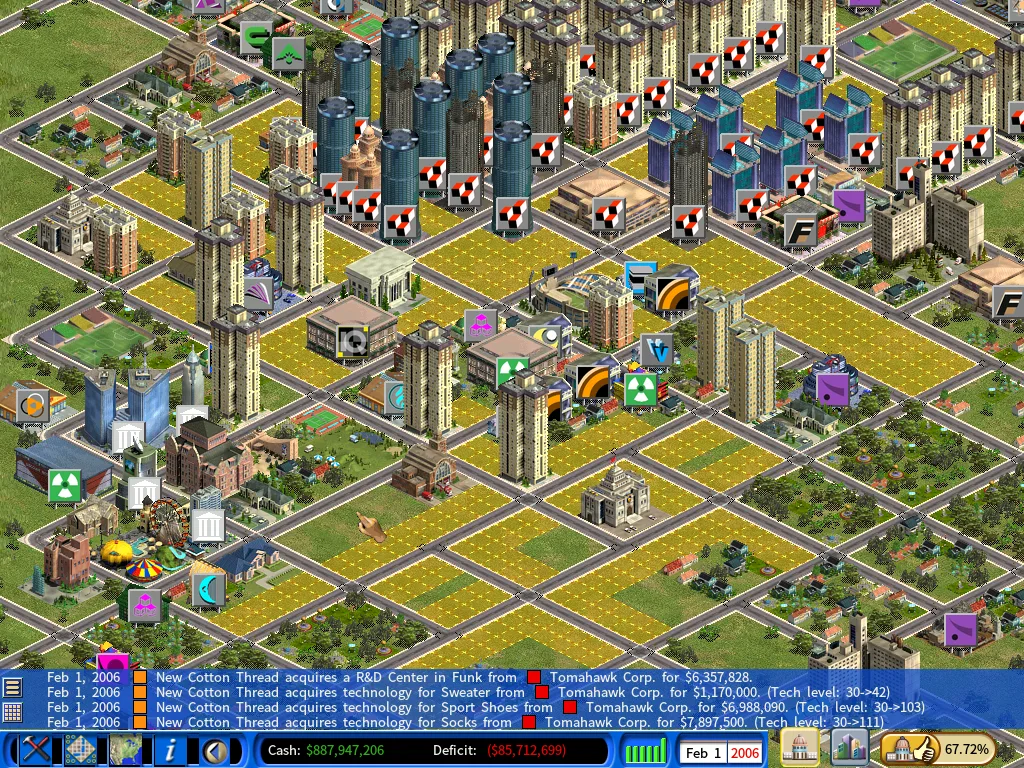
We re-zoned the land in all 4 cities following this pattern: used a "generic" not-for-sale zone for the whole city, then zoned some big mixed residential-commercial areas where services are available, and then chose an area in the periphery to "all-purpose" (for industrial and agriculture).
In Lynden we have specified an area for farming as that city is the nation's food hub and we want to make it easier to farming corporations by offering cheap agro-land.
Lambs Grove and Lynden show a clone-ish zoning pattern, with the land (east?) above the river dedicated to commercial-residential use and below it to all-purpose.
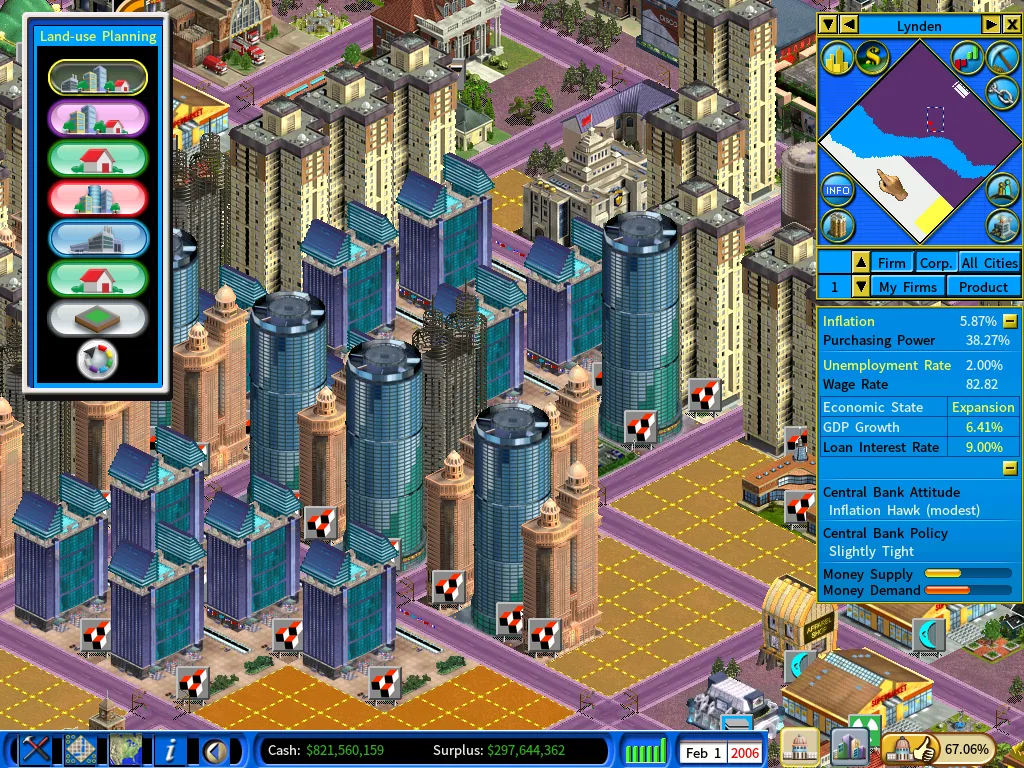
In Glen Fork we zoned a big square in the center as mixed commercial-residential to include the land with services and apartments below the river. The all-purpose land lying to the south-west.
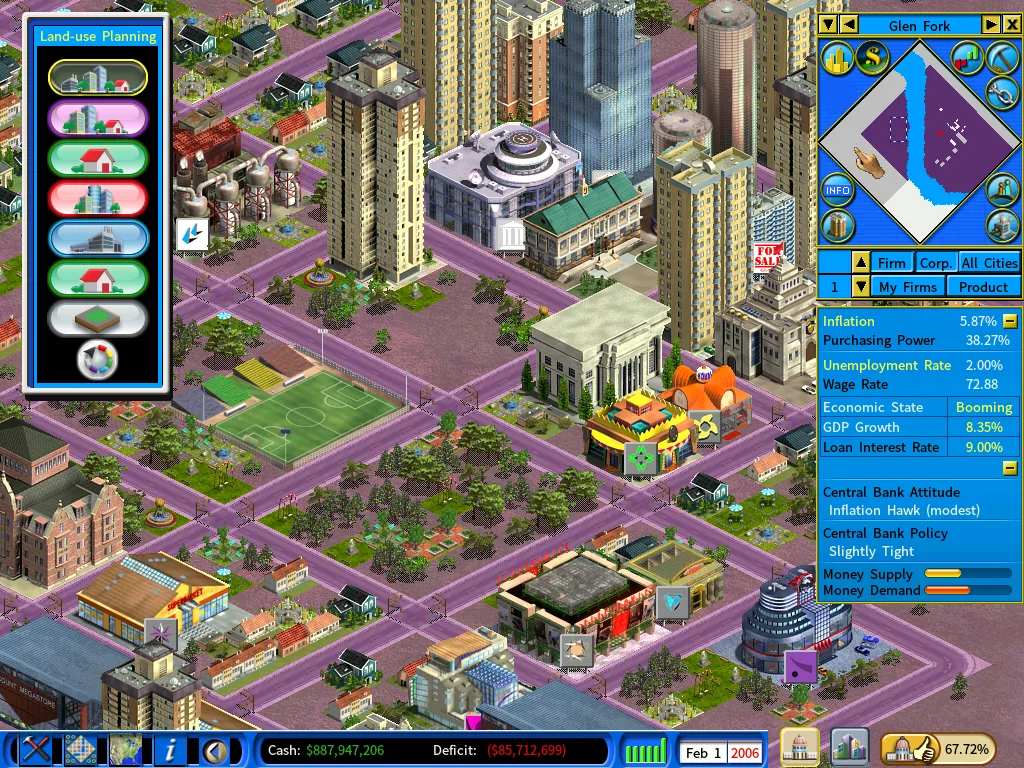
In Funk we left the area already urbanized and surrounded by factories zoned to a mixed commercial-residential, and chose one spot in the north-west to build New-Funk. The all-purpose quadrant is also in the south-west…
NEW FUNK:
Funk has been the typical cheap-labor, low-tax city that we usually find in most games, and so it has developed since 1990 an unhealthy industrial belt very close to the urban core. As a result, any new expansion of that core finds very acute land constraints.
It would be very expensive to relocate every factory further away from the living quarters, as with each "eviction" the Town Hall has to compensate the obliging corporation from the difference lost in land value. Such a transfer of wealth from the city's coffers to the previously-tax-subsidized corporations is something we want to avoid, by all means available.
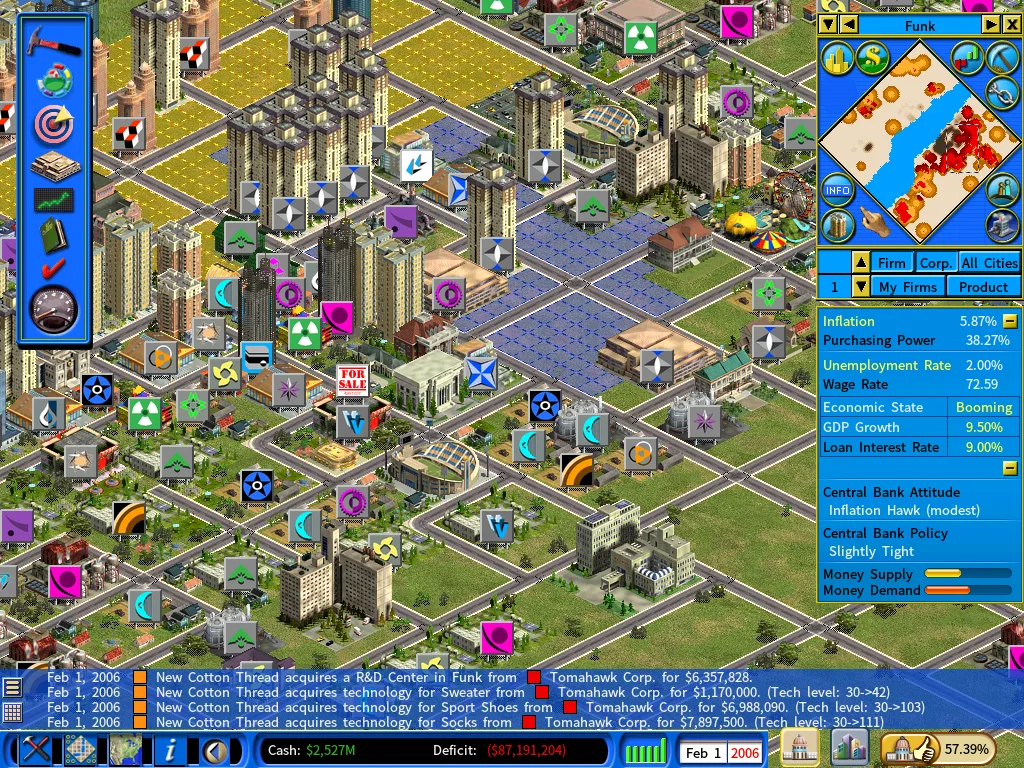
We then decided to clear the area with less industries, in the NW, and home New Funk in there (we'll "move" the city and not the industries).
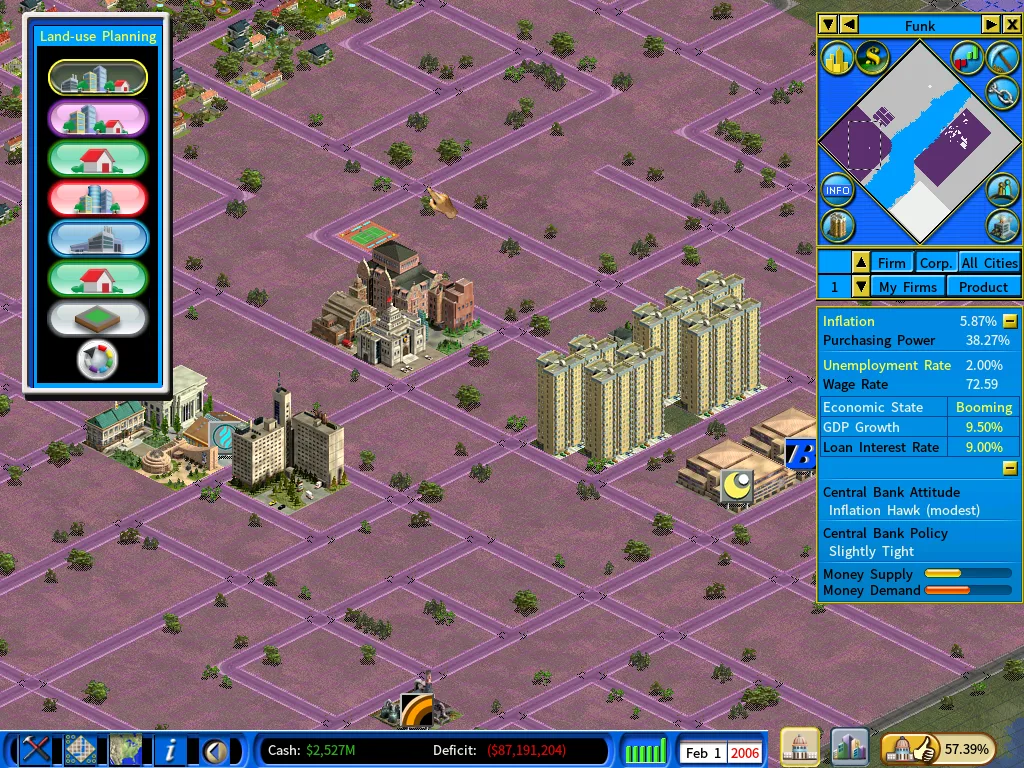
FUNK COMMERCIAL DISTRICT:
Finally! The CBD dot has appeared about where we were guessing it would.
The mayor has been busy this past year closing deals to move the firms doing business in the area to other locations, so that Tomahawk Corp. can step in and develop this treasure trove with new prime office space.
The hand in the screenshot shows where the dot is, just about the difficult to see cosmetics store below it.
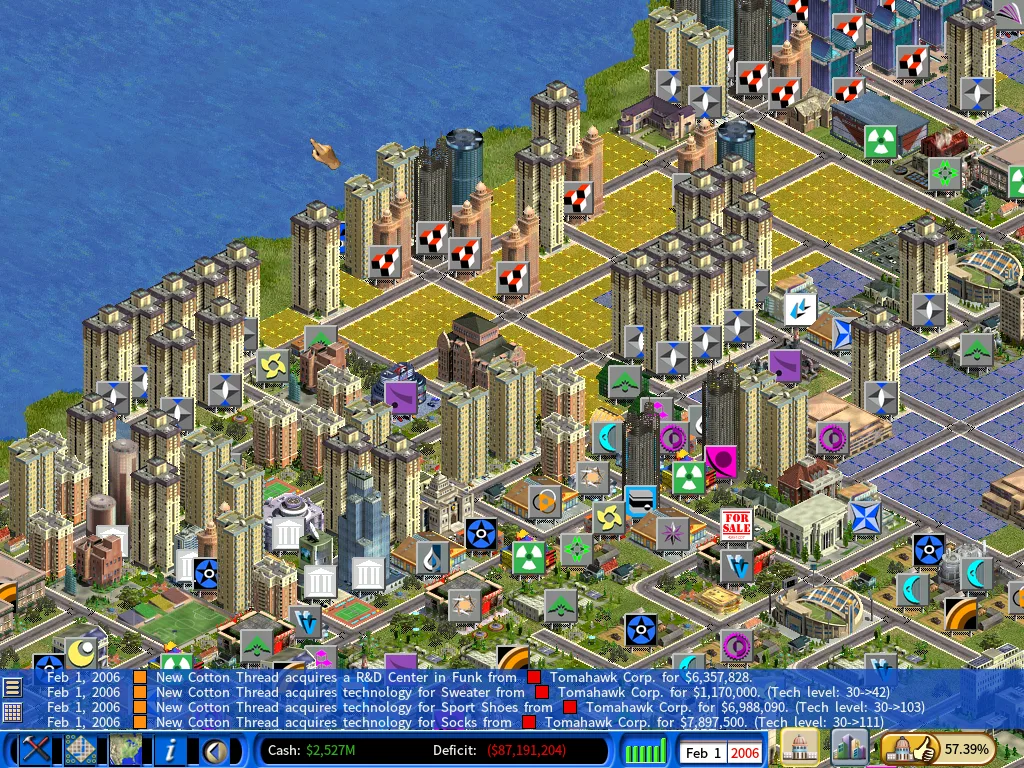
UNIVERSITIES & COMPETITIVENESS:
Somehow Sylvania is carving herself a place in the global market with her own brands…
It seems universities are the real kick-off for competitiveness. Following our heavy investment in these we have strong ratings as follows: (0-100)
Lambs Grove: Luxuries (jewelry & watches) above 70.
Lynden: Food (food & beverage) above 80.
Funk: Drugs above 70.
Glen Fork: Autos, at a modest 38.
As the budget allowed it and the demand was strong, we built a new university in both Lambs Grove and Lynden, so these have two now, ready to research new inventions and register new patents.
We'll try to support our subsidiaries by researching their specialties, esp. in Lynden, furniture, where Fusion Corp. has two R&D labs.
Chapter 44 — 25 October 2018
FEBRUARY 2006 – FEBRUARY 2008
FINANCES.
Real rates stand at 3.5%. Inflation still at 6%. So money is becoming a bit more expensive.
Looking at the Balance sheet we can see that our assets grew by 2 billion (net) in the interim and our debt shrunk by almost 400 million. We have channeled part of our surplus income to build new RE firms, as well as to the setting up of new ventures, as part of our investment plan, as usual.
We still follow the policy of maintaining low cash levels as we still have the option of expanding the line of credit already opened with the commercial bank.
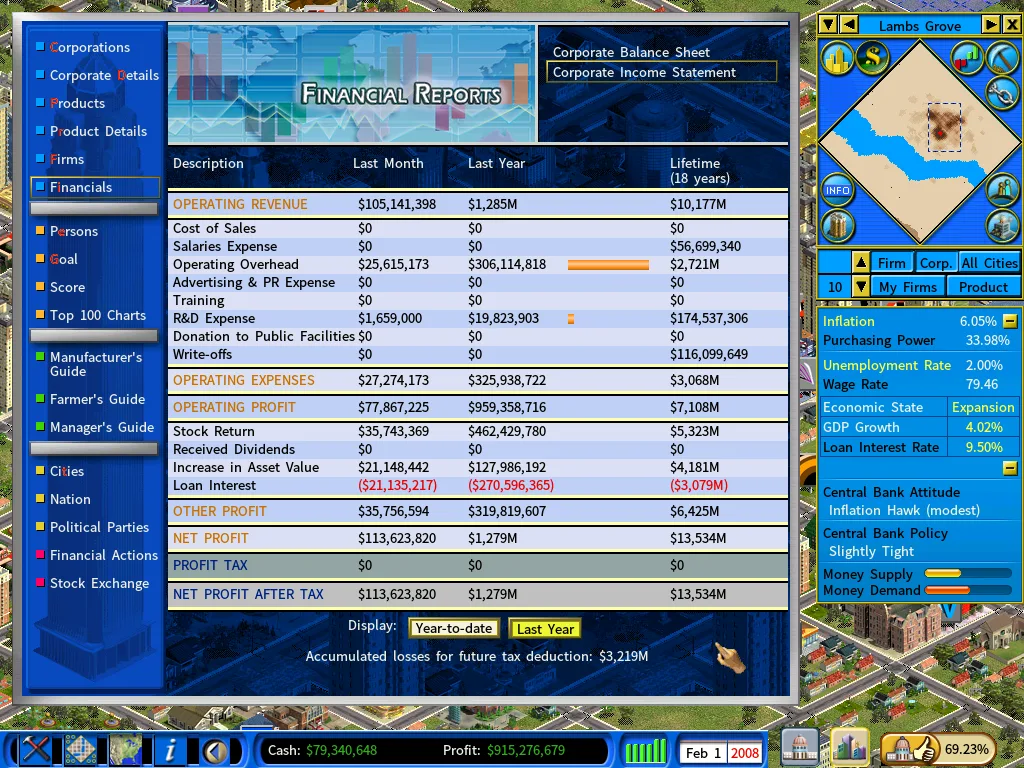
Also of notice is the growth of our intangible assets, that for a second time appear in our book. This time a modest 50 million. As you might see in the income statement our related expenses have been 230 million to date (R&D labs and salaries), so there's still way to go… We believe the gap will keep closing as our R&D department works in close proximity with the universities.
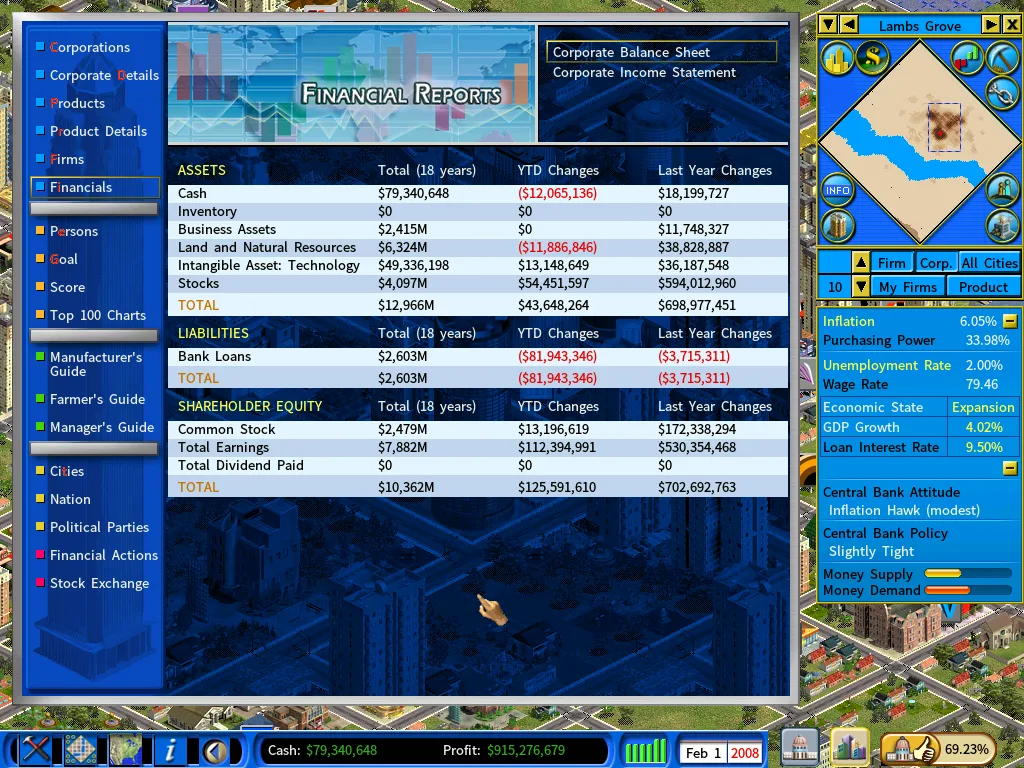
In terms of income we derive now 936 million each year from our RE firms (a 30% increase since 2006). All of the construction work for the period was done in 2006, so the new buildings are already filling our corporate chest.
STOCK MARKET.
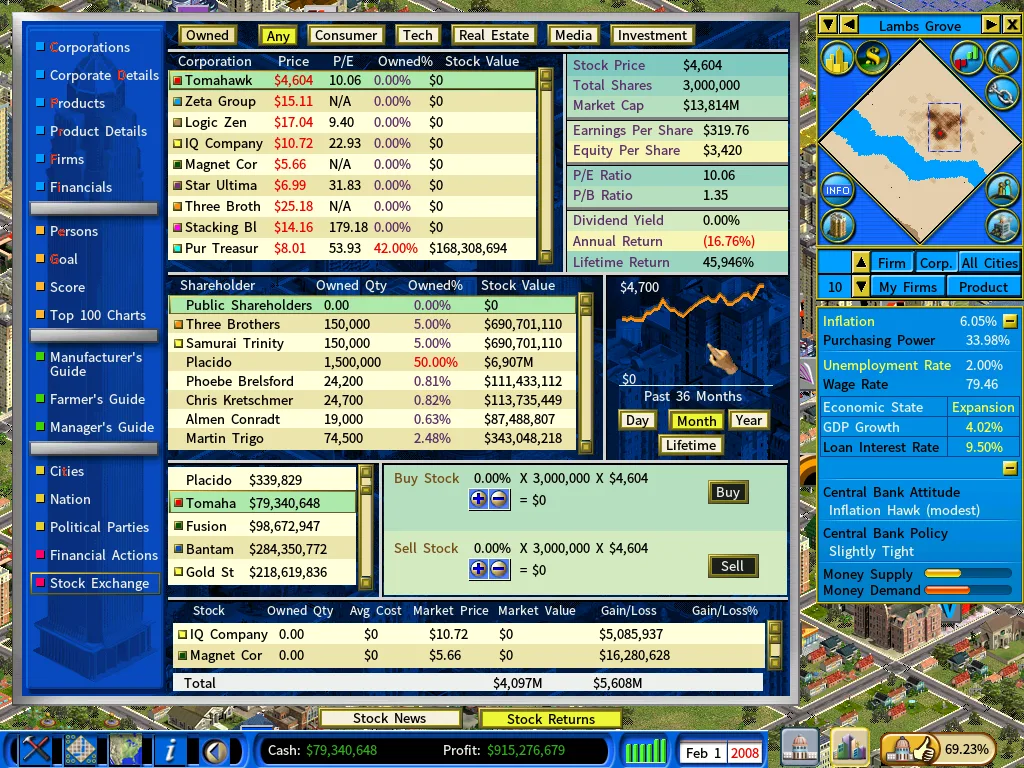
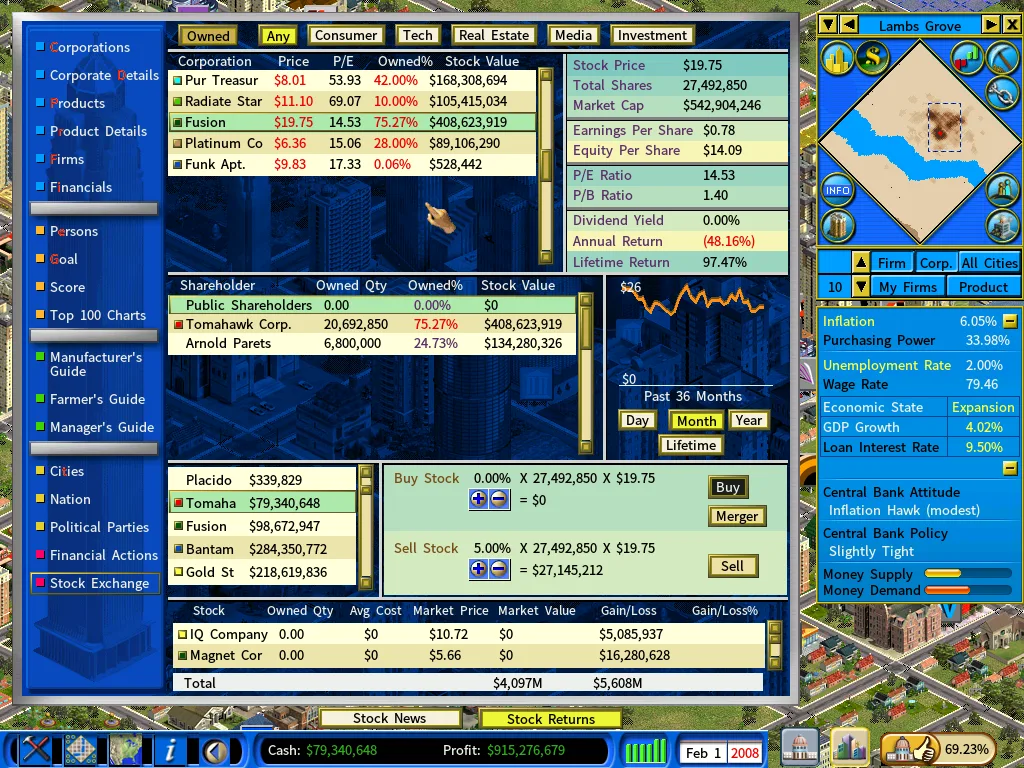
We did detect some value in a few public companies.
Pur Treasury and Radiate Star are two tech companies engaged in leather&footwear. As you can see they don't make a lot of money (1 million/month each), but their research capabilities make them very attractive. We have a very aggressive player in our private venture -New Cotton Thread- and we believe we could establish a cartel some time in the future in the textile industry. By acquiring a sizable share in these two rather small companies we could lay the foundation for that.
The creation of such a cartel will have the objective of selling our private company for a high price. After that we'd create new competition against it.
Meet the foe: Moon Harp (Mkt cap 1.57b). They are a big sized corporation engaged in the apparel class. We'll start looking to buy them once they become a direct target of New Cotton Thread (when the skirmishes wither and the battle begins) and their stock price (hopefully) drops.
Meet the contenders:
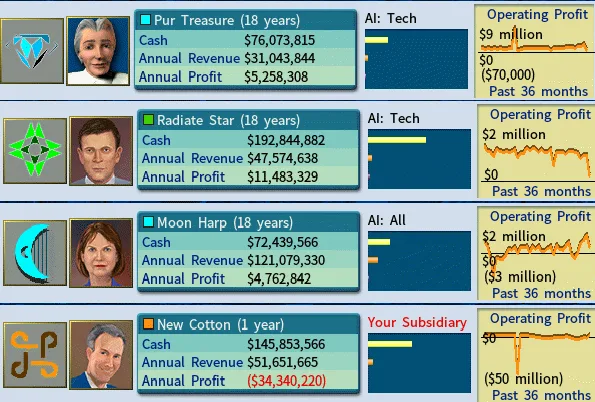
(and yes, a small collage bereft of relevant information. I'll expand in the future or by reader's request).
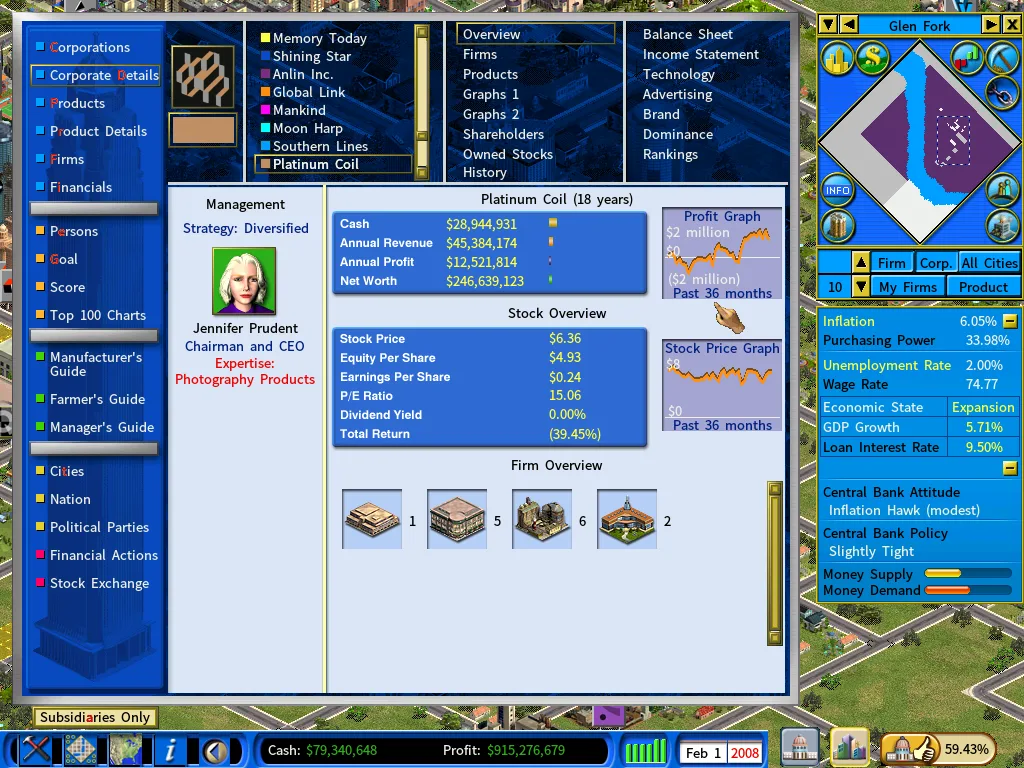
Platinum Coil is another company with some value we have been purchasing cheap (avg price 5,2$). They are selling compact cameras and we have no muscle in that area. We believe their price will increase very soon so we'll act with diligence. Our first objective will be to acquire 50% of the stock so we can make a bid for their technology.
Funk apartment Holdings. Their "floating" stock is below 5% and they are still and exclusively renters (they are a pure RE corporation, and "frozen"). Our position there is just a monitoring one.
NEW VENTURES.
Maybe we're rushing this a bit but we want to see our brand new technologies applied to the market, right now, so we have created these two 250 million corporations just for that.
Plastic Pills Ltd. (drugs)
Sylvanian Watchmakers Ltd. (watches)
We already have two other ventures with aims in these two classes but they are too slow in deploying other product classes than the ones in their field. Shame.
And finally:
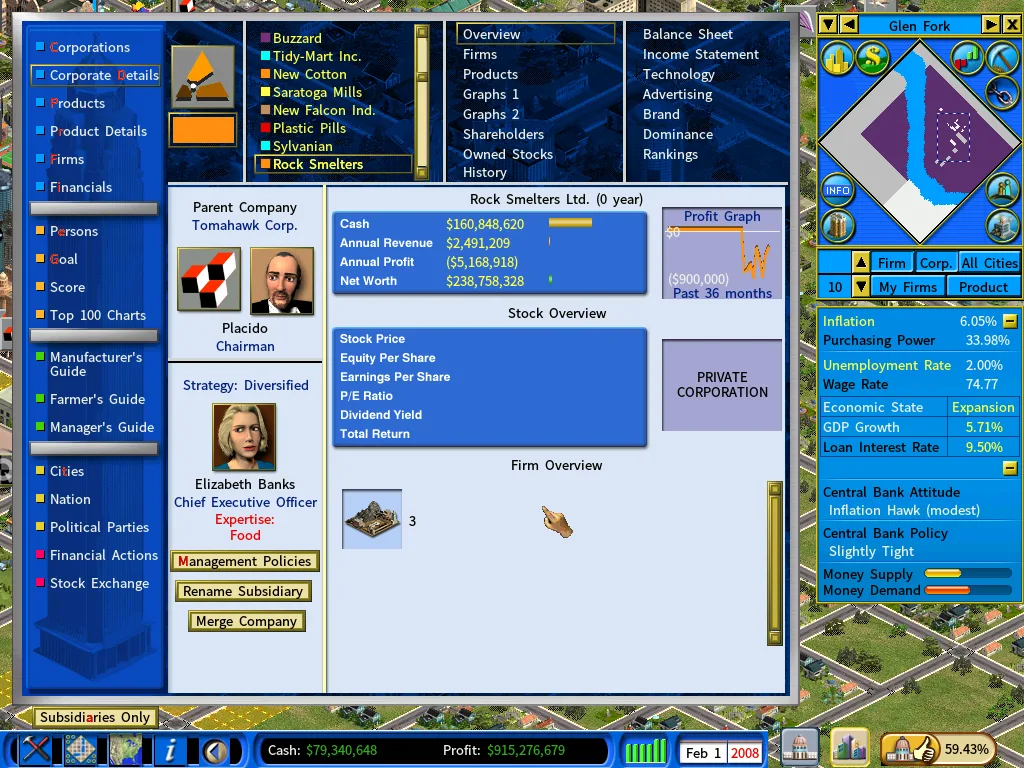
Rock Smelters Ltd. (metals mining).
With this one we'll make room in our policy of non-intervention and mess with them a bit. We found around a few available resources cheap and just built three mines (gold, aluminum, iron ore) to provide acceptable priced raw metals to our other subsidiaries. We might go as far as to produce steel but we'll probably go no further.
They are selling gold to our subsidiary Gold Standard (to bypass Global Link's outrageous monopoly prices) and aluminum to Falcon Industries (to make refrigerators). Hopefully the aluminum will also reach Saratoga Mill's canning factories, in time.
I'm posting the save file (v 5.1.33) in case someone wanted to take a peek. As you know, any comments or suggestions will be welcome, article or gameplay.
I'll post the rest of the period soon.
Thanks for reading.
Chapter 45 — 31 October 2018
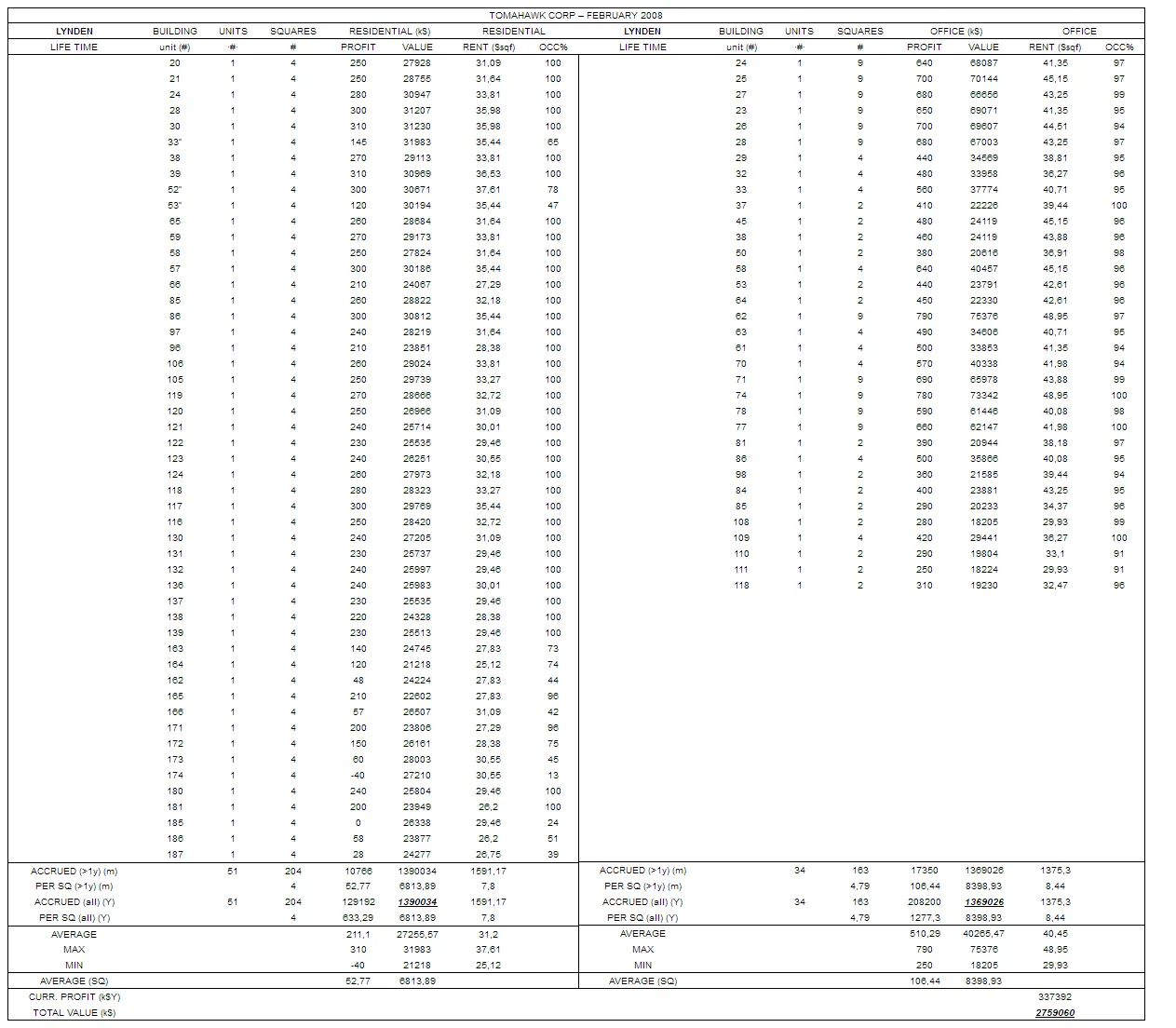
Next, the Improved IS&BS for our RE firms.
You can observe we've been using of late the 2×1 office for new construction in our commercial districts, as it pays the most per square of built land.
We have globally 147 apartment buildings and 129 office buildings. Of these there are 13 new apartments and 15 new office buildings, all built in 2006.
Our highest valued residential land square is in Lynden (at 8 million$) and our highest valued office land square too (at 12 million$).
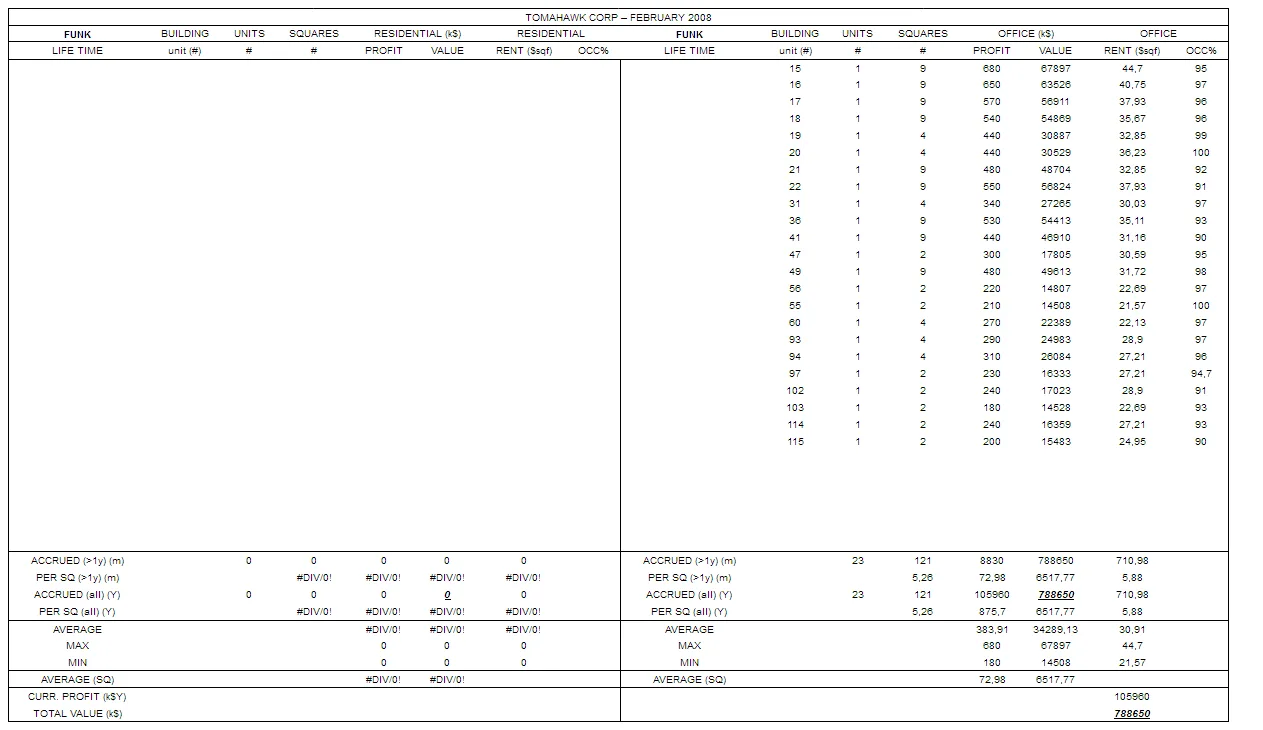
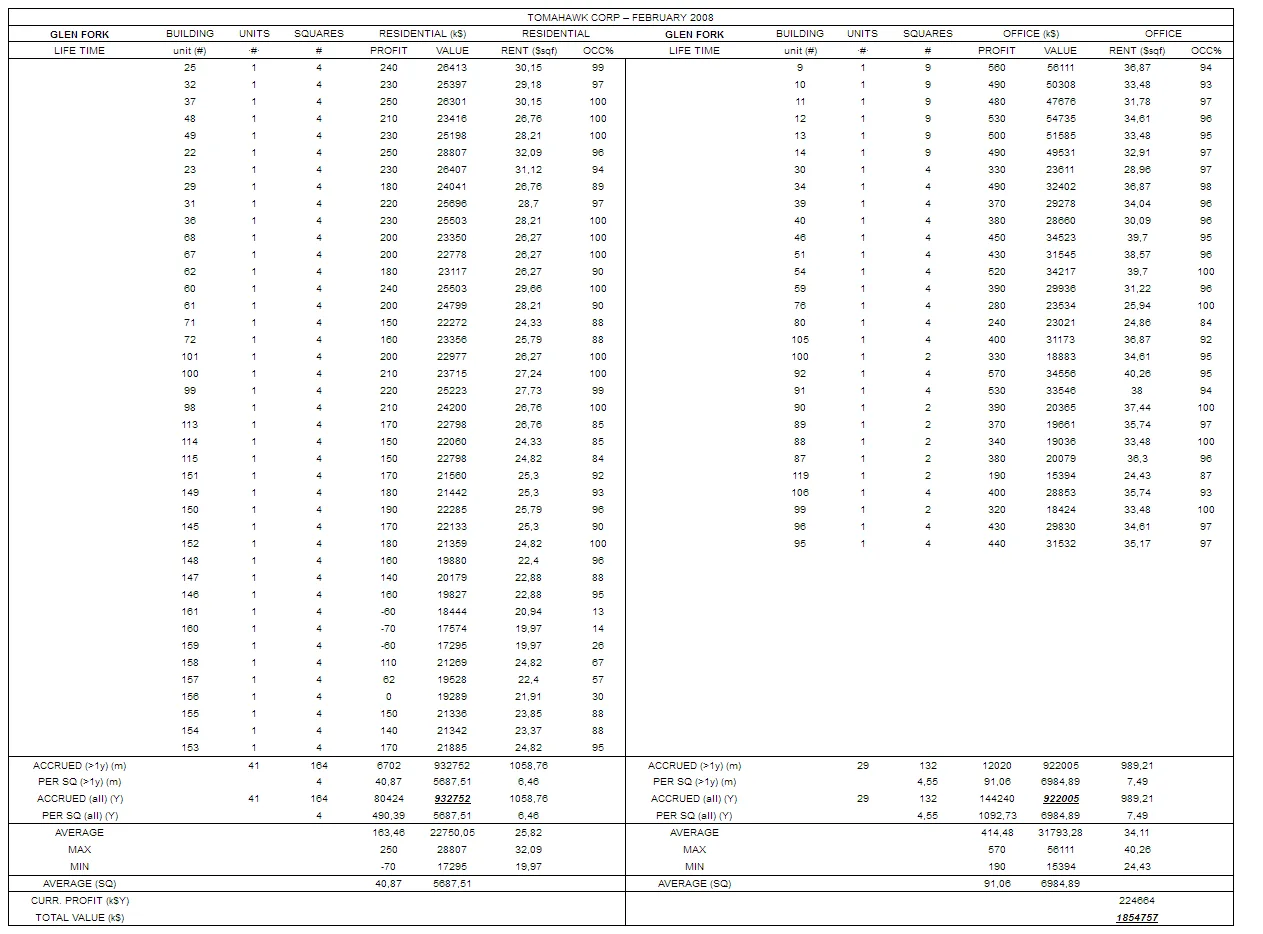
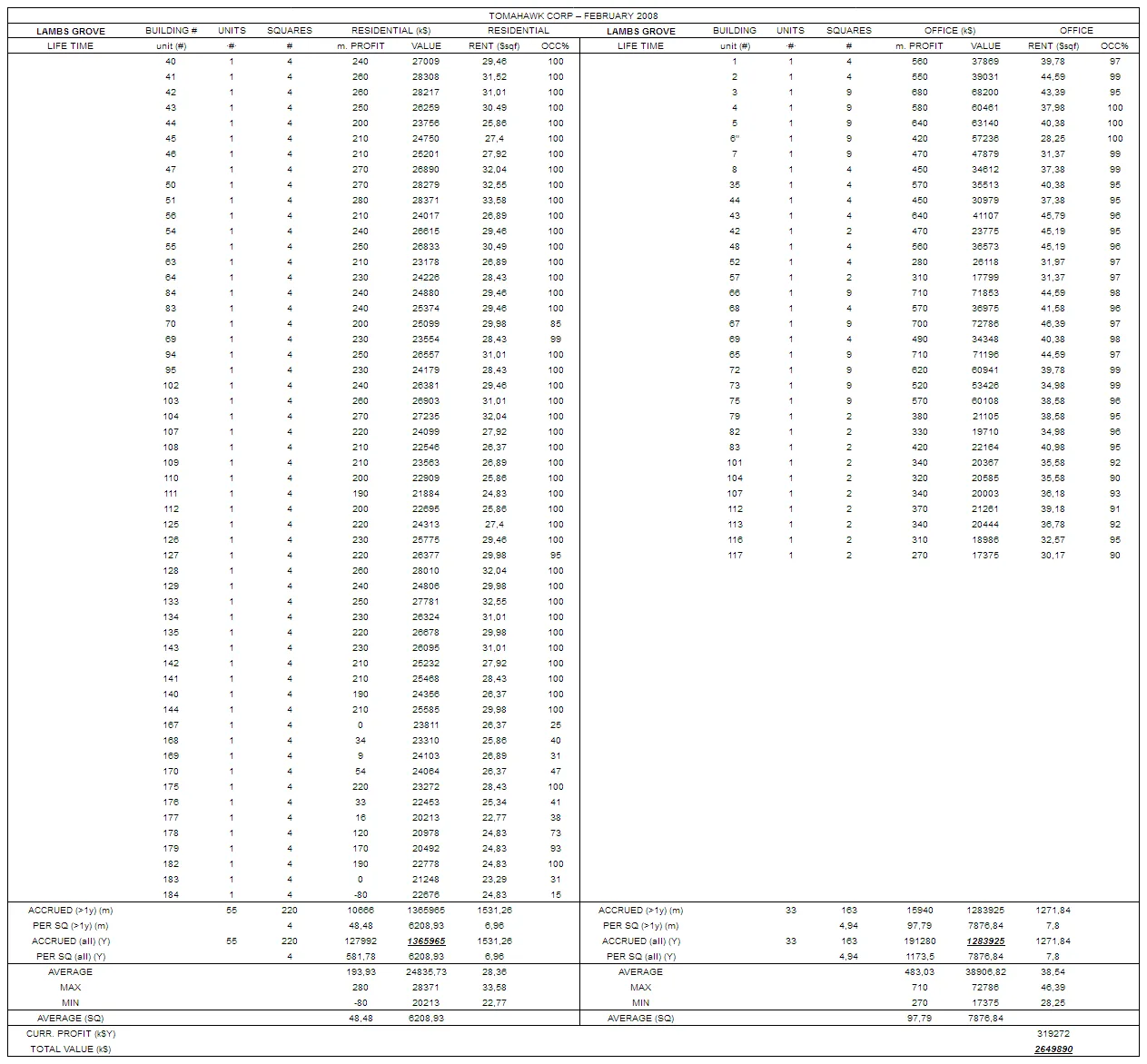
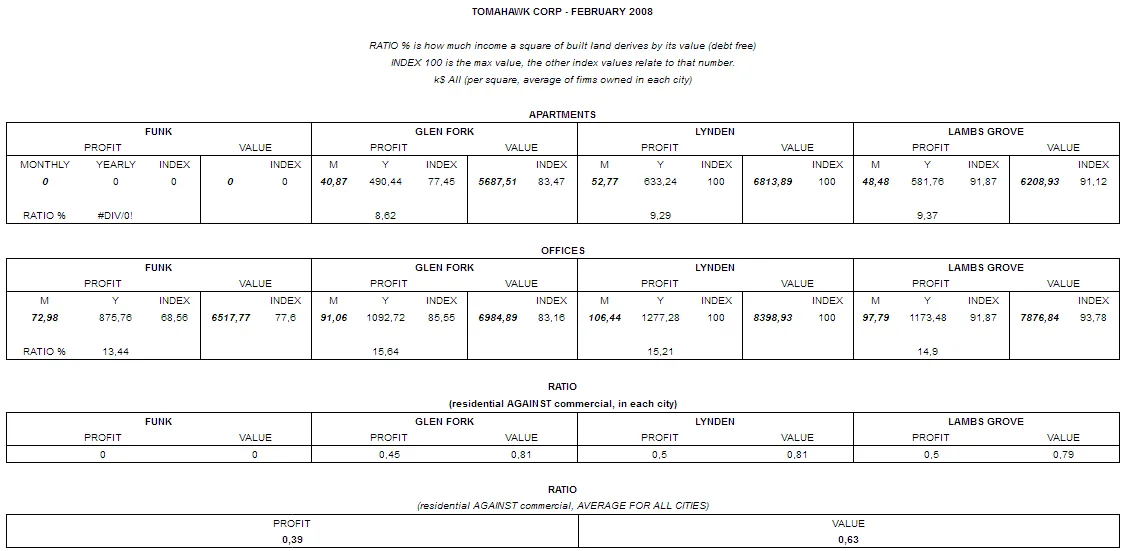
You can observe we're getting a very decent income of between 8,5% and 9,5% from our apartments, and between 13,5% and 15,5% from our office buildings (from their present market value).
We still see similar ratios from our previous report: our apartments add 20% less value and derive 50% less income than our offices. (The last ratio in the report should be ignored).
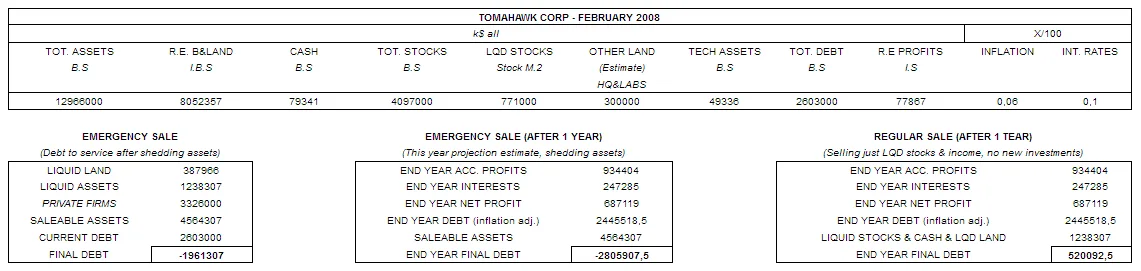
In the Financial Situation sheet we can see that our saleable assets are worth 2 billion more than our liabilities. That will help us estimate later how much we could expand our levels of debt in case we need new money for new investments (we'll discuss the possibilities in another post).
You can also see that the value of our "liquid" land (land unused) stands at about 350-400 million globally. One might argue we don't own enough, but one could also say we are making a very efficient use of it.
We will probably start investing in new land purchases with a view to construct new residential strongholds the following years.
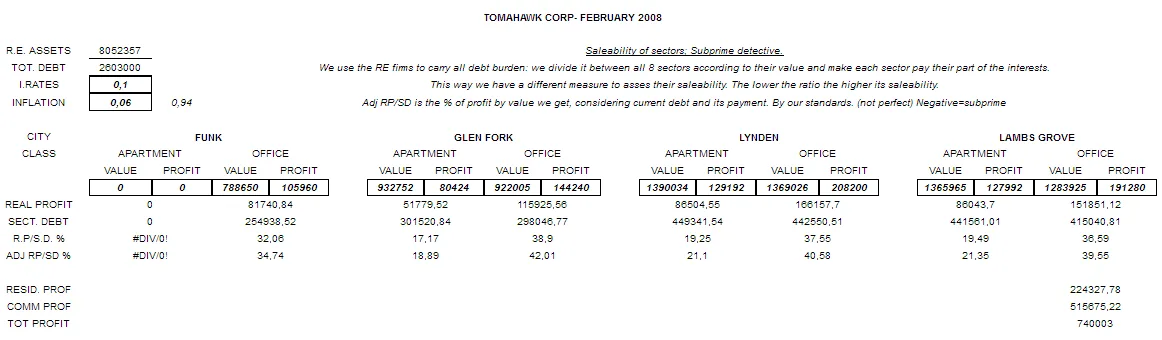
Finally, the Subprime Detective is also telling us that our current levels of debt are very manageable (we have high numbers in our adjusted real profits/sector debt). Once we decide how much to borrow we'll input the new data to see if our districts will buckle or not under the new burden.
At present, we could borrow 5 more billion from the commercial bank.
Chapter 46 — 29 November 2018
2008 INVESTMENTS.
We have noticed several different areas of interest:
1- land purchases (future new RE strongholds in cheap-land)
2- strenghtening our subsidiaries/new ventures: aggressive players in need of cash + newspaper company.
3- sharespotting: tech aim, textiles&computers&photography.
4- expanding R&D: filling the gaps in our research possibilities.
5- tech purchases: camera phone + new venture: Skynet Industries.
So, we borrowed 2 billion$ and invested it as follows:
1- 750m in land purchases in areas with low to medium land value, in all cities. We'll build new apartments there as soon as our current districts get "filled" (we will not build close to the old districts any more and leave the areas around them "unclaimed" and expensive so new stores can be built there, and so, as we described it in a previous post).
2- 250m to Rock Smelters as a cushion to claim new resources if they appear on the map, plus we'll use them to fund our political party.
100m in new shares to parent company, to Fusion corp. to help them build their furniture production lines.
100m used to acquire a 10m/year-revenue newspaper sold by Bill Laprad from Logic Zen Corp. (a public company), plus 150m to the Sylvanian Business Gazette, our new media venture.
There's a lot of money spent right now in brand-building and we want to get our hands there too.
We'll further capitalize Saratoga Mills (250m) as cash becomes available from RE income, next month, as they have low cash reserves and a negative cash flow and so are being forced to borrow to fund their operations.
3-100m in purchasing shares in two companies: a footwear company and a computer company.
We discussed about the textiles engagement we're planning in a previous post, so we just strenghten our position in the footwear tech company.
There are two companies selling computers: Southern Lines (500mm mkt cap) and Victory Group (250mm mkt cap). The first makes money and the second doesn't. We'll try to acquire the second and beef it up with cash. Both are already selling notebook computers and it seems a profitable business, qualified to keep under our watchful eye.
We'll wait and see if the photography company gets cheaper, once more, to buy their shares. We own 28% of the company at this moment and will do the buying probably on the way up, as they have become profitable but that hasn't appeared in their books yet.
4-140mm in land purchases&building of new R&D labs on them: 19 new labs! That way we have a presence in all technologies where the universities have their focus.
To mention: one lab costs 1 million/year. If there's no competitive advantadge we advance 6-8 points/year per product.
Our research classes: food-beverage-snacks; furniture; automotive; jewelry-watches; home appliances-electronic products; health care-drugs.
5- We purchased the Camera Phone invention from Ideas Hotbed for 17m. They're currently making 53m/year from it and they have no competition. Quite a surprise as they didn't even want to talk about it last time we contacted them! We needed about 7.5 years to be able to research that product in one of our advanced labs. Nice purchase.
We then used 250m to set up a new venture: Skynet Industries. We'll see if they can push the product on the market, and hopefully engage in researching the next telecom tech step: smartphones.
OK, we'll force them to do so…
We keep 260m in cash.
Let's consider two cases to sketch the financial stability of our corporation:
1- We borrow 2 billion. Present situation.
2- We borrow 5 billion. Pushing it to the limit.
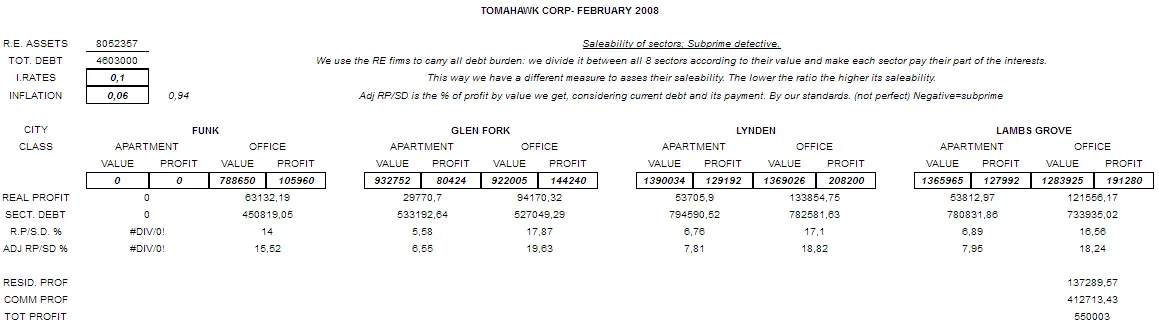
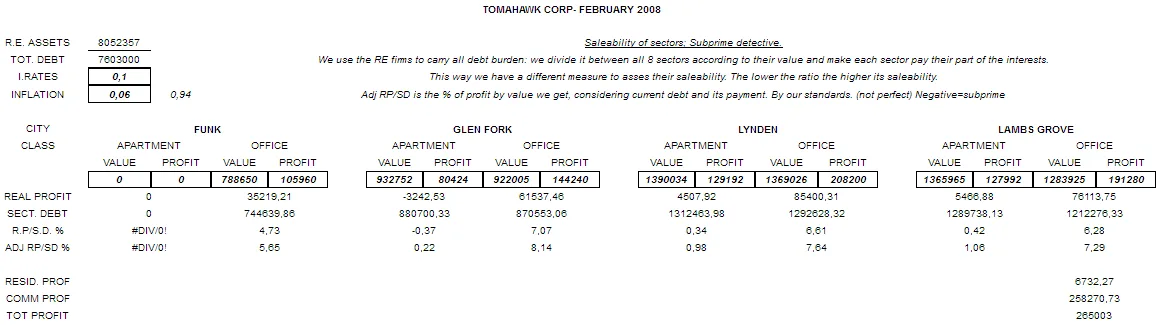
You'll notice that in the second case, with a 7.6 billion debt load, our RE districts hold out with positive numbers, albeit having the residential districts bordering subprime.
Barring a crisis, that will be the max. amount of debt in our book, meaning we could borrow up to 3 extra billion if we identify an investment opportunity later.
CITIES.
We have spent quite some money in new public facilities around, esp. close to our new land purchases. New elections will be called soon, so a bit of red tape won't hurt.
We'll keep monitoring their budgets and raise taxes if more cash is needed, but we believe they'll be fine.
We won't provide any screenshots this time but will be showing what we've done in future posts.
Next, we'll provide a close up of one of our subsidiaries before we continue playing, probably this week.
Thanks for reading.
Chapter 47 — 30 November 2018
BUZZARD AUTOMOTIVE CLOSE UP.
This is going to be descriptive and centered in one product: cars. Obviously more info could be offered, but the snapshots will provide a round picture.
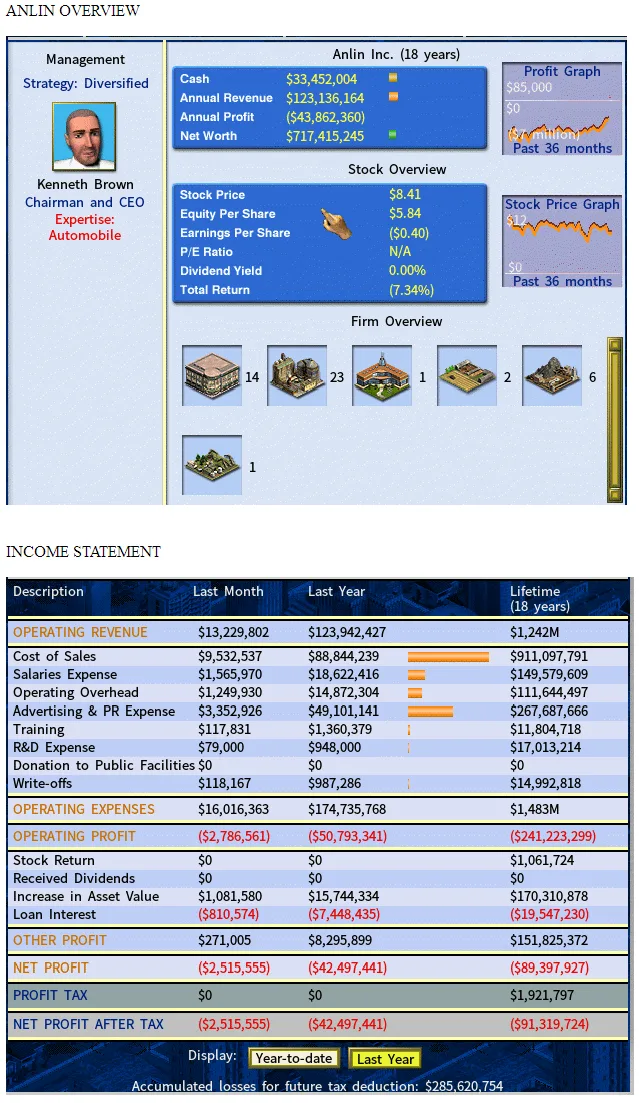
I chose the automotive subsidiary as the business is straightforward, and challenging. Let's remember one of the AI automotive corporations went under, and then merged with Anlin a few years earlier. The result wasn't very promising as you will realize.
Let's start with an overview of the company, and then of the competitor (Anlin Corp).
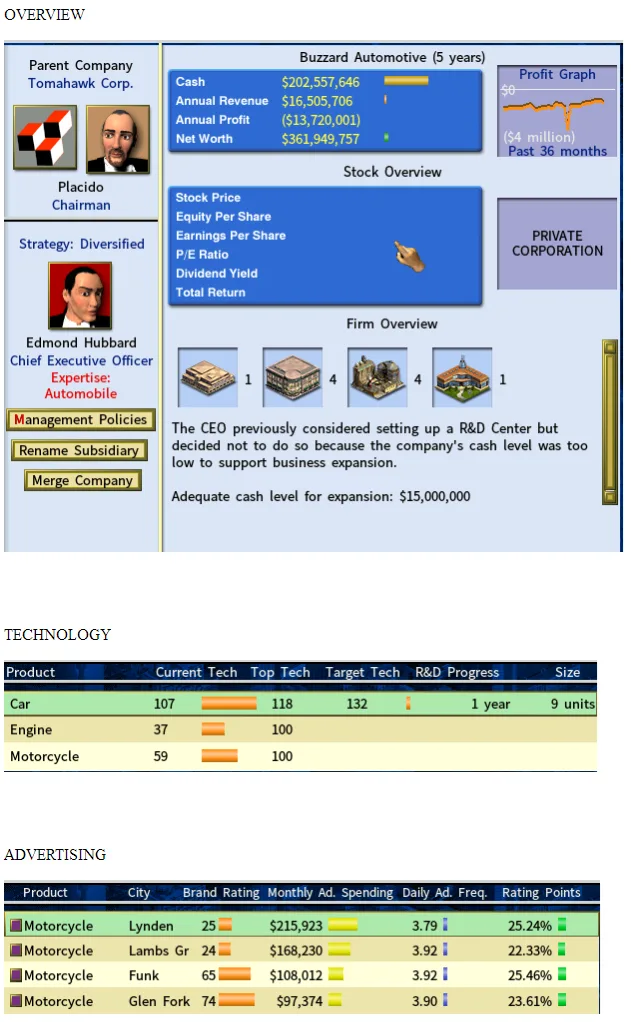
The brand shown is for motorcicles, but it's the same thing for cars.
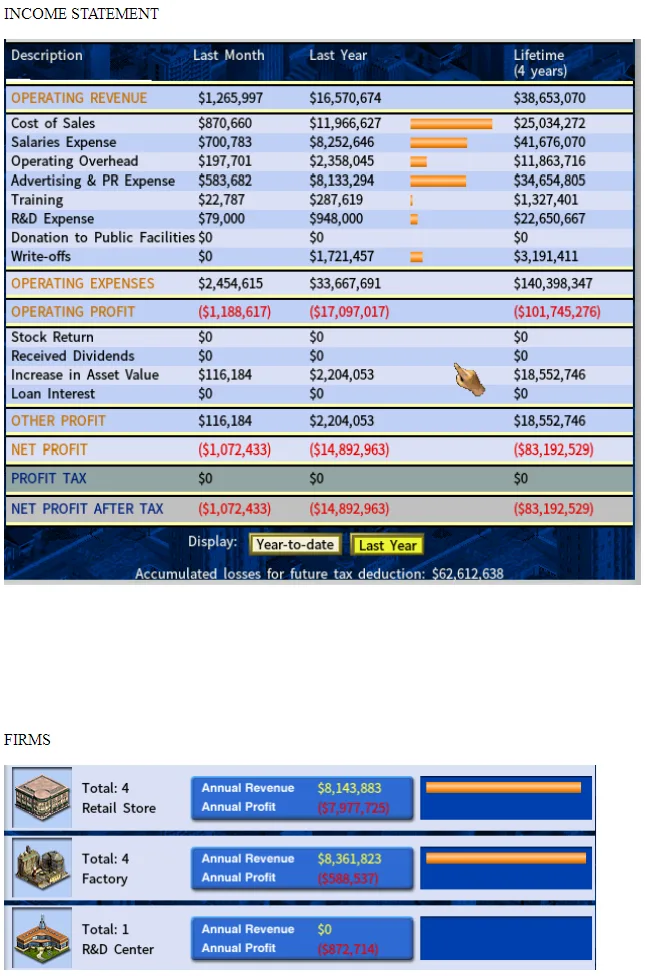
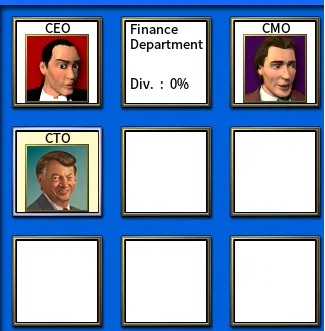
This is the corporate HQ and the two new managing directors for 2008: Mr.Trigo in the research department (our old CTO) and Mr. Kewl in the marketing department.
Now, the competition:
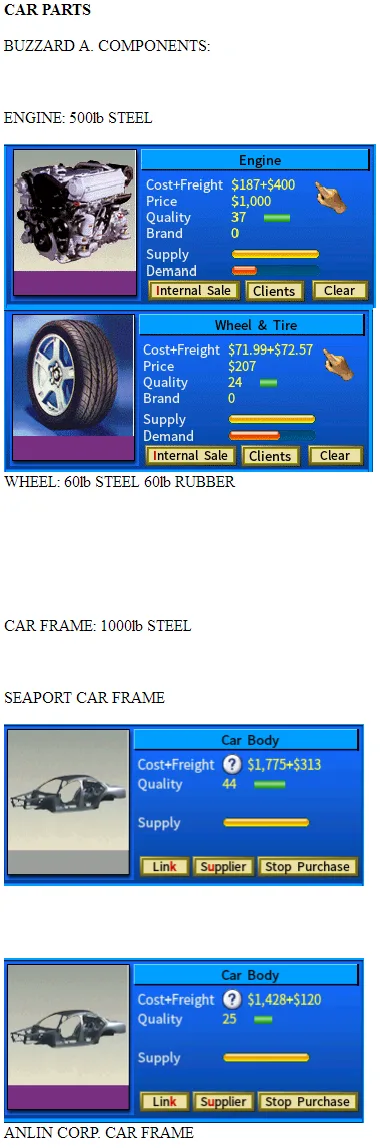
You noticed Buzzard A. owns 4 factories (all in Glen Fork): one produces engines, the other wheels, and the other two cars and motorcicles. The wheel factory is medium-sized and the others big.
Here's a view of the components that make a "Buzzard" car, from the car factory. There are two lines of production: one uses the seaport car frame and the other Anlin's car frame.
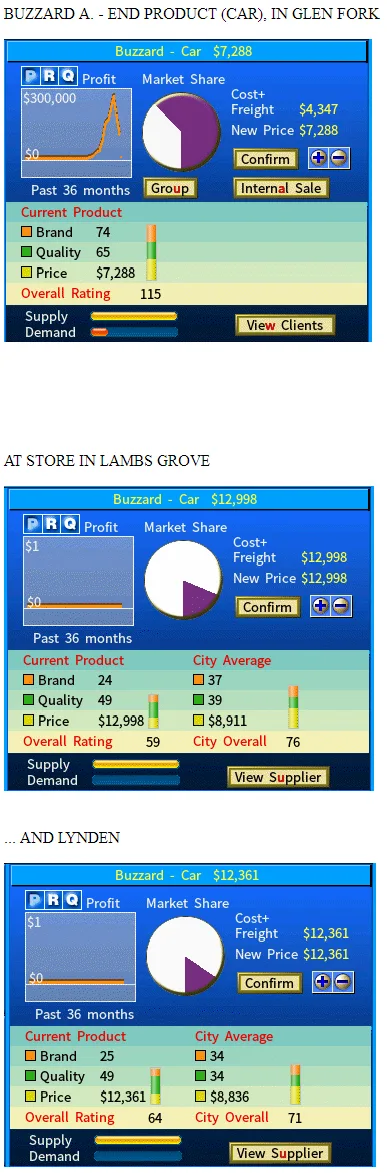
Here's the end product in the car factory, and below how it's displayed in the different car dealerships (one in each city).
As we instructed them to never sell below costs, in two dealerships they sell the car at cost (and no one buying them so far).
Finally, a snapshot of Sylvania's car market. You can see how the cars are sold in Glen Fork and Funk.
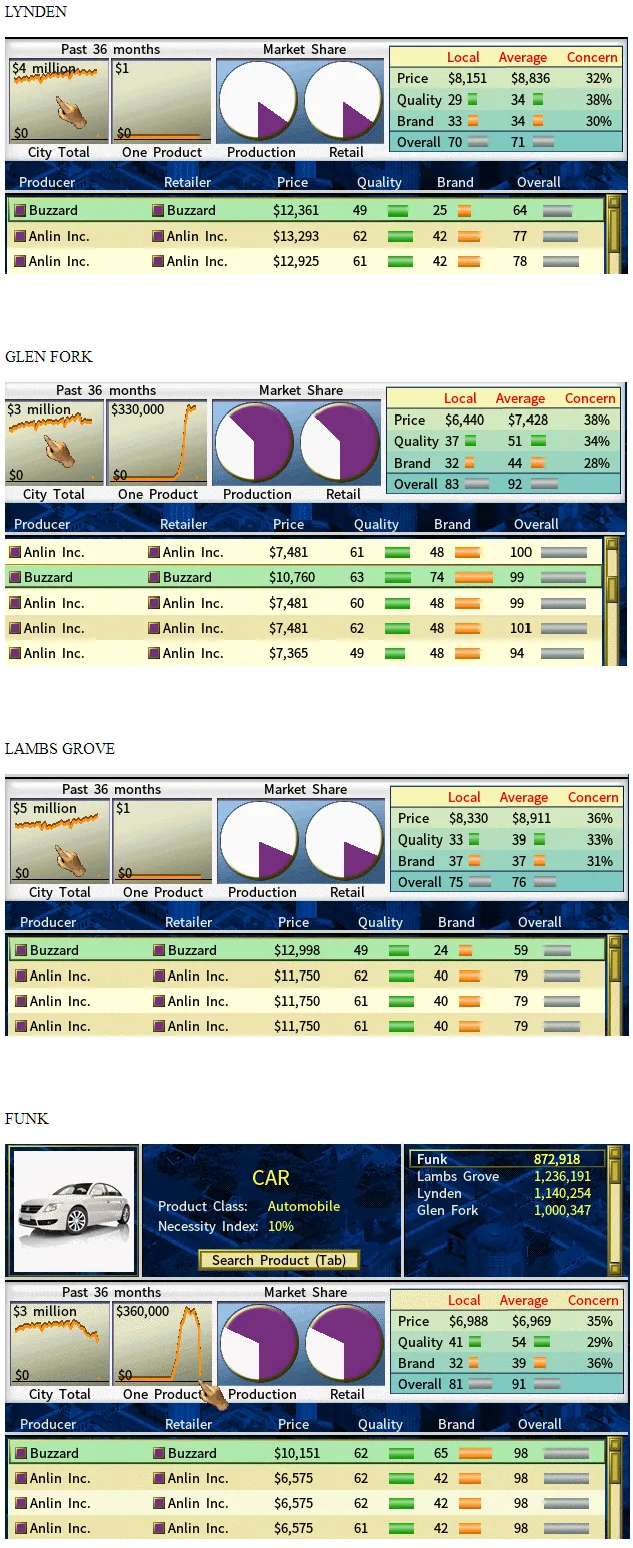
Unfortunately, the color for both Buzzard and Anlin is violet, so the cheese isn't as useful as it could be.
Chapter 48 — 11 December 2018
FEBRUARY 2008 – FEBRUARY 2010
First thing we'll update the close up of the car dealer.
We showed previously that our policy of "never sell below costs" made our (old) car models unsaleable: They started expensive at the factory and became more so at the store after transport costs were included in the price tag. That plus a low quality vehicle produced zero sales.
To make things worse, the old models created a glut at the dealership preventing the new, saleable, 3rd generation models from entering the stands.
Well, we didn't correct the issue at the time (we forgot) and so, we'll proceed to change our previous policy right away and dump the old models aside.
We also showed that the transport costs to gather the different materials at the factory were about 1000$ per car (frame+engine+4 wheels).
Buzzard A. Ltd. produces their own brand of engines and wheels and imports (now, all) the car frames from the seaport.
The cost of producing a car is about 4300$ (materials, transport and labor included) at the end of the production line, of which 813$ (our estimate) is earned by the engine & wheel factories.
That makes for 3500$ in total production costs, if we are not mistaken.
As car frames cost 1500$ each, labor must be about 1000$.
We didn't show that transport costs from the factory to the dealers are about 1000$ as well. Now we have provided quite a round picture, and so…
To the brand new Buzzard III:
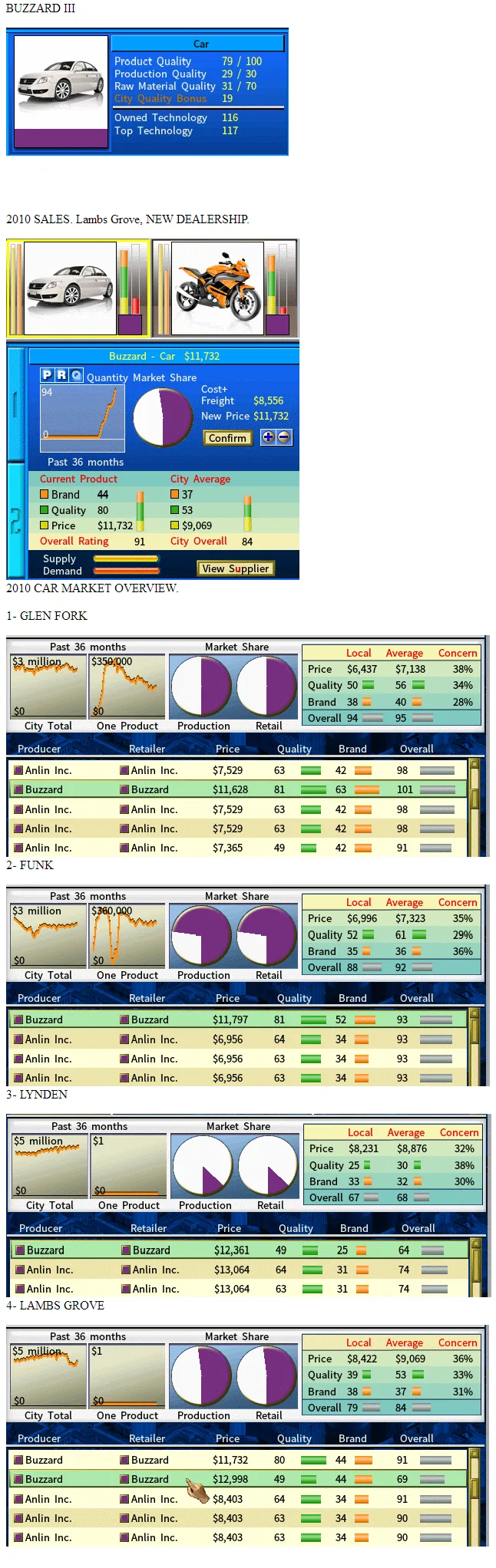
The model started being sold in 2009. You can check the quality boost from producing the cars in Glen Fork.
To end this sketch we provide a view of the competition's current brand outlook and their book, together with our subidiary's, for February 2010.
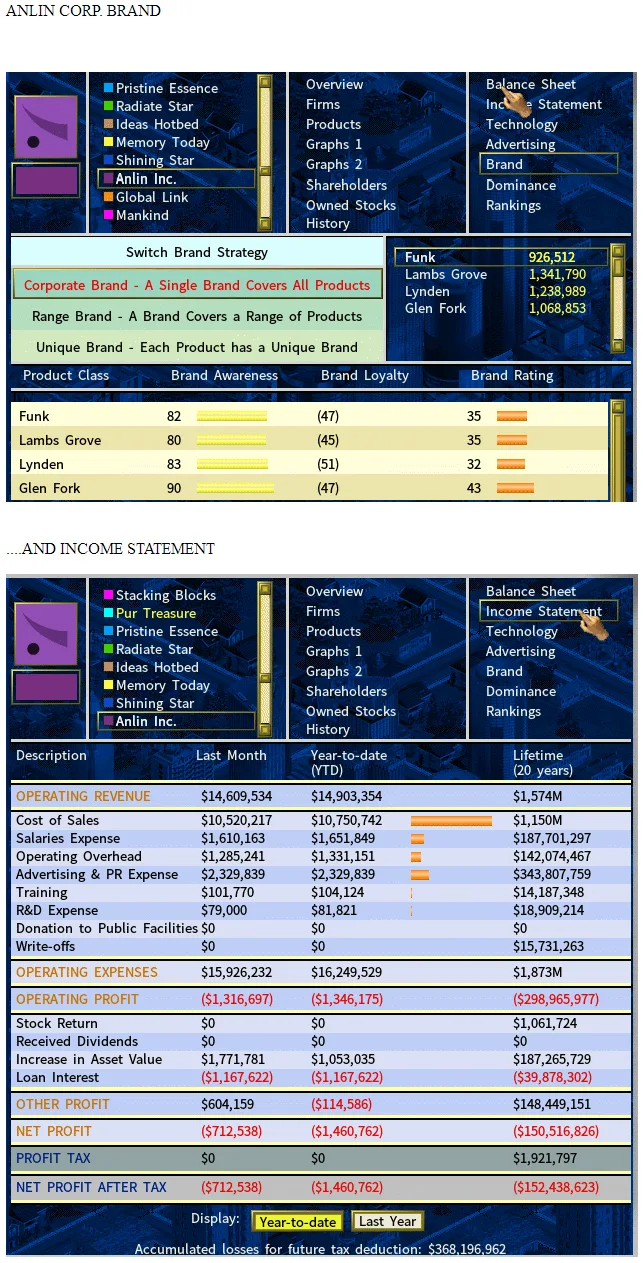
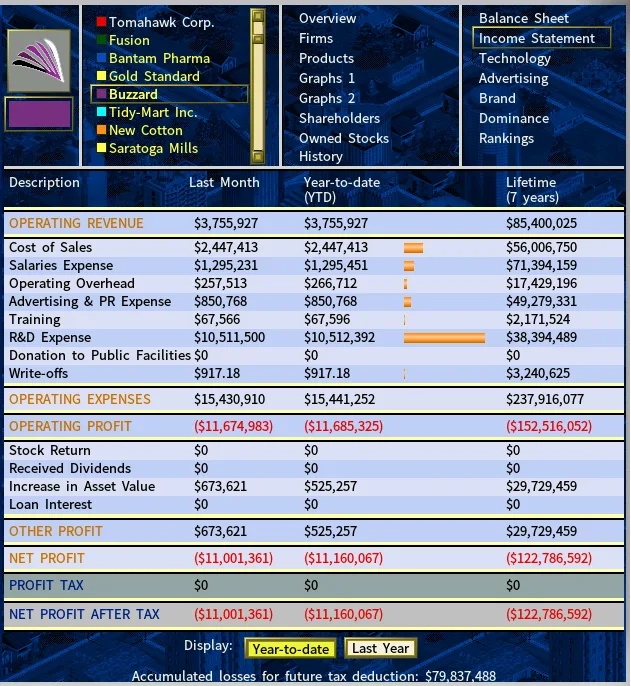
Thanks for reading!
Chapter 49 — 6 January 2019
Merry Xmas & happy New Year!
FINANCES.
Inflation remains above 6% and rates ticked up to 10%, so we are paying about 4% in interests.
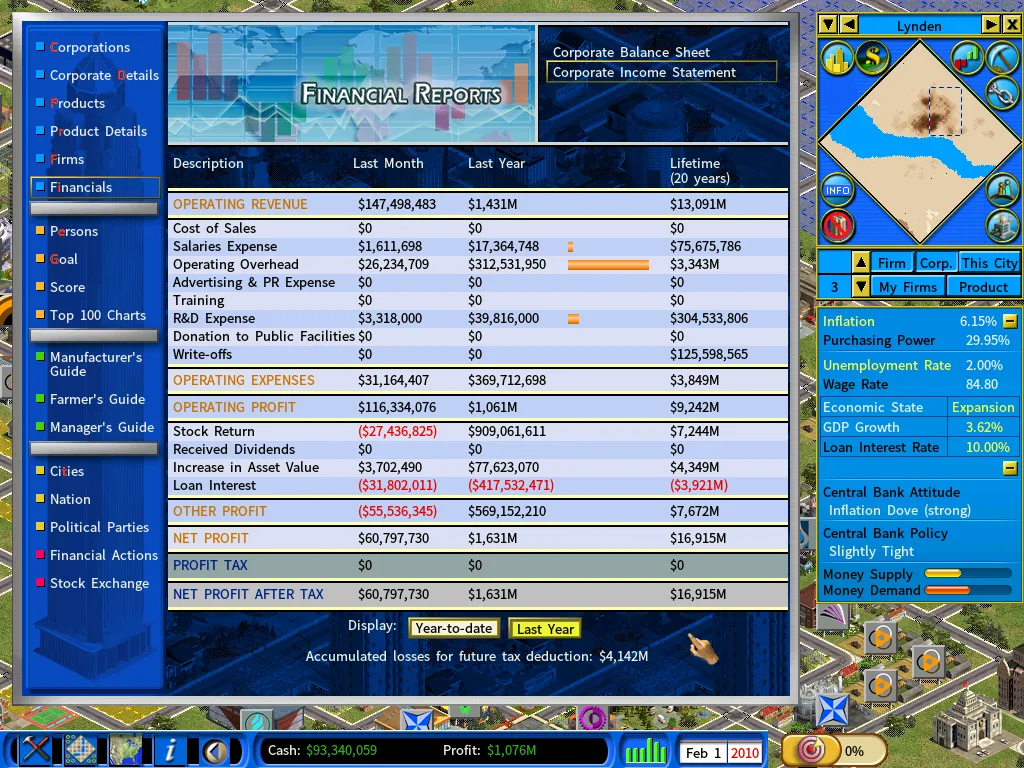
Still a cheap line of credit in our opinion because the offices we have built are paying a very handsome profit, as you will see next in the income statement.
Anyway, you get an idea of how profitable our office districts are, against the current price of cash, if we refer to the data we provided back in 2008: a 15% year profit over book value (which is higher than over land & construction value, our real costs). That means a 11% year profit after credit costs.
This January 2010 the chairman of the central bank changed to strong dove, so if the price of money gets once again below inflation our new projected residential districts will become really cheap. We'll keep supplying housing as demand appears and try to make use of the lower financing costs as they become available, as we consider such approach the most sensible route to follow.
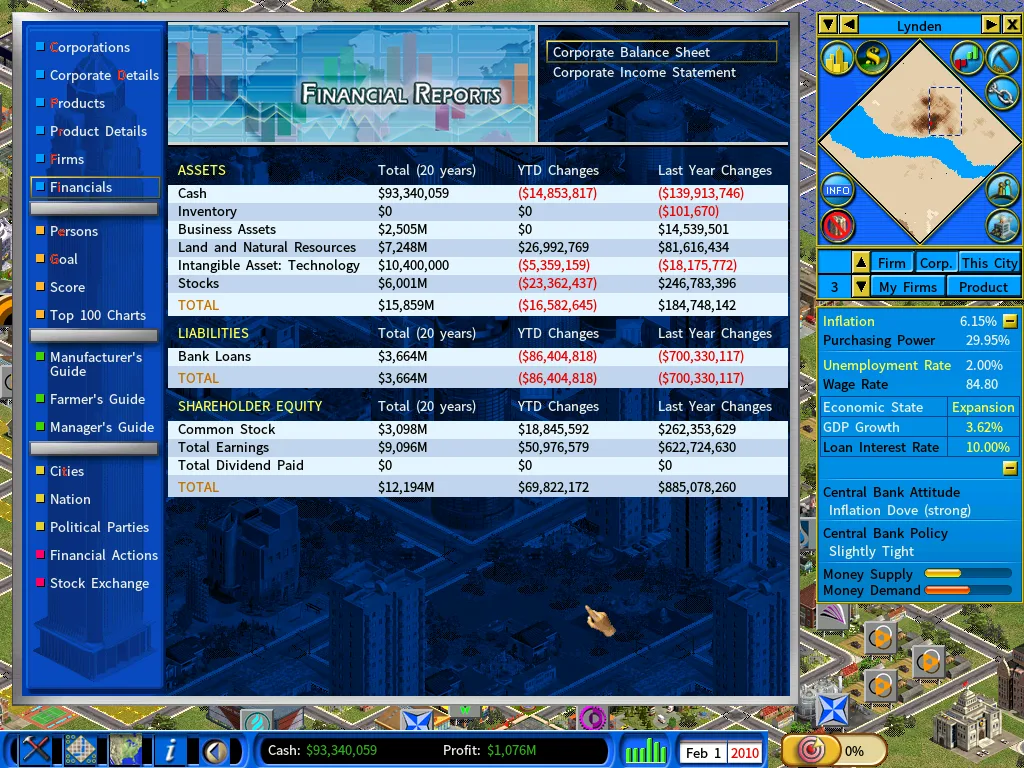
Net assets have increased by 18% to 12,2 billion, and we increased our debt overall by 1 billion to 3,6 billion.
Our income from RE firms increased by 50% to 1,4 billion/year.
We'd like to know the rents we're getting with more detail, but we won't offer the improved income statement for RE firms yet as preparing it is a bit too time consuming these days.
We also allocated a small monthly income to our CEO so he can now buy mansions from other personalities in strategic places.
STOCK MARKET.
We have focused our attention to the stock market more than is usual in the interim.
Here's the long term 20 year chart of Tomahawk Corporation. The price has been tracking very closely the increase in the perceived value of our assets. Right now we have a market capitalization that is 7% higher than our net assets.
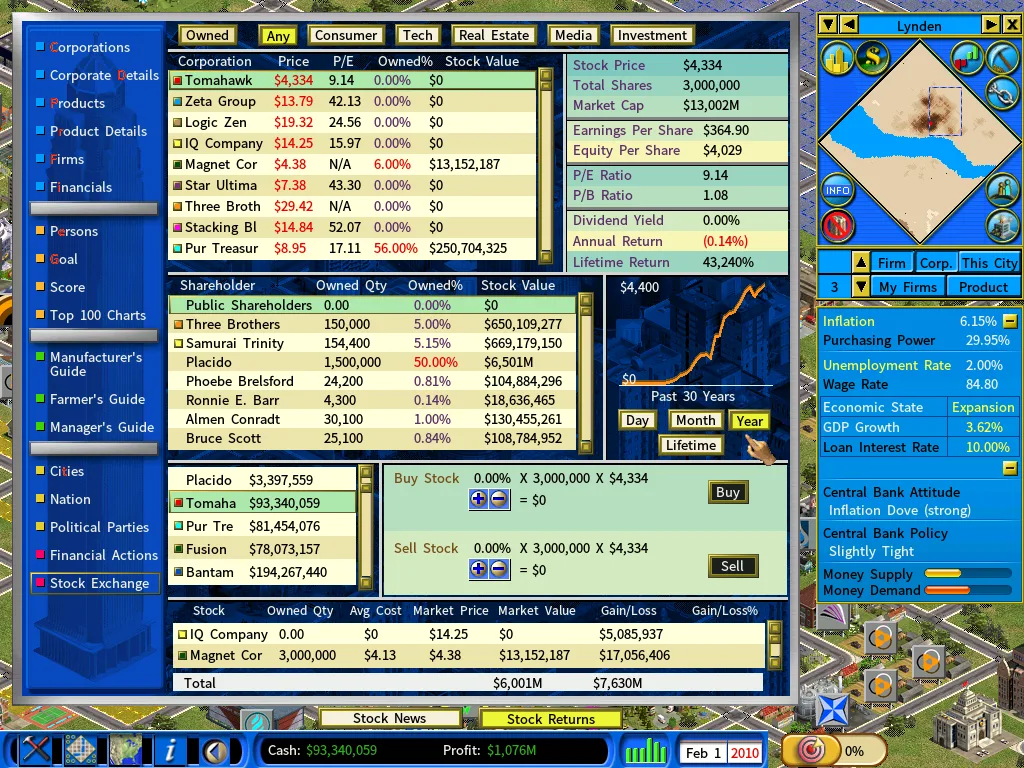
Here's our present holding of public stocks. I'll comment a bit on each:
1- Magnet Corp is a direct competitor of New Falcon Industries Ltd, our electronics subsidiary.
With a market cap. of 219mm it's the smallest of the public corporations. They currently have no debt, are losing a bit of money, but have built an acceptable brand for their products. Despite their book value being close to 3$/share, if we'd add the money they've spent advertising to their net assets we'd get a book value of about 390mm. With 50mm shares outstanding, each one would have then claims over almost 8$ worth of property, be it tangible or not. We don't mean we'd be ready to pay 8$/share despite that.
So, we plan to acquire them before they start getting into war and debt. That way we could assert our influence over the country's electro-market.
2- The textile techno-corporates Pur Treasury (leather) and Radiate Star (footwear): They were under our acquire radar a few years earlier. As you might remember we are creating an apparel monster, feeding it with cash so it grows tall & strong, before releasing it fully capable "outside" to become the main player in Sylvania's fashion market.
We have followed New Cotton Thread's operations with care and are quite happy with their progress.
So, here's what we have done:
PUR TREASURY: We are ATM their biggest stockholder and so we can dictate about their technology and financial operations. We'll increase our ownership if it becomes cheap and sell it if it becomes "very" expensive. Right now they sell their own brand of leather products and their research will keep being sold to New Cotton Thread at market price.
It's their notable research capabilities what makes them attractive in our opinion.
RADIATE STAR: We succeeded in buying up to 50% of their stock at about 10$/share but they got an almost one-off 50mm profit from technology sales, so the price went to 16$ and so we sold our stack (we were the main "promoters" of that price boost but not the only ones, as they got a breakthrough in sport shoes tech in August 2009). At this moment the price remains too high and we plan to re-purchase the shares in the future if they become cheap again (if we can, because it has merely 50% of total shares in "public stockholder's" hands). We might have to use New Cotton Thread Ltd as a spearhead to make a dent at their profits, once we get ready to start our purchase campaign later, and so discourage current ownership from helding their property too tightly.
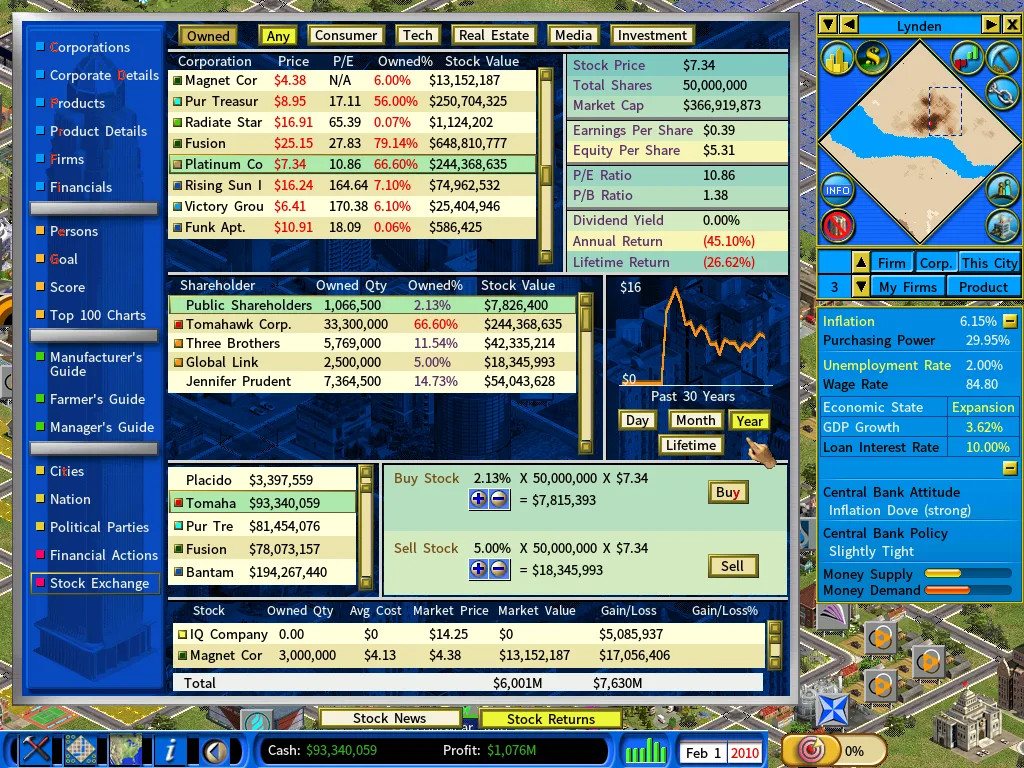
3- The camera-maker Platinum Coil: We were really fast in getting half their stock (we did so in the early spring 2008), but in the last 6 months other corporate players have truncated our chance of making it our subsidiary at a good price and so we'll have to bribe them for their stack. I did choose Platinum Coil for the Stock Market2 view so you could glance at their market data there.
They have a market cap of just 367mm but are already making 20mm/year selling their products. The company has no debt, a modest brand and no competition. They have been slow in deploying their products, so we might create a new player instead after purchasing all their technology and selling their stock later when it skyrockets (as is always the case after producing a heavy tech sale).
They have the compact and digital cameras already researched, and both products fetch a good price and have a decent market size.
4- The beverage corporate Rising Sun Intl: They are a medium sized player competing against our subsidiary Saratoga Mills through their wines. They have no debt and an average brand, but are having a tough time selling. We purchased their stock as it was offered cheap (about 12$) but we have no plans to hold it long term, as we believe they'll come under strong pressure in the future.
5- The computer-maker Victory Group: Our plans were to have them under our corporate wing by now, but we didn't push hard enough for it. The problem was that every time we made a purchase the shares exploded higher, so we focused our attention elsewhere. We won't be so squeamish this time around and bid generously for their stock… up to 8$/share (?)
How could we justify such price? Our "value" approach dictates a fair price of 4$/share and our "growth" approach a 40cents/share, from the current price of 6,4$/share. Let's see:
a) Their expenditures in brand building have been higher than their current equity (270mm to 260mm), so if we add both we'd get 530mm of assets backed by 65mm shares. They have a corporate brand with good awareness altough neutral loyalty, so they haven't had too much success there. I'm sure their brand is worth something altough maybe not all the money they threw at it.
b) They have Southern Lines Corp competing with notebook computers and that's all, because for some reason the market for desktop computers and printers is being totally neglected by both. We then have a prospect for making sales if we can see the reason these markets have stayed unclaimed.
c) We could direct their operations at gaining market share and integrating their products in our other subsidiary's electronic stores. We'll have then 5 players: Magnet, New Falcon Industries, Platinum Coil, Skynet Industries and Victory Group all sharing the same type of retail store.
Our plan then will be to make it our subsidiary and then proceed to swiftly change the directorate.
Now to the Stock Market Triptych:
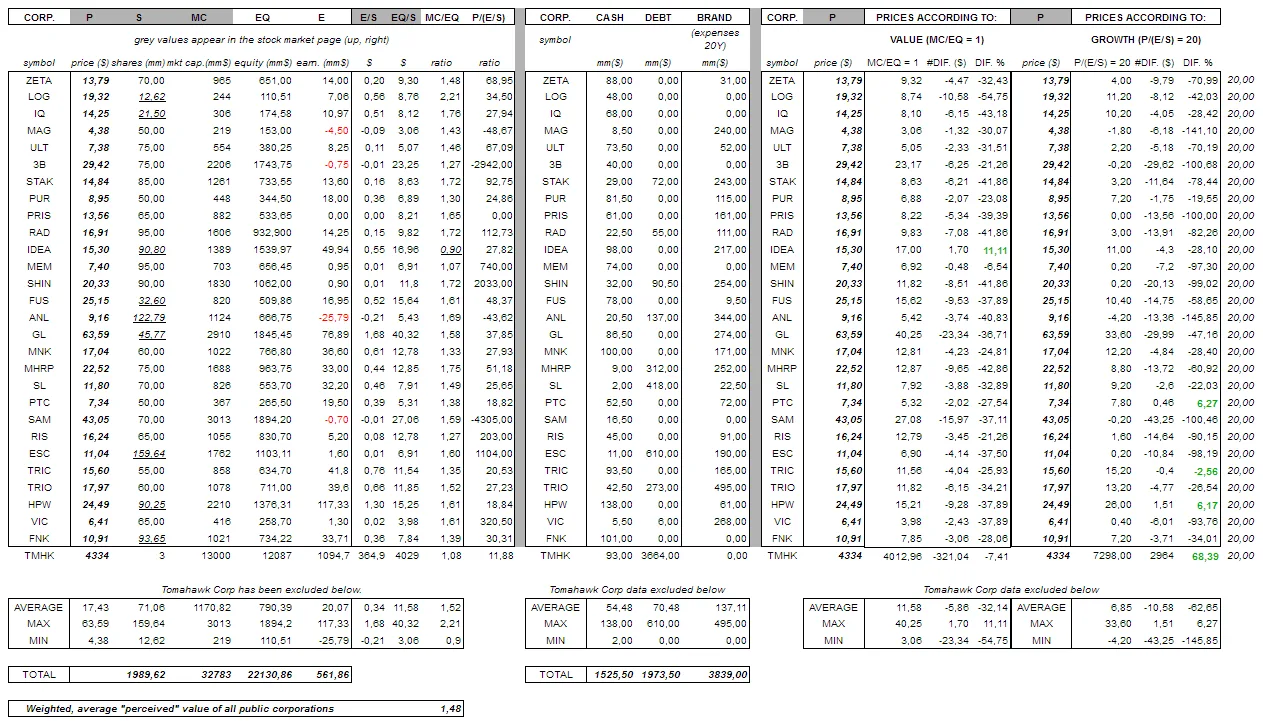
a) To the left I have included values that the game provides in the Stock Market information to each public corporation and a few composite values.
P: Current price of the stock.
S: Number of total shares. I have highlighted here possible "devaluations" of the stock.
MC: Market Capitalization (stockholder value).
EQ: Equity (bondholder value).
E: Total earnings (yearly).
E/S: How much one share of stock is earning each year.
EQ/S: Claims over property of one share.
MC/EQ: Difference between stockholder and bondholder perceived value (less than 1 meaning stockholders somehow despise the stock).
P/(E/S): Price-to-earnings (where you have how the stock is priced related to current earnings, good values from 0,1 to 20-ish).
b) In the center I have included the free cash, the debt and the money the corporation has used during its life to build its brand.
c) To the right I have included current prices together with two valuations used commonly, to grasp overpriced or underpriced stock:
MC/EQ=1: It's the bonholder fair value, where the stock is priced according to net assets. Below 1 it's considered getting cheap.
P/(E/S)=20: It's the price of the stock equivalent to 20 years of current earnings. I prefer 15 years, but then we'd get much worse "fair" prices.
Besides the "correct" price under these given conditions are the sylvanor($) points it should adjust to get there, and the percentage correction.
As you can then appreciate, we have been through a somewhat cheerful period of valuations by stockholders that still lasts to this day.
d) below: apart from averages, max. and min. values you find:
Total public shares outstanding.
Total market capitalization of Sylvania's stock market.
Total price of public corporate property.
Total earnings per year, total free cash levels and total debt incurred for all public corporations.
I'll summarize here something important to keep an eye on, in case we planned to purchase all the country's market:
Total market capitalization (excl. Tomahawk Corp + subsidiaries) 32,8 billion.
Total market capitalization (excl. Tomahawk Corp subsidiaries) 45,8 billion.
Total market capitalization (all corporations included) 50,55 billion.
Of the total value of the "claimed assets", our corporation owns about 19 billion, or 37,6% of total assets.
Chapter 50 — 2 March 2019
REAL ESTATE
We made some numbers about the current land price of our NEW "projected" residential districts (let's call it Project Y), and contrary to expectations its value increased a 3,3% after considering inflation (26mm in total).
We'd like to ascertain if it increases even more during the next two years. New task. In that case, we could allocate extra funds there if we find the other sectors too expensive.
Despite having quite an income we always find we're somehow short of cash, and land in the game is a "liquid" investment that we can sell in the blink of an eye. If its value tends to appreciate by merely holding it we will keep selling our assets to the bank, as long as real money rates remain low. Currently they stand at about 4% so borrowing to purchase land at the moment doesn't make too much sense. We'd use revenue then.
What we didn't do is to detail the purchases by city so we could know where the profits would be higher, so we'll have to spread our cash or rationalize the focus of our purchases. We'll do the first.
Well, I said we purchased land in all cities but we didn't do it in Glen Fork. We had already bought some land there back in 2006 to strenghten the city's budget and most of it is still showing in our Balance Sheet.
About new construction: we have been merely observing the growth in RE demand. As supply was high we decided to take a wait&see approach, and allocated our available cash toward a few public companies as detailed in a previous post. The result has been one office building constructed in two years.
We are not sure that our recent stock acquisitions have positively affected Sylvania's GDP, but we can say with certainty that not investing in new construction hasn't.
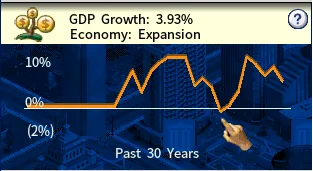
And talking about GDP, I'd like to show you (finally I remembered!) the near recession we got in Funk earlier in the game that made us sell our residential units in that city through an IPO.
Despite making a nice profit from the sale, you could believe that sometimes we have been tempted to cover our head with ashes and to mourn the departure of the prodigal child, for we have been missing a steady source of revenue since then.
Go tell me you'd have done better and guessed a comeback.
R&D
Our labs recently finished several projects and next year the breakthrough into the snacks products will be made, which we'll sell to Saratoga Mills Ltd, as this area still remains a wilderness of local producers and there's some money to be made in the field, we pressume. Unfortunatelly, the quality of these new products won't match the brand standard of the corporation, but anyway we'll see what happens and maybe adjust down the road.
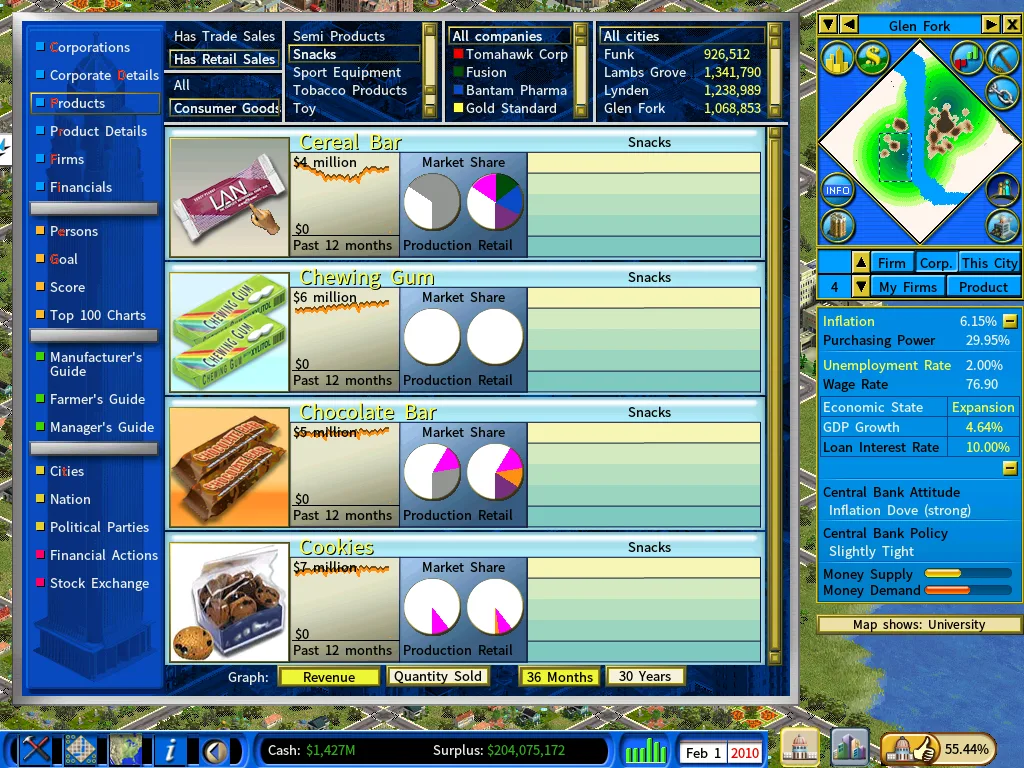
The market for Ice Cream and Yoghurt isn't shown.
Our research still focus on the same areas as last time we reported.
CITIES.
The budget is still balanced in all of them, but they are increasingly relying on selling their land assets to create a surplus, as we have been expanding our government expenditures and taxes haven't grown in step.
Now we know (thanks to our small analysis of the corporate market published earlier) that public companies have 1,5 billion in cash and 1,8 billion in debt, so these corporate land purchases that have been fattening our treasuries could shrink without notice, or even worse, revert. We'll have to keep a watchful eye over each city's budget and also to keep some funds to offer some cushion.
Despite the situation, we'll build new public facilities starting 2010. Cities like Funk have amassed quite a surplus (3.5 billion i.e) and we need to spend to encourage further economic activity. That way the demand for RE will also increase and remember we are the main players in the field.
Finally, we've lost Lynden to the Conservative Party, so we won't be able to manipulate the situation there. It seems there was a candidate that we didn't see because we didn't scroll the menu to the bottom of the screen.
NATION.
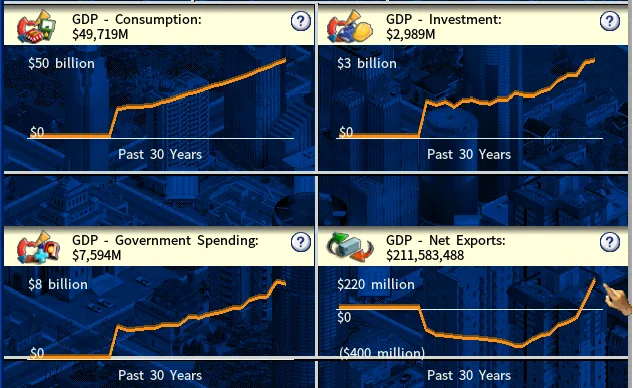
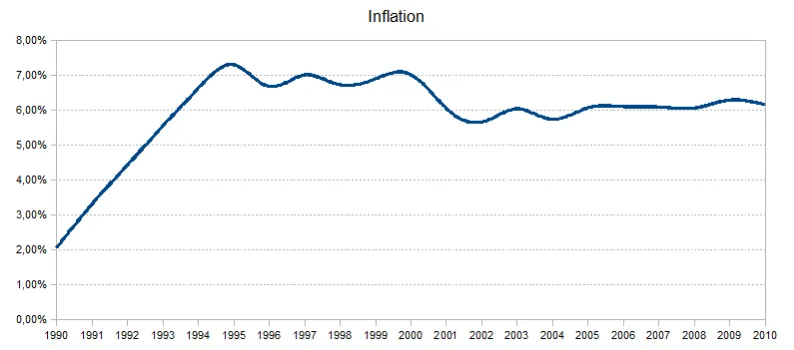
Here we provide the charts to grasp the evolution of the nation through these past 20 years.
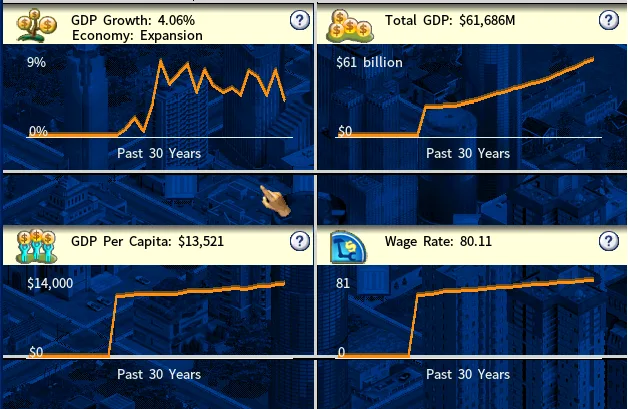
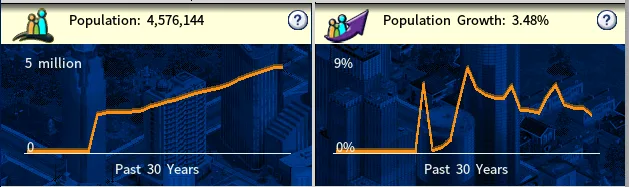
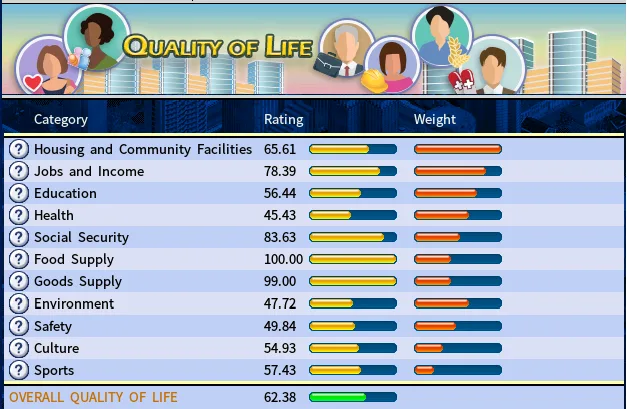
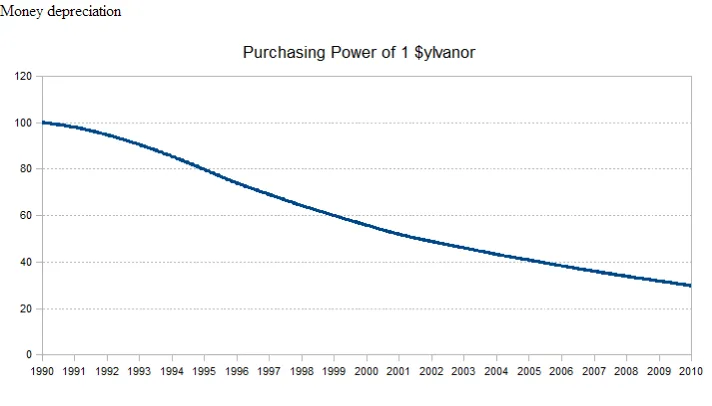
We have provided a different inflation chart and a different money depreciation chart as the ones from the game don't show valid curves and you have to go to the city chart to see the real thing. At this juncture of Game developement, the money depreciation is not of much use as we have no counterpart to compare with, but anyway, we guess that will boost exports somehow.
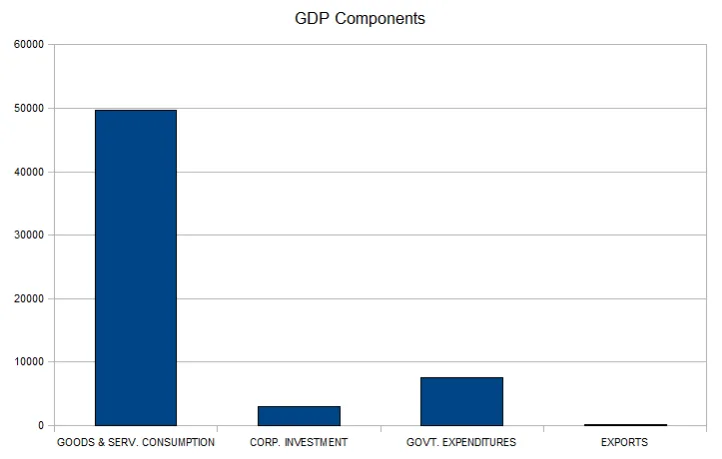
We also provide a bar chart to compare visually the size of the different components that structure the Nation's GDP (and then see how little exports are contributing to the total despite the fanfare).
PLANNING AHEAD.
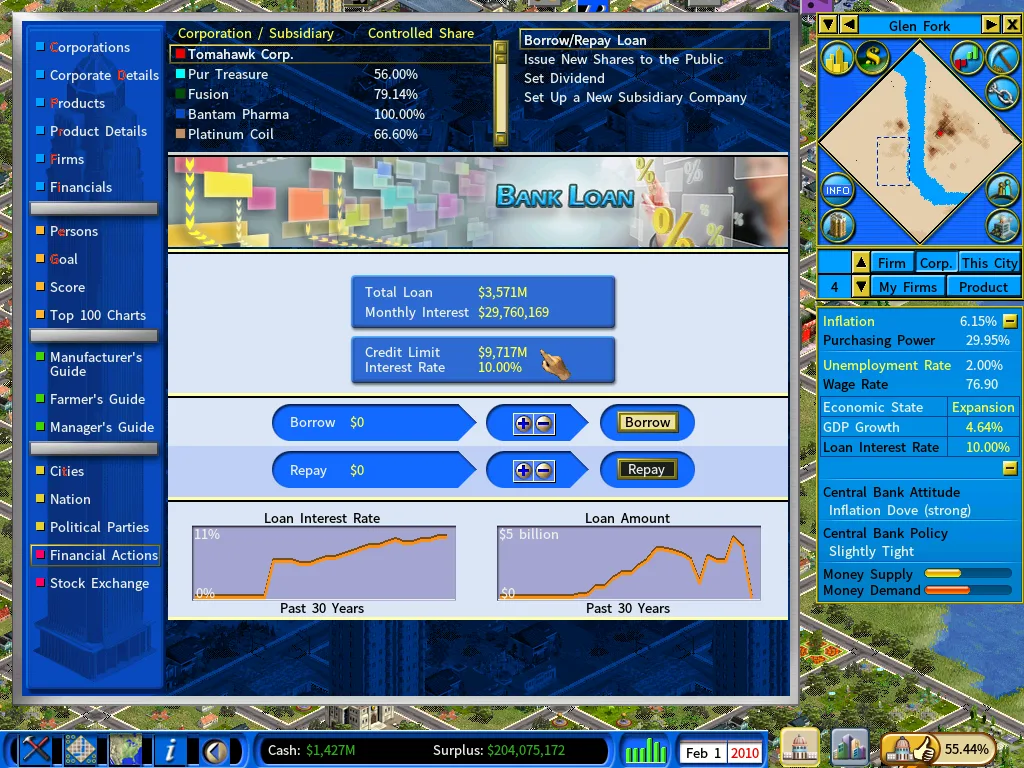
We have 9,7 billion available to monetize, so it would be interesting if we summarize the areas where such investment capital could flow into before we start playing our next 2 years.
1- New ventures and venture stuffing.
2- Land purchases.
3- RE construction & RE acquisition.
4- R&D expansion.
5- Public Stock investments.
6- CEO salary increase.
I will give some time (but not much!) before playing the next period and see if there are any suggestions about them from you, dear readers. Any comments will be welcome.
Thank you!
Chapter 51 — 11 March 2019
THE ADVERTISEMENT INDUSTRY.
This is a sector we had been overlooking, until 2007, when we noticed how much our subsidiaries were spending in ads.
In 2008 we created a small Media corporation with 250mm cash, with the objective of probing the market and assesing the possibilities of investing further in the field.
After 2 years these are the results:
3 newspapers built for 82 million (all) and 1 purchased for 103 million.
Starting capital: 250mm.
Setup costs: -185mm.
Revenue: 211 mm.
Operating expenses: -54 mm.
Operating profit: 157mm.
—–
Current assets: 363mm, of which:
Business assets: 202mm.
Cash:161mm.
That's a 45% increase in value in 2 years and a very nice performance, so we believe the publishing industry deserves some atention and a small summary:
We have looked up how much cash ALL corporations have been throwing at brand building and these are the numbers:
TOTAL money spent (20Y): 4,88 billion.
Public corporations: 3,83 billion (stock market triptych).
Tomahawk subsidiaries (private): 1,05 billion.
That makes for 244mm expenses, average, for all corporations combined, every year (or business potential if you prefer).
As we think that average does not fully grasp the reality, we have created yet another chart, this one to pinpoint past expenses during the last 10 years.
There is just one data entry for each year.
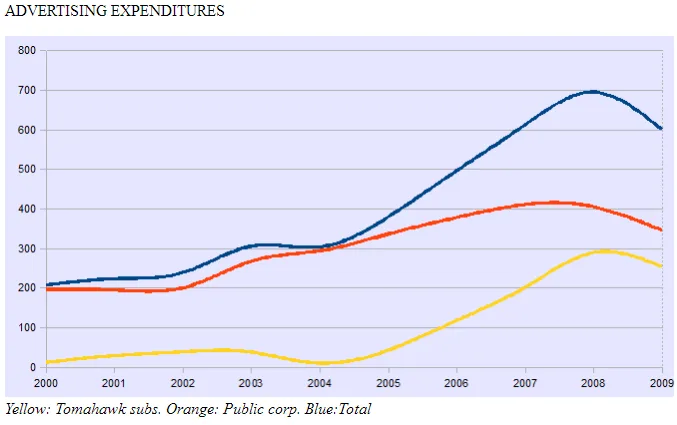
We can see that the money spent has been increasing every year, what tells us that both public and private corporations are
investing heavily in building their brand.
We see a marked decline for the past two years, and that probably has been the added competition we have introduced, which has forced sellers to cut their price. That's our conjecture but we might be wrong. The ad industry is a good barometer of the financial position of the players, so we could be looking at a slowdown for some reason, but we doubt it.
We can see that during the past 2 years total expenses have been about 1,3 billion, of which 211mm have been spent through our Gazzette, meaning that of every 6$ spent about 1$ has been spent with us.
The main player in the ad industry is government, as it has most of the media firms.
There's a TV station, purchased at a very early date from govt, that has changed hands between some corporate players and that is currently operated by "HPW". Take a look at the stock market triptych to realize the big earnings number this corporation currently has because it is related to their TV station. Apart from that we have "LOG" that is a media corporation that sold to us their, back then, only newspaper in Glen Fork.
If we expand our media business, ad prices will have to come down, profitability will suffer and the cities will take a hit in their budgets, so we'll have to increase taxes further.
On the other hand, we have access to a big credit line and could easily purchase distressed firms if a price war ensues.
As our Gazzette's CEO is doing quite a good job we could expand their operations in steps and follow their progress and adjust down the road.
So, we'll procceed to build some radio stations and see if these appeal to a new clientele that could have been eluding us.
We'll also try to build another chart, by city, to record the performance of the different firms on the field in another post to give a picture of what's going on.
Chapter 52 — 16 April 2019
FEBRUARY 2010 – FEBRUARY 2012
I'll start reporting this period showing images of the cities and specially where our new residential districts are located. It was quite some time since we offered such city views.
Lambs Grove:
You can see the upper boundaries of the commercial district below and the two areas that we have chosen because of its downtown and services proximity and also affordable land values.
There's also shown the TV station belonging to Hyper Power that we mentioned earlier, the one with such a fantastic revenue, currently for sale (they make 39mm/year and ask 393mm for it).
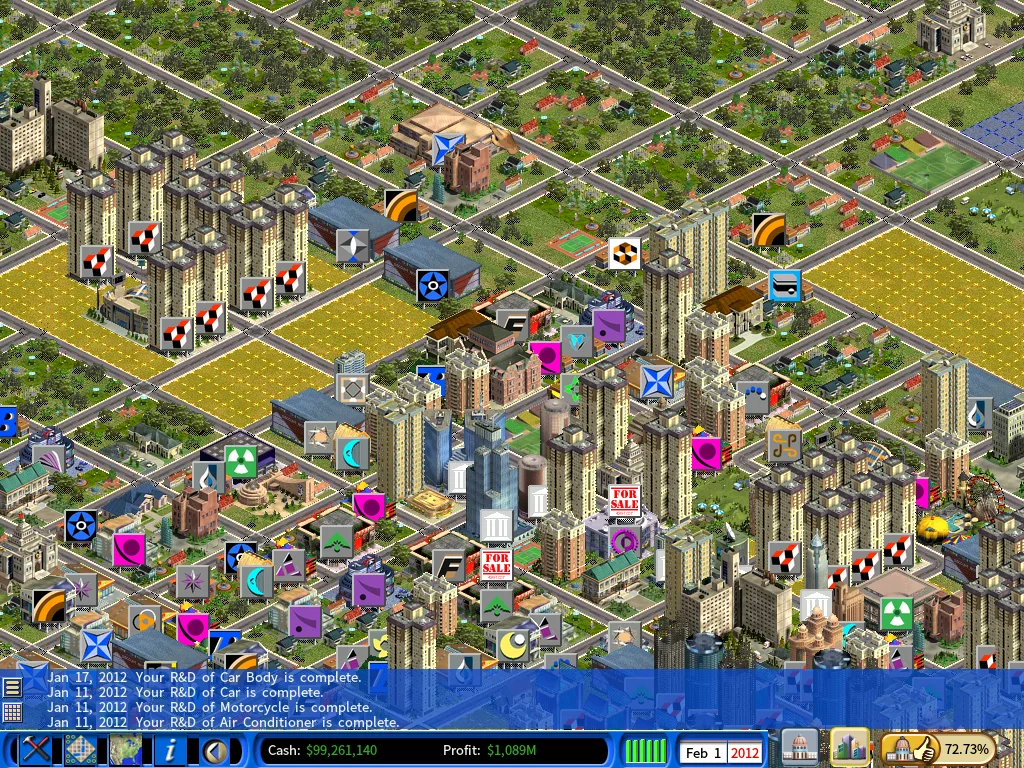
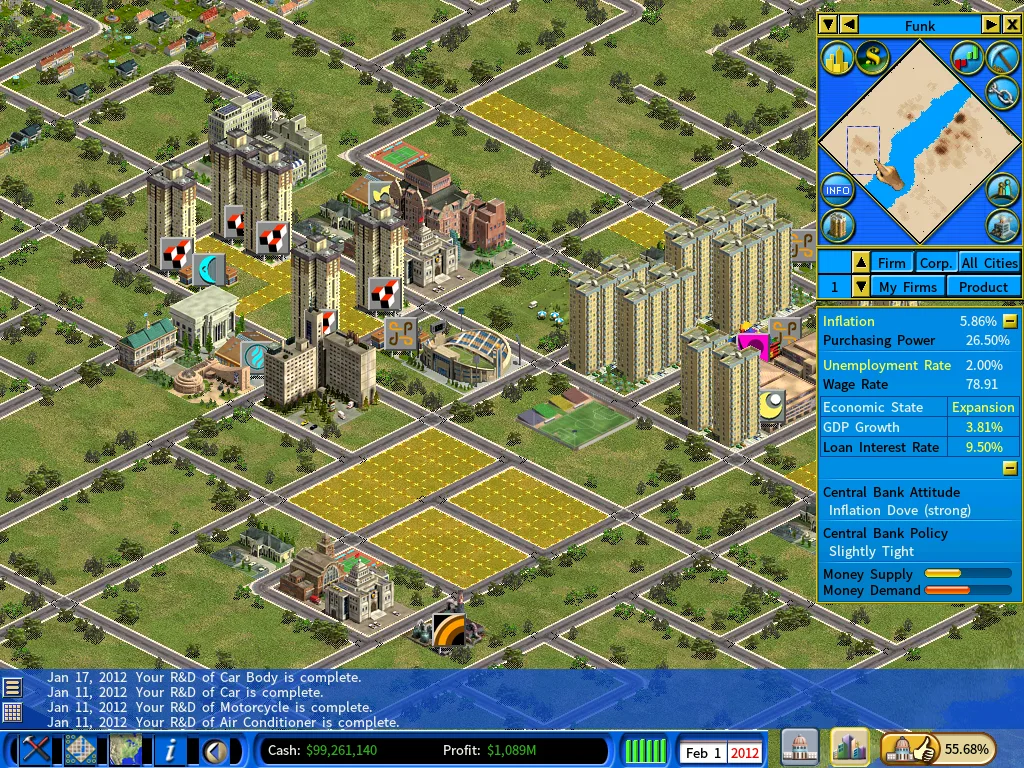
Funk:
We have included the mini-map to show the location of New Funk (the new pollution-free residential area) with five of our buildings already in place and lots of services around. As you can see there's already a bit of business activity going on with five stores, and two R&D labs, functioning in the area. The soviet-style buildings on the right are city owned and were the seed core of the "new" city.
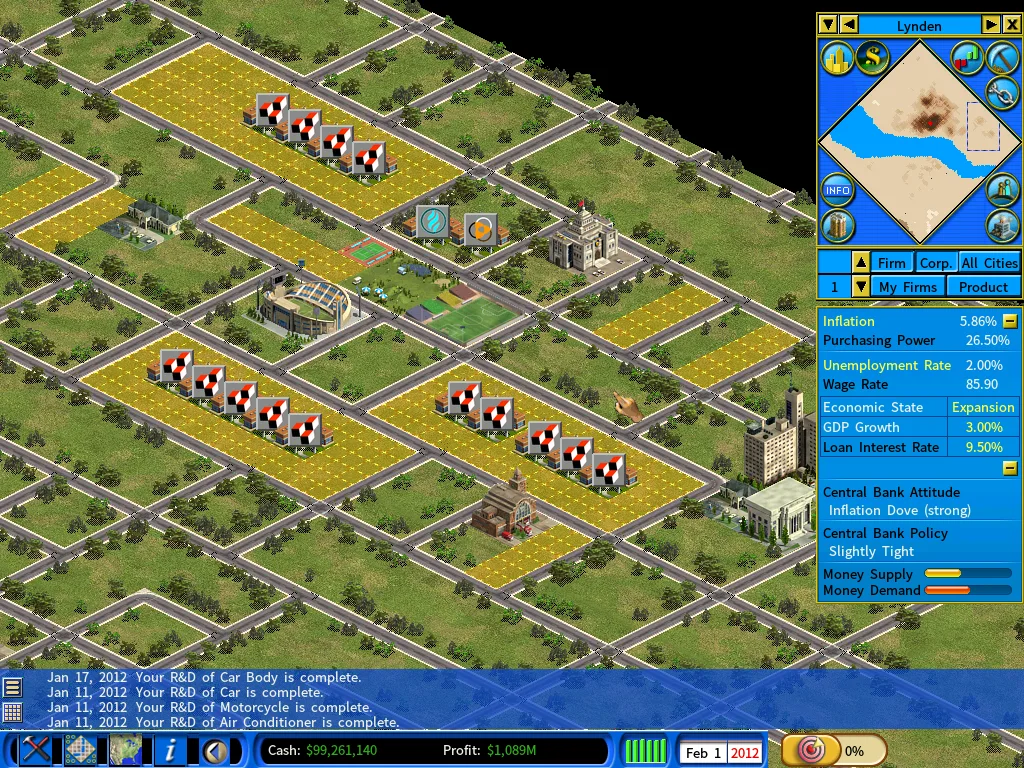
Lynden:
Here we have also included the mini-map to give a perspective of the new district's location. We were finishing our downtown district and will probably begin constructing here this 2012, and heartly expect that new stores will follow and offer the needed consumer goods to give our apartments a good life rating.
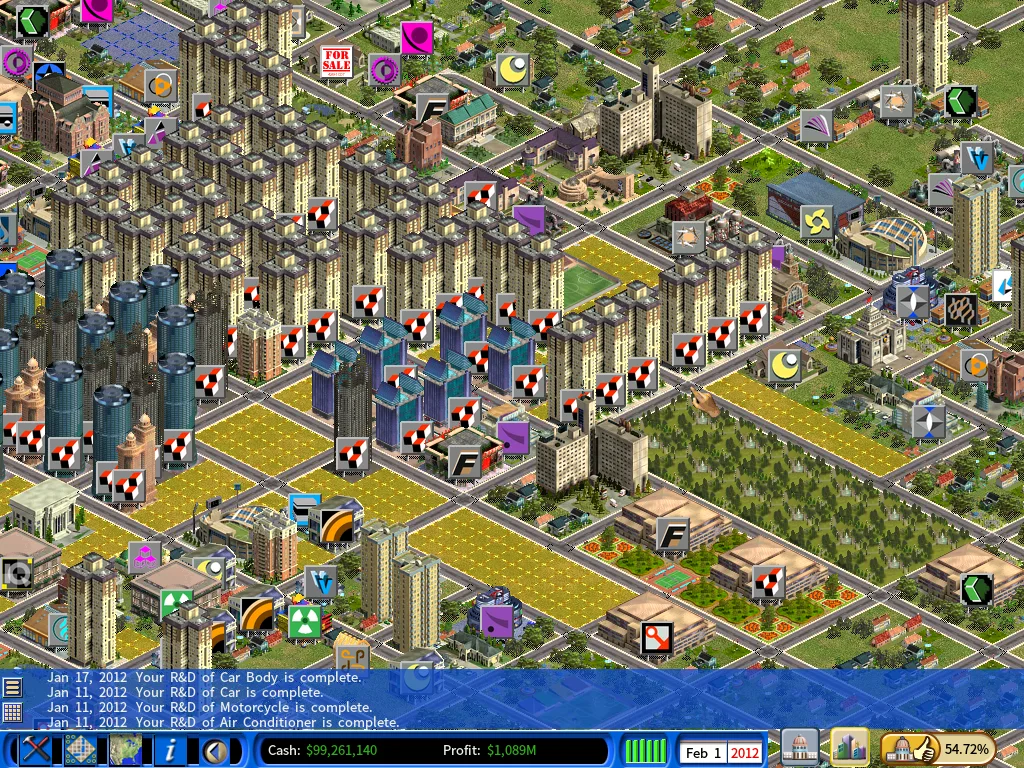
Glen Fork:
There's no special area allocated for a new residential district in this city. The yellow areas will be harboring the new apartments. You can see Tomahawk's HQ in the lower right corner and also the HQs of two of our new subsidiaries: Fruitcake Stores Ltd. and Jumbo Camera Ltd. The hand shows where our most recent buildings are being placed. The two small office buildings to the left are located at the center of the CBD.
FINANCES.
We are paying a 3,64% interest on our debt.
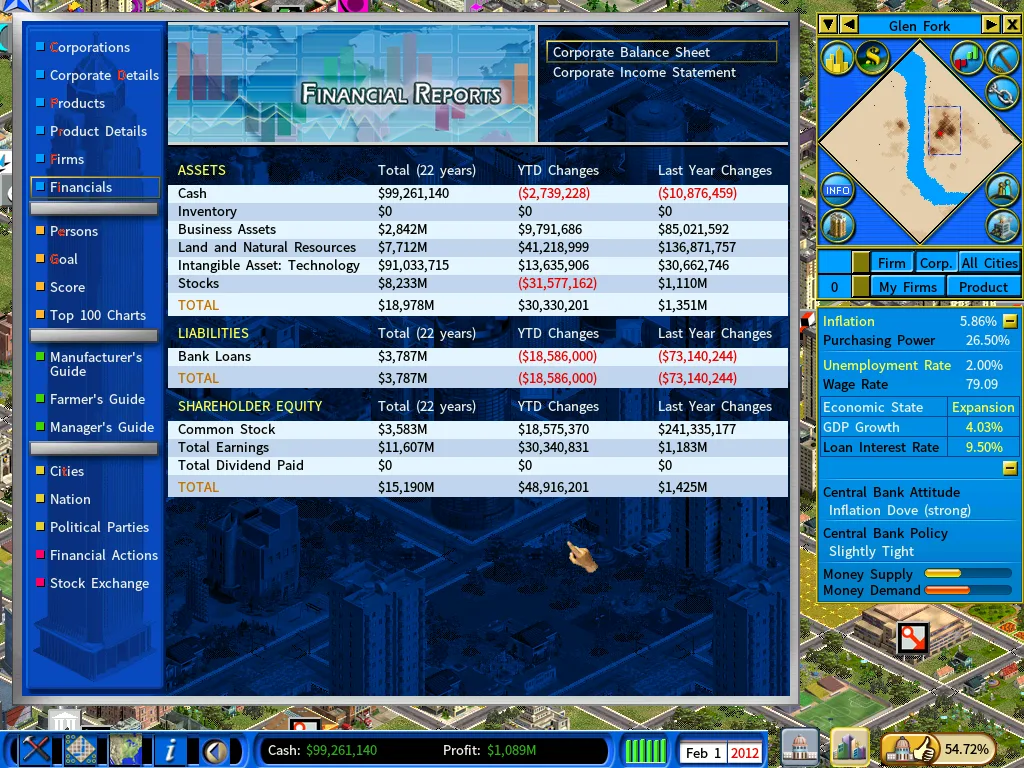
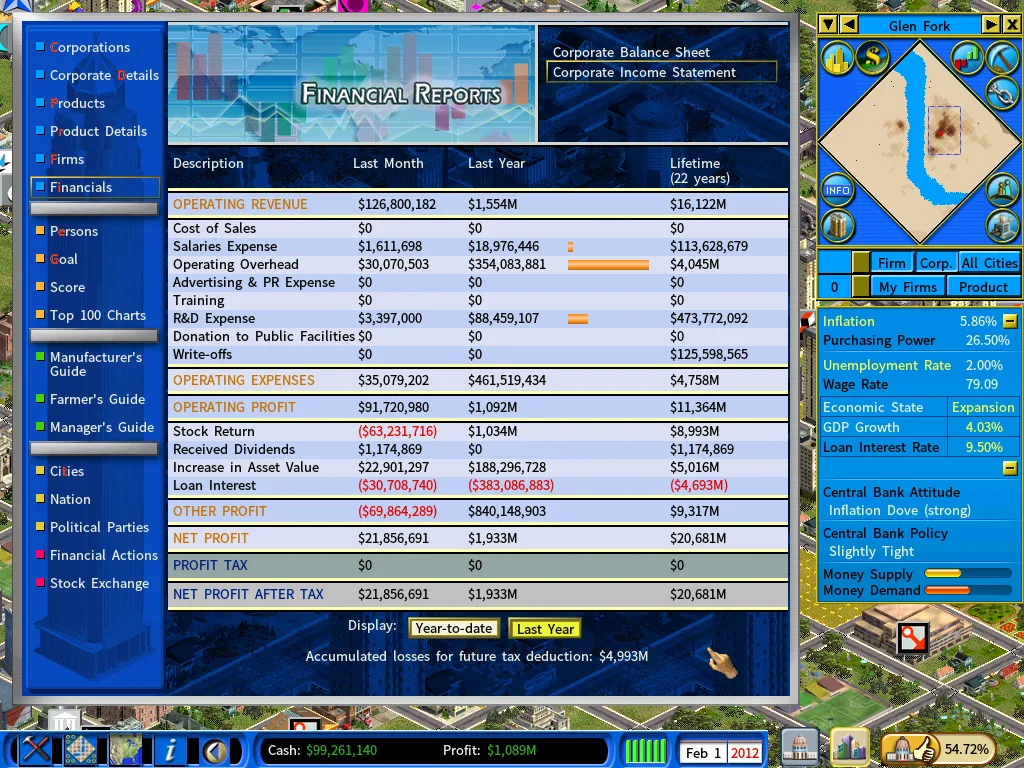
As always, we present the current balance sheet, income statement and public stock holdings of our corporation.
Our net assets increased by 3 billion to 15 billion since 2010 and our debt increased slightly to 3.8 billion.
Our income has increased just a fraction as last time we reported all our existing RE firms were steaming hot. From 2008 to 2010 there was virtually no construction, so we reached an income plateau sometime during 2009.
The Stock Market.
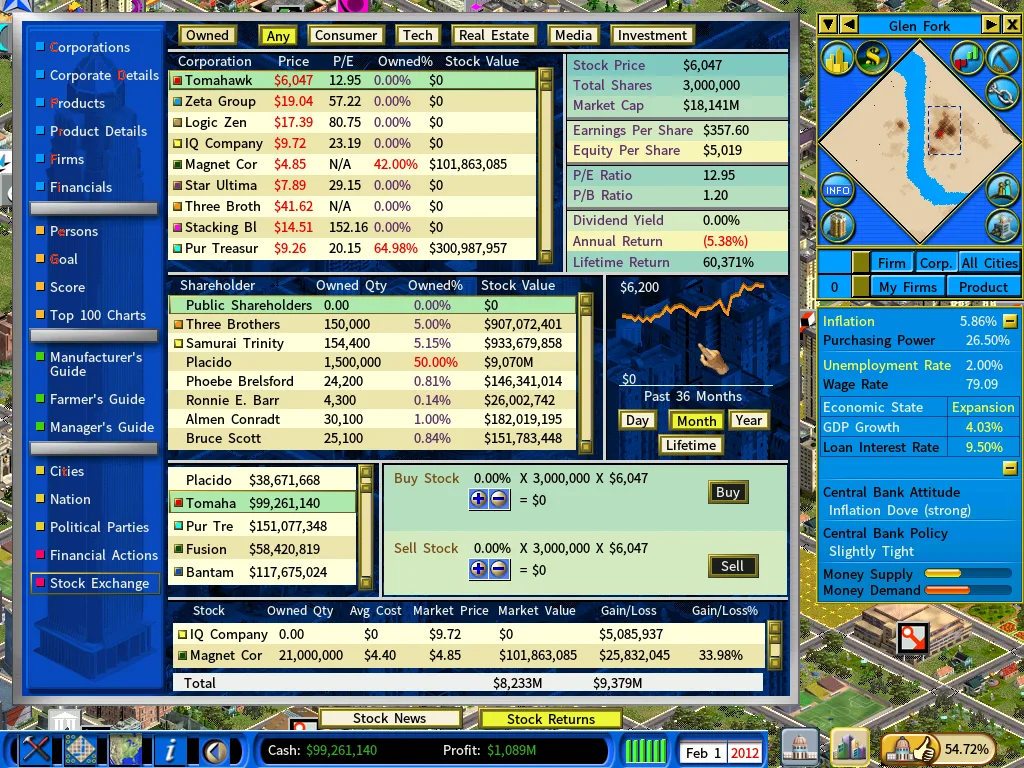
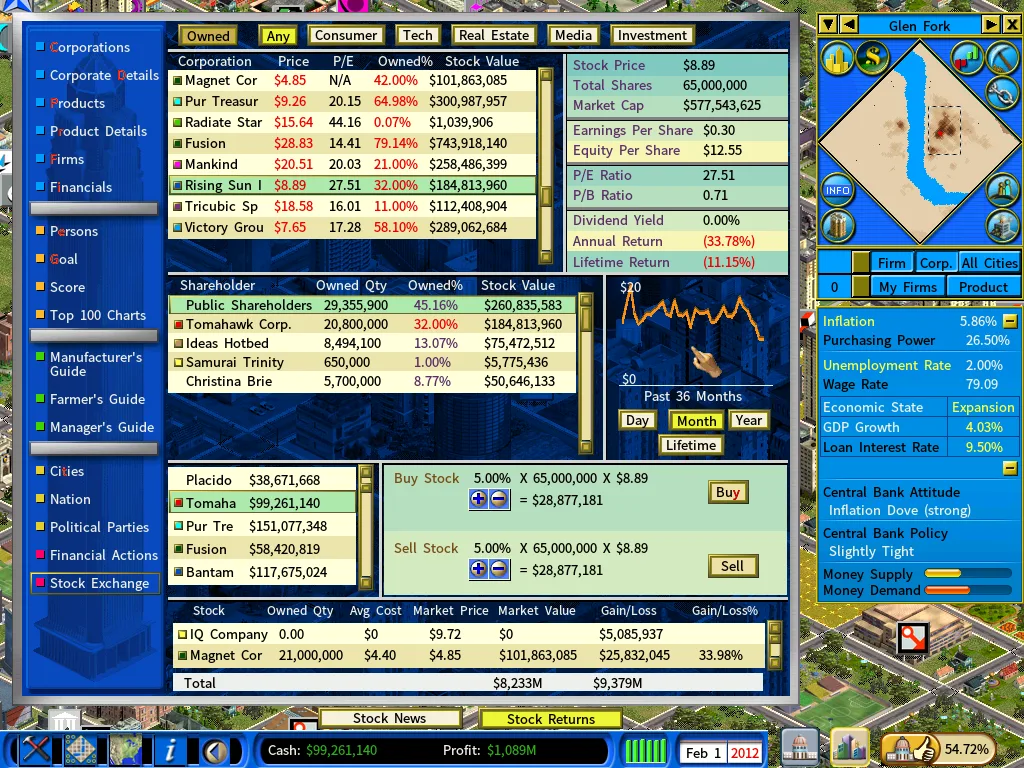
Some brief comments about our present holdings:
We shed our position in the photography corporation Platinum Coil after purchasing their most recent technology and started our own project through a new subsidiary: Jumbo Camera Ltd.
We had 34,5 million shares purchased at an average cost of 6 $ylvanor and sold them at about 10,5$ into a very hot-minded public for a modest gain of 150 million.
We'll show how that company was doing after we terminated our ownership in the NEW VENTURES section.
Mankind and Tricubic Space are two toy corporations that sell each the video game console and the handheld game console products. We have no way of researching these technologies fast nor cheap, so we'll have to participate in that market segment through acquisitions.
We also increased our participation in Magnet corp (electronics) and Victory Group (computer), over-paying for them to have them inside Tomahawk's sphere.
Finally, a curious development unfolded, and we have a consumer goods corp. valued below their book price: Rising Sun International (beverages).
We decided to show their price chart in the screenshot.
We had purchased some of their stock at book value and we will keep buying them as long as their shares remain shunned, as they are a direct competitor of Saratoga Mills and are currently profitable through their wines and high quality grapes.
Chapter 53 — 9 June 2019
NEW VENTURES
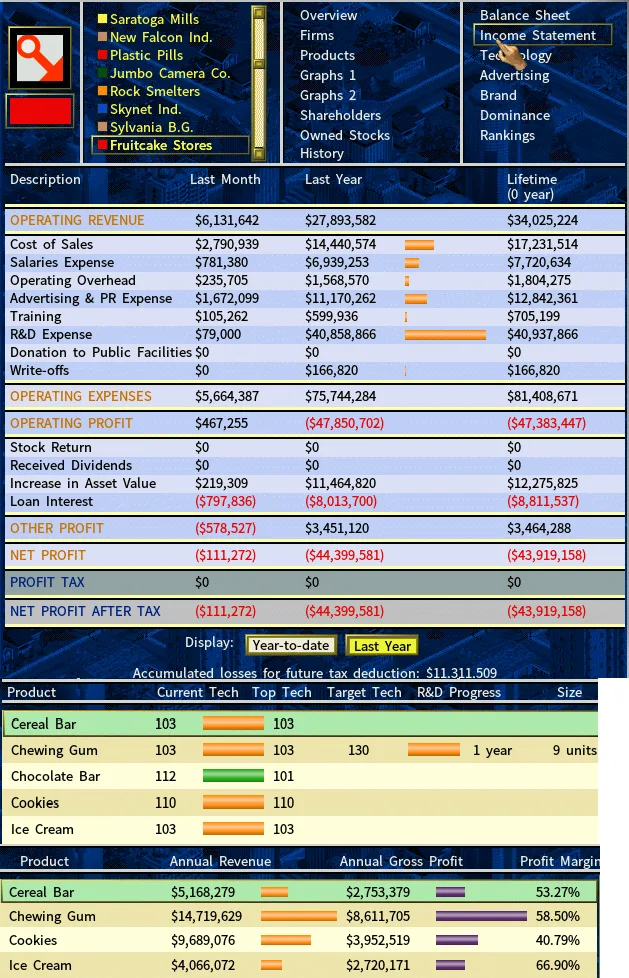
So, welcome our new subsidiaries. We transfered to each 500 million$ from Tomahawk's reserves so they could start their first set of operations. That includes the building of the HQ and the transfer of our technology to them, at market price. The total cost is show in the Income Statement: "R&D expense", under the "lifetime" column.
Fruitcake Stores Ltd.
Finally, we have corporation focused on selling snacks. As we said, that sector remains in the hands of the local producers for the most part, so we expect to turn a profit in the short term.
Selling candy is not the best money maker, but we want to encourage the economic activity in our nation by building factories, creating jobs and paying taxes. Our newly hired CEO seems to be aware of our expectations and is already involved in producing and selling 4 of the 6 possible products inside that class.
We provide an overview of the company.
Jumbo Camera Co.
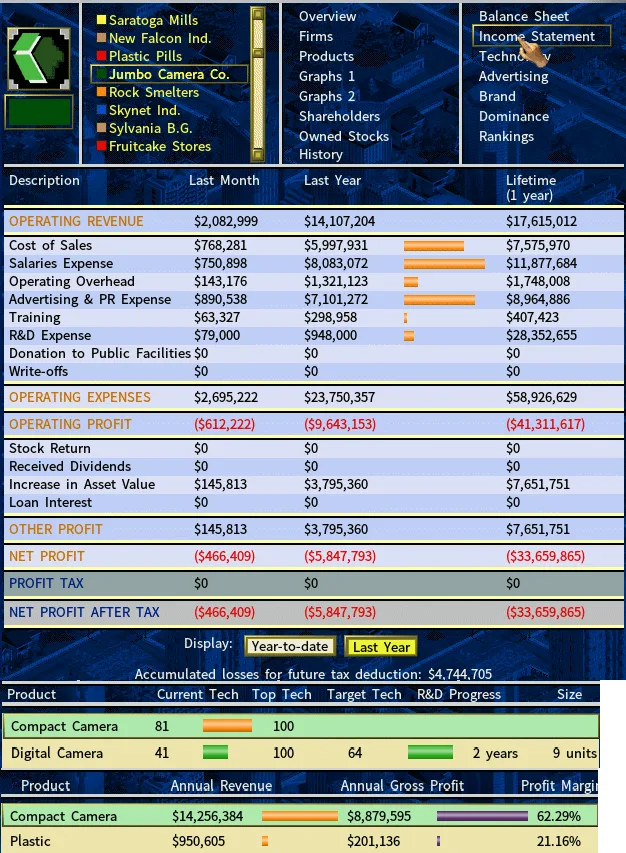
Our new subsidiary has been set to deal with our adversary, Platinum Coil, and their promising field of business.
As we mentioned before, we purchased Platinum Coil's technology after our 200mm$ investment gave us access to their board of directors. We then had to pay 30mm$ for the compact camera and digital camera's blueprints, which were then handed without delay to our subsidiary. The designs are currently being enhanced in the labs and turned into consumer goods in the assembly lines, to our satisfaction.
As always, we could have had our own monopoly, but we placed our bet for more jobs and higher wages overall, rather than profits, as we've been saying all along…
Here's an overview of the corp. You can see that they are already selling compact cameras, but they might find the digital camera design to be uncompetitive as it is.
Here's Sylvania's market for digital cameras:
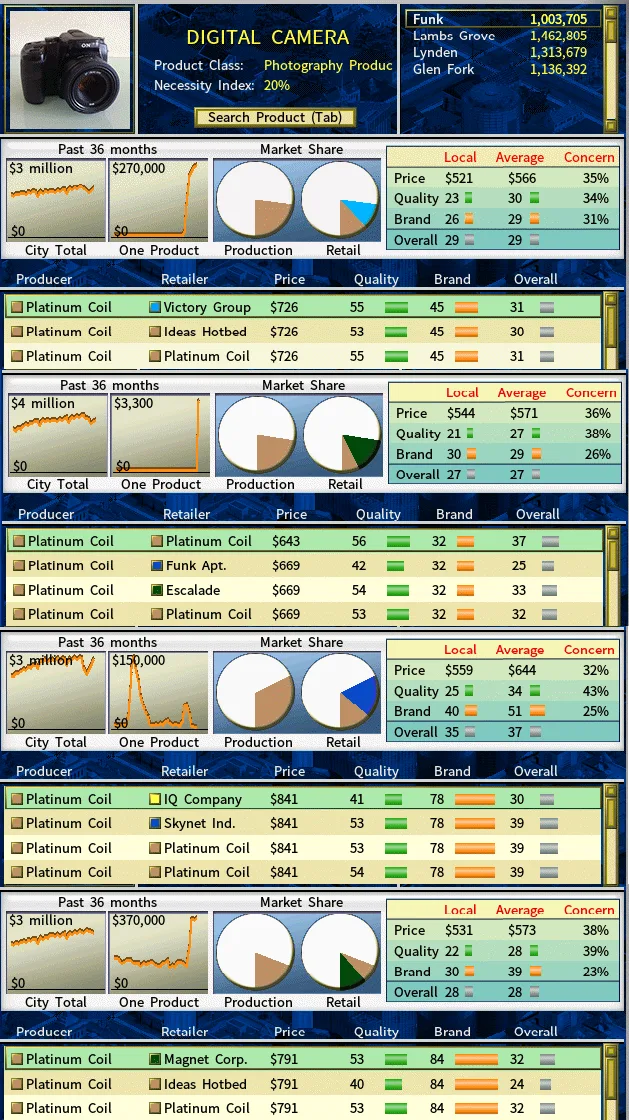
You can see that there are a couple of resellers unable to sell their 40 odd quality stock (Funk Apt and IQ), but the 55 quality cameras are being sold smoothly (Magnet and Victory). That puts our current research in the field in a proper perspective, and our subsidiary will probably have to "build" its brand before it can compete here, too.
We finally want to mention that photo cameras have very low production costs: compact cameras about 6$ and digital cameras about 12$, maybe then double that number after transportation costs. If you compare that to the price being asked at the stores you will realize that the margins in this market segment are huge.
Platinum Coil.
So, we sold our last bit of ownership in this company in February 2011, receiving 350mm$ from the desinvestment.
We present the market metrics from Platinum Coil in 2012.
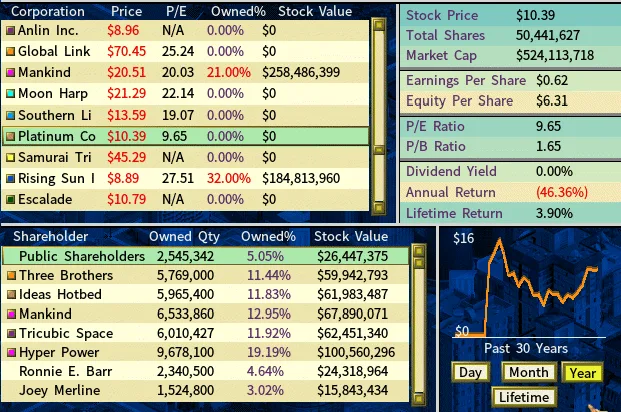
We can see that the price has been stuck around 10$ for the last year, and that the company presents strong earnings but an expensive valuation by current assets, altough that could be considered normal if the company's succesfully expanding. We could try to estimate their present situation by looking at their income statement and detailed product sales in order to guess where the company's heading. So let's try:
We present the data from 2010 and 2012.
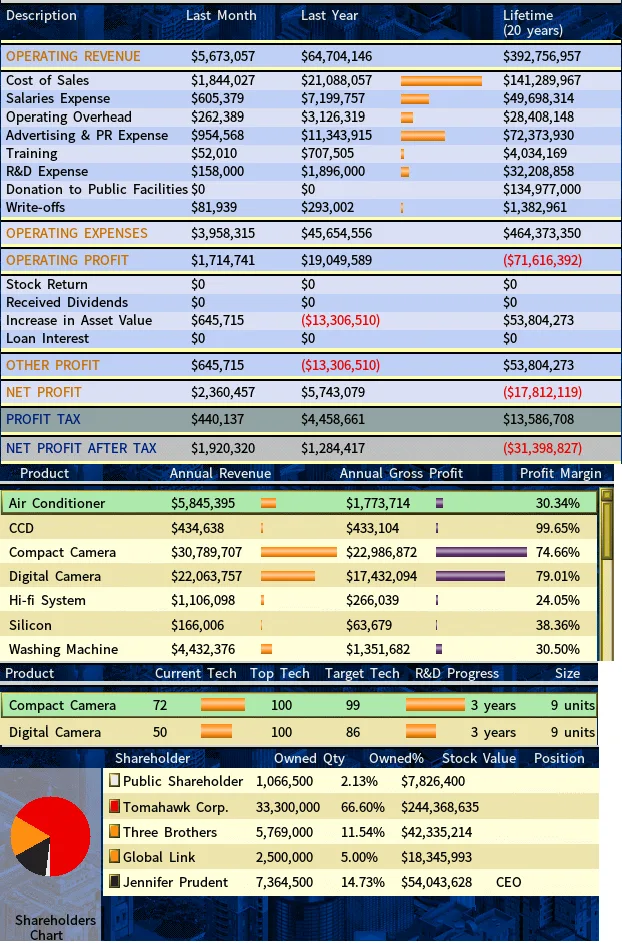
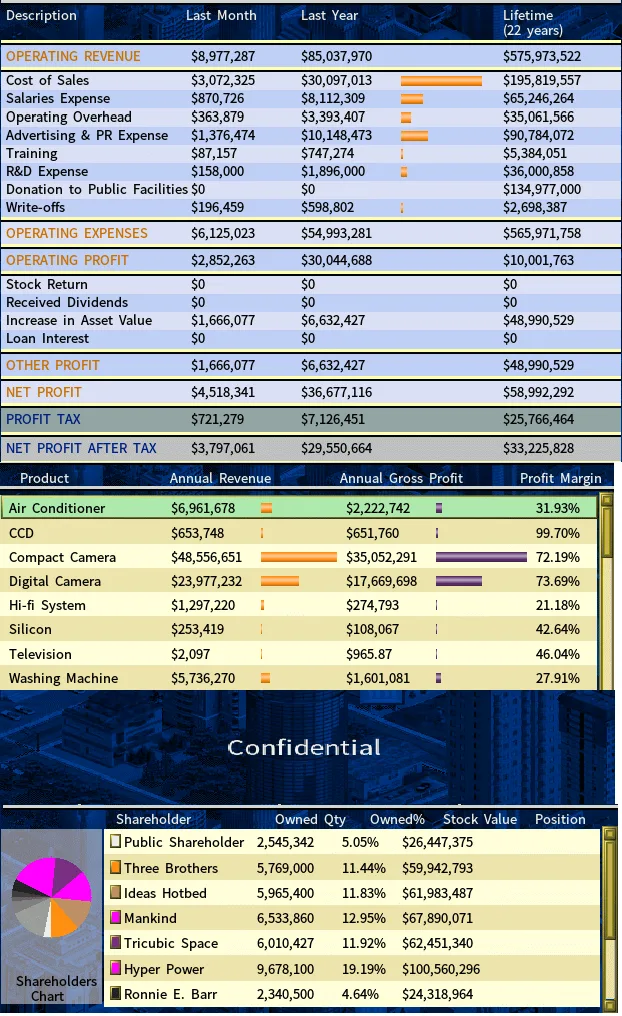
1- We can see that they went from making 1,3 mm$ (net profit after tax) in 2009 to 29,5 in 2011. That looks like an impressive feat! Also, if we look at their biggest expense, it's donations to political parties (donations to public facilities). That masks the history of their profitability: In 2010 we could have had the impression they didn't turn up a dime in their entire life and that they were losing money constantly. That alone could be a call to pay due attention and not to haste.
2- Their costs for both 2009 and 2011 have remained quite the same (except cost of sales) and that indicates a somehow "mature" business (?)
3- Looking at the product sales we see that the only product that grew their profits in the interim was compact cameras. Do they have there pricing power or are they expanding their operations and gaining market share?
4- Their revenue grew by 30%, from 65mm$ to 85mm$, but…
5- The operating profit (revenue minus costs) for both 2009 and 2011 grew by 50%. A fast growing corporation.
6- Let's look at the cost of sales: that also grew by 50%, meaning their sales efficiency didn't grow, so they probably are expanding their operations rather that charging a higher price for their compact cameras.
7- Let's see what percentage of the revenue was used to produce their sales: They went from using 32,6% of their revenue in 2009 to 35,4% in 2011. We believe that infers their sales efficiency has modestly deteriorated, and we think the appearance of our subsidiary could have caused that: they might have been forced to adjust their prices down.
We'll try to remember to update this in the 2016 post so we have data to compare again the evolution between 2013 and 2015.
Chapter 54 — 27 September 2019
SUBSIDIARIES.
Here's a summary of all our subsidiaries. It is presented so you can see at a glance those that did set sail and those still berthed.
In our opinion, the ones showing an (estimated?) annual loss are the ones that should be reviewed with care, and so we did, giving you just a few remarks now.
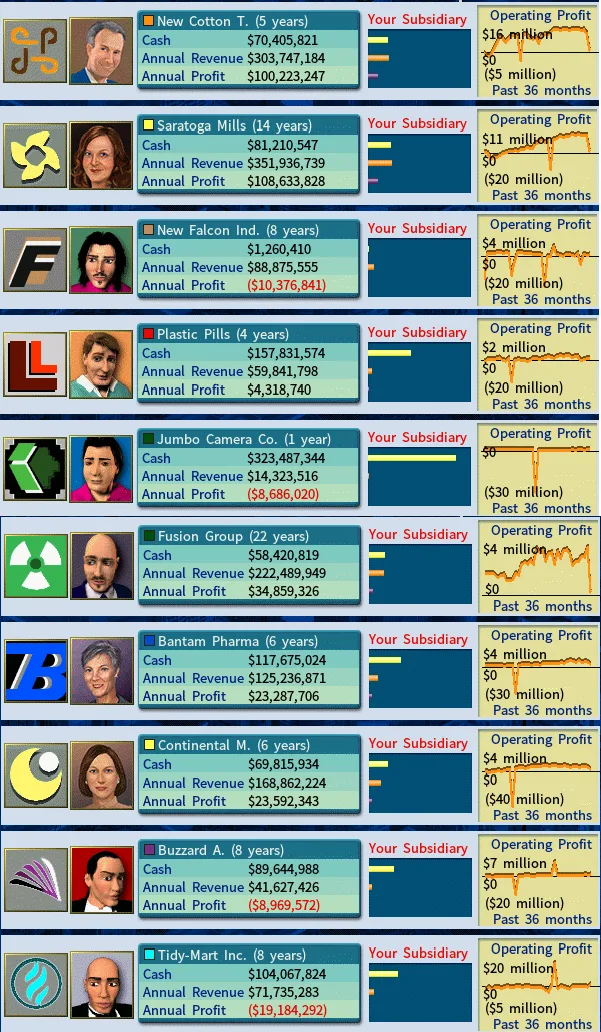
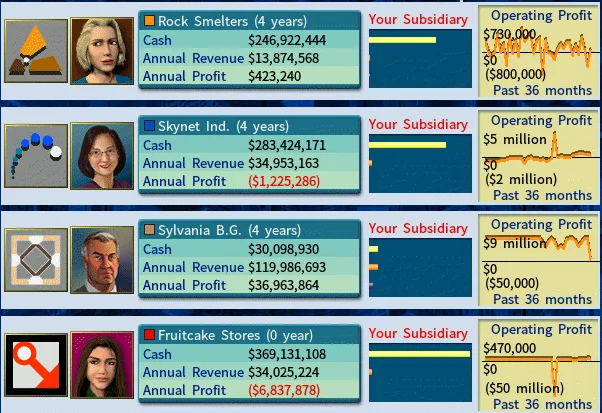
Putting aside our most recent ventures from that category:
A) We see Falcon Industries and Buzzard Automotive both steadily climbing their way out of the mire.
The first (Falcon) has a promising outlook as they have access to the new electronic products (camcorder&portable player). Also, part of their competition (Magnet Corp, one of three with expertise in the field) will be absorbed soon by Tomahawk, as they are on the verge of bankrupcy (so we claim).
The second (Buzzard) has the usual problems of both having a very limited variety of goods to sell (car&motorcycle) and on top of that their own specialized retail store.
We are helping them by means of R&D so they can establish a proper supply chain of semi-products and see if we can help them boost the final quality of their automotive brand.
About their competition (Anlin Corp), we reviewed them in an earlier post, but just to mention it now they are a big corporation with a horrible brand (corporate brand with both autos and sports goods, deep negative) and many natural resource-semi-farm firms.
Losing money and steadily falling into a debt hole, it might take them many years to go under, unless investors (bank&private) lose faith first, for the best course for Anlin would be to be taken apart, sold piecemeal and their name erased from all memory.
B) Skynet industries: are just starting to retail their own products (camera phones), as we recently appointed a new and more active CEO. Their field is telecom and there is one competitor: an investment firm turned diversified (Ideas Hotbed Corp).
As both the smartphone and Hud glasses will probably be invented by our subsidiary, or their parent, it's just a matter of time to see them making big money.
In any case, their camera phones have at this moment lvl 100 quality vs the competition's 50. On the other hand they have a much less developed distribution infrastructure (6 retail stores vs 18!)
C) Tidy-Mart Inc: are facing tough competition from one Shining Star Corp (household products).
We're happy enough offering them liquidity as long as they use it to expand, produce and hire folks, but we'd like to see both Shining Star's investors and lenders pick up the bill, and not us. Let's see how they are faring vs them.

We can see they have not jumped fully into two of their possible consumer products. We visited their stores and saw they JUST started selling washing powder and tissues in two of the four cities. That explains the low market share.
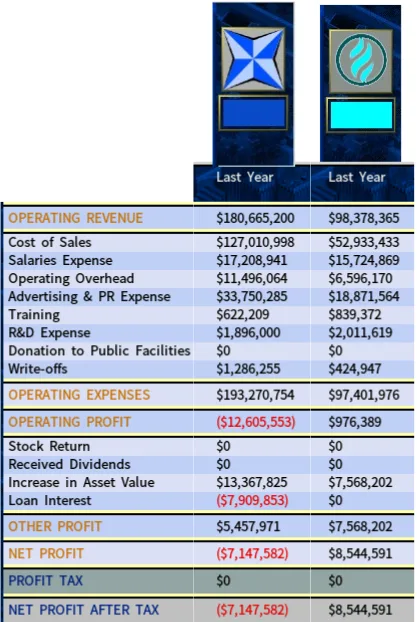
Looking at 2011's Income Statement we can see that the costs of sales are 70% vs our 54% of revenues (sales efficiency). That, together with a much higher cost to keep their brand (twice as expensive) gives us a nice competitive edge. Despite the above the margins are thin and we barely break even.
On top of that Shining Star has to pay 8mm/year in interests.
As there is room to grab some more market share we assume that in the future we'll do somehow better and they will spiral down, as long as our "efficiency" edge remains.
D) Finally, our resource subsidiary Rock Smelters: The gold mine they were operating just stopped producing, so we went to the books to asses its profitability.
Easy done? well, we looked into the firm statements and saw a 16mm net profit. BUT, we cannot see how much we paid for it! That's where a cash flow statement could come in handy.
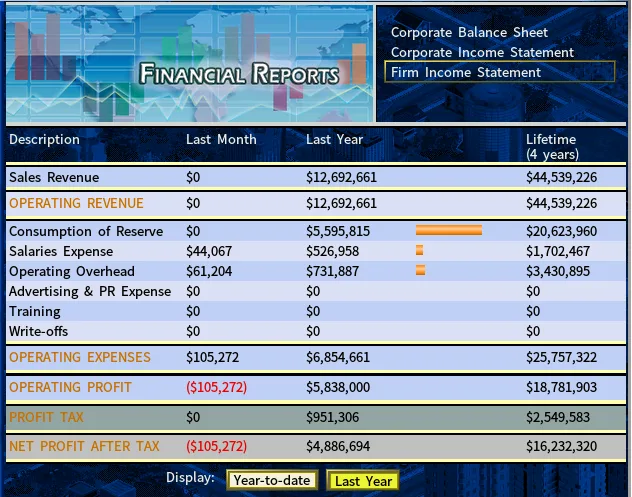
As we have been wise enough to prepare for such an occurrence, we loaded the game previous to our purchase to see the cost of the mine "to be".
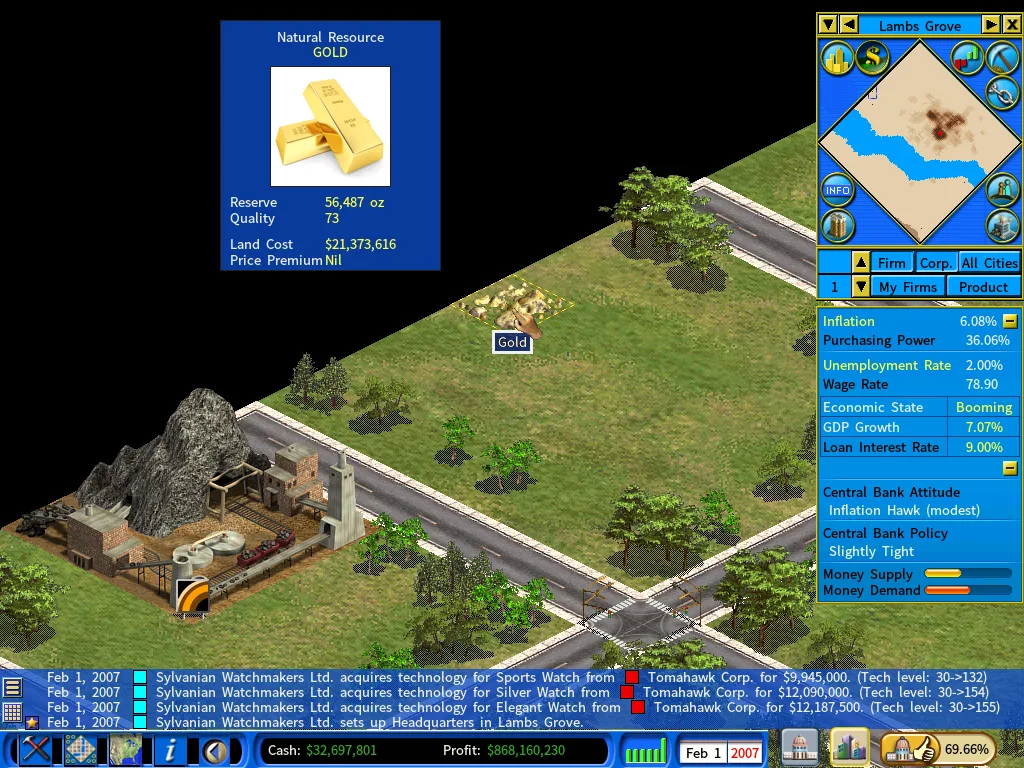
So 21 million$, plus the building.
Obviously, we haven't considered the benefits derived that our gold mine provided our other subsidiary making gold rings, as the market for gold was back then monopolized by Global Link…
As a side note, mention that the possibilities to expand in natural resource production are currently very limited, as there are no cheap locations available and most other corporations have sunk their cash reserves into setting up extraction facilities. We will try to be alert to any news regarding the finding of new deposits of any kind of resource to see if they don't come with a land cost premium.
TECHNOLOGY:
Finally, we prepared a list of our completed research. Despite being very simple, it gives us a nice snapshot.
I believe it would be nice to add current research (subsidiaries included), leadership, and possible purchases too, but that for another time.
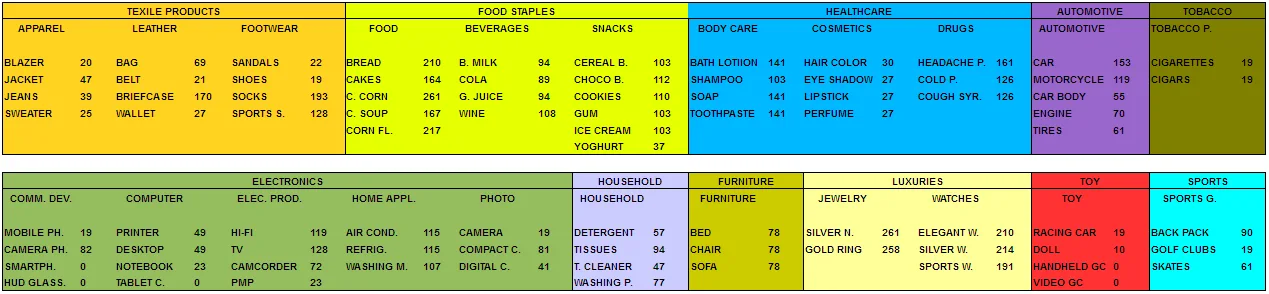
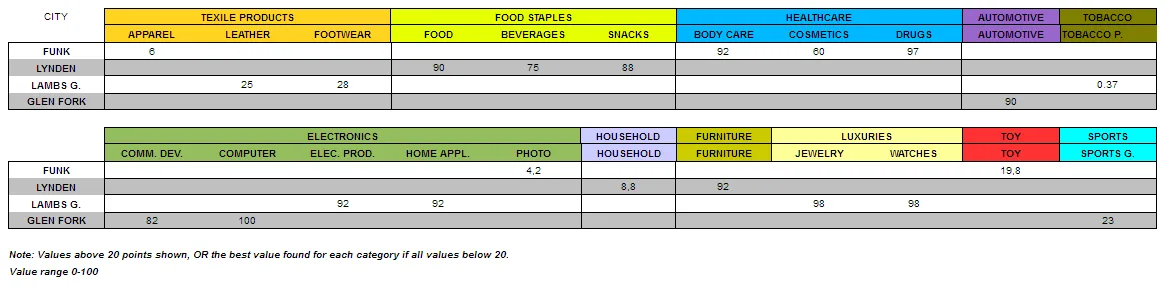
If you wonder how we achieved such advanced technology for segments where we have no expertise (like food staples), the answer is we hire researchers from the universities. That said, we should present another snapshot of city competitiveness (linked to university research), so here it is.
These two will help us assess our position, current and future.
REAL ESTATE:
We built since 2010: 25 new apartment buildings and 11 office buildings. The supply is still higher than the demand for both, and we are keeping it there, between the 0-10 range.
The moment we see money rates coming down we'll speed up the construction and keep the supply above the 10 range.
Once we reach 2020 we'd like to offer a chart correlating the RE supply with the GDP and see if it matches.
Chapter 55 — 27 September 2019
FUTURE:
I plan to put an end to this story by 2020, unless I change my mind later. I like playing this game a lot, and like even more to narrate about it.
I thought before that maybe some of you would like to follow the progress by getting the save games, but unfortunately, as you well know, the game is constantly being upgraded and my current version is too old to do something about it. So I try my best to offer a "useful" picture. I'm also sure I leave some aspects that I might deem irrelevant unanswered. I cannot show every piece of the puzzle in the reports so I have to judge and discriminate about the information offered. If you happen to have a different angle to it, or are interested in me shedding light on dark corners, write about it. As I always say, feel free to comment and offer advice and guidance.
If someone would like to set up goals or is interested in watching a specific outcome for this story, to your liking, amusement or just because of curiosity, please let me know. It could be akin to be on the board of directors of Tomahawk Corp. I.E. Want to see a subsidiary sale, say it!
Finally, It's been almost four months since last post. I think I'll find the time to finish this before year-end
So, I'll speed up the game reports jumping from 2012 now to 2016 and then 2020.
Thanks for reading!
Chapter 56 — 5 October 2019
FEBRUARY 2016
FINANCES
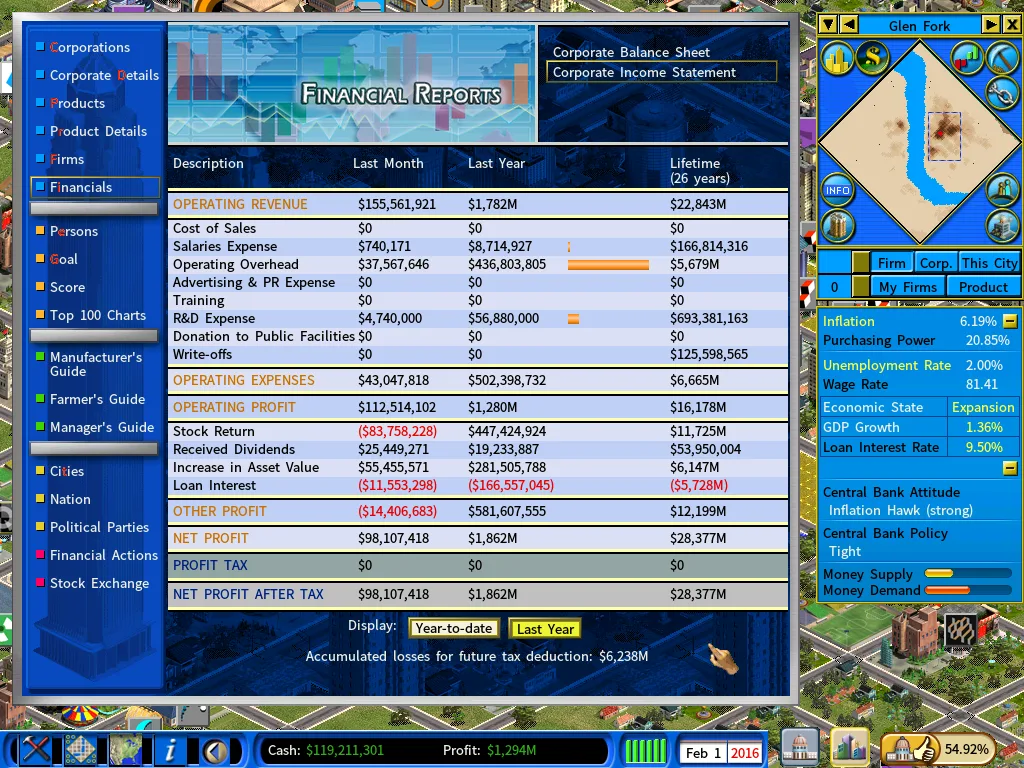
Our assets have grown by 7,5 billion$ in the past four years, to 22,7billion$. Of that, 2,5billion$ were amortized, so we reduced substantially both our liabilities and the interest charged therein.
As we have been getting enough cash on a monthly basis, from our business operations, for our investing activities (most of the time), we now find the corporation very well positioned to monetize back our assets if the situation so requires, with the revolving facility having 11 billion$ "available" as we speak.
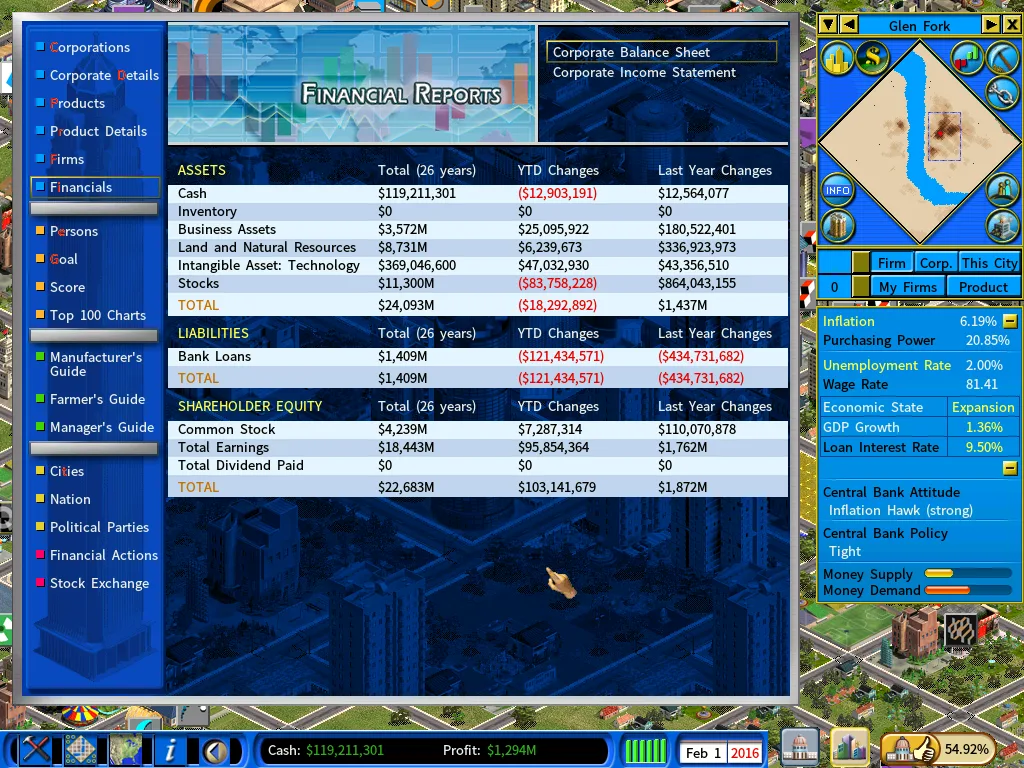
We can see that the profits from our RE firms stand at present at about 1,3billion$/year.
You will also notice that we have increased our R&D expenses substantially (a 40% increase since 2012), meaning we have built many new R&D facilities to keep filling the gaps in our research.
As it's been customary, we now present the two pictures for the Stock Market review.
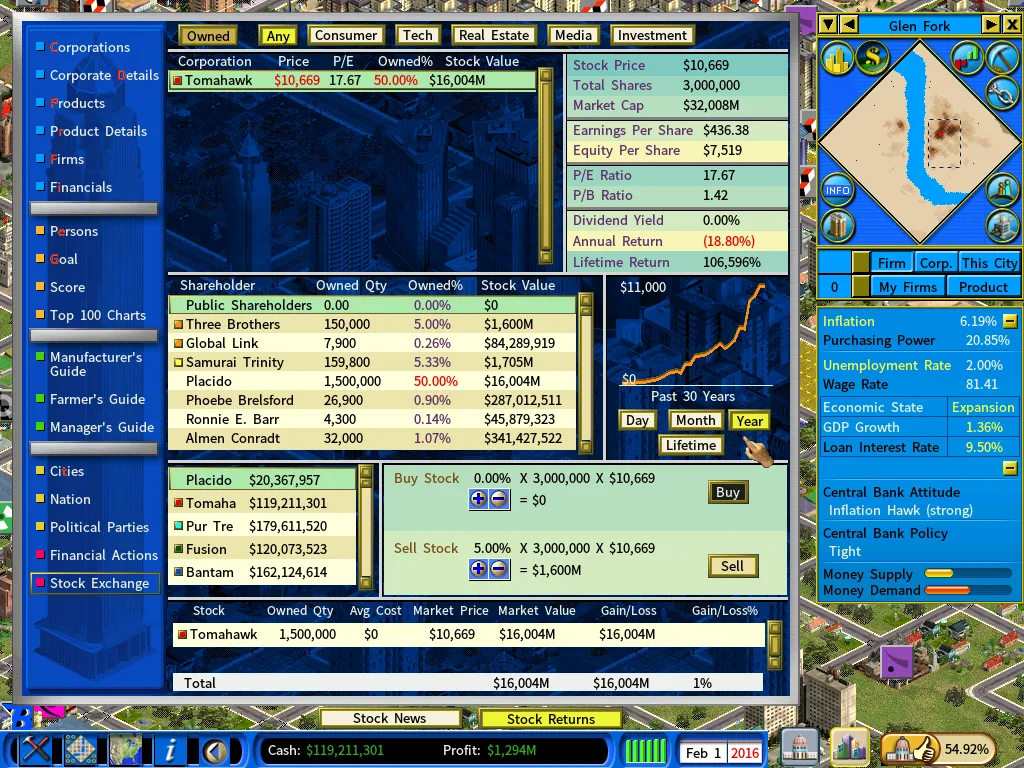
We can see that Tomahawk is now valued in the marketplace at 1,4 times its assets. That puts us on a similar value range compared to other public corporations (see stock market triptych).
We also see that we haven't yet required private capital investments nor have tried to buy back our shares.
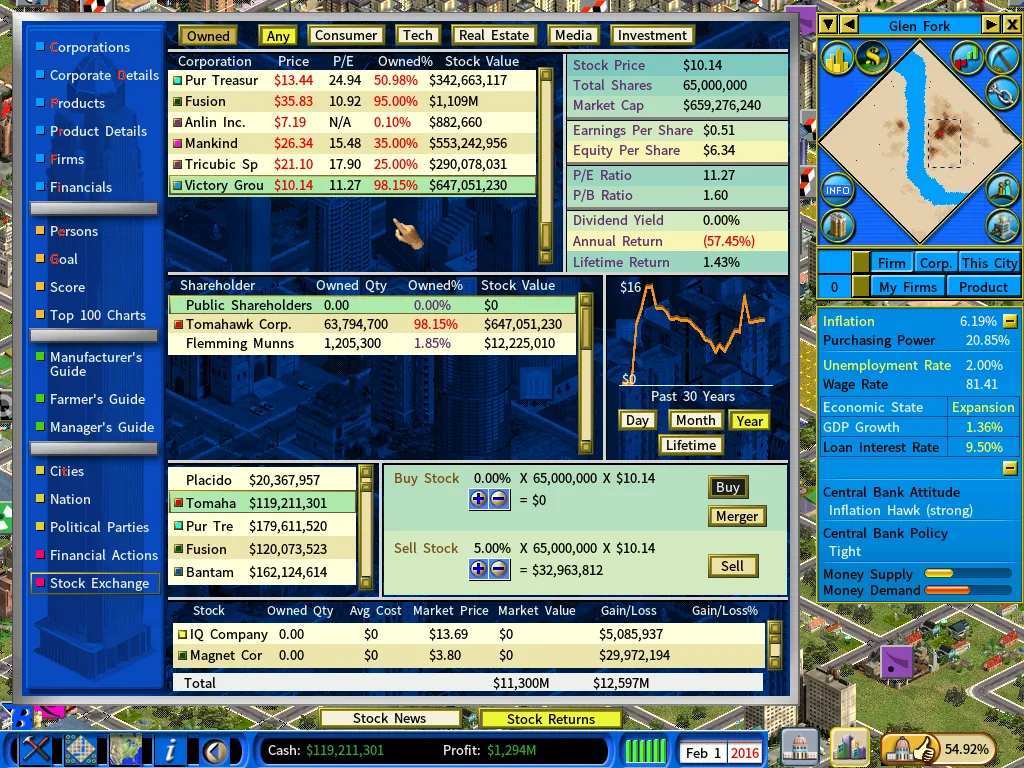
Here we show how we finally acquired the computer corporation Victory Group (we currently own 98,15% of it). You will also see that we increased our ownership in Fusion Corp. (furniture).
We fired the CEOs of both corporations and purchased their shares once they were out, in 2015.
As we do not plan to increase further our ownership, let's see the total costs of the acquisitions:
Fusion: average purchase price of 11$ for 30,97mm shares: 341mm$.
Victory G: average purchase price of 7,83$ for 63,8mm shares: 500mm$
It seems these numbers (from the stock exchange menu) don't add the "private" purchases to the equation. If we do so:
Fusion: "public" purchases 284mm$ + "private" purchases 359mm$ = 643mm$
Victory: "public" purchases 446mm$ + "private" purchases 126mm$ = 572mm$
(Edit: correct numbers now)
Next, we updated the Stock Market Triptych for 2016.
As we explained in a previous post how this worked, we won't do it again. Nevertheless, it comes simplified this time, and with an "enhanced" valuation metric to take into account earnings (right side).
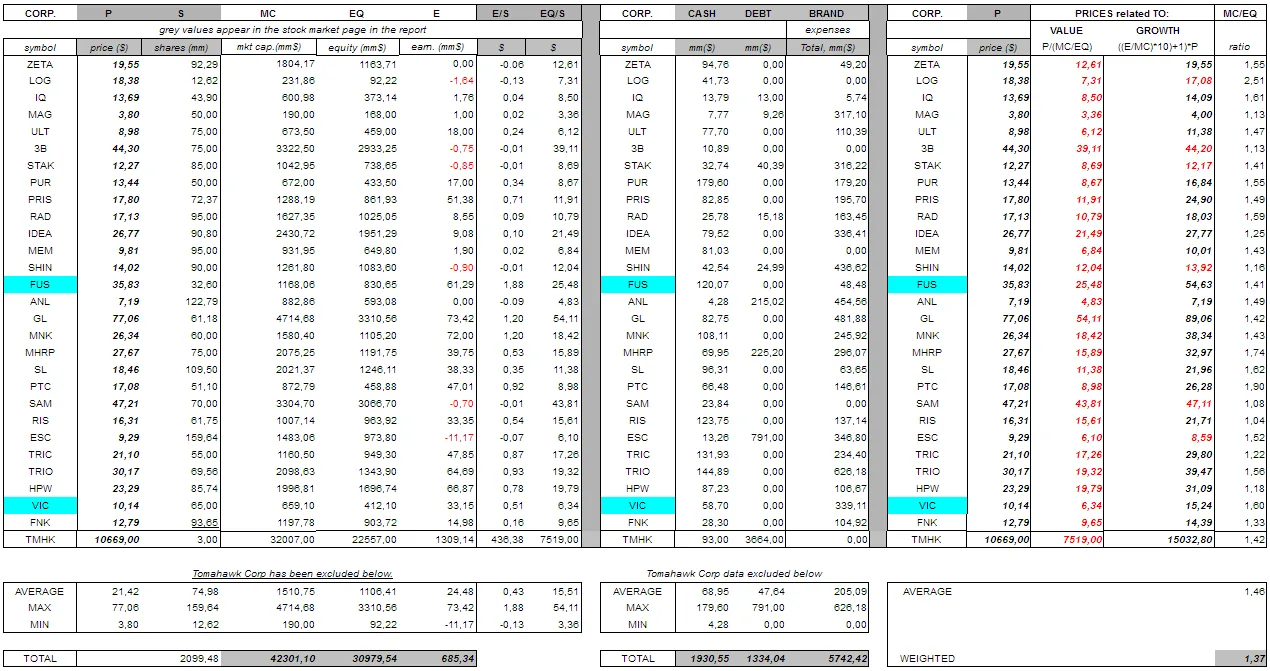
Also, as we wanted to know the market cap of the corporations not under our control, we excluded FUS and VIC from the triptych chart.
Then we thought it would be a better idea to add them to our subsidiaries in a new chart, dubbed "Sylvania's Corporate Market", and then compare both groups (Simulating we'd IPO our subsidiaries making 20% of their shares available in the market).
So here's the result, showing the whole of the nation's corporate market.
We can see that assets not under our control amount to 22,5 billion$ and are currently priced at a premium of 8 billion$.
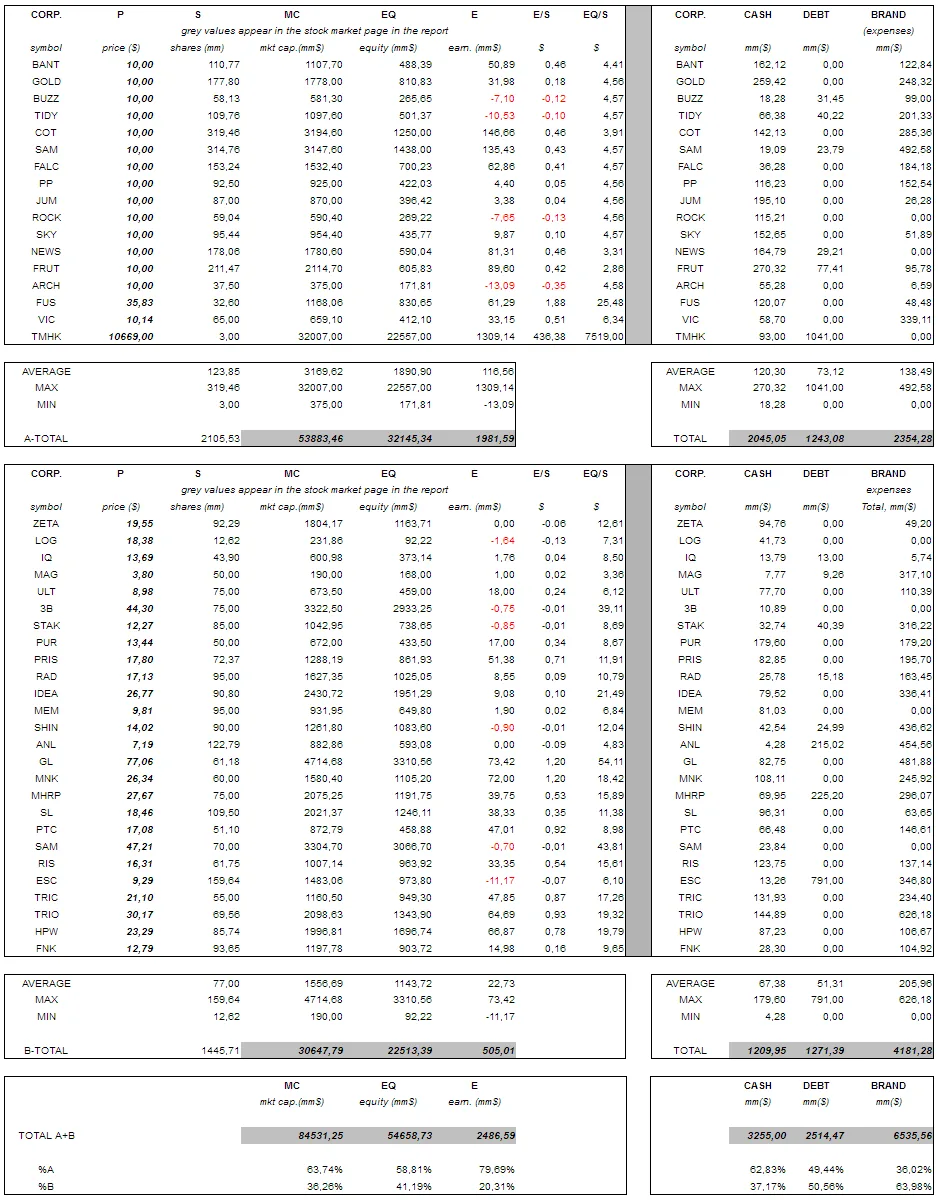
Edit: Changed, wrong inputs.