

Banking Company Strategy
By Stylesjl
Banking overview
A bank takes deposits from the public and lends that money back out to them. Real banks do a great deal besides — transfers, insurance, currency exchange, brokerage, financial planning — but Capitalism Lab simplifies all of that down to the traditional deposit-and-loan model. Lending is your only way of making money.
Do not let that simplicity fool you. Banking in Capitalism Lab is tricky to manage. This guide covers how to make a bank very profitable while keeping the risk of a major loss as low as possible.
In this guide
- Concepts and terminology
- Banking difficulty settings
- Recommended difficulty settings
- Picking headquarters and branch locations
- Starting strategy — banking from turn one
- Adding a bank to an established company
- Bank troubleshooting
- Conclusion
Concepts and terminology
Banks in Capitalism Lab borrow their vocabulary from the real finance industry. Here is what each term means in game.
| Term | What it means in game |
|---|---|
| Banking headquarters | The firm that houses your bank and controls all its branches. Every profit and loss consolidates here, and with the City Economic Simulation DLC the corporate tax on those profits goes to the city the HQ sits in. |
| Bank branch | The customer-facing firms that take deposits and make loans. More branch coverage means more of both. |
| Branch deposits | Deposits from the general public at a branch. The amount depends on local customer traffic and the Savings Rate Modifier, and is also affected by brand, service quality and the depositor interest rate. |
| Corporate deposit | Called Deposits from HQ in game: deposits from in-game corporations or persons, including your own personal money. No branches are needed to take them. |
| Corporate loans | Called Loans from HQ: loans made to in-game corporations. No branches needed, and the interest depends on the borrower’s credit rating. |
| Capital ratio | Your equity capital against the loans issued. Equity capital is what the bank owns that is not customer deposits. |
| Loans-to-assets ratio | How much of the bank’s assets are lent out. At 90% of $100 million in assets you hold $10 million cash and $90 million in loans. The Maximum Loans-to-Assets Ratio is the level at which the bank stops lending. |
| Loan demand | Total appetite for borrowing. When it is exhausted no new loans are made — either because a branch has served every customer in its area, or because the whole economy has reached its limit (with Realistic Loan Demand on). |
A worked example of the capital ratio. Inject $500 million into the bank and let depositors add $10.5 billion, and your equity capital is $500 million — even though the bank now holds $11 billion in cash. Lend $10 billion of it and your capital ratio is 5%.
Credit ratings
Every potential borrower carries a rating for the risk that they will not pay you back, from lowest risk to highest:
- AAA
- A
- BB
- CCC
- C
Further reading
The reference articles cover the concepts this guide does not:
- Bank Headquarters
- Bank Branch
- Understanding Bank Capital Requirements
- Banking and Finance DLC — the overview
Banking difficulty settings
These settings change the profit and the risk of a bank enormously. Here is what each one does.
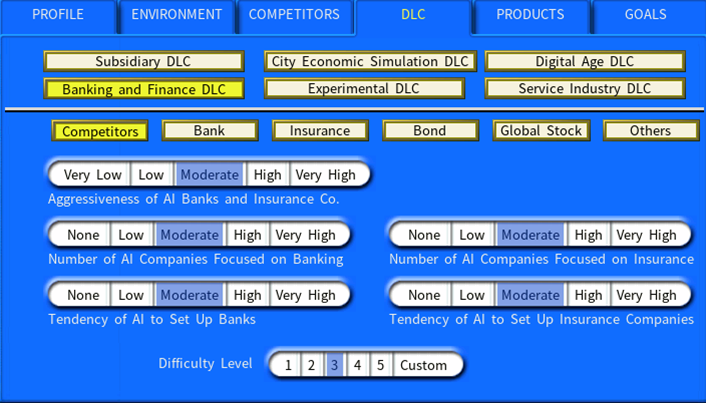
Competitors
| Setting | What it does |
|---|---|
| Aggressiveness of AI banks and insurance companies | How hard your AI rivals fight for market share. An aggressive banking AI spends more on advertising, staff training and branches, and raises deposit interest to pull customers away. |
| Number of AI companies focused on banking | How many competitors start the game as banks. |
| Tendency of AI to set up banks | How many diversify into banking later, after succeeding elsewhere. This does not change the number of banks at the start. |
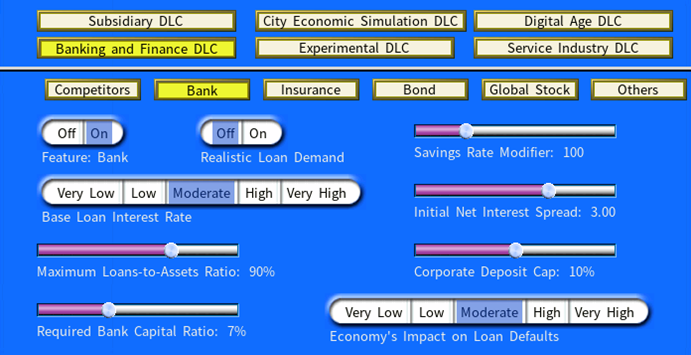
Bank
| Setting | What it does |
|---|---|
| Feature: Bank | Whether banks exist at all. Switched off, nobody can create one and every loan comes from a single in-game bank — how Capitalism Lab behaved before this DLC. |
| Realistic Loan Demand | Caps total loan demand at the size of the economy. Switched off there are still limits, but far higher ones. It exists to bound how profitable banks can become. It has no effect on corporate loans — corporations can borrow up to the bank’s available cash or their own credit limit. |
| Base loan interest rate | The “normal” rate in the economy, affecting bonds, deposits and loans alike. The actual in-game rate still moves with the central bank’s decisions. Setting it very high does not automatically make your bank more profitable — you owe depositors more as well. |
| Maximum loan-to-assets ratio | The ceiling on how much of a bank’s assets may be lent out. You or an AI can voluntarily set a lower figure to cut risk, but never a higher one. |
| Required bank capital ratio | How much of the bank’s own assets must be held in reserve. Customer deposits belong to someone else and do not count as equity. Fall below this and no new loans can be issued. |
| Savings rate modifier | How much the public deposits in your branches. A high setting usually makes the game easier — a bigger deposit base to lend from — though a flood of deposits can make the capital ratio hard to hold. No effect on corporate deposits. |
| Initial net interest rate spread | The “normal” gap between what you pay depositors and what you charge borrowers. Pay 2% and lend at 5% and the spread is 3%. A wider spread is a more profitable bank. Your own spread still varies with the deposit rate you set and the loans you make. |
| Corporate deposit cap | The most one corporate depositor may hold relative to the others, so that no single corporation endangers the bank by withdrawing suddenly. It does not limit corporate deposits in total. |
| Economy’s impact on loan defaults | How many loans fail in a downturn. Set high, a bank must run a much more conservative portfolio — especially in a volatile economy. |
Other settings that reach banking indirectly
| Setting | Why it matters to a bank |
|---|---|
| Your starting capital, and competitors’ | Set yours to High or Very High. Any lower and starting with a bank is a bad idea until you have accumulated capital elsewhere. The same holds for competitors — below high, they will not build banks at all. |
| Inflation and inflation strength | Inflation erodes your lending gains. Pay 3% and lend at 6% and you gain 3% nominally — but only 1% in real terms if inflation is 2%. Turning inflation down or off removes the drag. |
| Boom-bust cycle volatility | A more volatile economy means far heavier defaults at each downturn. High volatility together with a Very High economy impact on defaults can produce a catastrophic wave of them. |
| Number of competitors | More companies means more competition — but also a larger economy, and so more loan demand. |
Recommended difficulty settings
These are for custom games. The official Banking and Finance DLC scenarios use their own.
Very Easy / Beginner
For getting a feel for running a bank without competition or heavy defaults complicating the picture. Strongly recommended if banking is new to you.
- Number of AI companies focused on banking = None
- Tendency of AI to set up banks = None
- Realistic Loan Demand = No
- Base loan interest rate = Moderate
- Maximum loan-to-assets ratio = 90%
- Required bank capital ratio = 1%
- Savings rate modifier = 100%
- Initial net interest rate spread = 4%
- Economy’s impact on loan defaults = Very Low
- Your startup capital = Very High
- Inflation and inflation strength = Normal
- Boom-bust cycle volatility = Low
Easy
Once the basics are second nature. You now face competition, and real losses if you lend badly.
- Aggressiveness of AI banks and insurance companies = Low
- Number of AI companies focused on banking = Moderate
- Tendency of AI to set up banks = Moderate
- Realistic Loan Demand = Yes
- Base loan interest rate = Moderate
- Maximum loan-to-assets ratio = 90%
- Required bank capital ratio = 5%
- Savings rate modifier = 100%
- Initial net interest rate spread = 4%
- Economy’s impact on loan defaults = Low
- Your startup capital = Very High
- Inflation and inflation strength = Normal
- Boom-bust cycle volatility = Moderate
- Number of competitors = 25
Medium
Close to the default settings, with a few adjustments.
- Aggressiveness of AI banks and insurance companies = Moderate
- Number of AI companies focused on banking = Moderate
- Tendency of AI to set up banks = Moderate
- Realistic Loan Demand = Yes
- Base loan interest rate = Moderate
- Maximum loan-to-assets ratio = 90%
- Required bank capital ratio = 5%
- Savings rate modifier = 100%
- Initial net interest rate spread = 3%
- Economy’s impact on loan defaults = Moderate
- Your startup capital = Very High
- Inflation and inflation strength = Normal
- Boom-bust cycle volatility = Moderate
- Number of competitors = 25
Hard
If you want a fight.
- Aggressiveness of AI banks and insurance companies = Very High
- Number of AI companies focused on banking = Very High
- Tendency of AI to set up banks = Very High
- Realistic Loan Demand = Yes
- Base loan interest rate = Moderate
- Maximum loan-to-assets ratio = 90%
- Required bank capital ratio = 10%
- Savings rate modifier = 100%
- Initial net interest rate spread = 2%
- Economy’s impact on loan defaults = Very High
- Your startup capital = Very High
- Inflation and inflation strength = Normal
- Boom-bust cycle volatility = High
- Number of competitors = 50
Picking headquarters and branch locations
Headquarters
Look for a city with low land cost and a low wage rate, and put the building on the outskirts where land is cheapest.
The location of the HQ is irrelevant to how the bank functions, so there is nothing to gain from expensive land in the center.
Once built it can only be demolished when every branch is gone and the bank holds enough money to repay all depositors.
Branches
Judge these exactly as you would a retail shop: a high-traffic location is what matters.
Starting strategy — banking from turn one
This is for starting the game as a banking company and living off it, at least for the first several years. It assumes the Medium settings above.
Build the HQ and two or three branches
Put the headquarters on the outskirts of a low-wage city and add no more than 2 or 3 branches. Keeping costs down now is what lets the bank accumulate equity.
The early bank is fragile. The danger is the capital ratio falling below the required level before equity has built up, which is exactly why overheads must start small.
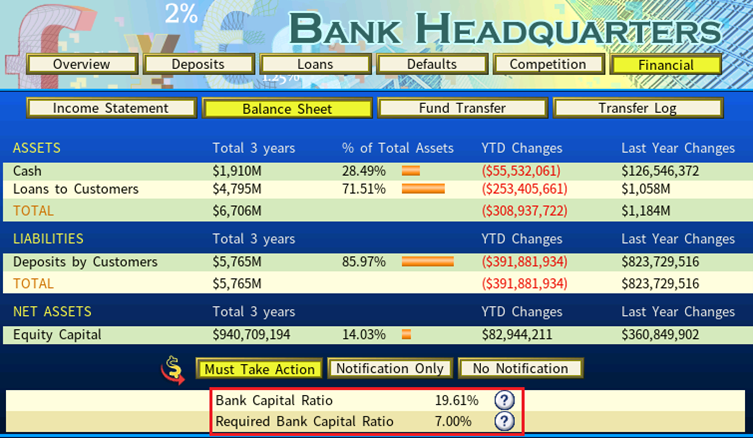
Set a small training budget
Branding and the deposit rate can wait; the training budget should be modest from the start.
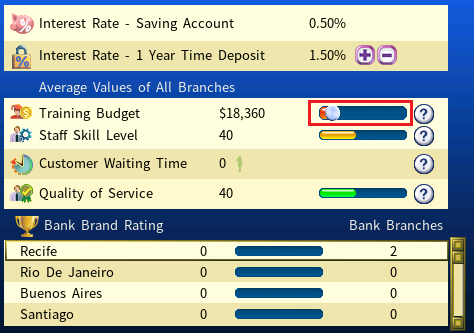
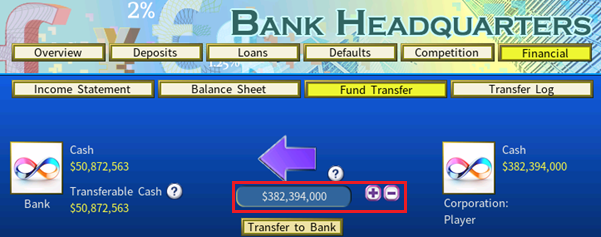
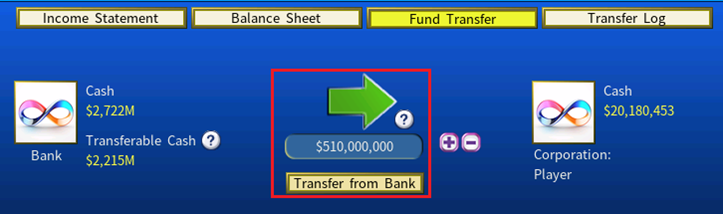
Transfer all your money into the bank
Every dollar you move in is equity capital.

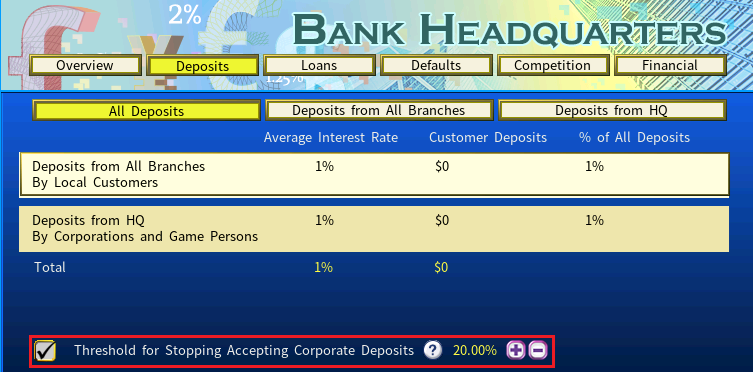
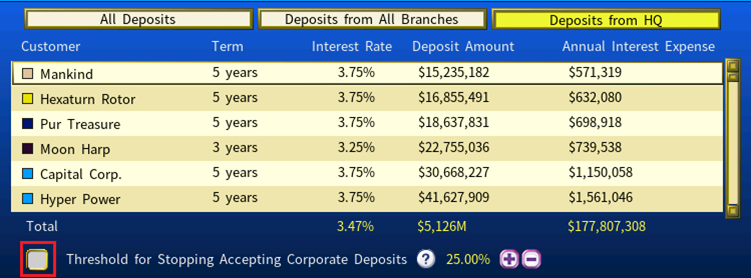
Cap corporate deposits
Limit what corporate depositors can put in, so that money does not flood the bank all at once and push the capital ratio below its minimum.
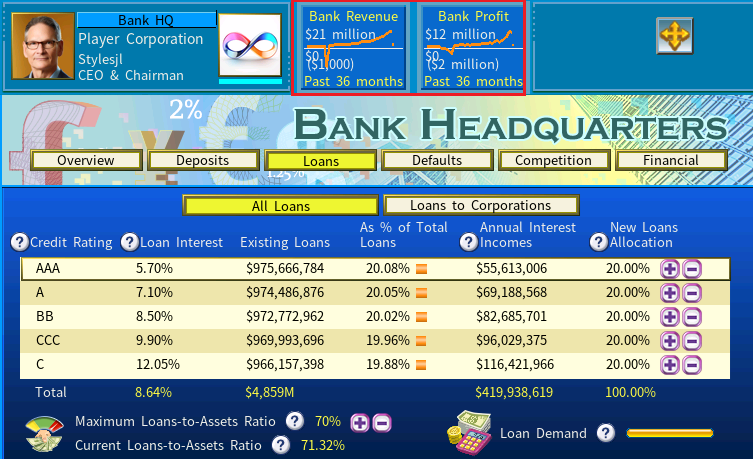
Unpause, and let the first month run
Loans start being issued and the bank starts making a profit.
Spend a little more — carefully
With an eye on the capital ratio, raise the training budget and start advertising.
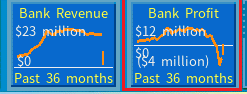
Cut expenses immediately if profit dips too low or the capital ratio gets close to its threshold.

Marketing has to be done through branches, because brand is calculated per city — unless you run the Digital Age DLC, where an internet company can advertise across every city at once.

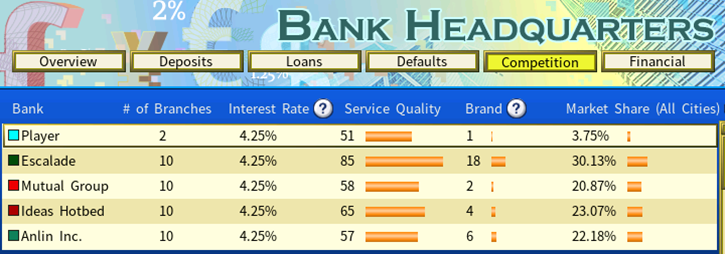
Size up the competition
At this point your market share is very small. Growing it is the next job.
Raise or remove the corporate deposit cap
Only once the capital ratio is healthy.
Pull cash back out to fund more branches

If your transferable cash is very low, stop. That means the capital ratio is too close to its minimum — fix that before expanding.
Build in other cities and set the training budget centrally
Once every branch is built, set the training budget for all of them at once from the HQ.

Have one branch per city handle that city’s marketing.

Consider raising the deposit rate
A higher rate attracts more deposits — but it also raises the cost of every existing deposit, so expect profitability to dip in the short to medium term.

If profits dip significantly, cut expenses. The aim is to expand, but cautiously. If something goes wrong, see Bank troubleshooting below.
Decide what to do with steady profits
You can plough them back into a larger loan portfolio, or withdraw cash and fund other industries.
Why diversifying matters
Funding other industries lowers the risk of the bank running short of cash or capital, because profits from elsewhere smooth out the temporary drops that loan defaults cause. Two industries worth expanding into:
- Media
- Retail and industry
The aggressive endgame
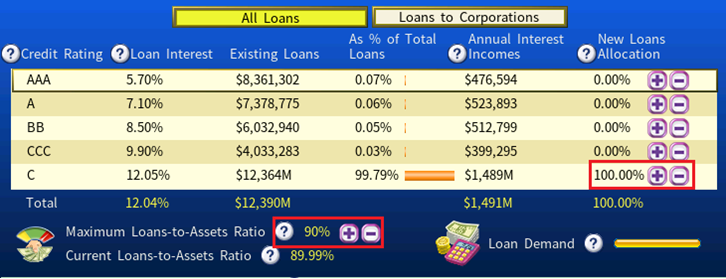
Once the other industries are earning well, you can afford far more risk in the bank: set the C loans (highest risk) to 100% and the loan-to-assets ratio to 90%.
The reason this works:
- C loans make the most money — but when a recession arrives their default rate goes so high that a bank running only C loans normally runs out of money and goes bust.
- With other industries behind you, you can transfer funds in when the bank runs low, or borrow and repay from those profits. You lose money in the short term; once the wave of defaults passes, the C loans prove very profitable indeed.
Adding a bank to an established company
Building a bank once you are already profitable means entering an industry where competitors are dug in. Two questions to answer first:
- Is there a better use for the money? A bank running high-risk C loans returns roughly 6% to 8%. Growing your existing empire may beat that.
- Is your income stable and large enough? Aim for at least $200 million annual profit and $500 million in cash, with no outstanding debts — so you can borrow in an emergency.
If you go ahead, you can skip the cautious early steps entirely, because you have the capital to put the ratio in a strong position immediately:
- Transfer as much capital in as you can — preferably $500 million or more.
- Set 100% of loans to C, the highest risk.
- Set the maximum loan-to-assets ratio to 90%.
- Put no cap on corporate deposits.
- Build as many branches as you can in every city. It may cost hundreds of millions, and it is how you take market share quickly.
- Set every branch’s training to maximum.
- Advertise in every city, or through a single internet company, at maximum spend.
- Leave the deposit rate level with your competitors’.
The bank then lends out both the capital you injected and a rapidly growing deposit base, and should become very profitable within months — taking market share steadily until its loan portfolio dwarfs its rivals’.
Bank troubleshooting
Capital ratio too low

The cause: the bank has lent too much relative to its equity. Usually one of:
- Too many deposits arrived and were lent out before equity capital had built up.
- The bank is unprofitable against the size of its lending — often heavy defaults, or a large overhead.
- Too much money has been transferred out.
To get out of it: move money in from outside. Use profits from your other industries, or issue bonds or borrow from another bank and repay later.
You can also borrow from your own bank and use that money to improve its capital ratio.
To prevent it:
- Limit deposits by stopping corporate deposits. If public deposits are the problem instead, cut training and advertising or lower the deposit rate so customers withdraw — carefully, because you can run out of cash doing this.
- Keep expenses low: branches, advertising, training and deposit interest all count.
- Raise income by lending more at high risk — with the defaults that may follow in mind.
Bank is out of cash

The cause: no cash on hand to meet expenses. Transfer money in to solve it.
Cash on hand is not equity. A deposit raises cash on hand; lending it out lowers cash on hand — and neither changes the bank’s total equity.
Usually one of:
- Deposits were withdrawn — often after you cut the deposit rate below competitors’, which sends depositors elsewhere.
- You are lending too much against your assets, which happens when the maximum loan-to-assets ratio is at or near 100%.
- A sudden wave of defaults, typical in a downturn.
- Spending outrunning income.
To prevent it:
- Be careful cutting deposit rates. If a run starts, raise them again to stop the capital leaving — and higher still if you need money in.
- Limit deposits, especially corporate ones: those depositors are temperamental and can withdraw exactly when you have lent most of it out.
- Keep the maximum loan-to-assets ratio at 90% or lower for a cash buffer, and lower still when the economy is weak.
- Keep expenses low.
- Raise income with more high-risk loans — again, with the defaults in mind.
Loan demand has fallen to zero

- Your market share is too small. Build more branches, advertise, train more.
- You have stopped deposits. That also shrinks your market share, and with it the customer base for loans.
- You have no branches. At least one is required — a headquarters generates no loan demand of its own.
- The economy is saturated. Only when your bank is very large or the economy very small — Survival Mode in the City Economic Simulation DLC, for instance. It generally happens once outstanding loans reach 400% to 500% of GDP with Realistic Loan Demand on; the limit without it is far higher. Grow the economy, or limit the capital inside the bank.
Conclusion
Banks make the Capitalism Lab economy more versatile and more dynamic, and give you a genuinely new way to make money. A bank can be a steady, relatively stable income source — as long as you control its expenses and hold a capital ratio high enough to keep lending. And the difficulty settings let you tune precisely how hard that job is.
Return to Banking and Finance DLC Main Page