

Import Company Strategy Guide
By Stylesjl
Import firms are a new way to get supplies into your company. This guide covers how to use them to maximize profit, and how the difficulty settings change what strategy makes sense.
Import Company: the BasicsThe hard constraints
- An import company handles any product except raw materials and farm products.
- 10 products at a time, no more.
- You cannot use another company’s import firm — not even a subsidiary’s.
How each setting changes the game
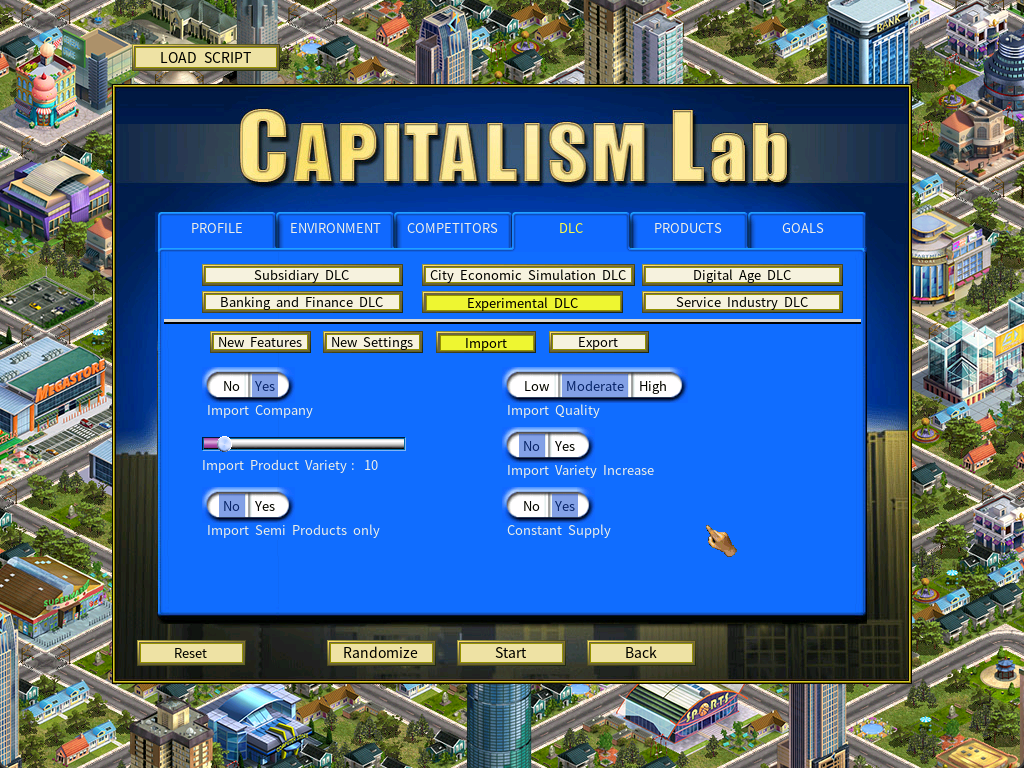
| Setting | What it does to the difficulty |
|---|---|
| Import product variety | Lower is harder. You may not be able to import everything you need, which forces you either to go without or to spend money producing it locally. |
| Import semi-products only | Set to yes, making money from retail stores alone becomes much harder — you have to manufacture the products yourself out of imported semi-products. |
| Import quality | No straightforward effect; it cuts both ways. High quality lets you sell or build good products without local substitutes — and makes your competitors, who import the same things, hard to beat. |
| Import variety increase | Widens what is importable over time. Useful in games where you cannot raise the capital for local import substitutes. |
| Constant supply | Switched off, imports do not last forever — so you need a plan to replace each one locally before it runs out. |
The settings combine
Low variety and semi-products only is where strategy gets interesting.
Worked example. Say you want to produce computers, which need electronic components, steel and CPUs. You cannot import CPUs — but you can import silicon. So you open a local CPU factory that runs on imported silicon. The lower the semi-product variety, the more of that kind of thinking the game demands.
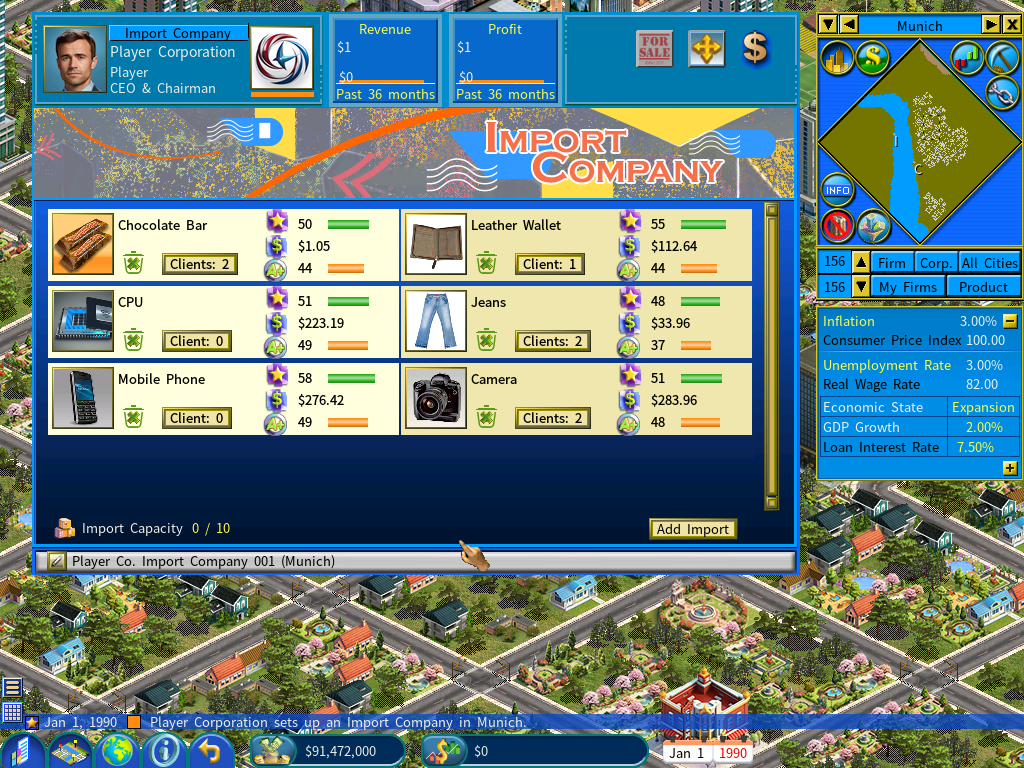
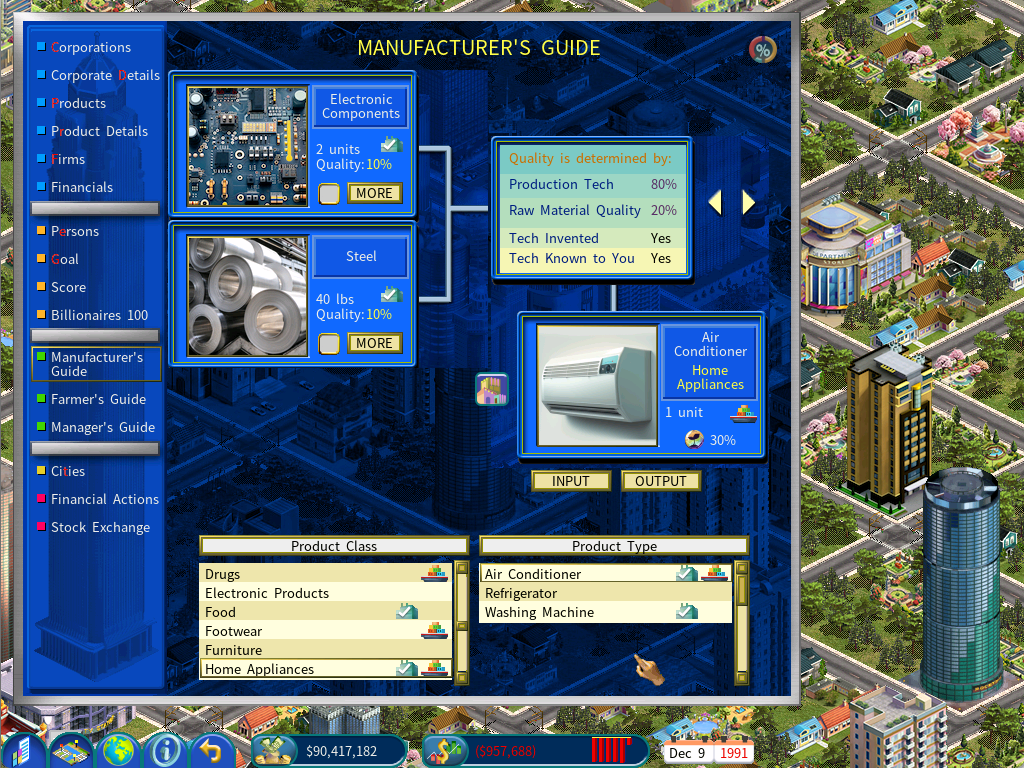
The same reasoning applies upward. You could import air conditioners and sell them in your retail stores — or import the electronic components and steel and manufacture the air conditioners yourself for a better margin, provided you can match the imported product on quality and price.
Three starting strategies
1. Retail only
Stay out of manufacturing at the start, or keep it minimal, and use the import company to feed finished goods straight to your shops. Up to 10 consumer goods — more if you can also reach seaports. Then use the proceeds to pivot slowly into manufacturing, replacing each import with your own product.
| For | Against |
|---|---|
| Works for almost any product, and starts on a low budget. | Competitors get a head start in manufacturing; imported supply may be limited in time or quantity; and you cannot use the export firm. |
2. Semi-product value adding
When consumer goods are unavailable or poor quality, import semi-products instead and turn them into value-added consumer goods for local sale and export.
It works badly for food, beverage, snack and service industries, which mostly depend on farm products — and those cannot be imported, with a few exceptions such as corn syrup, glass, paper and plastic.
It works well the moment you can import electronic components and steel, which opens up household appliances, electronics and a whole range of high-margin goods.
Do not hesitate to mix imported and local inputs. A farm that produces leather can make leather wallets and nothing else. Add imported textiles or linen and it can make jackets, handbags and briefcases.
3. Survival Mode
Imports matter most in Survival Mode, where limited capital and a limited market make a mine costing tens of millions almost impossible to justify.
Without imports, anything depending on mined raw materials — computers, automobiles, appliances — is out of reach, and without those products it is hard to make money or grow the city economy at all. With imports you skip the coal and iron mines entirely and bring in the steel.
A strong Survival Mode opening:
- Import electronic components, steel and CPUs.
- Produce and sell computers.
- Now that the city has computers, create computer software — importing DVDs and paper — and sell it in your retail shops.
Each step raises profits and gives the city jobs and income, which lifts the sales of everything else you sell and funds steady expansion.
Finding Survival Mode too easy this way? Lower the import variety, or turn off constant supply.
Where an import company is no use at all
Do not bother with one if you are starting in:
- Software — unless you need a source of DVDs and paper
- Internet and telecom companies
- Banking and insurance
- Real estate