

Export Company Strategy Guide
By Stylesjl
An export company sells what your farms and factories produce to markets outside the in-game cities. This guide covers how to use it to maximize profit, and how the difficulty settings and your business strategy change what works.
Export Company: the BasicsThe limits
- 8 products exportable at a time, through a maximum of 2 export firms.
- Each client has a total they are willing to buy. Once they hit it they stop buying, and it is time to move that slot to another product.
The difficulty settings
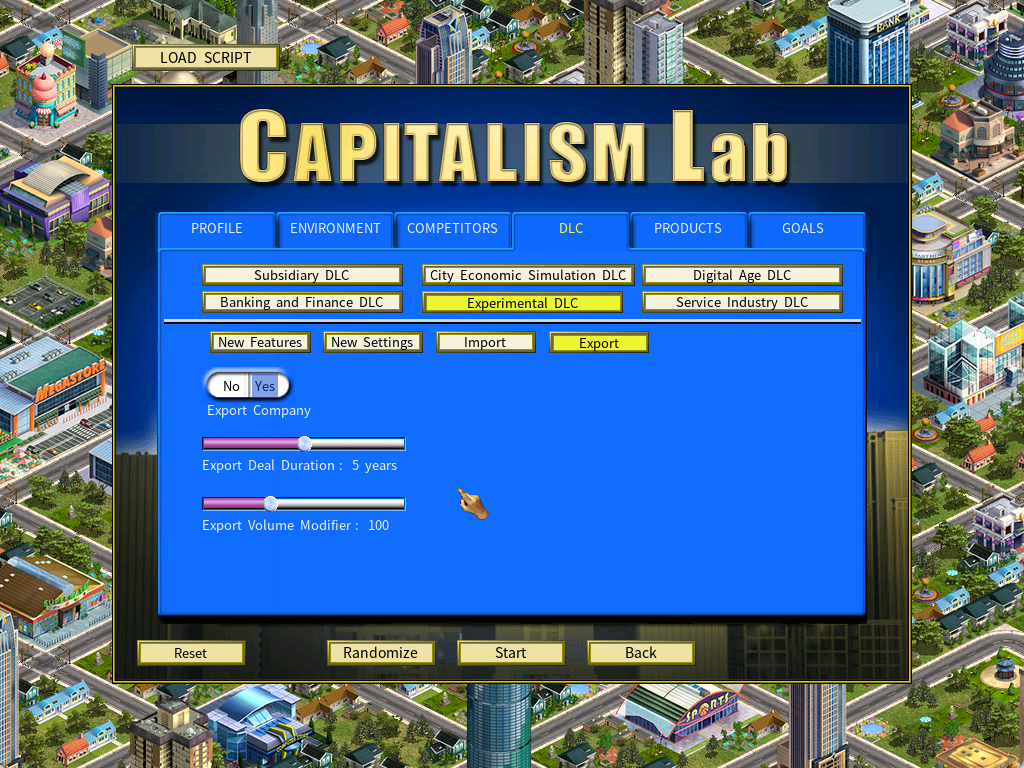
| Setting | What it does to the difficulty |
|---|---|
| Export deal duration | How long a deal runs once it starts. Longer is easier — you export the same product for longer before having to renew, if you even can. |
| Export volume modifier | How many units a client will take in total. Higher is easier, because it reduces how much you need retail stores to absorb locally. |
Two things also cap the volume, whatever the modifier says: the price and quality of what you are selling, and what your factories and farms can actually produce. A client cannot buy more than you can make.

General strategy
Build early, budget high
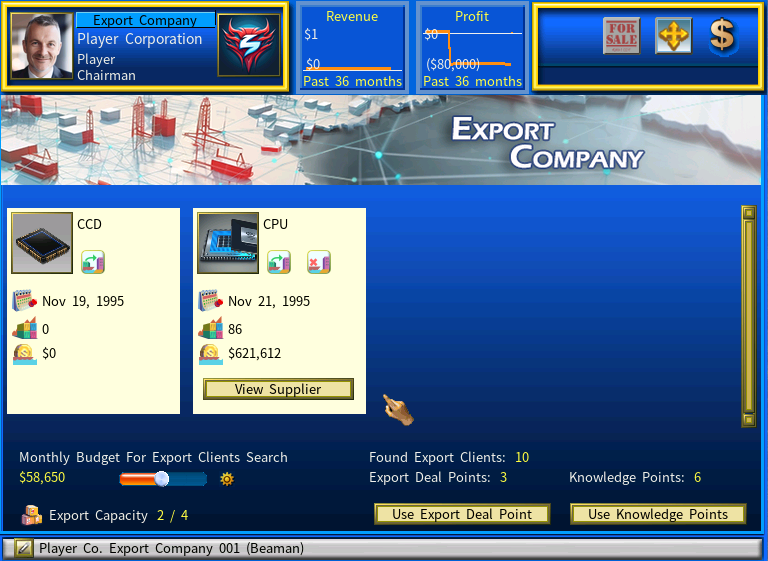
Build an export firm as early as you can and set the client search budget to maximum, so you find deals and earn export points as fast as possible. Once you have the deals you want, cut the budget back to save money — unless the deal duration is short, in which case leave it running.
Spend Knowledge Points to skip the wait
Knowledge Points buy a client immediately instead of budgeting and waiting for the right deal to appear. Most valuable in the early game.
Choose the eight products carefully
Export where there is spare capacity in the farm or factory. Never export something whose demand already exceeds supply — not unless you are ready to expand production to cover it.
Judging slack is harder than it looks. A farm using crops often shows excess inventory — and an export client can clear it out before the next harvest, starving your other firms.
Export both wheat and flour and the flour is worth more as an export. But if the wheat has all been exported before it reaches the flour factory, you have traded the higher margin away for the lower one.
Favor low marginal cost
Export what costs little per additional unit. Software is the clearest case — only paper, DVDs and freight. Raw materials are another: the mine’s fixed capital cost is already paid, which makes its output an excellent export candidate.
Watch price and quality
Both play a real part in how much a client will buy from you.
Exports can justify a semi-product
Suppose you can produce CPUs or CCDs but not electronic components. Normally those would be wasted money — no finished product uses a CPU or CCD without electronic components. With an export firm you simply export them directly, and use the proceeds to build your own electronics industry.
Pair it with an import company
Import cheap semi-products, assemble them into a finished product, export the result. Import steel, electronic components and CPUs, make computers, export the computers.
Specific strategies
Farm export — for a low budget start
Cheap livestock products, exported for fast cash. Build two farms and two factories producing:
- Eggs
- Leather
- Frozen pork, chicken, lamb or beef
- Beef patties or parma ham
A supermarket of your own can sell all of these, but you will have plenty of spare capacity at the start — so add an export company and use Knowledge Points and a high search budget to start selling immediately.
Prioritize leather, eggs, lamb and chicken. Those are the ones most likely to have the weakest local demand, so exporting them costs you the least at home.
Semi-product value adding
Import semi-products and turn them into value-added goods for export. What works depends on what you can import and what you want to sell — the import guide has the examples, including the goods you will have to produce locally, such as leather.
Software developer — Digital Age DLC only
Software has very high fixed costs and very low marginal unit costs, which makes widening its market unusually profitable. And because software takes time to develop, your export company has plenty of time to find clients for it — so you rarely need to spend Knowledge Points.
The approach:
- Build an export company at the start.
- Build every software company you can reasonably afford. Do not be afraid of debt — software repays it quickly once it is running.
- When the software is ready, build factories to produce it for both export clients and retail stores.
- Sell it every way you can — e-commerce, retail, export. The bigger the market, the better. If the factories overload, build more.
Any software exports, but favor titles with intrinsically high demand — an operating system, for instance. When demand saturates, move that export slot to a new title.
Survival Mode
Exports are how you break the small market problem that makes Survival Mode hard. Selling resources to export clients earns money you can put into other businesses, which grows the city — and the city is your local market.
It is still difficult, so start with the farm export strategy above: farms are easy to establish on very little capital.
Then move on to semi-product value adding, importing what would be expensive to produce. Steel and electronic components brought in become computers going out — and high-value products such as software can be exported even when there is barely any local demand for them.
Where an export company is no use at all
Do not bother with one if you are starting in:
- Internet and telecom companies
- Banking and insurance
- Real estate